















































































































Shopify vs Wix: A 2026 Comparison for Brands Selling Online in Turkey
Shopify means less work for a brand whose core business is selling products and that aims to grow. Wix does for a small business where sales are a channel added to a service or content site. The gap widens as the catalog grows and order volume rises.
 Author: Efe Gündüz Nodus Works Shopify Agency Founder
Published 19 min read
Shopify and Wix are SaaS platforms for opening an online store without code, built for different jobs. Shopify is e-commerce infrastructure centered on selling: every screen, from admin to checkout, is built around the order. Wix is a website builder, and e-commerce is one module alongside bookings, blogs and events. The answer to "Shopify vs Wix" comes from that distinction: is selling the site's main job, or one of several?
Brands that come to us to leave Wix for Shopify share one thing: they hit the platform's limits as the catalog grew and orders got complex. That limit is rarely visible on day one. With 30 products, either platform works. Add 500 products, variant-level stock, marketplace sync and campaign traffic, and the difference shows.
Shopify vs Wix: the short answer
For a brand whose core business is selling products, with plans to grow the catalog and expand into marketplaces or abroad, Shopify is the right choice. For a small business where sales are a second channel added to a service, education or content site, and the product count stays low, Wix means less setup work.
In practice, on Wix you design the site, then add a store; on Shopify you set up the store, then dress it in a theme. Wix's drag-and-drop editor puts design freedom first, while Shopify's theme structure keeps product, collection and cart pages in a standard skeleton built for selling.
Businesses where Wix comes out ahead
- The site is built around a portfolio, services, bookings or course sales; products are extra income.
- Fewer than 50 products with simple variants (one size, one color or a few options).
- No need for marketplace, ERP or multi-warehouse inventory.
- The owner wants to design and update the site themselves.
Businesses where Shopify comes out ahead
- Most revenue comes from product sales, and order volume is growing.
- Products sell in multi-dimensional variants such as size, color and material.
- Stock must sync with Turkish marketplaces like Trendyol or Hepsiburada, or an international one.
- Traffic spikes during campaigns, and checkout has to hold up under that load.
Our view is clear: if online sales are central to your business, start on Shopify, even with 20 products today. Switching platforms later costs more than the monthly plan difference between Wix and Shopify adds up to over years. Where sales really are a side channel, a few products added to a service site, we happily recommend Wix.
Price and cost per sale
Wix's cheapest plan that can sell products is Core, listed at $29.77 a month billed annually. Shopify Basic is $19 a month billed annually, but since Shopify Payments isn't available in Turkey, it takes a 2% transaction fee on every card sale. As monthly card revenue grows, Shopify's per-sale fee matters more than the plan price.
The two pricing pages follow different logic. Wix tiers plans by storage, collaborators and module level; Shopify separates them by transaction fee and staff accounts.
Plan prices side by side
| Plan | Monthly, billed annually | Product sales | Key limit |
|---|---|---|---|
| Wix Light | $17.77 | No | 2 GB storage, 2 collaborators |
| Wix Core | $29.77 | Yes, basic e-commerce | 50 GB storage, 5 collaborators |
| Wix Business | $39.77 | Yes, standard e-commerce | 100 GB storage, 10 collaborators |
| Wix Business Elite | $159.77 | Yes, advanced e-commerce | Unlimited storage, 100 collaborators |
| Shopify Basic | $19 | Yes | 2% transaction fee, no extra staff accounts |
| Shopify Grow | $54 | Yes | 1% transaction fee, 5 staff accounts |
| Shopify Advanced | $299 | Yes | 0.6% transaction fee, 15 staff accounts |
Sources: Wix Premium plans and Shopify pricing page, November 18, 2026. Wix notes that prices and currency vary by location and taxes are not included.
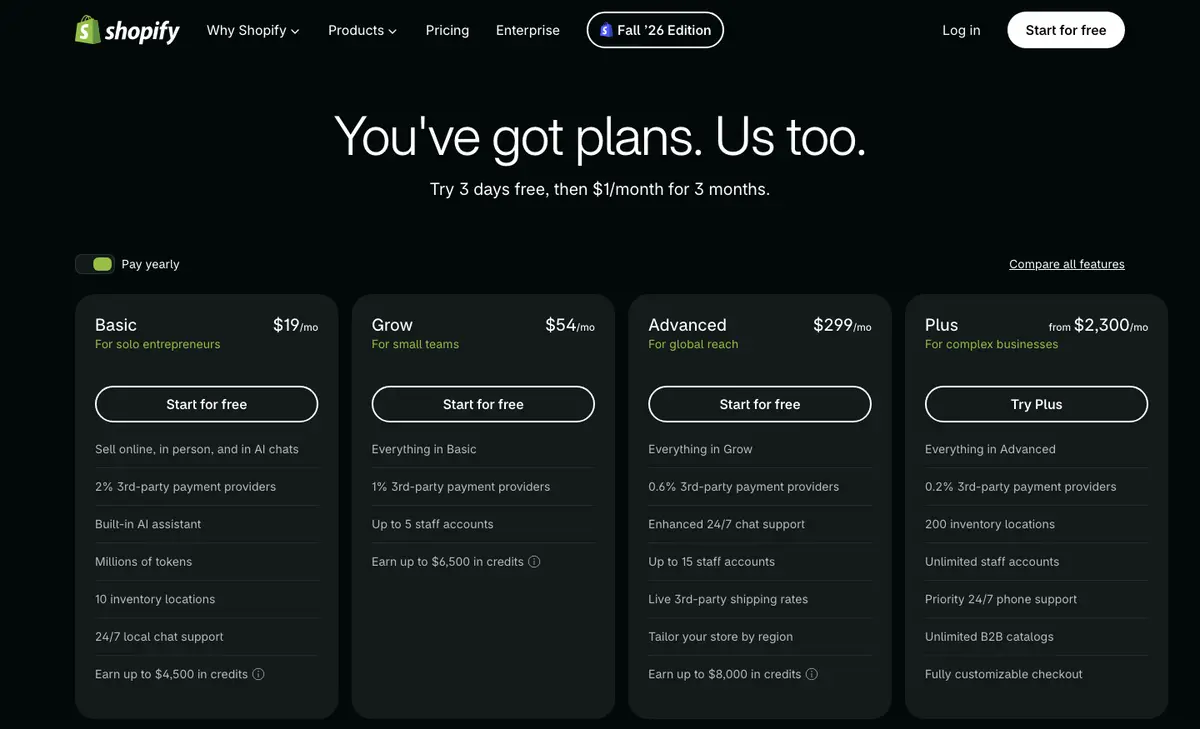
The first row points to a common mistake: Light, Wix's cheapest plan, can't accept payments. A Wix store needs at least Core, which costs roughly $11 a month more than Shopify Basic.
Fees per sale: transaction fee and payment provider
A Wix store in Turkey takes card payments through local providers such as iyzico, PayTR or Sipay (Wix payment providers). A Shopify store connects the same providers through official apps. The provider's commission falls under the same contract on both platforms; the difference is the platform's own cut.
Shopify's cut is transparent: 2% on Basic, 1% on Grow, 0.6% on Advanced. Wix's pricing page doesn't say whether it charges a platform fee on sales through third-party providers. If you're choosing Wix, get that answer from Wix in writing.
The math on monthly card revenue: a store with a 1,000 TL (Turkish lira) average order value and 200 orders a month pays 4,000 TL a month in transaction fees on Shopify Basic and 2,000 TL on Grow. If Wix charges no platform fee on third-party payments, that much favors Wix. If the store takes some orders by bank transfer (havale/EFT) or cash on delivery, Shopify charges no transaction fee on those and the gap narrows. Our Shopify transaction fees post breaks down fees and upgrade thresholds by plan; our PayTR vs iyzico comparison covers rate and settlement period (valör) differences.
Cost alone shouldn't decide, because switching platforms costs more than these differences add up to in a year. Working out which platform fits your catalog, order volume and integrations is the first step of our Shopify store setup process; setup, payment and shipping integrations are planned around that analysis.
Payment and shipping integrations in Turkey
In Turkey, Wix takes card payments through local providers such as iyzico, PayTR and Sipay, and Shopify connects iyzico and PayTR through official apps. On payments, both start from the same place. The real difference is in shipping, e-invoice / e-archive invoice (Turkey's mandatory electronic invoicing) and marketplace connections: Shopify has a wider choice of apps and integrations for Turkish carriers and accounting software.
In Turkey, an order's journey doesn't end at payment. A shipping label is printed, the tracking number goes to the customer, an e-archive invoice is issued and stock is deducted on marketplaces. If any step is manual, the workload grows in step with order count.
Turkish payment providers you can connect on Wix
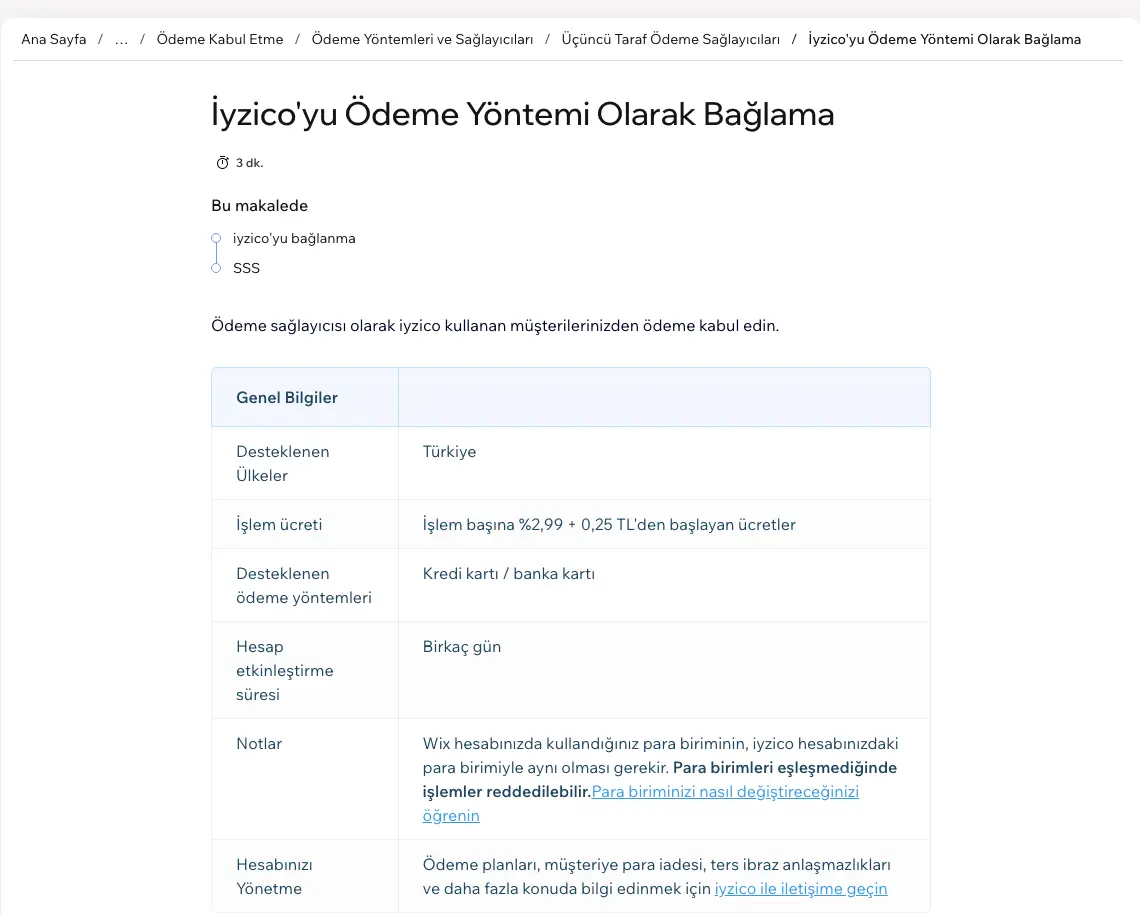
According to Wix's Turkish payment providers page, a Wix store in Turkey can connect iyzico, PayTR and Sipay. PayU Türkiye is still listed, but Wix's English and German help pages say it can no longer be connected. Wix's payment pages are inconsistent across languages: for iyzico, the Turkish page lists 2.99% + 0.25 TL, the English page 3.99% + 0.25 TL.
| Payment provider | Wix | Shopify |
|---|---|---|
| iyzico | Connects (Wix help page) | Official app, developer: iyzico |
| PayTR | Connects (Wix help page) | Official app, developer: PayTR |
| Sipay | Connects | Confirm app status with Sipay |
| Bank virtual POS (online card acquiring) | Confirm Wix support with the bank | Via a custom payment app |
| Havale/EFT, cash on delivery | As manual payment | As manual payment, no Shopify transaction fee |
The rate on Wix's help page is not the contract rate the provider will sign with you. Get it from iyzico or PayTR in writing; the same contract applies on both platforms.
Shipping, e-invoicing and marketplace connections
On shipping and accounting, the two platforms differ in the breadth of their app ecosystems. The Shopify App Store has tens of thousands of apps, including ready-made ones for Turkish carriers, e-invoice providers and marketplaces. At Nodus Works we set up Aras, Yurtiçi, Sürat and PTT Kargo integrations on Shopify, plus e-invoicing through Paraşüt and Trendyol stock sync.
On Wix, check the Wix App Market for these connections. Some Turkish carriers and e-invoice providers may have no Wix app; then you usually print labels by hand or use a third-party integrator.
At 50 orders a month, hand-printing labels and invoices takes half an hour a day; at 1,000, it is a full-time job. Our view: if you expect a few hundred orders a month within the first year, start on the platform where shipping and e-invoice integrations are ready-made. Our Shopify shipping integration guide compares how each carrier connects to Shopify.
Catalog scale: products, variants and inventory
Shopify allows up to 2,048 variants and 3 options (such as size, color, material) per product. On Wix, a product can have 6 options, 100 values per option and up to 1,000 variants in total. Wix offers more option dimensions, Shopify twice the variant capacity. Your products' variant structure decides which matters.
In categories sold in size and color combinations, such as apparel, footwear and accessories, the variant limit directly shapes product setup. A product over the limit is either split into several products or loses some combinations from sale.
Variant and option limits side by side
| Limit | Shopify | Wix |
|---|---|---|
| Variants per product | 2,048 | 1,000 |
| Options per product | 3 | 6 |
| Values per option | Within the variant limit | 100 |
| Extra options without variants | Via an app or metafields | Via modifiers |
Sources: Shopify developer changelog, 2,048 variants and Wix Stores limits. Shopify's 2,048-variant limit has applied on all plans since October 15, 2025; the previous limit was 100.
Two examples make it concrete. A T-shirt in 8 sizes, 15 colors and 10 prints comes to 1,200 variants: over Wix's 1,000 limit, but a single 3-option product on Shopify. A product sold with 5 options, such as size, color, fabric, collar and sleeve length, hits Shopify's 3-option limit; on Wix it stays one product with up to 6 options.
Inventory and multi-warehouse setups
As the catalog grows, the next question is where stock sits. Shopify tracks inventory by location: warehouse, retail store and third-party warehouse are separate locations, orders ship from the most suitable one, and marketplace integrations read stock from them. A brand with a physical store sees in-store and warehouse stock separately and can ship online orders from the store. We cover the physical-store side on our Shopify physical store POS integration page.
Our position: for a store with under 100 products, simple variants and one warehouse, there is no practical difference in catalog management. Past 500 products, you need bulk editing, CSV imports and automated product feeds from your ERP. At that stage, Shopify's Admin API and bulk editing apps turn catalog work from a manual chore into an automated flow.
Checkout and conversion: who controls the buying flow
Shopify's checkout is a one-page payment screen built for buying, and Shopify, citing research it commissioned, says it converts 15% better than rival platforms on average. For a store in Turkey, part of that comparison doesn't apply: express buttons like Shop Pay require Shopify Payments, and customers enter card details on the iyzico or PayTR page.
Checkout is the last screen that turns a product in the cart into a paid order. Every extra field, redirect or slow step there means some carts get abandoned.
Which Shopify checkout advantages apply in Turkey, and which don't
According to Shopify's enterprise page, its checkout converts on average 15.2% better, and up to 36% better, than competitors in comparable samples. The figure comes from research Shopify commissioned, with no published methodology; the 36% is a comparison with a single enterprise competitor. Treat it as Shopify's own claim, not independent measurement.
| Checkout feature | Shopify store in Turkey | Note |
|---|---|---|
| One-page checkout | Yes | On all plans |
| Abandoned cart emails | Yes | Via Shopify's built-in marketing automation |
| Shop Pay express checkout | No | Requires Shopify Payments |
| Card details entered on Shopify | No | Customer is redirected to iyzico or PayTR |
| Checkout rules (Shopify Functions) | Yes | Discount, payment and delivery rules |
| Custom fields in checkout steps | On Plus | Extensions in information, shipping and payment steps require Plus |
The two middle rows explain why Shopify's global conversion edge doesn't fully show in Turkey: some checkouts Shopify measures finish in one tap with Shop Pay. In a Turkish store, the customer completes address and shipping on Shopify and the card step on the provider's page.
Wix checkout
Wix checkout sits in the same editor ecosystem as the rest of the site and allows more visual design changes. To change buying logic (making a payment method conditional, hiding a shipping option based on the cart), you use Velo, Wix's developer platform, and apps. Card payments in Turkey go through iyzico or PayTR on Wix too, so customers see a similar redirect.
Our view: in Turkey, the checkout conversion gap depends less on the platform than on the provider's payment page, the 3D Secure flow and whether shipping costs surprise customers at checkout. Show shipping costs on the product page, keep guest checkout on and keep required fields to a minimum. These three steps move conversion before a platform switch would.
SEO and visibility in AI search
Wix and Shopify both cover basic technical SEO (sitemap, editable title and meta description, 301 redirects, robots.txt). Wix allows more URL freedom: you can remove the product-page prefix in SEO settings. On Shopify, the /products/ and /collections/ prefixes are fixed. The deciding difference for e-commerce SEO, though, is how category pages and product data are managed.
On an e-commerce site, most organic traffic lands on category (collection) and product pages. So how a platform builds these two page types matters more for rankings than its blog module.
URL structure and fixed prefixes
| URL feature | Shopify | Wix |
|---|---|---|
| Product URL | /products/product-name, fixed prefix | /product-page/product-name, prefix removable |
| Category URL | /collections/category-name, fixed prefix | Depends on category page setup |
| Slug editing | Per product and collection | Per product |
| 301 on slug change | Automatic redirect option | Automatic 301, can be turned off |
Sources: Wix, customizing your page URL structure and the Shopify admin.
Shopify's fixed prefixes can create a second URL (/collections/category/products/product) for products opened inside a collection. Shopify sets the product's main URL as canonical on these pages; linking products in collections straight to the /products/ address in the theme concentrates crawl budget and internal link signals on one URL.
Speed and Core Web Vitals
On both platforms, speed depends on the weight of the theme and apps. On Wix, every animation and section added in the editor adds page weight; on Shopify, each app can inject its own script into the storefront. Track speed with Search Console's Core Web Vitals report, which uses real-user data.
Visibility in AI search
In March 2026, Shopify launched Agentic Storefronts for US stores, feeding the catalog to assistants such as ChatGPT and Copilot; no timeline has been announced for Turkey. Today, AI visibility rests on the same basics on both platforms: a robots.txt that doesn't block GPTBot, Google-Extended and PerplexityBot, complete Product schema on product pages, and product descriptions that answer questions directly.
Our assessment: for a blog-heavy site with under 100 products, Wix's SEO tools are enough. For a store with hundreds of collections, filtered category pages and a multilingual catalog, Shopify's product data structure, metafields and Markets-managed hreflang tags keep scaling manageable. For a technical SEO audit on either platform, our SEO optimization process starts with crawl, indexing and schema checks.
Selling abroad: multiple languages and currencies
Both platforms support multilingual stores, but for a company in Turkey, letting customers pay in their own currency is restricted on both. Multi-currency payments need Shopify Payments on Shopify, and Wix Payments, PayPal or Stripe on Wix; none of these is available to companies in Turkey. A store using iyzico or PayTR collects in its store currency.
The storefront side of selling abroad (translation, country-specific price display, domains) works on both. The restriction is on collecting payment, for the same reason: local-currency collection depends on the platform's own payment infrastructure or on global providers that don't open accounts in Turkey.
Each platform's tools for selling abroad
| Feature | Shopify | Wix |
|---|---|---|
| Multiple languages | Markets and translation apps, URL per language | Wix Multilingual |
| Country pricing and domains | Per market via Markets | Limited |
| Collecting in local currency | Requires Shopify Payments | Requires Wix Payments, PayPal or Stripe |
| Collecting as a company in Turkey | In store currency (iyzico, PayTR) | In site currency; others display only |
| Expansion store (different store currency) | Separate Shopify store, central management on Plus | Separate Wix site |
| hreflang | Added automatically by Markets | Added by Wix Multilingual |
Sources: Shopify pricing page, Wix multi-currency overview. Per Wix's help page, currencies the connected provider doesn't accept are display only; customers pay in the site's main currency at checkout.
Shopify's edge abroad is Markets. In one store you set a price list, domain or subfolder, language and tax settings per market, and one product record sells in several countries at different prices. Wix has multiple languages and currency display, but its market-level pricing and tax management is less detailed than Shopify Markets.
Our recommendation: while international revenue is a small share, a TL store accepting foreign cards is enough on either platform. If selling abroad will be your main growth channel, Markets' per-market pricing and the expansion store option put Shopify ahead.
Moving from Wix to Shopify: when and how
A move from Wix to Shopify comes up when the catalog nears Wix's variant limit, when Turkish shipping and e-invoicing are done by hand, or when you need marketplace sync. Products, customers and orders move with migration apps, the design is rebuilt in a Shopify theme, and every Wix URL is redirected to its new Shopify address with a 301.
Timing decides the cost. Moving a 50-product Wix store takes a few days; with 1,000 products, thousands of customer records and hundreds of product pages ranking on Google, it stretches over weeks.
Signs it's time to move
- One of your products is nearing Wix's limit of 1,000 variants per product.
- Shipping labels and invoices are prepared by hand for every order.
- You also sell on Trendyol or Hepsiburada and update stock in two places by hand.
- You need a checkout rule Wix doesn't offer (B2B pricing, minimum order value, conditional payment methods).
Migration steps
- URL inventory: Export every Wix URL from the sitemap and Search Console.
- Data transfer: Import products, customers and orders into Shopify via CSV or a migration app. Many migration apps in the Shopify App Store list Wix as a source platform.
- Theme and design: The Wix design doesn't carry over; it is rebuilt in a Shopify theme.
- Redirect map: Redirect Wix's
/product-page/productaddresses to Shopify's/products/productwith 301s. - Payments and integrations: Set up iyzico or PayTR plus shipping and e-invoice integrations, then place a test order.
- Domain and launch: Point the domain to Shopify and submit the sitemap in Search Console.
In our migration projects, the longest step isn't data transfer but the redirect map: every product and category URL is matched one by one. Our Shopify migration service runs a Wix to Shopify move end to end, with a URL inventory, a 301 map and post-launch ranking tracking.
Frequently asked questions
Is Shopify or Wix cheaper?
Wix's cheapest plan that can sell products is Core ($29.77 a month billed annually); Shopify Basic is $19 a month billed annually. In Turkey, though, Shopify takes a 2% to 0.6% transaction fee on every card sale, depending on the plan. Confirm in writing whether Wix charges an extra fee with third-party providers; that answer decides it.
Can you run an online store on Wix?
Yes. Wix's Core, Business and Business Elite plans support product sales and payments; Light can't accept payments. In Turkey, card payments go through iyzico, PayTR or Sipay. For sites with few products, simple variants and sales as a second channel, Wix is enough.
Do iyzico and PayTR work on Wix?
Yes. Wix's help pages list iyzico and PayTR as providers you can connect in Turkey; Sipay is listed too. PayU Türkiye can no longer be connected. Take the commission rate from the contract you sign with the provider, not from Wix's help page.
How many variants can a Shopify product have?
A Shopify product can have 3 options and 2,048 variants in total; this limit has applied on all plans since October 15, 2025. Wix allows 6 options and 1,000 variants per product. Shopify leaves more room for many colors and sizes, Wix for many option dimensions.
Will I lose SEO when moving from Wix to Shopify?
If every Wix URL is redirected with a 301 to its new Shopify address, there is no lasting loss. Wix product pages sit under /product-page/ and Shopify's under /products/, so every product URL changes. Ranking fluctuation in the first few weeks is normal.
Which is better for SEO?
Both cover basic technical SEO. Wix gives more freedom with URL prefixes; Shopify scales with hundreds of collections, a multilingual catalog and Markets-managed hreflang. On a small, content-heavy site the difference is small; with a large catalog, Shopify's product data structure pulls ahead.
Conclusion
The choice between Shopify and Wix starts with where sales sit on your site. If sales are a side channel of a service or content site, the catalog is small and variants are simple, Wix's editor and plans are enough. If product sales are central, the catalog will grow, or shipping and e-invoice integrations, marketplace sync or foreign markets are planned, Shopify covers those needs without a platform change.
On cost, the plan gap between Wix Core and Shopify Basic is small; the real difference lies in Shopify's transaction fee and Wix's fee policy on third-party payments. Get that from Wix in writing and run the numbers on your own card revenue.
As a next step, settle the payment side with our PayTR vs iyzico comparison. To plan a setup that fits your catalog, order volume and integrations, book a free intro call with our Shopify store setup team.