















































































































Shopify Transaction Fees 2026: How Much Does a Store in Turkey Pay per Sale?
Shopify Payments is not available in Turkey, so every card sale carries two deductions: the payment provider's commission and Shopify's transaction fee, which runs from 2% down to 0.2% by plan. Shopify charges nothing on bank transfers (havale/EFT) or cash on delivery.
 Author: Efe Gündüz Nodus Works Shopify Agency Founder
Published 22 min read
Shopify transaction fees in Turkey are the sum of what a Shopify store in Turkey gives up on every sale, and they come in three parts: Shopify's own transaction fee of 2% down to 0.2% depending on the plan, the commission of a payment provider such as iyzico or PayTR, and the instalment surcharge on sales paid in instalments. Shopify Payments, Shopify's in-house payment processing, is not open to companies based in Turkey. So every Shopify store selling by card in Turkey pays deductions to both the payment provider and Shopify.
The most common costing mistake we see at Nodus Works in the stores we set up is treating the monthly Shopify plan price as the total cost. The plan price is a fixed line; the real cost builds up in per-sale deductions. A store on the Basic plan with 500,000 TL (Turkish lira) in monthly card revenue pays 10,000 TL a month in Shopify transaction fees alone. That is several times the monthly price of the Basic plan.
What Shopify transaction fees in Turkey include: three layers of deductions
On a 1,000 TL card sale through Shopify in Turkey, the total deduction on the Basic plan is 41.90 TL (4.19%) at PayTR's advertised starting rate and 63.15 TL (6.32%) at iyzico's business rate. Of that, 20 TL is Shopify's transaction fee and the rest is the payment provider's commission. On instalment sales, the instalment surcharge comes on top.
Keep the three layers apart, because a different decision drives each one. Your plan sets Shopify's transaction fee, your contract sets the provider commission, and your instalment policy sets the surcharge. Saving in one layer does not change the others.
Layer 1: Shopify's transaction fee
Shopify takes a plan-based percentage of every payment collected through a provider other than Shopify Payments. According to Shopify's pricing page, the rate is 2% on Basic, 1% on Grow, 0.6% on Advanced and 0.2% on Plus. The fee appears as a separate line on your Shopify bill and is charged in US dollars together with the plan price.
This fee is independent of the payment provider's commission. What iyzico deducts goes to iyzico, and what Shopify deducts goes to Shopify. Both are calculated on the same order amount.
Layer 2: Payment provider commission
The payment provider connected to Shopify takes its commission from the card transaction and pays the rest into your bank account at the end of the settlement period (valör). According to PayTR's website, PayTR's virtual POS (online card acquiring) charges from 2.19% with 7-day settlement; if you choose next-day payout, the rate goes up. According to iyzico's sign-up page, a business seller with more than 20,000 TL in monthly sales pays 4.29% + 0.25 TL, and payouts reach the account weekly.
Both providers set rates per business. The advertised rate is a starting point; a store whose monthly revenue grows can renegotiate. When you compare offers, ask for rates on the same settlement period, because a next-day rate and a 7-day rate are not comparable. We compared the two providers on payout timing, company requirements and Shopify integration in our PayTR vs iyzico article.
Layer 3: Instalments and the instalment surcharge
On instalment sales, the bank's instalment surcharge is either passed on to the customer or absorbed by the store. If the store absorbs it, the surcharge comes straight out of profit. If it is passed on, the payment provider usually adds it on its own payment page; Shopify sees the product amount on the order, not the amount charged to the card.
How to show the surcharge on the Shopify order record is a separate accounting question; we cover the steps in our guide to the instalment surcharge in the Shopify order record.
Shopify transaction fee by plan and the total deduction on a 1,000 TL sale
Shopify's transaction fee is 2% on Basic, 1% on Grow, 0.6% on Advanced and 0.2% on Plus. Shopify charges no transaction fee on bank transfers (havale/EFT), cash on delivery, or manual payments marked as "paid" on draft orders. On refunded orders, however, the transaction fee Shopify collected is not returned.
The tables below use figures read from the official Shopify, PayTR and iyzico pages on November 18, 2026: PayTR 2.19% (7-day settlement), iyzico 4.29% + 0.25 TL (business). Redo the calculation with your own contract rate.
Transaction fee table for Basic, Grow, Advanced and Plus
| Plan | Plan price (annual / monthly billing) | Shopify transaction fee | Shopify's share of 1,000 TL | Total with PayTR (21.90 TL) | Total with iyzico (43.15 TL) |
|---|---|---|---|---|---|
| Basic | $19 / $27 | 2% | 20.00 TL | 41.90 TL (4.19%) | 63.15 TL (6.32%) |
| Grow | $54 / $72 | 1% | 10.00 TL | 31.90 TL (3.19%) | 53.15 TL (5.32%) |
| Advanced | $299 / $399 | 0.6% | 6.00 TL | 27.90 TL (2.79%) | 49.15 TL (4.92%) |
| Plus | From $2,300 | 0.2% | 2.00 TL | 23.90 TL (2.39%) | 45.15 TL (4.52%) |
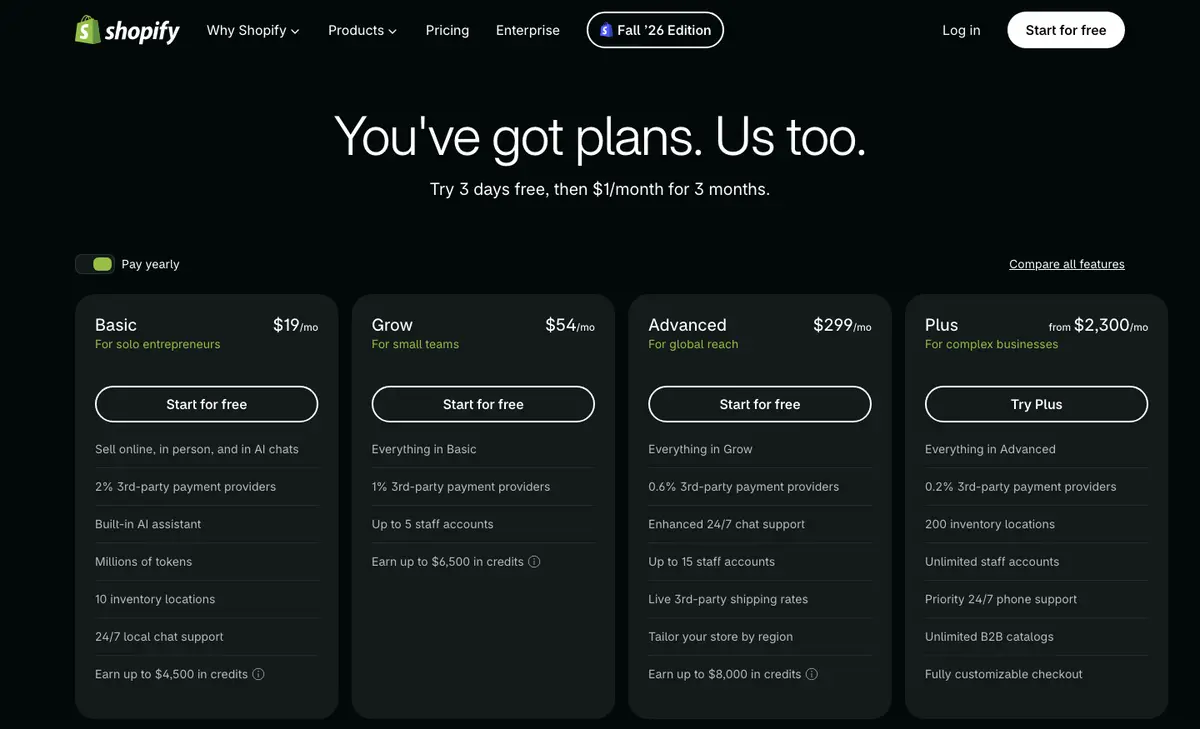
The feature differences between plans, and which plan suits which store, are the subject of our Shopify fees 2026 article. We show the plan price here only because it feeds into the upgrade calculation.
The table leads to two conclusions. First, at advertised rates the gap between providers (2.1 percentage points) is bigger than the gap between Basic and Grow (1 point), so your choice of provider deserves as much attention as your choice of plan. Second, the plan gap grows linearly with revenue: at 1 million TL in monthly card revenue, Shopify's share is 20,000 TL on Basic and 10,000 TL on Grow.
Which payments are exempt from the transaction fee
According to the Shopify Help Center, the transaction fee does not apply to:
- Orders paid by bank transfer (havale/EFT)
- Cash on delivery orders (cash or card)
- Orders created from draft orders and marked as paid or pending
- Payments taken in store with Shopify POS
- Test orders
This list directly changes the cost for stores selling B2B or wholesale. A wholesaler that sends draft orders to its dealers and collects by bank transfer pays Shopify no transaction fee on those orders. If half the order volume comes in by bank transfer, the effective transaction fee on Basic falls to 1% of revenue.
Do you get the transaction fee back on a refunded order?
No. Shopify does not return the transaction fee on a refunded order. The payment provider's refund policy depends on your contract: some providers keep the commission on a refunded transaction, others refund part of it.
In categories with high return rates (apparel, footwear), this rule becomes a real cost line. If an apparel store on Basic runs a 20% return rate, every refunded 1,000 TL order leaves 20 TL in Shopify fees as a permanent loss. If 100,000 TL of 500,000 TL in monthly card revenue is refunded, that loss is 2,000 TL a month.
Our recommendation: in stores with a return rate above 15%, choose your plan based on gross card revenue rather than net revenue (after refunds), because Shopify charges its fee on the gross amount. If you want your payment setup, instalment structure and refund flow built together, our Shopify integration solutions team connects iyzico, PayTR and bank POS accounts along with the order and refund flow.
Why Shopify Payments is not available in Turkey and how that affects cost
Shopify Payments is Shopify's own payment processing and is open only to companies based in the countries Shopify lists; Turkey is not on that list. So a Shopify store in Turkey takes card payments through iyzico, PayTR or a bank POS and pays a transaction fee of 2% down to 0.2%, depending on the plan, on every card sale.
Shopify does not explain country by country why it offers Payments in some markets. What matters to a store owner is the outcome, not the reason, and the outcome comes down to four points.
Four consequences of not having Shopify Payments
- The transaction fee stays. A store using Shopify Payments pays Shopify no separate transaction fee; a store using a third-party provider does. That is why every card sale in Turkey carries two deductions.
- Multi-currency collection is not available. According to Shopify's pricing page, showing prices and charging in the customer's local currency, and offering local payment methods, require Shopify Payments. A store in Turkey collects payment in its store's main currency.
- Shopify's accelerated checkout buttons are limited. Shopify's own express options such as Shop Pay run on Shopify Payments. In a store in Turkey, the customer enters card details on the payment provider's page.
- The Plus exemption does not apply. The transaction fee on Shopify Plus is 0.2%; Plus stores that use Shopify Payments as their only provider pay no such fee at all. A Plus store in Turkey pays the 0.2%.
How big the cost gap is for a store in Turkey
Shopify Payments card rates vary by country, and there is no rate for Turkey. So the question of how much cheaper selling would be if Shopify Payments existed in Turkey has no exact answer. The part you can measure is the transaction fee: a store with 500,000 TL in monthly card revenue pays 10,000 TL a month on Basic, 5,000 TL on Grow and 3,000 TL on Advanced. A store on Shopify Payments never pays this line.
Negotiating with your payment provider does not change this line; only the plan sets Shopify's transaction fee. We calculate the plan thresholds in the "Plan upgrade threshold" section below. Setting up a company abroad to switch to Shopify Payments is a separate project on the tax, accounting and currency transfer side; for most stores, going down that road just for the transaction fee raises costs rather than cutting them.
Payment provider commissions: iyzico, PayTR and bank virtual POS
The commission of payment providers connected to Shopify in Turkey is set by contract: PayTR advertises rates from 2.19% with 7-day settlement, and iyzico advertises 4.29% + 0.25 TL for business sellers. For virtual POS accounts issued directly by banks, the maximum rates of the Central Bank of the Republic of Türkiye (TCMB) apply: as of November 2026, 3.56% for single-payment credit card transactions, 1.04% for debit cards and 1.90% for foreign cards.
The three options do the same job with different costs and setup effort. Payment institutions (iyzico, PayTR) offer fast applications and ready-made Shopify apps. A bank virtual POS usually comes with a lower rate. In return, connecting it to Shopify takes custom development.
| Provider | Starting rate | Shopify connection | Best for |
|---|---|---|---|
| PayTR | From 2.19% (7-day settlement) | Official Shopify app | Low advertised rate, next-day payout option |
| iyzico (business) | 4.29% + 0.25 TL | Official Shopify app | Foreign currency collection add-on, pay-by-link |
| iyzico (individual) | 4.49% + 0.25 TL, pay-by-link only | Does not connect to Shopify checkout | Test sales by sellers without a company |
| Bank virtual POS | Negotiated with the bank, single-payment credit card cap 3.56% | Custom payment app | High revenue, direct relationship with the bank |
Sources: PayTR virtual POS, iyzico sign-up page, TCMB maximum commission rates. TCMB rates exclude BSMV (Turkey's banking and insurance transaction tax).
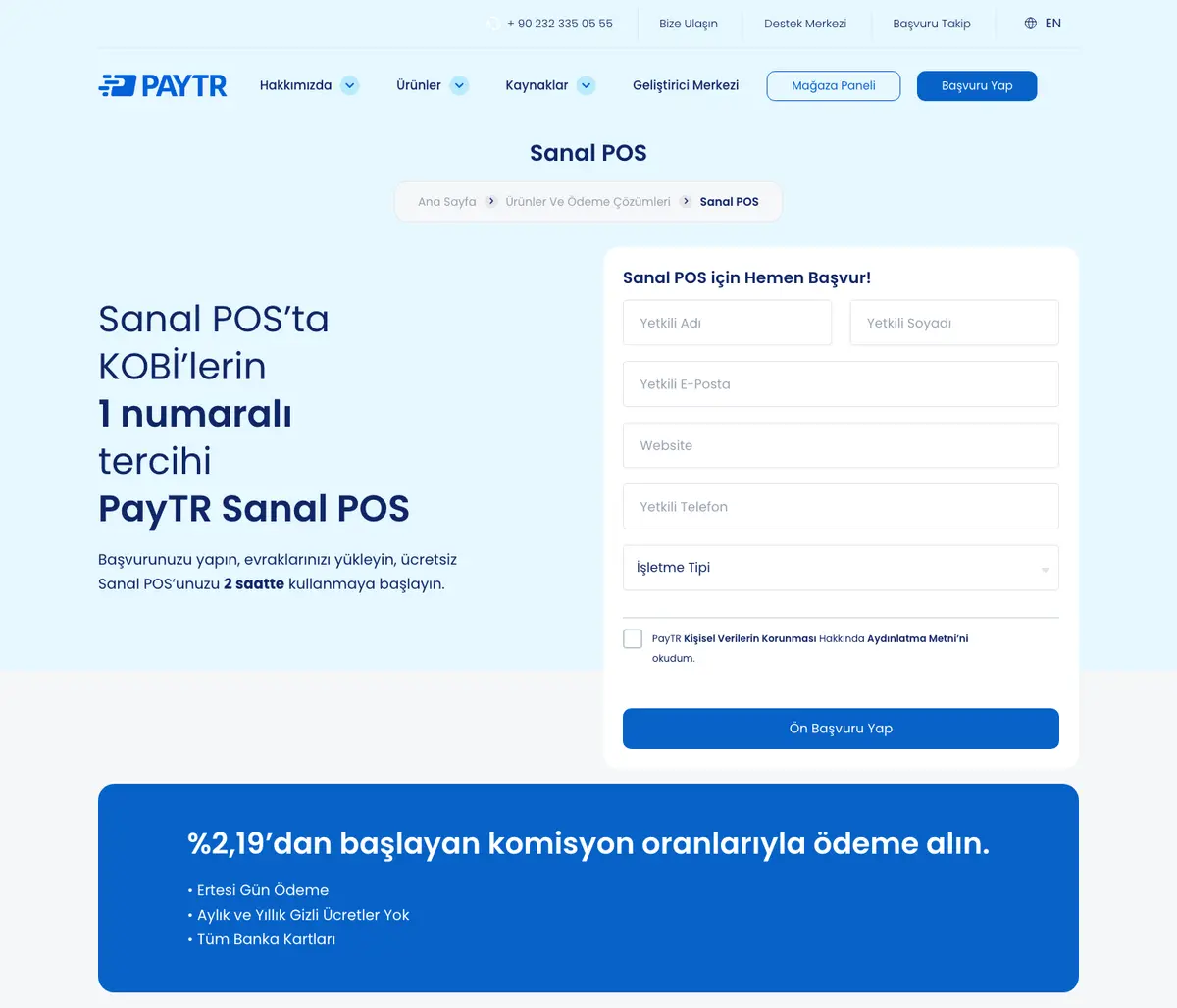
The TCMB table sets the ceiling banks may charge merchants; below it, banks price freely. The ceiling itself is not what you should expect to pay. A store with high monthly revenue can get a single-payment rate well below the ceiling from its bank. We explain step by step how a bank POS connects to Shopify in our Shopify virtual POS setup guide.
How the settlement period relates to commission
The settlement period is the time it takes for a sale's money to reach your account, and payment institutions trade that time against commission. PayTR's 2.19% starting rate applies to 7-day settlement; choosing next-day payout raises the rate. A November 2025 roundup by Vergimerkezi puts the market average for next-day payout at 2.80% to 3.90% (Vergimerkezi).
Your cash cycle should drive the settlement decision. A store that pays its suppliers in 30 days loses nothing with 7-day settlement and gets a lower rate. A store that funds its ad budget from each day's sales, on the other hand, should weigh the higher next-day rate against the cost of a cash squeeze.
Individual vs business sellers
Card payments connected to Shopify checkout require a company. According to iyzico's sign-up page, individual accounts without a company can only use pay-by-link (4.49% + 0.25 TL); a separate link is sent for each order, and the payment is not tied to the Shopify order automatically. That setup is enough for a few test sales. For regular sales, set up a sole proprietorship (şahıs şirketi): it usually takes a few business days and is the only way to apply for card payments in a company's name.
Deductions on instalment sales: surcharges and TCMB caps
On instalment sales, the deduction grows with the number of instalments. Under TCMB's November 2026 table, a bank can charge a merchant at most 3.56% for a single-payment credit card transaction, and each additional instalment adds 1.78 points to that cap. The cap is 12.46% at 6 instalments and 23.14% at 12. If the store absorbs the surcharge, this rate comes straight out of profit.
The TCMB table sets the upper limit banks may apply, and the rates exclude BSMV (TCMB, Maximum Commission Rates Applicable to Merchants). Payment institutions such as iyzico and PayTR set their instalment rates under their own contracts. The table below uses the cap rates to show how fast instalment costs grow.
Maximum deduction by number of instalments
| Instalments | Maximum commission (bank, excl. BSMV) | Maximum deduction on a 1,000 TL sale | Plus Shopify transaction fee on Basic |
|---|---|---|---|
| Single payment | 3.56% | 35.60 TL | 55.60 TL |
| 2 instalments | 5.34% | 53.40 TL | 73.40 TL |
| 3 instalments | 7.12% | 71.20 TL | 91.20 TL |
| 6 instalments | 12.46% | 124.60 TL | 144.60 TL |
| 9 instalments | 17.80% | 178.00 TL | 198.00 TL |
| 12 instalments | 23.14% | 231.40 TL | 251.40 TL |
Source: TCMB, validity period November 1, 2026 to November 30, 2026. Rate = 3.56 + (number of instalments − 1) × 1.78.
The last column shows a detail specific to Shopify. When the store absorbs the surcharge, Shopify still charges its transaction fee on the product price; together with the instalment cost, the total deduction passes 14% of revenue at 6 instalments.
Should you pass the surcharge on or absorb it?
The answer depends on your product margin and on competitors' instalment offers. For a brand with a gross margin above 50%, "3 instalments at the single-payment price" is a campaign tool that grows basket size at a maximum cost of 7.12%. For a store with a 25% gross margin, the same offer hands more than a quarter of the margin to instalments at the cap rate.
Our recommendation: pass the surcharge on to the customer by default, and offer store-funded instalments only during campaigns, on specific product groups and capped at 3 instalments. Work out the cost of this setup before the campaign with the rate in the last column; if the extra basket value the campaign brings does not cover that cost, the campaign grows revenue but shrinks profit.
Plan upgrade threshold: the revenue at which Grow or Advanced pays off
On Shopify, moving from Basic to Grow pays for itself once monthly card revenue passes $3,500 on annual billing. For Grow to Advanced, the threshold is about $61,250 in monthly card revenue on annual billing. Only card orders count toward the threshold; bank transfers and cash on delivery are not subject to Shopify's transaction fee.
The logic of upgrading is simple: the higher plan costs more but lowers the transaction fee. Switching pays off at the revenue where the plan price difference equals the transaction fee saving.
Threshold calculation
| Upgrade | Plan price difference (annual / monthly billing) | Transaction fee reduction | Threshold revenue (annual billing) | Threshold revenue (monthly billing) |
|---|---|---|---|---|
| Basic → Grow | $35 / $45 | 1 point (2% → 1%) | $3,500/mo | $4,500/mo |
| Grow → Advanced | $245 / $327 | 0.4 points (1% → 0.6%) | $61,250/mo | $81,750/mo |
| Advanced → Plus | About $2,000 | 0.4 points (0.6% → 0.2%) | About $500,000/mo | About $475,000/mo |
Formula: threshold revenue = plan price difference ÷ transaction fee reduction. The Plus calculation uses the $2,300 starting price; Plus pricing changes as revenue grows and is set by contract (Shopify pricing page, November 17, 2026).
When converting the thresholds to TL, use the exchange rate of the billing period; Shopify bills the plan price in dollars and the transaction fee on its dollar equivalent.
What decides your plan besides the transaction fee
The transaction fee calculation is half of the plan decision. Grow adds 5 staff accounts and advanced reports over Basic, so a store with a growing team may move to Grow even below the threshold. Advanced offers 15 staff accounts and a custom report builder. The case for Plus is usually not the transaction fee at all: checkout customization, B2B and multi-store (expansion store) management are the real reasons stores pick Plus.
What we observe: stores in Turkey change plans months after their revenue crosses the threshold. A store whose monthly card revenue has passed $3,500 but is still on Basic pays at least 1% of revenue in extra transaction fees every month. Changing plans takes a few minutes in the Shopify admin and causes no data loss in the store. We compare plan features in detail in our Shopify fees 2026 article, and we cover the reasons for moving to Plus beyond the transaction fee on our Shopify Plus solutions page.
Hidden costs: app fees, themes, currency and chargebacks
Beyond per-sale deductions, Shopify has four more cost lines: monthly app subscriptions, a paid theme, exchange rate and bank costs on the dollar invoice, and money lost on disputed payments (chargebacks). None of these appear on the pricing page, and in a small store they can add up to more than the plan price.
They are usually left out of fee calculations because they are tied to the month, not the sale. Divided by monthly revenue, though, they become a real percentage added to the cost of each sale.
App subscriptions
On Shopify, most Turkey-specific needs are met with apps: payment provider, shipping, e-invoicing, marketplaces, product reviews, filtering. Payment provider apps are usually free; the others run on monthly dollar subscriptions. In a store using 6 to 8 paid apps, the monthly app bill can be several times the price of the Basic plan.
| Item | How it is billed | What to check |
|---|---|---|
| App subscriptions | Monthly, in dollars, added to the Shopify bill | Unused apps keep billing |
| Usage-based app fees | Per order or per SMS | The bill multiplies in campaign months |
| Paid theme | One-off, in dollars | Updates included, bought again for a second store |
| Domain | Yearly | Can be bought from Shopify or elsewhere |
| Exchange rate and bank costs on the Shopify bill | Every billing cycle | Bank's foreign transaction fee and exchange difference |
| Chargeback (payment dispute) | Per dispute | Provider's dispute fee and the lost amount |
Dollar billing, exchange rates and VAT
Shopify bills the plan price, app subscriptions and transaction fees in dollars and charges them to the card on file. When a dollar bill is paid with a TL card, the bank's exchange rate and any foreign transaction fee come into play. For services bought from abroad, the company may have to declare VAT (KDV) itself under the reverse-charge mechanism; settle the bookkeeping of your Shopify bills with your accountant (mali müşavir).
Chargebacks
When a cardholder disputes a payment, the amount is pulled back from the store's account, and the store loses the money if it cannot prove delivery. For transactions approved with 3D Secure, liability for fraud-related disputes usually shifts to the card-issuing bank; for "item not received" disputes, the carrier's delivery record decides. That is why, in the stores we build, we treat an integration that writes the tracking number to the Shopify order automatically as mandatory.
5 ways to lower your fees
The two decisions that change the per-sale deduction most on Shopify are your plan and your payment provider; after them come your settlement choice, a bigger share of bank transfers, a tighter instalment policy and cancelling unused apps. With PayTR on Basic, the total deduction of 4.19% falls to 3.19% with the first step; for a store working with iyzico, the provider's offer is the second big lever.
The steps are ordered by impact. The first two take a change in the admin and a phone call; the others need a store policy.
1. Choose your plan by card revenue
If monthly card revenue has passed $3,500 on annual billing, move to Grow. This one step cuts the transaction fee from 2% to 1% of revenue. Work out the thresholds for your own revenue with the table in the "Plan upgrade threshold" section and choose annual billing, which saves $8 a month on Basic and $18 on Grow.
2. Negotiate with your payment provider using two offers
Get written offers from iyzico and PayTR for the same settlement period and the same declared revenue. Pass the lower offer on to the other provider. Stretch the settlement period to the longest your cash flow can handle; 7-day settlement comes with a lower rate than next-day payout.
3. Make bank transfer visible
Shopify charges no transaction fee on bank transfers and cash on delivery, and there is no provider commission on these payments. A small discount for paying by bank transfer (for example 2%) gives part of the card deduction, about 4.2% with PayTR and 6.3% with iyzico on Basic, to the customer and keeps the rest in the store. This works especially well for high-value baskets and B2B orders.
4. Limit instalments to campaigns
Keep store-funded instalments switched off by default. During campaigns, offer "3 instalments at the single-payment price" on selected product groups; for 6 or more instalments, pass the surcharge on to the customer.
5. Clean up your app bill every quarter
Review the app lines on your Shopify bill every 3 months. Uninstall apps you don't use; uninstalling stops the subscription, and when it also removes the script the app added to your storefront, it helps site speed too.
If you want to review your payment setup together with your plan, provider, instalments and accounting flow, our Shopify consulting team builds a deduction breakdown from your last 3 months of order data.
Frequently asked questions
How much commission does Shopify take per sale?
Because Shopify Payments is not available in Turkey, Shopify charges a transaction fee on every card payment taken through iyzico or PayTR: 2% on Basic, 1% on Grow, 0.6% on Advanced and 0.2% on Plus. This fee comes on top of the payment provider's commission. Shopify charges no transaction fee on bank transfer or cash on delivery orders.
Is Shopify's transaction fee refunded when an order is refunded?
No. Shopify does not return the transaction fee it collected on a refunded order. Whether the payment provider refunds its commission depends on your contract. In categories with high return rates, choose your plan based on gross card revenue, because Shopify charges its fee on the amount before refunds.
How much is deducted in total from a 1,000 TL sale on Shopify?
On Basic at PayTR's advertised rate (2.19%, 7-day settlement), the total deduction is 41.90 TL: 21.90 TL to PayTR and 20 TL to Shopify. At iyzico's business rate (4.29% + 0.25 TL), the total is 63.15 TL. On Grow, both totals drop by 10 TL. On instalment sales, the surcharge is added on top.
When will Shopify Payments launch in Turkey?
Shopify has not announced a timeline. Shopify Payments is open only to companies based in the countries Shopify lists, and Turkey is not on that list. Stores in Turkey take card payments through iyzico, PayTR or a bank virtual POS.
Which payments are exempt from Shopify's transaction fee?
According to the Shopify Help Center, bank transfers, cash on delivery, draft orders marked as paid or pending, Shopify POS payments and test orders are not subject to the transaction fee. In stores that receive a third or more of their orders by bank transfer, the effective transaction fee falls below the rates in the table.
When should I move from Basic to Grow?
Moving to Grow pays for itself once monthly card revenue passes $3,500 on annual billing or $4,500 on monthly billing. At that threshold, Grow's higher plan price is offset by the 1-point drop in the transaction fee. Calculate the threshold on your average card revenue over the last 3 months.
How much do fees go up on instalment sales?
Under TCMB's November 2026 table, the maximum bank rate for a single payment is 3.56%, and each additional instalment adds 1.78 points: 7.12% at 3 instalments, 12.46% at 6. Payment institutions set their own instalment rates by contract. If you pass the surcharge on to the customer, the store does not carry this cost.
Conclusion
Shopify transaction fees in Turkey come in three layers: Shopify's transaction fee of 2% down to 0.2% by plan, the payment provider's commission, and the instalment surcharge on instalment sales. On Basic, the total deduction on a 1,000 TL sale at advertised rates is 41.90 TL with PayTR and 63.15 TL with iyzico. The two decisions that move this figure most are your provider and your plan: the gap between providers is 21.25 TL, and moving from Basic to Grow saves 10 TL.
To manage the deductions, track your card revenue, bank transfer share and instalment policy separately. With those three numbers in hand, you can work out the plan threshold, the provider negotiation and the campaign cost from the same table.
As a next step, compare plan features in our Shopify fees 2026 article. If you want a real deduction breakdown from your store's last 3 months of order data and a payment setup built around it, talk to our Shopify integration solutions team and book a call.