












































































































Shopify vs ikas: A 2026 Decision Guide for Brands Selling in Turkey
For a store that sells only in Turkey and relies mainly on marketplaces, ikas means less setup work. For a brand planning to sell abroad, build custom features or scale up, Shopify's app ecosystem and Markets infrastructure make the difference.
 Author: Efe Gündüz Nodus Works Shopify Agency Founder
Published 21 min read
Shopify and ikas are two e-commerce platforms on which brands in Turkey run their online stores as rented software (SaaS). Shopify is a global platform based in Canada and used in more than 175 countries. ikas was built for the Turkish market and bundles domestic shipping, e-invoice (Turkey's mandatory electronic invoicing) and marketplace integrations into its plans. The answer to "Shopify vs ikas" depends on one variable: whether the brand will sell outside Turkey in the next 24 months.
At Nodus Works we have moved stores from ikas to Shopify, and the decision was almost never about price. It comes in one of three situations: international orders start, the store needs a custom checkout or B2B flow, or the brand wants to open a second country. The comparison below puts numbers on these three breaking points.
Shopify vs ikas: the short answer and who each one suits
For a store that sells only in Turkey, relies on Trendyol and Hepsiburada and has no technical team, ikas means less setup work. For a brand that plans to sell abroad, build a custom purchase flow or absorb campaign traffic a few times a year, Shopify is the longer-lasting foundation.
The two platforms solve the same problem from different ends. ikas bundles what a Turkish store needs on day one: a domestic shipping contract, a virtual POS (online card acquiring), e-invoicing and marketplace connections. Shopify provides few of these itself; each Turkey-specific need is added as an app or integration. So ikas goes live faster in month one. By month 18 the picture can change: every part added on Shopify can be swapped out, while a part bundled in ikas stays within the plan's limits.
Store profile where ikas comes out ahead
- All sales are to Turkey and in TL (Turkish lira).
- Over half of revenue comes from marketplaces; the website is the second channel.
- No technical team and a limited agency budget.
- Under 500 products with a simple variant structure.
Store profile where Shopify comes out ahead
- International orders or a second country are planned within 12-24 months.
- Checkout needs custom rules (minimum basket, B2B price list, campaign logic).
- Two-way stock and order sync with an ERP (Logo, Nebim, SAP) is planned.
- Campaign periods bring 5-10 times normal daily traffic.
One warning here. Some brands that say "Turkey only for now" get their first international order within 12 months, and switching platforms then costs more than choosing the right one at the start. We cover the migration steps and data transfer order in our ikas to Shopify migration guide.
Our position is clear: even if international plans are uncertain, we recommend Shopify for a brand with over 200 products and growing annual web revenue. For a small store certain to stay in Turkey and marketplace-led, ikas's ready-made packages mean less work, and there we have no hesitation recommending ikas.
Cost comparison: plan fees and per-sale fees
Shopify's Basic plan is $19 a month billed yearly, and since Shopify Payments is not available in Turkey, Shopify takes a 2% fee on every card sale. ikas's Start plan is free, paid plans start at 55,927 TL a year, and ikas takes no separate platform commission per sale. Monthly revenue, not the plan fee, drives total cost.
The two pricing pages are hard to compare: one quotes monthly prices in dollars, the other yearly prices in TL. The table below combines figures read from both official pricing pages on November 17, 2026.
Plan fees side by side
| Plan | Price (November 17, 2026) | Platform fee per sale | Staff accounts |
|---|---|---|---|
| Shopify Basic | $19/mo (yearly), $27/mo (monthly) | 2% (third-party payments) | No extra accounts |
| Shopify Grow | $54/mo (yearly), $72/mo (monthly) | 1% | 5 |
| Shopify Advanced | $299/mo (yearly), $399/mo (monthly) | 0.6% | 15 |
| Shopify Plus | From $2,300/mo | 0.2% | Unlimited |
| ikas Start | 0 TL | None | Limited, 100 products |
| ikas Lift | 55,927 TL/year (4,660 TL/mo equivalent) | None | 1, 500 products |
| ikas Scale | 83,983 TL/year (6,998 TL/mo equivalent) | None | 5, unlimited products |
| ikas Scale Plus | 139,423 TL/year (11,618 TL/mo equivalent) | None | 15, unlimited products |
Sources: Shopify pricing page and ikas pricing page. The ikas page does not say whether VAT (KDV) is included and states that paid plans are sold yearly only.
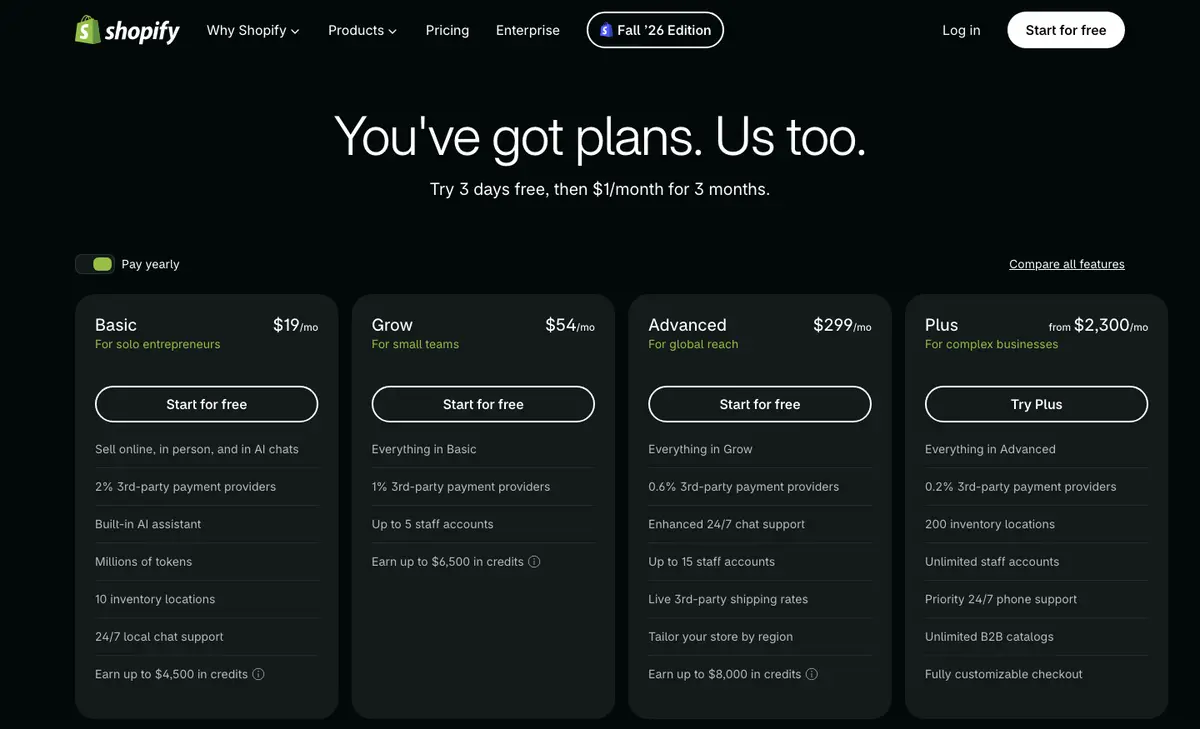
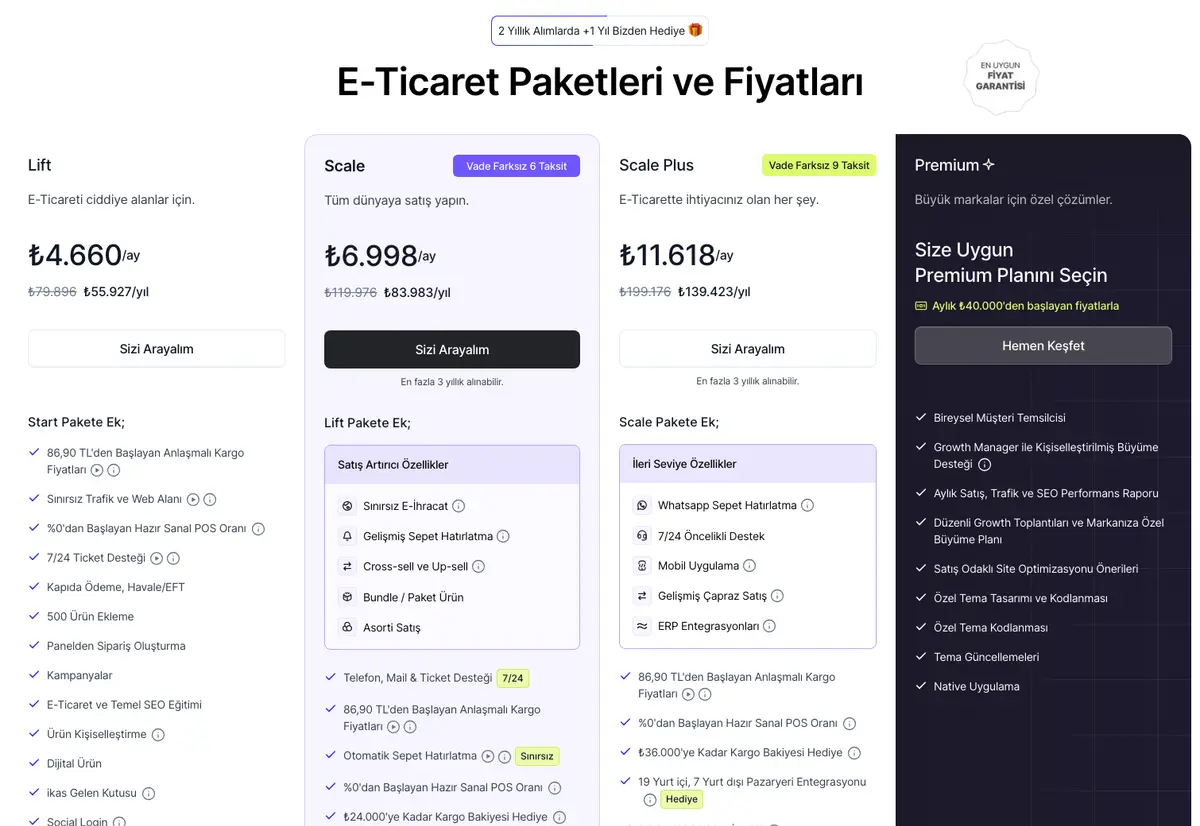
The decisive column is "Platform fee per sale". Shopify charges it to every store using a third-party payment provider (iyzico, PayTR, a bank POS) instead of Shopify Payments. Since Shopify Payments is not open to companies in Turkey, every Shopify store taking cards in Turkey pays it.
Who takes what on a 1,000 TL order
The calculation below applies PayTR's advertised starting rate for a 7-day settlement period (valör), 2.19%, to both platforms (PayTR Virtual POS, November 18, 2026). iyzico's advertised business rate is 4.29% + 0.25 TL; with iyzico, each row's total rises by 21.25 TL. Real rates depend on your contract; the aim is to show the platform difference.
| Scenario | Payment provider fee | Platform fee | Total | Share of revenue |
|---|---|---|---|---|
| Shopify Basic + PayTR | 21.90 TL | 20.00 TL | 41.90 TL | 4.19% |
| Shopify Grow + PayTR | 21.90 TL | 10.00 TL | 31.90 TL | 3.19% |
| Shopify Advanced + PayTR | 21.90 TL | 6.00 TL | 27.90 TL | 2.79% |
| ikas paid plan + PayTR | 21.90 TL | 0 TL | 21.90 TL | 2.19% |
| Shopify, bank transfer or cash on delivery | No provider | 0 TL | 0 TL | 0% |
Most comparisons skip the last row. Shopify takes no transaction fee on manual methods such as bank transfer (havale/EFT) and cash on delivery (Shopify Help Center, billing cycles). For a B2B or wholesale store that gets a third or more of its orders by bank transfer, Shopify's per-sale cost drops below the table's rates.
At 300,000 TL in monthly card revenue, Basic's 2% fee reaches 6,000 TL a month. Moving to Grow cuts this to 3,000 TL; the $35 plan difference is a small part of that saving. So on Shopify, choosing a plan is a matter of revenue thresholds. Our post on Shopify transaction fees gives the full breakdown of plan and per-sale fees with upgrade thresholds.
On yearly billing, moving from Basic to Grow pays for itself once monthly card revenue passes about $3,500: the plan difference is $35 a month, the fee saving 1% of revenue.
Exchange rates: a dollar invoice or a TL invoice
Shopify bills in dollars; ikas prices in TL. This is not a cost item in itself, but it changes cash planning. On Shopify, yearly billing works as a 12-month hedge: the yearly Basic plan is $8 a month cheaper than monthly and unaffected by the exchange rate for a year. On ikas, the yearly TL price is locked at payment; at renewal the new price list applies.
Here is the break-even. ikas Lift's monthly equivalent of 4,660 TL equals Shopify Basic's 2% fee at about 233,000 TL in monthly card revenue. Below that, Basic's fee is cheaper than Lift; above it, ikas leads. The same calculation for ikas Scale (6,998 TL) and Shopify Grow (1%) lands at about 700,000 TL. In both, Shopify's dollar plan fee comes on top, and bank transfer orders drop out on the Shopify side. Price alone should not pick the platform: for most stores the gap is a few thousand TL a month, while leaving the wrong platform costs many times that. To weigh the choice against your revenue mix and 24-month goals, our Shopify consulting team runs this calculation on your own order data.
International sales: Shopify Markets vs ikas e-export plans
Shopify offers international selling on every plan through Markets: country domains, languages, price lists and tax settings are managed from one store. For a company in Turkey, the constraint is payment, because letting customers pay in their own currency requires Shopify Payments. On ikas, e-export and unlimited languages and currencies come with Scale and above.
Both platforms solve "selling abroad" at the storefront. The real difference appears when the order is paid and the money comes home to Turkey.
Multiple currencies and country-specific pricing
With Shopify Markets, a store sets a euro price list for Germany and a dollar list for the US, and gives each market its own subfolder or domain (such as /de-de, /en-us). One product record can then sell in several countries; translations, price rounding and hreflang tags are managed in Markets.
There is a limit for stores in Turkey. According to Shopify's pricing page, showing local-currency prices and accepting local payment methods require Shopify Payments. As that is not open to companies in Turkey, a store using iyzico or PayTR charges in its base currency. Currency converter apps show euro prices on the storefront, but the card is charged in the store currency and the customer's statement shows a different figure.
We use two ways around this limit:
- Separate expansion store: A second Shopify store with euro or dollar as base currency, connected to a provider that can collect foreign currency. Products and stock are fed from the main store by a sync app.
- Company abroad: The store runs under a company set up in a country where Shopify Payments is available. This is a separate tax and accounting project and should be planned with your accountant.
On ikas, the pricing page calls Scale "Unlimited E-Export" and puts country price lists, and pricing updated hourly to the Central Bank of the Republic of Türkiye (TCMB) rate, in Scale and above. Lift lists no e-export. An ikas store selling abroad starts at Scale, at least 83,983 TL a year.
Collecting international payments: real options for a company in Turkey
For a company registered in Turkey, the most direct route to foreign card payments is enabling foreign card acceptance with its local payment institution. Per the TCMB's November 2026 table, the maximum merchant fee banks may charge on cards issued abroad is 1.90% (TCMB, Maximum Commission Rates Applicable to Merchants). Payment institutions price outside this cap under their own contracts; ask for the foreign card rate separately.
Stripe and PayPal do not open accounts for companies registered in Turkey. A platform listing them for international payments does not mean a Turkish company can use them. With ikas or Shopify alike, base your international payment plan on where your company is registered, not on a provider's name.
In international sales the platform comes second; the first decision is which company, in which country, collects the money and in what currency.
Our recommendation: while first international orders are a few dozen a month, foreign card acceptance on the main store is enough. When international revenue passes a fifth of the total, it is time to discuss a separate currency store or a company abroad. At that point Shopify's Markets and multi-store setup leave more options than a single-package platform.
Turkey integrations: shipping, e-invoicing and marketplaces
ikas includes domestic shipping contracts and marketplace connections; the Scale plan lists Trendyol, Hepsiburada, N11, Amazon and Etsy. On Shopify each integration is added as an app or custom build. ikas saves time at setup, while Shopify lets you replace each integration individually.
A Turkish store's daily operations run on three connections: shipping labels and tracking, e-invoices and e-archive invoices, and marketplace stock sync. When these run disconnected, manual work per order rises and stock errors become marketplace penalty points.
Built-in integrations (ikas) vs app-based setups (Shopify)
| Integration | ikas | Shopify |
|---|---|---|
| Shipping contract | ikas's negotiated carrier rates, in the plan | Your own carrier contract + integration app |
| Shipping labels and tracking | From the admin panel | App or custom integration for carriers like Aras, Yurtiçi, Sürat, PTT |
| E-invoice / e-archive | Integrator connection from the panel (confirm the plan with ikas) | Via an app with software like Paraşüt or Logo |
| Marketplaces | Scale: Trendyol, Hepsiburada, N11, Amazon, Etsy; Scale Plus: 19 domestic, 7 international | App or integrator per marketplace |
| ERP (Logo, Nebim, SAP) | Limited to the plan's connections | Ready-made app or custom build |
Source: ikas pricing page, November 17, 2026. The Shopify column reflects integrations Nodus Works has built.
Reading the table: on ikas, shipping and marketplaces are live on day one, and the plan decides which carrier, at what price and with which field mapping. On Shopify you choose each connection. If your own carrier deal beats ikas's rate, or your carrier is not on ikas's list, the difference goes straight to cost. Our Shopify shipping integration guide compares Shopify's shipping options carrier by carrier.
Trendyol, Hepsiburada and stock sync
The real work in marketplace integration is keeping one stock figure correct across website and marketplaces. If sync lags, the last unit on two channels sells twice, and the marketplace counts the cancellation against your seller performance. When setting up a Trendyol integration on Shopify, we define stock update frequency, variant matching and price difference rules (such as a marketplace price higher by the commission) one by one.
On ikas the sync comes with the plan and works well for small catalogs. Once the catalog reaches thousands of variants, or product data comes from an ERP, being unable to control sync frequency and field mapping becomes a constraint. So for stores fed by an ERP and working with several warehouses and marketplaces, we recommend Shopify. To plan shipping, e-invoicing, marketplace and ERP connections on Shopify as one data flow, our Shopify integration solutions team builds it with no manual step left per order.
App ecosystem and custom development
Shopify's App Store lists tens of thousands of apps, and Shopify Functions allow code-level customization of discount, payment method, shipping and cart rules. ikas also offers developer docs and an API, but its app store and developer community are not on Shopify's scale. With a non-standard sales rule, this difference shows directly in project time.
An app ecosystem's value is whether a solution exists when the need arrives. A feature you do not need today (subscriptions, product personalization, B2B price lists, a loyalty program) may surface in 18 months; on Shopify a ready-made app usually solves it, on ikas the ikas roadmap or custom development.
Checkout customization and Shopify Functions
Shopify Functions are small pieces of code that run on Shopify's servers and change checkout behavior. With Functions a store can add:
- Discount rules: Rules Shopify's built-in discounts lack, such as "buy 3 from one collection, get the cheapest free".
- Payment method rules: Hiding cash on delivery above a set amount, or showing only cards on international orders.
- Shipping rules: Removing free shipping when the cart holds a heavy product.
- Cart validation: Minimum order quantity, B2B customer limits or address format checks.
Checkout UI extensions, which change how checkout looks, work at two levels. Extensions on the thank-you and order status pages work on all plans; those in the information, shipping and payment steps require Shopify Plus (Shopify developer docs, Checkout UI extensions).
Limits of custom development on ikas
ikas publishes developer docs at ikas.dev and offers API access to theme and store data. Bundled features cover common Turkish needs; the limit shows once a need goes beyond the plan. For a custom checkout rule, customer-specific ERP pricing or a non-standard shipping calculation, ikas is limited to the endpoints the platform exposes.
Our practice: before choosing, we list 5 custom rules the business may need in the next 24 months and mark each on both platforms as "ready-made app", "buildable via API" or "not possible". A platform with a "not possible" is out if that rule is central to the business. For rules no ready-made Shopify app covers, our software solutions team builds Functions and custom apps.
SEO, speed and visibility in AI search
Shopify and ikas both cover technical SEO basics (automatic sitemap, editable robots.txt, title and meta description fields, 301 redirects). Shopify's notable difference is fixed URL prefixes: products sit under /products/, collections under /collections/, and these cannot be changed. Speed depends more on the theme and number of installed apps than on the platform.
For SEO, neither platform is "better". The outcome depends on site architecture built with the platform's limits in mind. When you switch platforms, the redirect map decides whether SEO survives.
URL structure and fixed prefixes
On Shopify the URL template is fixed:
| Page type | Shopify URL structure |
|---|---|
| Product | /products/product-name |
| Collection | /collections/collection-name |
| Page | /pages/page-name |
| Blog post | /blogs/blog-name/post-name |
Prefixes are fixed; only the last part (the handle) is editable. A Turkish-language store therefore shows an English prefix like /products/. Google Search Central's URL structure guide recommends readable words; in our experience the prefix language alone does not decide rankings. The real risk is migration: a store moving from ikas to Shopify must 301-redirect every old URL to its new Shopify address.
On ikas, robots.txt is generated automatically and, per ikas support documentation, can be edited manually under Sales Channel > SEO and Domain. The sitemap updates itself when products are added.
Core Web Vitals: speed depends on theme and app load, not the platform
Both platforms serve pages through a CDN. A store's LCP (load time of the largest content element) and INP (interaction delay) depend mainly on theme weight and the number of apps adding scripts to the page. On Shopify any app can add its own JavaScript to the storefront; with 15-20 apps installed, mobile performance scores fall behind the same store on a lean theme.
Our rule: we check whether each installed app adds storefront scripts, remove unused apps and clean their leftovers from the theme code. To measure speed, use the Core Web Vitals report in Search Console (real user data), not a lab score.
Visibility in AI search
In March 2026 Shopify launched Agentic Storefronts for US stores. The feature feeds the store catalog to AI assistants such as ChatGPT and Copilot. When it will reach stores in Turkey is unclear. ikas has announced no similar catalog feed.
Today the basis of AI visibility is the same on both platforms: robots.txt must not block GPTBot, Google-Extended and PerplexityBot, product pages need complete Product and Offer schema, and product descriptions should answer questions directly. To have these three steps audited on your store, our SEO optimization process starts with a technical audit.
Exit cost: how easily you can take your data with you
A platform's true cost shows when you leave. Product, customer and order data export from both Shopify and ikas, but customer passwords move from no platform, and every old URL needs a 301 redirect to its new address. Because ikas sells paid plans yearly only, exit timing is tied to the contract date.
Considering an exit scenario when choosing a platform is risk management, not pessimism. Switching after 3 years, with a larger catalog, thousands of customer records and hundreds of URLs ranking on Google, costs many times more than choosing right on day one.
What moves and what doesn't
| Data | Does it move? | Note |
|---|---|---|
| Products, variants, images | Yes | Via CSV or a migration app |
| Collection / category structure | Yes, with remapping | Platforms structure categories differently |
| Customer records | Yes | Name, email, address, marketing consent |
| Customer passwords | No | Customers reactivate accounts on the new platform |
| Order history | Yes, with an app | For reporting and customer accounts |
| Gift card and points balances | Partly | Depends on the app |
| URLs and rankings | Via 301 redirects | One row per old URL |
| Theme and design | No | Rebuilt on the new platform |
Passwords cannot move for a technical reason: platforms store them as an irreversible hash. After migration, customers get an account activation email, and its open rate decides how fast former customers return on the new site.
In our migrations, the biggest exit cost is URLs, not data. Product data moves in a day or two; a gap in the redirect map causes ranking losses lasting months. So every migration starts with a full URL inventory of the old site: the sitemap, indexed pages from Search Console and URLs with backlinks go into one list, and each row gets its new address. The step-by-step order is in our ikas to Shopify migration guide; to run the migration with a URL inventory and 301 map, our Shopify migration service covers it, including ranking loss monitoring.
Decision matrix: the right platform in 6 questions
If you answer "yes" to four of the 6 questions below, Shopify fits your store better; "no" to four, ikas does. On a three-three split, international sales decide: if you plan to sell abroad within 24 months, choose Shopify.
Rather than comparing platforms on paper, the matrix starts from your store's situation. Each question condenses one section of this post.
| Question | If "yes" | If "no" |
|---|---|---|
| 1. Do you plan to sell abroad within 24 months? | Shopify (Markets, expansion store) | ikas is enough |
| 2. Is monthly card revenue below 233,000 TL? | Shopify Basic's transaction fee costs less than ikas Lift | ikas Lift's flat fee is cheaper |
| 3. Does checkout need custom rules (B2B pricing, minimum basket, hidden payment methods)? | Shopify (Functions) | ikas is enough |
| 4. Does product data come from an ERP (Logo, Nebim, SAP)? | Shopify | ikas is enough |
| 5. Does the catalog exceed 500 products or use multi-dimensional variants? | Shopify | Either works |
| 6. Does revenue come mainly from marketplaces, with the website second? | ikas (built-in marketplaces) | Shopify |
The threshold in question 2 is the revenue at which ikas Lift's monthly equivalent equals Shopify Basic's 2% fee; Shopify's dollar plan fee comes on top.
In short: for a store certain to stay in Turkey, marketplace-led and with a small catalog, ikas means less work and a lower per-sale cost. If any of these three conditions will change, starting on Shopify removes the cost of a platform migration two years later.
Frequently asked questions
Is Shopify or ikas cheaper?
It depends on monthly card revenue. ikas takes no platform fee per sale and its Start plan is free; in Turkey, Shopify takes 2% to 0.2% of every card sale depending on the plan. Below about 233,000 TL in monthly card revenue, Shopify Basic's fee stays cheaper than ikas Lift; above it, ikas leads. Shopify charges nothing on bank transfer and cash on delivery.
Will my Google rankings drop if I move from ikas to Shopify?
If every old URL is 301-redirected to its new address, there is no lasting drop. Temporary fluctuation is normal for 2-6 weeks after migration while Google recrawls the new addresses. Lasting losses come from unredirected URLs and changed page content. Start with a complete list of the old site's URLs.
Can you use Shopify in Turkey, and how do you take payments?
Yes. Companies in Turkey open Shopify stores and take card payments through the official Shopify apps of iyzico or PayTR. Shopify Payments is not open to companies in Turkey, so Shopify takes a plan-based fee on every card sale. Bank transfer and cash on delivery are added as manual payment methods.
Can you sell internationally with ikas?
Yes, on Scale and above. ikas's pricing page lists e-export, unlimited languages and currencies, and country price lists from Scale up; Lift has no e-export. For international payments, get written confirmation from ikas of which provider is open to your Turkish company.
Does Shopify integrate with Trendyol and Hepsiburada?
Yes, but not in the plan. On Shopify, marketplace connections run through an app or integrator, with stock, price and order sync configured separately. On ikas Scale, Trendyol, Hepsiburada, N11, Amazon and Etsy connections come with the plan.
Is Shopify too much for a small store?
For a store with under 100 products selling only in Turkey and mainly through marketplaces, ikas means less setup work. If product sales are central and you have growth goals, Shopify Basic starts at $19 a month billed yearly, and you upgrade the plan as you grow while staying on the same platform.
Conclusion
The choice between Shopify and ikas depends less on today's cost than on the store's direction over 24 months. For a store selling in Turkey, marketplace-led and with a small catalog, ikas means less work with ready-made shipping contracts, built-in marketplace connections and zero platform fee per sale. When international sales, custom checkout rules, an ERP connection or a growing catalog come in, Shopify meets those needs through its app ecosystem and Functions without a platform change.
On cost, card revenue decides: put Shopify's transaction fees and plan thresholds in one table with ikas's yearly prices, and for most stores the gap is a few thousand TL a month. That is small next to the cost of leaving the wrong platform.
Next, use the plan threshold table in our Shopify transaction fees post to run your own numbers. To settle which platform fits your revenue mix, catalog and 24-month goals, talk to our Shopify consulting team and book a free intro call.