Shopify Integration Solutions & Custom App Development

We bring your brand's digital operations together and connect every process into a single flow. By integrating your Shopify store with ERP, accounting, invoicing, shipping, returns and CRM systems, we eliminate operational complexity and make your workflow automated, error-free and sustainable. Our core strength is building custom Shopify apps tailored to your store.

As an experienced partner working with Shopify brands in Türkiye, we use the Admin API, Storefront API, Shopify Functions and webhook infrastructure to build custom app solutions for every need that off-the-shelf apps cannot meet. From payment infrastructures to shipping processes, ERP integrations to marketing automation — we unite everything in a single ecosystem.

200+
200+ active brands
growing on Shopify with Nodus Works
Custom App
Custom Shopify app development for your store — Admin API, webhooks and Functions
5 carriers
Yurtiçi, Aras, MNG, Hepsijet and DHL integration
4 ERPs
Two-way data flow with Logo, Mikro, Nebim and Netsis
Two-way
Real-time data flow between Shopify and your ERP and accounting
Secure API & custom app integration
Brands growing with Nodus Works
SHOPIFY INTEGRATION & CUSTOM APP

Our Shopify Integration & Custom App Services

We bring your brand's digital operations together into a single flow. By integrating your ERP, accounting, shipping, CRM and marketing systems with Shopify, we also build custom apps for your store where off-the-shelf solutions fall short.

Automated Order Management

Every order in your Shopify store runs in full sync with your payment and shipping processes. Each transaction can be tracked and managed in real time from a single dashboard. This reduces manual intervention and boosts operational speed and customer satisfaction.

Shipping & Delivery Tracking

With carrier integrations such as Yurtiçi, Aras, MNG, Hepsijet and DHL, we make your shipping processes fully automated. As soon as Shopify orders are handed to the carrier, tracking numbers land in the system instantly. Your customers follow deliveries seamlessly while you save time on logistics.

Accounting & ERP Integration

We enable two-way data flow between ERP systems such as Logo, Mikro, Nebim and Netsis and your Shopify store. Stock, invoice and order information is updated automatically, with no need for manual data entry. Thanks to this integration, your financial processes become more transparent, faster and error-free.

CRM & Email Automation

With Omnisend, Klaviyo, Mailchimp and HubSpot integrations, we pull customer data from Shopify automatically. With segmentation, automated email flows and personalized campaigns, we increase customer loyalty. Thanks to CRM integration, your brand's communication stays consistent at every touchpoint.

Marketing & Advertising Integrations

With Google Analytics 4, Meta Pixel, Google Merchant Center and Looker Studio connections, we gather your marketing data in a single ecosystem. We measure your Shopify store's conversion rates and let you track performance in real time. This way, you can optimize your ad investments based on data.

Custom Payment Infrastructure Development

We can develop custom payment infrastructure solutions for Plus stores. With Shopify Markets integration and multi-currency support, we make your global sales operations seamless. For customers in different countries, automatic pricing, tax and shipping calculations kick in. Your brand scales in international markets with a professional user experience.

DATA FLOW

How does data flow between Shopify, the ERP, shipping and accounting?

Integration ends the practice of entering the same information into two systems by hand. First, the primary source of each piece of data is defined: for most brands, products, stock and prices come from the ERP; orders are created in Shopify and distributed from there to the ERP, the shipping carrier and the accounting software. The flow below summarizes the setup we built in our Nebim, Logo, SAP and Paraşüt projects.

ERPNebim · Logo · SAP
  • Product record, variant and barcode
  • Stock by location
  • List and campaign prices
  • Processes and invoices incoming orders
HUBShopify
  • Orders and payments are created here
  • Products, stock and prices are updated from the ERP
  • Every change is reported instantly by webhook
  • Transfer status is tracked on the order screen
SHIPPING AND ACCOUNTINGShipping carriers · Paraşüt
  • A shipment is created when the order is packed
  • The tracking number is written back to the order
  • The invoice is created when the order is fulfilled
  • Returns and cancellations are recorded on both sides

Live examples: Nebim at Antioch and Vamos, Logo at Bonne Nuit, SAP at Volta Motor, and Paraşüt (a Turkish cloud accounting tool) plus eight shipping carriers at our own brand Haters Studio. For a brand without an ERP, Shopify becomes the primary source of products and stock; the shipping and invoicing flow stays the same.

WHICH DATA, WHICH DIRECTION

Which data flows in which direction?

Most sync errors come from two systems changing the same field. That is why, during discovery, each data type gets one primary source, one direction and one trigger. In a Shopify store that uses an ERP, the table typically looks like this:

DataDirectionWhen it is transferredWhat we watch for
Product record and varianttitle, SKU, barcode
ERP → ShopifyWhen a new product is created and when the record changesThe matching key is the SKU or barcode, not the product name. Descriptions, images and SEO fields are edited in Shopify; the ERP transfer does not overwrite them.
Stockby location
ERP → ShopifyOn every stock movement; with bulk updates for large catalogsERP warehouses are mapped one to one to Shopify locations. Retail store, main warehouse and returns warehouse are defined separately.
Pricelist and sale price
ERP → ShopifyWhen the price list changesFor sale prices, the original price goes into Shopify's compare-at price field; the campaign starts and ends in both systems at the same time.
Order
Shopify → ERPThe moment the order is created, by webhookAn order that cannot be transferred waits in the queue and is retried; the error is logged, and no order is lost silently.
Billing detailsTurkish ID number, tax number
Shopify → ERP or accounting softwareTogether with the orderThe distinction between individual and corporate invoices is read from the checkout fields; the choice between e-Fatura and e-Arşiv, Türkiye's two e-invoice types, is made accordingly.
Shipment and tracking number
Shopify → carrier, tracking info carrier → ShopifyWhen the order is packed; whenever the shipment status changesOnce the tracking number is written to the order, Shopify's shipping notification goes to the customer automatically.
Invoice
Shopify → Paraşüt or ERPWhen the order is fulfilledNo separate accounting entry is needed. At Haters Studio, the invoice is created in Paraşüt automatically when the order is fulfilled.
Returns and cancellations
Shopify → ERP and accountingWhen a return or cancellation is recordedPartial returns, orders split across two shipments and cancellations after payment are tested as separate scenarios; stock goes back to the location where the return was received.

For a brand without an ERP, Shopify is the primary source of products, stock and prices; the table then consists of the order, shipping and invoice rows.

Custom App Development

Shopify Custom App Development

Our core strength at Nodus Works is building custom Shopify apps tailored to your store. Using the Admin API, Storefront API, Shopify Functions and webhook infrastructure, we build bespoke solutions for every operational need that off-the-shelf apps cannot meet. Private apps installed only on your store — not listed on the App Store — give you full control over your operations.

Store-Specific Custom App

Private apps installed only on your store, not published on the App Store. Directly integrated with your ERP, WMS, B2B portal and internal systems.

Shopify Admin API Integration

Custom API connections that sync order, inventory, customer and product data in real time. Bidirectional data flow eliminates manual entry.

Shopify Functions & Checkout

Custom discount rules, payment flows and checkout extensions. Advanced customization and multi-market support for Plus stores.

Webhooks & Automation

Custom workflows triggered automatically when orders are placed, stock changes or returns arrive. Turn your operations into 24/7 automation.

Third-Party System Connections

Custom bridge apps with Logo, Mikro, Nebim, Netsis, SAP, carriers, CRM and marketplace APIs. Seamlessly connect your existing software investment to Shopify.

Maintenance & Scaling

Ongoing support, security updates and new feature development for live custom apps. Scalable architecture that adapts to your growing operations.

EXTENSION POINTS

Where does a custom app touch Shopify?

A custom app connects to the store through the Admin API and webhooks; the part you see on screen is added through Shopify's extension points. Because no code is embedded in the theme or the checkout, the app stays in place when the theme changes or is updated.

Theme app block

Features such as stock alerts, size charts or dealer pricing are delivered as app blocks and app embeds that are added and removed in the theme editor on Online Store 2.0 themes.

Theme app extension

Checkout and thank you page

Fields, notices or offers are added to checkout. Extensions in the information, shipping and payment steps are exclusive to Shopify Plus; thank you and order status page extensions work on all plans.

Checkout UI extensionShopify Plus

Shopify Functions

Discount logic, hiding or reordering shipping options, filtering payment methods, cart validation and bundle rules run on Shopify's own infrastructure. In a store-specific custom app, Functions require Shopify Plus.

Delivery customizationCart transform

Admin extensions

The order's ERP transfer status, invoice number or shipping barcode appears on the order screen; actions such as “Resend to ERP” are done inside the admin without switching panels.

Admin blockAdmin action

Customer account

Custom pages and blocks are added to the new customer accounts: dealer balance, points status or a donation summary. At Wear the Peace, the donation and impact panel sits inside the customer account.

Customer account extension

Metafields and metaobjects

Technical specs, care instructions or dealer terms coming from the ERP are not pasted into the product description; they are written to defined fields. The theme, filters, mobile app and marketplace feeds all read from the same field.

Metafield definition
Permissions and signature verification

The app is installed only with the access scopes it needs, and keys are kept in encrypted environment variables, not in the code. Every webhook from Shopify is verified with its HMAC signature; a request with a mismatched signature is not processed.

Queue and retry

Incoming events go into a queue first. If the other system is down, the job is not lost and is retried at increasing intervals; the same event arriving twice does not create a duplicate record. A regular reconciliation job picks up missed events.

NUMBERS FROM THE FIELD

What do our integrations do in production?

Each figure comes from the real operations of a single brand, taken from our case studies.

99.9%of Volta Motor orders transferred to SAP automaticallyShare requiring manual intervention: 0.1%
8shipping carriers in a single fulfillment flowHaters Studio: Yurtiçi, Aras, PTT, HepsiJET, Kargoist, Sürat, DHL, UPS
6,000+products on the same stock with NebimAntioch: website, mobile app and Noon
180+active dealer accountsAdell's B2B sales platform on Shopify
Our Process

Our Integration Process

From needs analysis to post-launch support, we plan and manage every step of the integration process for you, end to end.

01

Needs Analysis & System Mapping

We review your existing processes: payment, shipping, ERP, CRM. We prepare an integration plan suited to your brand's volume and operational structure.

02

Integration Selection & Licensing

We determine the applications to be used (Shopify App, custom API, third party). We complete the work needed for the required licenses, permissions and security configurations.

03

Setup & Configuration

The selected systems are integrated into the Shopify admin. Data matches (product, customer, order ID) are established.

04

Testing & Sync Verification

Order, stock, price, customer and shipping scenarios are tested. We make sure all data flows work correctly in both directions.

05

Training & Usage Support

We show your team how to manage the integrations from the dashboard. Processes such as shipping label printing, invoice syncing and email automations are explained.

06

Launch & Support

After all systems go live, we monitor performance and data for the first 30 days. In case of any issue, we provide instant intervention and correction support.

CUSTOM APP SOLUTIONS

Custom App Solutions for Every Need

Off-the-shelf Shopify apps don't meet every business need. Nodus Works builds custom apps from scratch based on your brand's unique operational requirements — from B2B sales to warehouse management, custom invoicing to customer portals.

B2B & Wholesale App

Customer-specific pricing, minimum order limits, approval flows and dealer portal. Run your wholesale operations fully automated on Shopify.

Inventory & Warehouse Management

Multi-warehouse, batch tracking and real-time stock sync. Eliminate stock inconsistencies between marketplaces, ERP and Shopify.

Custom Shipping & Logistics

Carrier selection, automatic label printing and tracking number transfer. Custom integration apps for domestic and global carriers.

Invoicing & Accounting App

E-invoice, e-archive and ERP invoice sync. Automate your entire financial process from order to invoice with a custom app.

Customer Portal & Loyalty

B2C customer panel, points system and custom campaign management. Deliver a personalized shopping experience to your customers.

Reporting & Dashboard

Multi-channel sales reports, KPI dashboards and data visualization. Manage all operational data from a single custom app panel.

Our SaaS Solution

Manage Multichannel Sales from One Hub: Station

Station is the central management layer that sits between your Shopify store and marketplaces like Trendyol and Hepsiburada. You enter product, stock and price once; Station distributes this information automatically to all your sales channels. That way you no longer have to update each panel separately and stay consistent and up to date across all your channels.

All Channels from One Panel

Define product, description, price and stock in Station once; let them appear the same, accurate and up to date across Shopify and your marketplaces. Your brand consistency is preserved on every channel.

Real-Time Stock Sync

When a sale happens on one channel, stock updates instantly across all channels. The "we sold it but it's out of stock" scenario, along with the cancellations, returns and negative reviews it causes, disappears.

Prices & Campaigns in Seconds

Make a price increase, discount or campaign decision once; Station pushes it to all channels within minutes. With bulk updates you manage hundreds of products at once and handle seasonal transitions effortlessly.

All Orders on One Screen

Orders, returns and cancellations from all channels land in Station automatically. You track what you sell on which channel and its real stock impact from one place.

Unlimited Marketplace Connections

Connect Trendyol, Hepsiburada, N11, Amazon and more to a single Station account. Adding a new channel takes minutes; your product and stock information is carried over to that channel instantly.

Reporting & Performance Analysis

See which channel and which product sold how much on a single dashboard. With Station's reports, manage your profit margin, stock turnover rate and channel performance based on data.

CHOOSING THE PATH

Ready-made app, Flow, Station or a custom app?

Not every need calls for custom code. In the discovery call, we first check whether a ready-made option does the job; we decide on custom development only after the limit of the ready-made option is clearly visible, and together with a maintenance plan.

PathIts limitWhen it is the right choice
Shopify App Store app
Its logic cannot be changed. Two apps touching the same data conflict, and each requires its own monthly subscription.
When the need is standard and your workflow fits the app's logic: basic shipping, email, product reviews.
Shopify Flow
Not designed for complex data exchange with external systems or for error recovery.
Recurring rules inside the store: hiding a product when stock hits zero, tagging high-value orders, sending notifications to the team.
StationNodus Works app
If a brand-specific pricing rule or category mapping is needed, it is used together with custom development.
When marketplaces, the ERP and shipping are to be managed from a single panel with the same stock and prices.
Store-specific custom app
It needs maintenance. Shopify releases a new API version every three months, and the app is updated on that schedule.
When the ERP has a brand-specific setup, or when a custom screen inside the admin or a business rule with Functions is needed.
Public appShopify App Store
It goes through Shopify's review; compliance with App Store rules and the Billing API is required.
When the same need exists in many stores and is worth turning into a product. We have more than 15 apps live on the App Store.
Middlewareintegration layer
Requires a separate server, monitoring and security management.
When several internal systems outside Shopify, such as warehouse, production and legacy platforms, need to meet in one hub.

We do not recommend a custom app for a need that the first three rows of the table can solve. In the proposal, we state in writing which path we chose and why.

NODUS WORKS APPS

Which of our apps run in integration projects?

In integration projects, three of our apps most often take the place of custom code: Station brings marketplace, ERP and shipping connections into a single panel, Syncly keeps stock and prices aligned across two or more Shopify stores, and Goldus refreshes prices indexed to gold and exchange rates with the current rate. Because we build and maintain all three ourselves, updates to these connections do not need to be planned separately the way store-specific code does.

Bundle Works app iconWishalert app iconSortmax app iconBulkly app iconLoyalis app iconWizard app iconToptan app iconNodmob app iconPeakmerce app iconSeodus app iconCompliTR app iconScheduly app iconSupport app iconV
S1Syncly app icon2Goldus app icon3Nodus Works
  1. 1Station
  2. 2Syncly
  3. 3Goldus
15+ apps built by Nodus WorksUsed in this service
S

Station

Hub for marketplaces, ERP and shipping
01

Instead of writing a separate connection for every marketplace and shipping carrier, Station becomes the hub. Products, stock and prices are entered once and distributed to marketplaces; ERP transfers and shipments are tracked from the same panel.

Where it runs
Shopify, marketplaces, ERP, shipping
What it replaces
A separate connection for each channel
View Station
Syncly app icon

Syncly

Sync between Shopify stores
02

For a brand selling the same product in more than one Shopify store, stock that drops in one store has to drop in the others as well. Syncly aligns stock and prices across stores automatically; prices are calculated with the margin rule you set for each store. There is no need to build separate middleware for two Shopify stores.

Where it runs
Two or more Shopify stores
What it replaces
Custom sync code between stores
View Syncly
Goldus app icon

Goldus

Exchange-rate-indexed pricing
03

For products priced against gold or a currency, changing prices by hand with every rate movement is not feasible. Goldus updates product prices automatically based on the current rate; if prices do not come from the ERP, no separate integration is needed for rate data.

Where it runs
Rate-indexed product prices
What it replaces
A custom connection to a rate service
View Goldus

Which data is written by which app or connection is decided during discovery, together with the data direction table; no field is changed by two solutions.

Contact
Let's Build the Integration Together

We're ready to integrate your Shopify store with your ERP, shipping, CRM and accounting systems — and build custom apps tailored to your store. Let's discuss your needs in a free meeting.

Book a Meeting
CASE STUDIES

SAP, Nebim and Paraşüt: three real connections

Three brands, three different source systems: an enterprise ERP, a retail-focused ERP and an accounting tool. The screens are from the live stores.

Motor vehicles · SAP

Prices and stock in SAP appear on the product page automatically

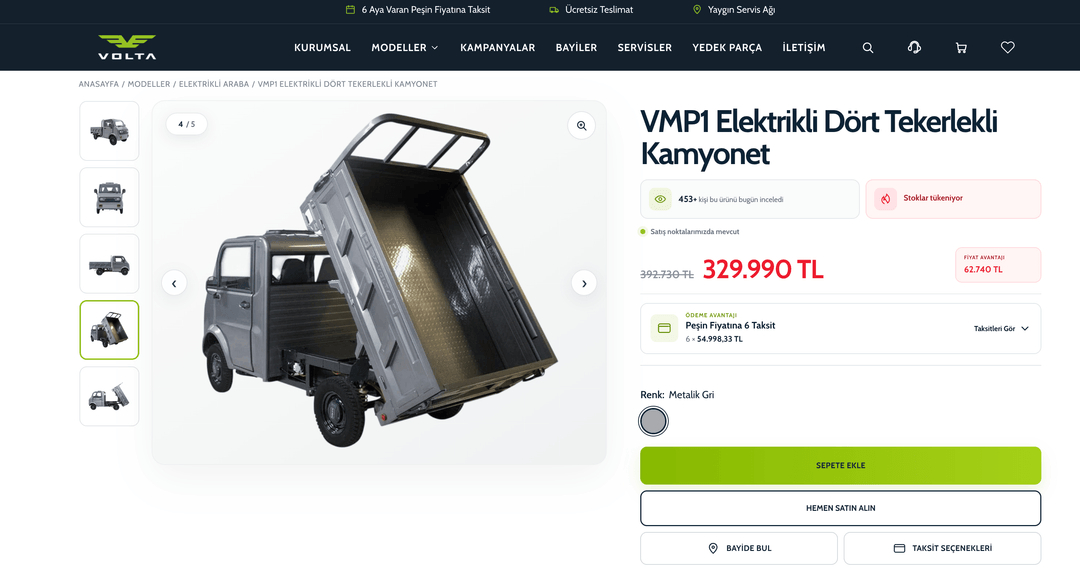
Volta Motor runs its operations on SAP. We moved the store from Ideasoft to Shopify and connected it to SAP; when a price or stock level changes, the site updates on its own, and online orders are processed directly in SAP.

4product groups from a single SAP catalog: motorcycles, scooters, bicycles, ATVs
  • Campaign prices take effect in SAP and on the site at the same time
  • Products, categories and content were moved to the new structure
  • Prices and stock are managed in one place
Read the case study
Menswear · Nebim

A custom sync app connected to Nebim

We built a custom sync app that connects Antioch's Shopify Plus store to Nebim. Products, stock, prices and orders flow between the two systems without manual transfers; a sold product never stays available on any channel. The same setup was later applied at Vamos.

3sales channels on the same Nebim stock: web, mobile app, Noon
  • All shipping carriers, including Sürat Kargo, DHL and UPS, in one flow
  • Theme, mobile app and sync from the same team
Read the case study
Our own brand · Paraşüt

Invoicing and shipping need no manual work

We test the setups we recommend to clients in our own brand first. At Haters Studio, the invoice is created in Paraşüt automatically when the order is fulfilled; shipments go out through eight carriers from a single flow, without entering data in separate panels.

Paraşütthe invoice is created automatically when the order is fulfilled
  • The same setup is used for brands working with Bizim Hesap, another Turkish accounting tool
  • If one carrier is delayed, orders can be switched to another
Read the case study
FAQ

Frequently Asked Questions

What is a Shopify custom app?
A Shopify custom app is a private application installed only on your store and not published on the App Store. Using the Admin API, webhooks and Shopify Functions, it enables custom data flows between your ERP, shipping, accounting or internal systems and Shopify. It is built for operational needs that off-the-shelf apps cannot meet.
Should I choose an off-the-shelf app or a custom app?
Off-the-shelf apps are sufficient for standard needs (basic shipping, payment, email). However, when you need custom ERP connections, B2B pricing, multi-warehouse management or unique workflows, custom app development is a more sustainable and cost-effective solution. At Nodus Works, we help you choose the right approach together.
How long does custom app development take?
It depends on scope. A simple API integration or webhook-based custom app can be completed in 2–4 weeks. Multi-system integration, B2B portal or comprehensive automation projects may take 6–12 weeks. We provide a clear timeline after the discovery meeting.
Does the custom app work only on my store?
Yes. The custom apps we build are installed only on your Shopify store and are not listed on the App Store. Your data and business logic remain exclusive to you, giving you operational advantages your competitors cannot access.
How is custom app development priced?
Pricing depends on the number of systems to integrate, data complexity, UI requirements and maintenance model. After the discovery phase, we offer fixed-price or phased proposals. The initial discovery meeting is free.
Can you replace our existing integrations with a custom app?
Yes. If you're using multiple off-the-shelf apps that cause operational issues, we can consolidate all integrations under a single custom app. This reduces costs, improves performance and simplifies maintenance.
Which payment systems can I use on Shopify?
In Türkiye we can integrate iyzico, PayTR and Craftgate; worldwide, solutions such as Stripe, PayPal and Shopify Payments. All systems comply with PCI-DSS security standards.
Is my ERP or accounting system compatible with Shopify?
You need to get in touch with us for this.
How does shipping integration work?

Shopify shipping integrations fully automate all your post-order fulfillment processes. When an order is created, the system works in sync with the relevant carrier to generate shipping details automatically and adds the tracking number to the order. Customers are notified by email and SMS as the shipping status changes, ensuring transparent communication throughout the delivery process.

When your shipment is delivered, the order is archived automatically and the process is closed. It is compatible with sender-paid and cash-on-delivery shipping types; for cash-on-delivery shipments, the payment amount is deducted automatically from the order total. It works seamlessly with carriers used in Türkiye and globally, such as Yurtiçi, Aras, MNG, Sürat, DHL, UPS, ShipEntegra and ShippyPro. To activate the integration, all you need is to enter the API credentials of the relevant shipping provider.

Why is CRM integration important?
Thanks to CRM systems (Klaviyo, Mailchimp, HubSpot), we segment customer data and build automated email flows. This can increase repeat sales by up to 25%.
Can my Google Analytics and ad accounts be connected to Shopify?
Yes. Thanks to GA4, Meta Pixel, Merchant Center and Looker Studio integrations, you can track ad conversions from a single place.
Can you develop custom integrations and custom apps?
Yes — this is Nodus Works' core area of expertise. We build custom Shopify apps for your store using the Admin API, Storefront API, Shopify Functions and webhook infrastructure. We set up custom integrations with ERP, shipping, accounting, CRM and third-party systems. For every scenario where off-the-shelf apps fall short, we can build bespoke applications from scratch.


JOIN THOSE
WHO CHOOSE US...

We create Shopify solutions for everyone.

Do you want to set up a new Shopify store, improve your existing one, create custom integrations, or solve speed issues? We are expert Shopify partners who handle the technical work for you.

Dossha

#shopify

Les Benjamins

#shopify

Nocturne

#shopify

Fellas

#shopify

Mai

#shopify

Karaca

#shopify

Milagron

#shopify

Kiğılı

#shopifySeo

Şölen

#shopify

Adell

#shopifyB2B

Ohora

#shopify

Rendrea

#shopifyBooking

Babeskin

#shopify

The New Lab

#shopify

DTF Town

#shopify

Eczaclick

#shopifySeo

Thermos World

#shopify

Halı.net

#shopify

Blend-r

#shopify

Oioi

#shopifySeo

Nowshopfun

#shopify

Marie Claire

#shopify

Gaziburma

#shopify

Book in the World

#shopify

WHY WITH US
YOU NEED TO WORK
WE WOULD LIKE TO TELL YOU

We understand Shopify very well; we stand out against every segment in Turkey:)

Gülümseyen, siyah saçlı ve siyah kazak giymiş genç adam portresi.Koyu saçlı, koyu renk kazak giymiş düşünceli genç kadın, koyu renk arka planda.Gri kazak ve koyu gömlek giymiş, kısa saçlı gülümseyen erkek portresi.Kısa kıvırcık saçlı, sakallı genç adam siyah kazakla, koyu geometrik desenli arka planda.
Koyu gri arka plan önünde yeşil kazak giymiş, hafif dalgalı saçlı, gülen genç kadın.Düz siyah saçlı, gri kazak giymiş genç kadın, koyu arka planda kameraya bakıyor.Gözlüklü ve koyu kazak giymiş, karanlık desenli arka plan önünde ciddi ifadeli erkek portresi.

A team of only Shopify speakers

WE COMMUNICATE VERY QUICKLY - THANKS TO OUR TICKETED SYSTEM
Düz siyah saçlı, açık tenli ve nötr ifadeye sahip genç kadın portresi.

Yo!

My banners seem to be broken :(

Can you help me, I'm on the campaign trail.

Hi Elif!

We dissolve in 2 minutes.

Kısa kıvırcık saçlı, sakallı genç adam siyah kazakla, koyu geometrik desenli arka planda.

Transparent
contract model

Get Quote
Get Quote

Start your next project with Nodus Works

Scroll —
Scroll —
Scroll —