We strengthen your Shopify store's digital visibility and make your
brand stand out in search engines. By bringing technical SEO, content
optimization and authority management together under one roof, we
build a sustainable growth foundation. As a Shopify partner agency in
Türkiye, we grow your organic traffic with a technical structure
aligned to search engine algorithms, strategic keyword planning and
high-conversion content production.
At Nodus Works, we see SEO not merely as ranking but as a core element
of brand authority. Thanks to our SEO strategies that work fully
integrated with the Shopify ecosystem, your store is easier to find,
reaches the right audience and turns your visitors into lasting
customers. This way, your digital presence becomes not just visible
but impactful and measurable.
200+ active brands growing on Shopify with
Nodus Works
Core Web Vitals
compliance with Google thresholds for LCP · CLS · INP
Schema
structured data markup
301 / 404
redirect & broken link management
Mobile-first
a fast, crawlable store on every device
Technical SEO audit
Brands growing with Nodus Works
SHOPIFY SEO
Technical SEO Analysis &
Optimization
We strengthen the technical foundations that determine your store's
search engine performance end to end. By bringing elements such as
speed, crawlability, indexing and structured data up to Google
standards, we raise organic visibility and user experience together.
Core Web Vitals Compliance
By reaching Google standards for LCP, CLS and INP metrics, a faster
page experience is designed.
Accurate Crawling and Indexing
With robots.txt, sitemap.xml, llms.txt and canonical settings, your
pages are expected to be read flawlessly by search engines.
Image & Code Optimization
Speed gains are achieved through image compression, lazy loading,
moving critical code and code minification.
Structured Data (Schema)
Product, article and organization data are conveyed to Google
correctly.
404 & 301 Redirect Management
Broken links and redirect chains are fixed to prevent SEO loss.
Mobile Compatibility Tests
A high-performance, user-friendly appearance on every device is the
goal.
ON THE SCREEN
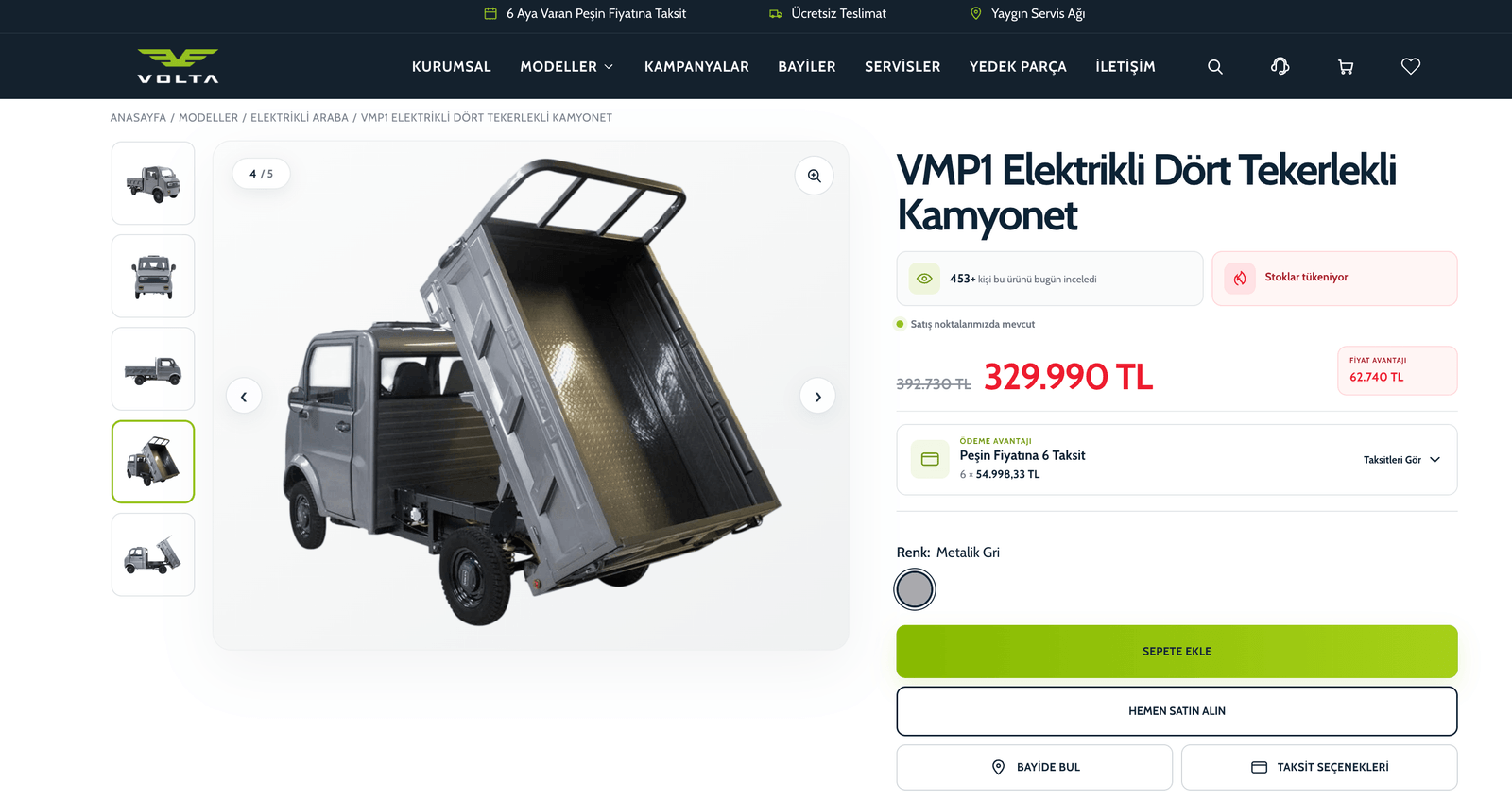
What does Google actually read on a Shopify product page?
This is Volta Motor's product page on Shopify. Each numbered element is a field Googlebot and AI answer engines use to understand the page. In an SEO audit we check every product template against these six points.
Menu and collection structureThe Models menu leads into motorcycle, scooter, bicycle and ATV collections. When each search cluster is assigned to a single collection, two pages never compete for the same keyword, and internal link equity flows to the collections.
Breadcrumb trailHome / Models / Electric car / product. Shopify's default themes do not print a long breadcrumb; the visible trail and the BreadcrumbList schema need to carry the same steps.
Product name and title tagThe product name is the only h1 on the page. The SEO title is written separately in Shopify's “Search engine listing” field; the model name and the category keyword appear in both.
Gallery images and alt textEach image's alt text describes the product, the color and the angle; file names are made meaningful before upload. If image width and height are not defined, the page shifts while loading and CLS suffers.
Price and stock statusThe price and availability in the Product and Offer schema must match what the page shows and what the Merchant Center feed says. If the three sources conflict, Google drops the rich result and the free listing.
Color selection and variant URLEvery color opens a separate URL with a ?variant= parameter in Shopify. We check that the canonical points to the main /products/ URL and that variant URLs are not indexed as separate pages.
Why SEO?
Why SEO Optimization?
Although Shopify offers a technically strong infrastructure, without
the right SEO setup you can only use a fraction of its potential. At
Nodus Works, we develop custom SEO strategies that strengthen your
store in terms of organic traffic, conversion and brand awareness.
Technical Infrastructure Strength
We optimize Shopify's fast, secure and stable infrastructure to SEO
standards. We fix broken links, indexing issues, and canonical and
noindex errors.
On-Page Optimization (On-Page SEO)
We refine the title, meta description, alt text, heading and schema
structures of your product, category and blog pages.
Speed and Core Web Vitals Performance
We compress images, clean up unnecessary apps, and shorten load times
with lazy loading and a CDN.
Content and Blog Strategy
With category-level copy, FAQ sections, topic clusters and blog
content, we build a Google-friendly content ecosystem.
Backlinks & Brand Authority
After competitor analysis, we build a high-quality link plan. We clean
up spam backlinks and strengthen brand authority.
Data Analysis & Reporting
We track performance through Google Analytics, Search Console and
Looker Studio. Every month we measure your growth with numbers and
present it in clear reports.
TECHNICAL AUDIT
Technical SEO errors specific to Shopify
Most of these errors are missing from a generic SEO checklist; they come from Shopify's fixed URL structure, theme code and app ecosystem. These are the ones we find most often in our audits, and how we close each of them:
Error
What happens in the store
How we fix it
Product URLs nested in collections
Product cards link to /collections/collection/products/product. The same product opens under several URLs; even with a correct canonical, crawling is spent on duplicate addresses.
We change the product card link in the theme template to point directly to the /products/ URL and verify the canonical with Search Console's URL Inspection.
Filter and sort pages in the index
Search & Discovery filters and sort_by parameters generate thousands of thin URLs; the “Crawled, currently not indexed” rows in the indexing report keep growing.
We block unneeded parameters with robots.txt.liquid. Combinations with real search demand, such as “black leather boots”, become separate collections with their own description.
Tag pages duplicating collections
Product tags open new URLs in the /collections/collection/tag format; content nearly identical to the collection gets indexed under two addresses.
We remove tag links from the theme or set them to noindex. A tag with real demand is turned into a proper collection.
Markets live, translation half done
An English or German version was opened with Shopify Markets, but part of the fields were never translated. The Turkish page ranks in the target country, and the foreign language page shows up as mixed content.
We translate titles, descriptions, handles and meta fields with Translate & Adapt, and check that the hreflang tags Shopify prints point to each other on every language version.
Code from a removed app still in the theme
The app was uninstalled, but the scripts and styles it added to theme files keep loading. LCP and INP get worse.
We clean orphaned code from theme files and keep the app embeds of active apps enabled only on the templates that need them.
Handle changed without a redirect
The product name changed, the handle was updated, and the redirect box was left unchecked. The old URL returns 404 and the value of external links is lost.
We match the 404 list in Search Console with Shopify's URL redirects screen and send every old URL to the right page with a 301.
Product schema printed twice
The theme and an SEO app each output a separate Product node for the same product. When price or stock conflicts, the rich result disappears.
We reduce the schema to a single source: Product, Offer and BreadcrumbList are generated from Shopify data in one block and validated with the Rich Results Test.
robots.txt rewritten from scratch
While editing robots.txt.liquid, Shopify's default rules were deleted. Cart, checkout and internal search URLs are now open to crawling.
We keep the default rules and only write the lines to be added; after the change we check Search Console's robots.txt report.
AI crawlers blocked
A bot protection app or a ready-made rule blocks OAI-SearchBot and PerplexityBot. The store does not appear as a source in ChatGPT and Perplexity answers.
We allow these crawlers in robots.txt.liquid and in the app settings. The Google-Extended decision is made together with the brand; it does not affect the store's position in Google Search.
Ratings in the schema that are not real
AggregateRating was written although there are no reviews. This violates the structured data policy and carries the risk of a manual action.
Ratings are printed only from real reviews, using the data of the review app in use. If there are no reviews, the field is not written at all.
AI SEO & GEO
Rank at the Top in
AI Search Results
Modern SEO is no longer just about meta titles and keywords. Answer
engines such as Google AI Overview, ChatGPT, Perplexity and Gemini read
what a page is about, which category products relate to, and the store's
internal link structure through structured data. We make your store
compatible with GEO (Generative Engine Optimization) and AI search; with
our own Seodus app, we build the schema, breadcrumb and
internal linking infrastructure without writing any code.
AI Overviews & Answer Engines
Answer engines such as Google AI Overview, ChatGPT, Perplexity and
Gemini read your page more clearly with structured data; your brand's
chance of being cited as a source in AI answers increases.
GEO (Generative Engine Optimization)
We turn your content into a meaning map that generative search engines
can understand; the relationships between products, collections and
content become clear.
JSON-LD Structured Data
With Seodus, Product, FAQ, Article and Organization schemas are
created without writing code and automatically injected into the
theme's head section.
Advanced Breadcrumbs
We enhance Shopify's limited breadcrumb structure and show the
product-collection relationship with long, meaningful category paths.
Internal Linking & Information Architecture
By connecting related pages, we strengthen the flow of authority
within the site and make it easier for crawlers and AI agents to
understand the store's structure.
E-E-A-T & Trustworthy Context
By clearly defining brand, publisher and content information, we
create a trustworthy content context for AI search and search engines.
Organic visibility is no longer a single results page. We put side by side how each surface reads the store, what needs to be done in Shopify and where the result is measured.
Search surface
How it reads the store
Work to do in Shopify
Where it is measured
Google classic results
Googlebot crawling, the index and ranking signals
Canonical, robots.txt.liquid, sitemap, collection architecture, Core Web Vitals
Search Console performance report
Google AI Overviews and AI Mode
Quotes from pages in Google's index that are eligible for a snippet
Sections that answer the question in the first sentence, tables and definitions; no nosnippet restriction on the page
Inside Search Console web data; no separate breakdown
Google ShoppingFree listings
The Merchant Center product feed and the product schema on the page
Feed via the Google & YouTube app; GTIN and brand fields; the same price and stock in the feed and on the page
Merchant Center and Search Console shopping reports
ChatGPT search
OAI-SearchBot crawling and web search results
OAI-SearchBot access, clear company and product information, llms.txt
chatgpt.com referrals in GA4
Perplexity
PerplexityBot crawling, answers that cite sources
PerplexityBot access; definitions and figures given with their source
perplexity.ai referrals in GA4
Gemini
The Google Search index; Google-Extended separately controls the use of content in Gemini models
The Google-Extended decision, consistent brand information in the schema
gemini.google.com referrals in GA4
Microsoft Copilot
The Bing index
Bing Webmaster Tools verification and sitemap submission
Bing Webmaster Tools and GA4 referrals
There is no published ranking formula for which page an AI answer engine will quote. Google states that AI Overviews have no additional technical requirements beyond regular Search; the common ground is a page that is crawlable, indexed and structured to answer the question clearly.
OUR APPS FOR SEO
Which parts of technical SEO do our own apps handle?
We handle three jobs with apps we built ourselves: Seodus adds schema markup, breadcrumbs and internal linking without code, Wizard builds the collection structure from the store menu, and Sortmax moves out-of-stock products to the end of the collection so visitors arriving from organic search see products they can buy in the first rows. We configure them based on the findings of the SEO audit.
SV
123
1Seodus
2Wizard
3Sortmax
15+ apps built by Nodus WorksUsed in this service
Seodus
Schema, breadcrumbs, internal links
01
We fill in the schema types and breadcrumb trail the audit found missing without rewriting the theme template. After installation we follow the breadcrumb and product snippet reports in Search Console; any template that shows invalid items is fixed right away.
It creates smart collections from the headings in the store menu and sets up the menu quickly. Instead of opening the collection assigned to each search cluster in the keyword map by hand, we generate it from the menu tree. Collections are exported for review in a spreadsheet, and the corrected version is imported back.
Where it runs
Collections, store menu
What we check
Each search cluster landing in a single collection
It automatically moves out-of-stock products to the end of the collection. Unpublishing a sold-out product sends its URL to a 404; with Sortmax the product stays published and only its position changes. The remaining products are sorted by metafield, stock, tag or sales data, manually pinned products keep their place, and many collections are managed in bulk.
Where it runs
Collection pages
Metric we track
Engagement rate on collection pages with organic entrances
Every app adds code to the page. LCP, CLS and INP values are compared on the same pages before and after installation. All our apps are listed on the apps page.
From technical analysis to monthly reporting, we plan and manage your
organic growth step by step.
01
Technical SEO Analysis
In the first step, we analyze your Shopify store's technical structure
in detail. We identify crawl budget, indexing issues, sitemap, and
canonical and hreflang errors. Based on this data, we lay the
foundation of the SEO plan.
02
Keyword & Competitor Research
We identify keywords that offer opportunities in your industry with
balanced competition. By analyzing competitors' organic strategies, we
set goals that will differentiate your brand.
03
On-Page Optimization
We update all SEO elements of your product, category and blog pages:
meta data, URL structure, headings (H1-H3), alt texts, internal
linking, schema markup. Each page comes to clearly tell search engines
"what it offers."
04
Content Strategy & Blog Plan
We create a content plan aligned with Google's E-E-A-T (Experience,
Expertise, Authority, Trust) criteria. With keyword clusters,
category-level descriptions, frequently asked questions and blog
content, we grow your search volume.
05
Speed & Performance Improvements
We optimize surplus images, scripts and apps in Shopify themes. By
improving LCP, CLS and INP scores, we enhance both the user and Google
experience.
06
Reporting & Continuous Improvement
SEO is a dynamic process. With monthly reports we measure your
progress, interpret Search Console data, and update the strategy based
on new opportunities. The goal: more organic traffic and sales growth
every month.
TIMELINE
How long does a Shopify SEO project take?
Shipping the first technical package typically takes 5-9 weeks; content, GEO and measurement then continue as a monthly cycle. The timeline depends on the number of products and collections, the number of languages opened with Markets, the state of the theme code and how quickly development approvals come in.
2-3Business days: access and data validationAccess to Shopify, Search Console, GA4 and Bing Webmaster Tools; we check that the purchase event reaches GA4 correctly.
1-2Weeks: crawl and page mapIndexing report, canonical conflicts, filter URLs and 404s; each search cluster is assigned to a single page.
2-4Weeks: technical fixes and schemaTheme templates, robots.txt.liquid, 301 mappings, Core Web Vitals, product and organization schema.
MonthlyContent, GEO and measurementCollection copy, FAQ blocks, llms.txt and a monthly task list based on Search Console data.
Free Tools
Try Our Free Shopify SEO Tools
Shopify SEO Analysis Tool, LLMs.txt Generator, Theme Finder, Package
Calculator and more. With free tools that run instantly in your
browser—no signup required—measure your store's SEO health right away.
Two different starting points: in one, a growing catalog had made the search structure complicated; in the other, the store was moving to Shopify from another platform. The figures come from the measurements in the case studies.
Sportswear · Category architecture and SEO
A category structure rebuilt around real searches
QLU's growing product range had made its category structure complicated, and the brand's search visibility was lower than it should have been. We rebuilt the categories under women, men, kids and accessories based on how people actually search, and redesigned the color, size, activity and fabric filters.
62%increase in organic traffic, in three months
Time on site up 28%
19% improvement in conversions from category pages
Organic search traffic that grew after the migration
While moving Volta Motor from Ideasoft to Shopify, we transferred products, categories and content to the new structure; our priority was to keep selling throughout and to protect search visibility. The motorcycle, scooter, bicycle and ATV categories were organized so customers reach the model they are looking for quickly.
+33%organic search traffic: the last 20 days compared with the first 20 days after launch
My Shopify store is already fast — do I still need technical SEO?
Yes. Speed is only one part. Crawling, indexing, canonical, hreflang
and schema errors directly affect your Google ranking.
What if my Shopify theme isn't SEO-friendly?
Theme-related surplus code, incorrect tagging and duplicate URLs
reduce performance. We fix all of these errors.
Can robots.txt or sitemap.xml be edited on Shopify?
Yes, they can be edited. The right configuration raises your site's
index rate.
Are technical SEO and site speed the same thing?
No. Site speed is a sub-topic of technical SEO; matters such as the
overall structure, accessibility and data markup are also included.
Will my Google rankings stay fixed after SEO?
SEO is a dynamic field; as competitors, Google updates and user trends
change, rankings can fluctuate. With a monthly maintenance plan we
monitor and improve regularly to deliver lasting growth.
Should technical SEO work be a one-time thing?
No, periodic follow-up is needed. Google updates, new pages and app
changes can upset the balance.
JOIN THOSE WHO CHOOSE US...
We create Shopify solutions for everyone.
Do you want to set up a new Shopify store, improve your existing one, create custom integrations, or solve speed issues? We are expert Shopify partners who handle the technical work for you.
Dossha
#shopify
Les Benjamins
#shopify
Nocturne
#shopify
Fellas
#shopify
Mai
#shopify
Karaca
#shopify
Milagron
#shopify
Kiğılı
#shopifySeo
Şölen
#shopify
Adell
#shopifyB2B
Ohora
#shopify
Rendrea
#shopifyBooking
Babeskin
#shopify
The New Lab
#shopify
DTF Town
#shopify
Eczaclick
#shopifySeo
Thermos World
#shopify
Halı.net
#shopify
Blend-r
#shopify
Oioi
#shopifySeo
Nowshopfun
#shopify
Marie Claire
#shopify
Gaziburma
#shopify
Book in the World
#shopify
WHY WITH US YOU NEED TO WORK WE WOULD LIKE TO TELL YOU
We understand Shopify very well; we stand out against every segment in Turkey:)
A team of only Shopify speakers
WE COMMUNICATE VERY QUICKLY - THANKS TO OUR TICKETED SYSTEM











 1
1 2
2 3
3




































.webp)
.webp)