














































































































Shopify vs T-Soft: 2026 Cost, Infrastructure and Migration Comparison
The licence gap between T-Soft Basic (45,000 TL) and Shopify Basic (about 11,500 TL on annual billing) is closed by Shopify's 2% transaction fee at roughly 1.67 million TL in annual card revenue. Marketplaces, bank virtual POS and B2B depend on the package tier on T-Soft and on app choice on Shopify.
 Author: Efe Gündüz Nodus Works Shopify Agency Founder
Published 37 min read
T-Soft is a Turkish e-commerce platform founded in 2003 at the Yıldız Technical University Technopark that runs its stores on its own cloud servers. Shopify is a Canada-based, subscription SaaS e-commerce platform; according to StoreLeads data, there are 18,475 live Shopify stores in Turkey as of November 2026. The answer to "Shopify vs T-Soft" is not in the licence price but in where the cost comes from: on T-Soft, marketplaces, bank virtual POS and B2B sales unlock with the package tier. On Shopify, the plan fee stays low, but a transaction fee is taken from every card sale and Turkey-specific connections are set up through apps.
We built this comparison by reading T-Soft's package data directly from the data source behind its pricing page; we converted Shopify prices to TL at the November 18, 2026 dollar rate of the Central Bank of the Republic of Türkiye (TCMB). We added two datasets: we scanned 2,752 .tr sites on the Tranco list for platform fingerprints, and T-Soft showed up on 60 sites, Shopify on 73. According to StoreLeads' November 2026 report, 14 of the 34 stores that left T-Soft in the last 90 days moved to Shopify. At Nodus Works we run migration projects from Turkish platforms to Shopify; we know from these projects where the two platforms part ways.
Shopify vs T-Soft: the short answer and which one suits whom
For a brand that sells domestically, leans on marketplaces and sells to dealers with price lists, T-Soft provides most Turkey-specific connections in the package and takes no platform cut per sale. For a brand that sells directly abroad, does development work on themes and apps, or opens its catalogue to several markets, Shopify pulls ahead. The licence gap closes with revenue: the 33,499 TL difference between T-Soft Basic (45,000 TL) and Shopify Basic (about 11,501 TL on annual billing) is matched by Shopify's 2% transaction fee at roughly 1,675,000 TL in annual card revenue.
The two platforms price in opposite ways. T-Soft takes the cost up front as an annual package fee, and that fee does not change as sales grow. Shopify spreads the cost over time and revenue: the monthly plan fee is low, but every card sale adds a transaction fee of between 2% and 0.2% depending on the plan, plus app subscriptions for Turkey-specific connections. That is why a low-revenue store pays less on Shopify, while a store whose card revenue runs into the millions and whose needs fit a T-Soft package pays less on T-Soft.
The store profile where T-Soft comes out ahead
- Most sales come from Trendyol, Hepsiburada and other domestic marketplaces, and the website runs off the same stock.
- Sales go to dealers or corporate customers on account, with special price lists (B2B from the Special Plus package upwards).
- Card revenue is large enough that Shopify's per-sale transaction fee exceeds the annual package fee.
- You want connections such as e-invoice, shipping and bank virtual POS managed under one contract, through one support line.
The store profile where Shopify comes out ahead
- The brand sells, or plans to sell, directly to customers abroad; several markets, languages and currencies will be managed in one store.
- Code-level changes to the theme, a custom app or a headless storefront are needed.
- You want to work with ready-made connections to global apps such as Klaviyo, Judge.me or Recharge.
- The store starts with low revenue in its first year and wants cost to grow with sales rather than paying an annual licence up front.
These two profiles rest on the features listed on the platforms' own pricing pages. T-Soft's package contents vary by sales channel: alongside the directly sold Starter (Başlangıç) and Professional (Profesyonel) series, there is an "AI" series sold through resellers and a promotional Süper package. When getting a quote, ask in writing which package includes each feature you need as standard.
Pricing: T-Soft's 4 package series and Shopify plans in TL
In November 2026, T-Soft's directly sold packages range from 45,000 TL to 360,000 TL including VAT (KDV); for the top two packages, a quote is requested instead of a price. Shopify's plans run from $19 to $299 a month on annual billing, and Shopify Plus starts at $2,300; at the TCMB rate, Basic comes to about 11,501 TL a year and Advanced to about 180,995 TL. T-Soft's pricing page does not state the licence term; next to the price it only shows "12 instalments".
T-Soft packages: Starter and Professional series
T-Soft groups its packages into two main series. The Starter series is described as designed "for businesses just starting out", the Professional series "for e-export and large-scale businesses". Each package adds features on top of the previous one.
| Package | Promotional price | List price | Main features added to the previous package |
|---|---|---|---|
| Basic | 45,000 TL | 75,000 TL | Domestic payment systems, app store with 300+ apps, free themes |
| Basic Plus | 60,000 TL | 90,000 TL | Blog, product comparison, cross-selling, amount-based instalments |
| Special | 90,000 TL | 135,000 TL | Theme customisation, web service (API), local bank virtual POS |
| Special Plus | 105,000 TL | 165,000 TL | B2B features, on-account payment, store module |
| Improve | 135,000 TL | 210,000 TL | B2C and B2B, supplier XML, 1,000+ campaign scenarios |
| Advantage | 210,000 TL | 315,000 TL | 1 shipping and 1 marketplace integration |
| Performance | 360,000 TL | 540,000 TL | Custom concept theme, project management, 2 marketplaces in total |
| Exclusive | Quote | Quote | ERP integration, 3 marketplaces in total, 2 languages, multi-currency |
| Supreme | Quote | Quote | 4 marketplaces in total, 3 languages, e-export, country-based pricing |
Source: T-Soft e-commerce packages, November 19, 2026. Prices include VAT.
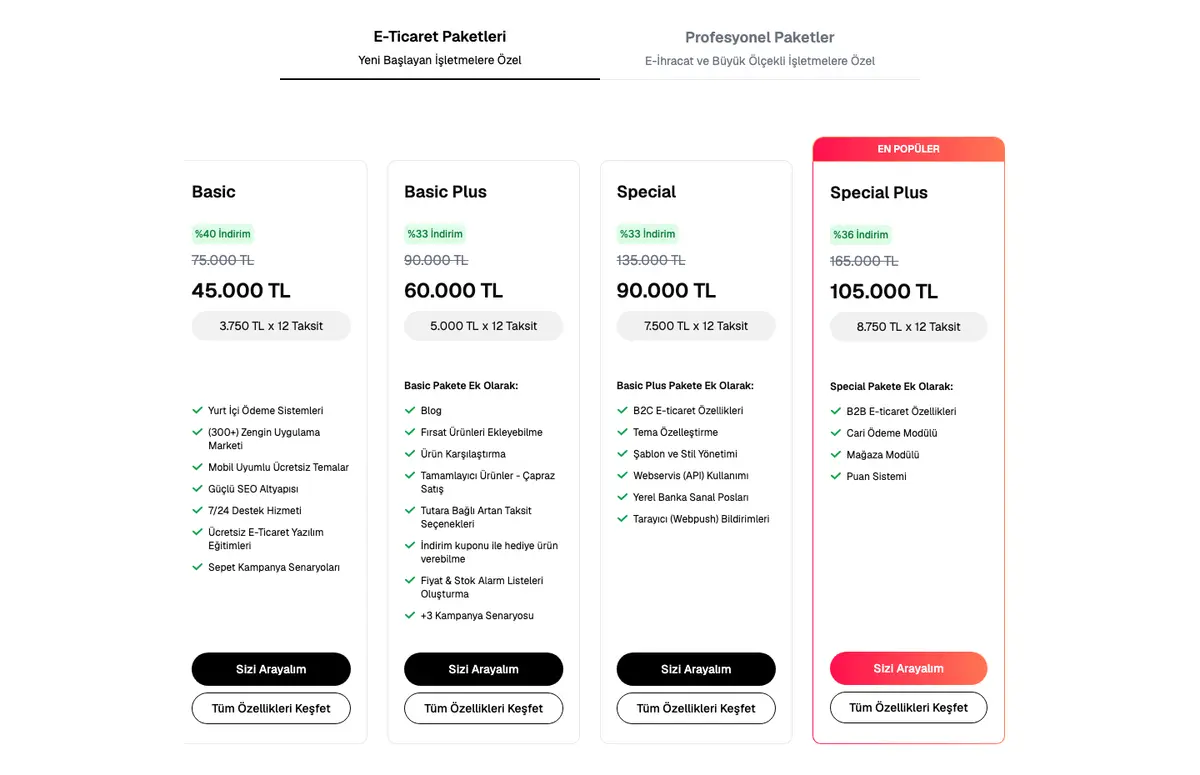
The row in the table that changes the decision is Special. Basic and Basic Plus only work with "domestic payment systems", that is, payment institutions such as iyzico and PayTR. Connecting a virtual POS issued directly by a bank, using the web service (API) and customising the theme unlock with the Special package (90,000 TL). For a store planning to negotiate a lower commission through a bank virtual POS, T-Soft's real entry price is 90,000 TL, not 45,000.
The AI series and Süper package in the reseller channel
T-Soft's pricing data contains two more series. The AI series, sold through resellers, uses a different tiering from the Starter series and unlocks marketplaces earlier. The Süper package is a single promotional package.
| Package | Promotional price | List price | Key features |
|---|---|---|---|
| Start AI | 49,000 TL | 99,000 TL | 2,000-product limit, e-archive invoice and e-invoice, T-Soft Kargo integration |
| Grow AI | 79,900 TL | 159,900 TL | 3 marketplaces, 1 carrier, Etsy, Ozon, Akakçe and Cimri integration |
| Pro AI | 109,900 TL | 219,900 TL | Unlimited domestic marketplaces, API, B2B and dealer modules |
| Prime AI | 199,900 TL | 399,900 TL | 3 international marketplaces, standard accounting integration, multi-currency |
| Süper | 139,000 TL | 556,000 TL | Unlimited domestic marketplaces, 3 international marketplaces, unlimited languages and currencies |
Source: the package data service behind T-Soft's pricing page, November 19, 2026. Prices include VAT.
The descriptions of all four packages in the AI series include the line "upload up to 2,000 products"; for a store whose catalogue exceeds this limit, the series is ruled out from the start. Put the two series side by side and you see the same need met at different prices. In the directly sold series, the first marketplace integration comes with the Advantage package (210,000 TL), and with a single marketplace. In the reseller channel, Grow AI gives 3 marketplaces for 79,900 TL and the Süper package gives unlimited domestic marketplaces for 139,000 TL. When getting a quote from T-Soft, send the same requirements list not only to the direct sales team but also to a T-Soft reseller.
Shopify plans in TL
| Plan | Monthly, billed annually | Annual total (TL) | Annual total, billed monthly (TL) | Transaction fee on card sales |
|---|---|---|---|---|
| Basic | $19 | 11,501 TL | 16,344 TL | 2% |
| Grow | $54 | 32,688 TL | 43,584 TL | 1% |
| Advanced | $299 | 180,995 TL | 241,528 TL | 0.6% |
| Plus | From $2,300 | From 1,392,265 TL | Annual contract | 0.2% |
Source: Shopify pricing; TL amounts calculated at the TCMB foreign exchange selling rate of November 18, 2026 ($1 = 50.4444 TL). Excludes taxes added to the Shopify invoice.
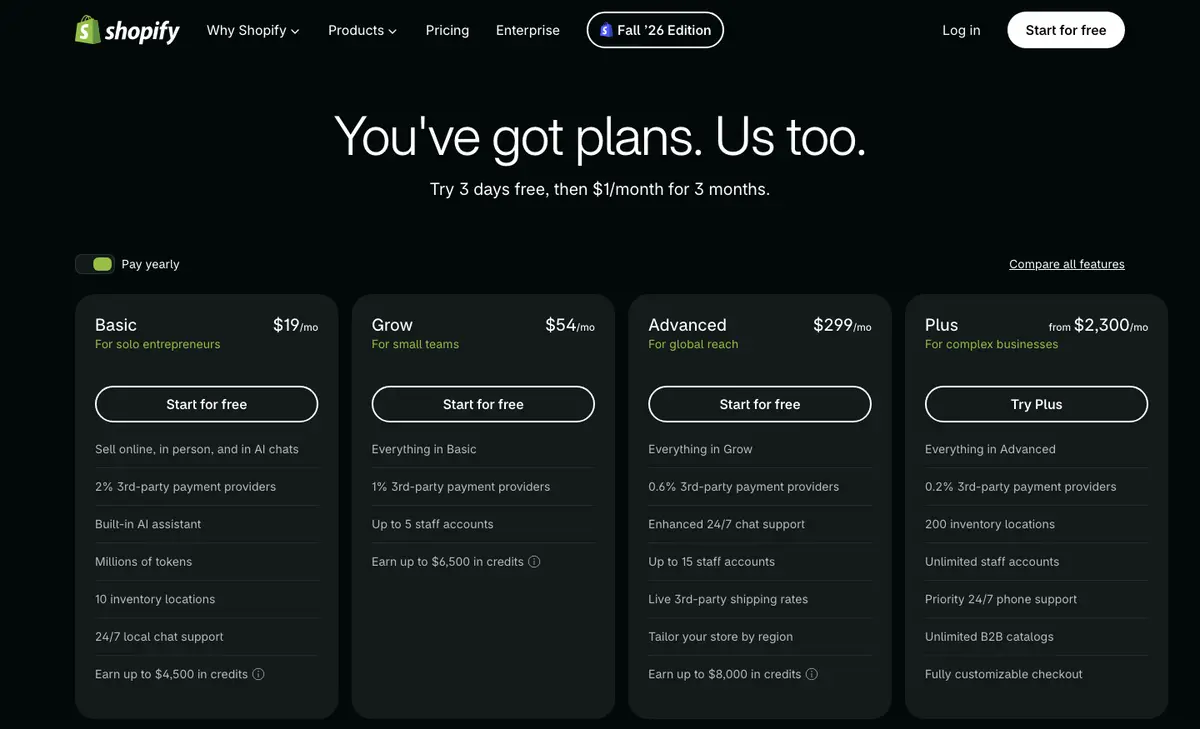
Shopify's plan fee is fixed in dollars, and its TL equivalent moves with the exchange rate. T-Soft's price is in TL and includes VAT. This difference creates two separate risks in budget planning: on Shopify, currency risk shows up on the bill every month; on T-Soft, the risk is concentrated in how much the package price will rise at renewal.
Break-even: when the transaction fee closes the licence gap
Between T-Soft and Shopify, the licence gap and the transaction fee offset each other. We ran the numbers with two examples:
- T-Soft Basic vs Shopify Basic: Licence gap 45,000 − 11,501 = 33,499 TL. Shopify Basic's 2% transaction fee reaches this amount at 1,674,950 TL in annual card revenue.
- T-Soft Grow AI vs Shopify Grow: Licence gap 79,900 − 32,688 = 47,212 TL. Shopify Grow's 1% transaction fee reaches this amount at 4,721,200 TL in annual card revenue.
Only the licence fee and Shopify's transaction fee go into the break-even calculation. The payment institution's commission is paid on both platforms, so it does not change the result. One item is left out of the calculation: on Shopify, Turkey-specific connections (e-invoice, marketplaces, local shipping) are mostly set up with paid monthly apps, and these subscriptions pull the threshold down. Shopify charges no transaction fee on bank transfer and cash on delivery; in a store with a low share of card revenue, the threshold moves up.
We calculated the per-sale effect of Shopify's transaction fee on the total deduction in Turkey, together with PayTR and iyzico rates, in our Shopify transaction fees guide.
Per-sale deductions: transaction fee, virtual POS and "0 commission on orders"
T-Soft takes no share of sales; the phrase "0 Commission on Orders" on its pricing page says exactly that. Shopify, because Shopify Payments is not available in Turkey, deducts a transaction fee of between 2% and 0.2% depending on the plan from every card sale. The payment institution's or bank's commission is paid separately on both platforms. On a 1,000 TL card sale at PayTR's starting rate, a T-Soft store pays 21.90 TL in deductions and a Shopify Basic store pays 41.90 TL.
Platform share and payment institution share are separate items
A card-paid order can incur two deductions. The first is the commission of the payment institution or bank: according to the PayTR Virtual POS page, it starts at 2.19% with a 7-day settlement period (valör), and according to iyzico's sign-up page, it is 4.29% + 0.25 TL for corporate sellers. The second is the platform's share. On T-Soft there is no such share. According to Shopify's pricing page, a store using a payment provider other than Shopify Payments pays 2% on Basic, 1% on Grow, 0.6% on Advanced and 0.2% on Plus.
| 1,000 TL card sale | Platform share | PayTR share (2.19%) | Total deduction |
|---|---|---|---|
| T-Soft (all packages) | 0 TL | 21.90 TL | 21.90 TL (2.19%) |
| Shopify Basic | 20.00 TL | 21.90 TL | 41.90 TL (4.19%) |
| Shopify Grow | 10.00 TL | 21.90 TL | 31.90 TL (3.19%) |
| Shopify Advanced | 6.00 TL | 21.90 TL | 27.90 TL (2.79%) |
| Shopify Plus | 2.00 TL | 21.90 TL | 23.90 TL (2.39%) |
Source: Shopify, PayTR and T-Soft pricing pages, November 19, 2026. Redo the calculation with your own contract rate.
Shopify's transaction fee is independent of the payment provider; even if the store switches from iyzico to PayTR or to a bank virtual POS, the fee keeps being charged as long as it does not use Shopify Payments. Shopify takes no transaction fee on manual payment methods such as bank transfer and cash on delivery. The transaction fee Shopify takes on a refunded order is not returned.
Bank virtual POS: a package tier on T-Soft, a development job on Shopify
A virtual POS issued directly by a bank is the option where you can negotiate a lower rate than with payment institutions. TCMB's maximum commission table sets the ceiling for single-payment credit card transactions at 3.56% as of November 2026, and a high-revenue store can agree on a rate below this ceiling.
The route to a bank virtual POS differs on the two platforms. On T-Soft, local bank virtual POS unlock in the Special package (90,000 TL); Basic and Basic Plus only work with payment institutions. On Shopify, iyzico and PayTR connect through official apps, while a bank virtual POS requires developing a custom payment app. We covered the technical process of connecting directly with banks in our Shopify virtual POS setup guide.
A bank virtual POS widens the deduction gap between T-Soft and Shopify. On T-Soft, the lower the bank rate, the lower the total deduction. On Shopify, even if the bank rate drops, the plan's transaction fee stays on top.
Plan selection thresholds on Shopify
For a Shopify store in Turkey, the transaction fee is the item that determines plan choice. Moving to a higher plan pays off once the plan difference is covered by the drop in transaction fee:
- Basic to Grow: Annual plan difference 32,688 − 11,501 = 21,187 TL. The transaction fee drops from 2% to 1%. The threshold is 2,118,700 TL in annual card revenue.
- Grow to Advanced: Annual plan difference 180,995 − 32,688 = 148,307 TL. The transaction fee drops from 1% to 0.6%. The threshold is 37,076,750 TL in annual card revenue.
Every Shopify store in Turkey with annual card revenue above 2.1 million TL pays less on Grow than on Basic; Advanced's transaction fee advantage only covers the plan difference above 37 million TL. For most stores, the reason to move to Advanced is not the transaction fee but features such as reporting and the number of staff accounts.
In instalment sales, the instalment surcharge arises the same way on both platforms and depends on the contract with the payment institution. We set out in a table how the instalment cost grows with the number of instalments in our Shopify transaction fees guide.
Marketplace, ERP and shipping integrations: package limit or app
On T-Soft, marketplace, shipping and ERP connections are limited by package tier and by count: in the directly sold series, the first marketplace comes as a single channel in the 210,000 TL Advantage package, and ERP integration unlocks in the quote-only Exclusive package. On Shopify, none of these connections depends on the plan. Each is set up with a separate app or integrator, and its cost is added on top of the licence as a monthly subscription.
| Connection | T-Soft (direct sales series) | T-Soft (reseller AI series and Süper) | Shopify |
|---|---|---|---|
| E-invoice and e-archive invoice | T-Soft e-invoice solutions | Free integration from Start AI upwards | Via an app or accounting software |
| Domestic marketplaces | 1 in Advantage, 2 in Performance, 3 in Exclusive, 4 in Supreme | 3 in Grow AI, unlimited in Pro AI and Süper | Via an integrator app, no limit on the number of channels |
| International marketplaces | E-export features in Supreme | Etsy and Ozon in Grow AI, 3 in Prime AI and Süper | Apps for Amazon, Etsy and others |
| Shipping | 1 in Advantage, 2 in Exclusive, 3 in Supreme | T-Soft Kargo in Start AI, 1 in Grow AI | A separate app or integrator for each carrier |
| ERP and accounting | From Exclusive upwards (quote) | Standard accounting integration in Prime AI | App or custom integration |
| Price comparison (Akakçe, Cimri) | Supplier XML in Improve | Akakçe and Cimri in Grow AI | Via an XML feed app |
Source: T-Soft pricing page and package data service, November 19, 2026; Shopify App Store.
Marketplaces: choosing between a count limit and a monthly subscription
On T-Soft, marketplace integration is sold by the unit. A brand selling on Trendyol, Hepsiburada, Amazon and n11 needs at least the Supreme package (quote) in the directly sold series. The same brand can get unlimited domestic marketplaces for 109,900 TL with Pro AI in the reseller channel. This gap between the two series shows that on T-Soft, the quote channel determines the price more than the package name does.
A caveat: on the same T-Soft pricing page, the package cards and the feature comparison table do not agree on the number of marketplaces. The card lists 3 marketplaces for Grow AI and unlimited domestic marketplaces for Pro AI; the comparison table shows "1" marketplace integration for both packages. Clarify at the quote stage which number goes into the contract.
On Shopify, the marketplace connection is not Shopify's product but an integrator's. Sentos, Entegra or similar integrators move stock, prices and orders between Shopify and the marketplaces and charge a monthly fee. The number of channels is not limited by the plan; the integrator's package sets the limit. We explained how a marketplace connection is set up on Shopify and which data flows in which direction in our Shopify marketplace integration guide.
On T-Soft, the number of marketplaces is a package limit, and a fourth channel means the next package up; on Shopify, the number of marketplaces is a matter of the integrator contract, and a new channel changes the monthly fee. Channel count and order volume decide which is cheaper.
ERP and accounting: a ready-made module versus mapping work
T-Soft's ERP page lists software such as Logo, Mikro, Nebim, SAP, Netsis, Paraşüt, Bizim Hesap, Akınsoft, Uyumsoft, Canias, Workcube and Microsoft Dynamics. In the directly sold series, ERP integration unlocks in the Exclusive package, whose price is not on the page. Prime AI (199,900 TL) in the reseller channel includes "standard accounting integration".
On Shopify, the ERP connection is set up either with a ready-made app or with a custom integration. The type of ERP and the complexity of the data flow determine which route to take. Three examples from our projects:
- Bonne Nuit: Same-day chocolate delivery with Shopify Plus and a Logo connection (case study).
- Vamos: The move from wholesale to global streetwear sales with Shopify Plus and Nebim (case study).
- Lazzoni: Custom ERP sync software for Shopify Plus where the ready-made module fell short (case study).
The real work in an ERP connection is not switching the connection on; it is mapping fields such as variant codes, warehouse-level stock, account codes and return invoices. This work is the same on T-Soft and on Shopify. The difference is that on T-Soft the module is tied to the package, while on Shopify the mapping is done with an app or custom software. We compared which route suits which ERP on Shopify in our Shopify ERP integration guide.
Shipping and e-invoice: in the package on T-Soft, in separate apps on Shopify
T-Soft's FAQ section says shipping integrations are "included as standard". The feature comparison table splits this into two items. Discounted shipping and integration through Cargong, T-Soft's shipping intermediary, is available in every package. A direct connection to the store's own contracted carrier ("logistics integration"), however, is zero from Basic to Special Plus; it is 1 in Advantage, 2 in Exclusive and 3 in Supreme. For a store working with its own shipping contract, the Starter series has no direct carrier connection.
On Shopify, there is no official Shopify connection for Turkish carriers such as Aras, Yurtiçi, Sürat, PTT and Hepsijet. Apps or integrators build the connection. E-invoice and e-archive invoice come the same way: you need an app that passes Shopify orders to Paraşüt, Logo or an e-invoice integrator. In our own brand Haters Studio, we connected Paraşüt and 8 carriers to Shopify; in this setup, every connection means a separate subscription and a separate support contact.
As long as the number of connections stays below the package limit, T-Soft's package model gives a more predictable cost than Shopify. As the number of connections or the complexity of ERP mapping grows, the work moves outside the package on both platforms. When a brand moving to Shopify needs marketplace, shipping, e-invoice and ERP connections set up in one plan, our Shopify integration solutions team verifies the field mapping on a test store before going live.
Who uses them: StoreLeads data and our scan of 2,752 sites
According to StoreLeads, in November 2026 there are 18,475 live Shopify stores in Turkey and 1,572 live T-Soft stores worldwide. In store count, Shopify is roughly 12 times ahead. Among sites that draw traffic, the gap closes: when we scanned 2,752 .tr sites on the Tranco list, T-Soft showed up on 60 and Shopify on 73, and the highest-ranked site is on T-Soft (Pazarium, 23,010). T-Soft serves fewer stores, which on average draw more traffic.
Store count and category distribution
| Metric | T-Soft | Shopify (Turkey) |
|---|---|---|
| Live stores | 1,572 (worldwide) | 18,475 |
| Stores in Turkey | 1,435 (91.3%) | 18,475 |
| Annual growth (Q3 2026) | 24% | 27% |
| Largest category | Apparel, 342 stores (21.8%) | Apparel (29.7%) |
| Second category | Home and garden, 271 stores (17.2%) | Home and garden (14.9%) |
| Third category | Business and industrial, 146 stores (9.3%) | Beauty (8.1%) |
Source: StoreLeads T-Soft report and StoreLeads Turkey Shopify data, November 2026.
The two platforms' category distributions split on the "business and industrial" row. On T-Soft, the third-largest category is B2B-heavy business and industrial products; on Shopify, that spot goes to beauty brands. T-Soft unlocking its B2B and dealer modules in the fourth package of the Starter series fits this distribution. In StoreLeads' T-Soft list, the most common product counts are between 250 and 999 (17.8%) and between 1,000 and 4,999 (15.4%); a third of T-Soft stores work with a mid-sized catalogue.
The .tr scan: the two platforms neck and neck among sites with traffic
In November 2026 we downloaded the home page of every .com.tr and .tr site in the Tranco top 1 million list and searched the HTML for platform fingerprints: for T-Soft, the tsoftstatic file address and the string "T-Soft E-Ticaret"; for Shopify, cdn.shopify.com and Shopify.theme. 2,372 sites returned content; of the 380 sites that returned no content, 374 hit bot protection or returned a connection error.
| Metric | T-Soft | Shopify |
|---|---|---|
.tr sites | 60 | 73 |
| In the Tranco top 100k | 3 | 2 |
| In the Tranco top 300k | 11 | 12 |
| Median Tranco rank | 759,998 | 755,934 |
| Highest-ranked sites | Pazarium (23,010), Slazenger (83,199), Manuka (87,608), Motomax (105,344) | Derimod (77,256), Rani (85,302), Volta (106,637), Eveshop (164,999) |
Source: Nodus Works platform scan, November 2026. The lower the Tranco rank, the more visits the site gets.
The stores StoreLeads lists as T-Soft's highest-traffic ones are on .com domains: Dermoeczanem, BKM Kitap, Robotistan and Lufian. These sites fall outside our .tr scan. In other words, some of T-Soft's large customers are outside the 60 sites in the table. With a roughly 12-fold gap in store count, the two platforms coming out almost level among .tr sites with traffic shows that the average T-Soft store gets more traffic than the average Shopify store.
Migration data for the last 90 days: stores leaving T-Soft go to Shopify most
StoreLeads lists stores that changed platforms in the last 90 days separately. For T-Soft, the picture runs both ways:
| Direction | Stores | Main source or destination |
|---|---|---|
| Moved to T-Soft | 49 | Custom software 24, ikas 7, WooCommerce 6, IdeaSoft 4, Ticimax 3, Shopify 1 |
| Left T-Soft | 34 | Shopify 14, ikas 7, custom software 6, Ticimax 4, WooCommerce 2, IdeaSoft 1 |
Source: StoreLeads T-Soft report, November 13, 2026 update.
T-Soft gains 15 stores net, and the source of that gain is brands leaving their own custom software. In the relationship with Shopify, the direction is reversed: in 90 days, 14 stores moved from T-Soft to Shopify and 1 from Shopify to T-Soft. Markamama and Kip, which StoreLeads cites as examples, also show up on Shopify in our own scan; the two data sources confirm each other for these two brands.
Selling abroad: T-Soft e-export packages and Shopify Markets
T-Soft's e-export page only shows the Exclusive and Supreme packages, which are priced by quote. Multiple languages, multiple currencies and country-based pricing unlock in these packages, or in Prime AI and the Süper package in the reseller channel. On Shopify, the same functions are available on every plan through Shopify Markets. The shared bottleneck is collecting payment by foreign card: PayPal and Stripe, which T-Soft lists, do not open accounts for companies incorporated in Turkey.
E-export features on T-Soft, package by package
T-Soft's feature comparison table lists international sales features in detail, package by package:
| Feature | Basic and Basic Plus | Special to Performance | Exclusive | Supreme | Prime AI | Süper |
|---|---|---|---|---|---|---|
| Multiple languages | No | Optional | 1 additional language | 2 additional languages | Yes | Unlimited |
| Multiple currencies | No | Optional | Yes | Yes | Yes | Yes |
| Country-based pricing (20 prices per product) | No | Optional | Optional | Yes | Yes | Yes |
| Country detection from IP address | No | Optional | Yes | Yes | Yes | Yes |
| PayPal and Stripe integration | No | From Improve upwards | Yes | Yes | No | Yes |
| Masterpass Global (foreign cards) | No | From Improve upwards | Yes | Yes | No | Yes |
Source: feature comparison data on T-Soft's pricing page, November 19, 2026.
The table's footnotes contain two conditions. Country detection from IP address requires that "IP services be purchased separately". For the multi-language feature, "entering translations into the system is the customer's responsibility". In other words, T-Soft switches on the language infrastructure and leaves the translation work to the store.
Collecting by foreign card: PayPal and Stripe are listed, but there is no account in Turkey
PayPal suspended its operations in Turkey in June 2016 after failing to obtain a payment institution licence from the Banking Regulation and Supervision Agency (BDDK). Turkey is not on Stripe's list of supported countries. These two integrations, which T-Soft lists from the Improve package upwards, only work with a company incorporated abroad. A company incorporated in Turkey accepts foreign cards through iyzico, PayTR or a bank virtual POS; in TCMB's November 2026 table, the maximum commission on foreign card transactions is 1.90%.
A payment method appearing in a platform's payment list does not mean it is open to a company incorporated in Turkey; foreign card collection is determined not by the platform but by the country where the company is incorporated. The same rule applies to Shopify: Shopify Payments is only open to companies incorporated in the countries Shopify lists, and Turkey is not on that list.
Shopify Markets: market management on every plan
On Shopify, multiple languages, multiple currencies, country-specific pricing and domains are managed from a single store with Shopify Markets, and these features are not limited by plan. For translation, there is Shopify's free Translate & Adapt app; after automatic translation, the store still has to correct the text. Letting customers pay in their own currency at checkout, according to Shopify's Help Center, requires Shopify Payments or a payment provider that supports multiple currencies. For a company in Turkey, this step depends on the choice of payment provider.
What puts Shopify ahead in international sales is not the language and currency module but the ecosystem. Shipping, tax and review apps for the target country, global marketplace connections and the option to move to Shopify Payments with a company incorporated abroad all work in the same store. We built Delta Clothing's wholesale automation, which sells in the US, on Shopify.
Opening a shipping country is not exporting
When we scanned 73 Turkish brands using Shopify, we found that 19 stores had left Shopify's default 29-country shipping list unchanged and only 12 stores had chosen their shipping countries themselves. Most of the stores that left the country list open had not defined separate prices, shipping rates or return flows for those countries. On T-Soft the picture is the same: switching on the e-export module does not bring sales without a carrier contract and a return address for the target country.
Small courier shipments from Turkey use the Electronic Commerce Customs Declaration (ETGB); ETGB applies to shipments worth no more than 15,000 euros and weighing no more than 300 kilograms. Both platforms build the storefront; customs declarations, carrier contracts and tax calculation remain part of the store's operations.
Theme, API and technical SEO: developer access
On T-Soft, custom theme upload opens from the Special package, and standard web service (API) access, according to the comparison table, from the Improve package. On Shopify, theme code and API access are available on every plan; the only plan-dependent areas are those reserved for Plus, such as checkout customisation. On the technical SEO basics, the two platforms are level: all 40 sites we measured had a canonical tag and a working sitemap.xml.
Theme and code access
All T-Soft packages include mobile-friendly ready-made themes and an app store with more than 300 apps (T-Soft Apps). Changes to the theme itself depend on the package tier. According to the feature table, "Custom Theme Upload" is not available in Basic and Basic Plus and is available from Special upwards. A custom-designed concept theme is standard in the Performance package and optional in the lower packages. In the reseller channel's AI series, custom theme upload is not ticked in any package.
On Shopify, a theme is made up of files written in a templating language called Liquid, and the store holds all of these files on every plan. The store can buy a theme from the Theme Store, have an agency write one from scratch, or change the code of its existing theme line by line. The area reserved for Plus is limited to a few points, such as writing extensions for the checkout interface.
On T-Soft, the package sets the limit on what you can change in the theme; on Shopify, the store's development budget sets that limit.
API access: the package card and the comparison table say different things
T-Soft's Special package card includes the line "Web Service (API) Usage". The feature comparison table on the same page, however, shows "Standard Web Service Usage" as zero in Special and Special Plus and available from Improve upwards. In the reseller channel, the web service opens in Pro AI. In the Supreme package, "Advanced Web Service Solutions" is a separate line. A store that will connect an ERP, warehouse software or a custom reporting tool should ask in writing in which package, and with what scope, the API opens.
On Shopify, the Admin GraphQL API and webhooks can be used on every plan. A store can write its own custom app and access product, order, stock and customer data. For a brand that wants to build a headless storefront, the Storefront API and Shopify's Hydrogen framework are also open on every plan.
Technical SEO measurement across 40 sites
We picked the 20 .tr sites with the highest Tranco rank on each platform and measured their home pages by sending requests one by one from Istanbul.
| Metric | T-Soft (20 sites) | Shopify (20 sites) |
|---|---|---|
| Canonical on the home page | 20/20 | 20/20 |
Accessible sitemap.xml | 20/20 | 20/20 |
Sitemap declared in robots.txt | 13/20 | 20/20 |
| JSON-LD structured data on the home page | 19/20 | 16/20 |
| Median time to first byte | 0.40 s | 0.24 s |
| Median home page HTML size | 268 KB | 842 KB |
| Median script tags on the home page | 38 | 82 |
| Product and category URL structure | Root level /{ad}, some with a trailing number | /products/{handle}, /collections/{handle} |
Source: Nodus Works measurement, November 19, 2026.
The two platforms come out ahead on different rows of the table. The home page of T-Soft sites weighs a third of a Shopify site's and loads less than half as many scripts. On Shopify, the server's first byte arrives faster, but the HTML grows as apps installed on the store add scripts to the page. This measurement is not real-user data; the Core Web Vitals result is determined by the theme, image sizes and third-party code.
The difference in the robots.txt row comes from configuration. According to T-Soft's feature table, robots.txt management is available in all packages, and /sitemap.xml works on all 7 sites that do not declare a sitemap. Only the declaration line is missing. According to Google Search Central's sitemap guide, a sitemap can be submitted in robots.txt or through Search Console.
Migrating from T-Soft to Shopify: URL structure and data transfer
Product, category, customer and order data move from T-Soft to Shopify via XML or API export; customer passwords and T-Soft's URL structure cannot be carried over. Because product and category addresses on T-Soft sit at root level, each old address must be connected to its /products/ or /collections/ counterpart on Shopify with a separate 301 redirect. For a standard catalogue, the migration takes 1 to 2 weeks. If there are loyalty points, B2B price lists or an ERP connection, it takes longer.
What moves over and what is rebuilt
| Data or module on T-Soft | Shopify counterpart | Migration route |
|---|---|---|
| Products, variants and stock | Products and variants | XML or API export, import via CSV or Matrixify |
| Product and category URLs | /products/{handle}, /collections/{handle} | 301 redirect table built from the list of old addresses |
| Customer accounts | Customer records | Name, email and address move over; passwords do not |
| Past orders | Archived orders | Export via API and an import app |
| Points system and wallet | Loyalty app | Transfer of point balances per customer |
| B2B price lists and on-account payment | Built-in B2B on Plus, an app on other plans | Mapping of dealers and price lists |
| Outfit combinations and bundled products | Bundle app | Rebuilding the product relationships |
On Shopify, a product address always starts with the /products/ prefix and a category address always with /collections/, and these prefixes cannot be changed; that is why every root-level T-Soft address must be connected to Shopify with a 301 redirect.
The trailing number in T-Soft URLs
On the T-Soft sites we scanned, product and category addresses sit at the same root level. Some of them end with T-Soft's database number, such as /seramik-tencere-877 or /erkek-kasmir-yun-karisimli-pantolon-750. This number has no counterpart on Shopify, and the address itself does not tell you whether it belongs to a product or a category.
So when leaving T-Soft, generate the redirect list from the exported data, not from address patterns. Prepare a mapping table that puts the T-Soft address, its number and the new Shopify handle on the same row for every product and category. Campaign pages, brand pages and blog posts should also go into this table; every old address Google has crawled should have a counterpart. We covered the step-by-step process and common mistakes in our T-Soft to Shopify migration guide.
Contract and domain: plan your exit when you buy the package
Because T-Soft's pricing page does not state the licence term, build your exit timeline around the end date in the contract. Start the migration 6 to 8 weeks before the licence expires; that way the T-Soft panel stays open while the Shopify store goes live, and you can check the order archive and the redirects from the old panel.
T-Soft also sells domain names. If you bought your domain through T-Soft, you will need to request the transfer code (EPP code) from T-Soft when you leave. When buying the package, check that your company's name appears in the registrant field; if it does not, start the correction at least two weeks before the migration timeline.
Migrating from T-Soft to Shopify means running the URL mapping table, the transfer of points and B2B data, and the rebuild of marketplace and ERP connections on a single timeline. Our Shopify migration service verifies these three jobs on a test store before launch day and uploads the redirects before the DNS change.
Shopify vs T-Soft: a decision matrix in 6 questions
Six questions settle the Shopify vs T-Soft decision: how much card revenue you have, how many marketplaces you will connect to, whether you sell to dealers, whether direct sales abroad are a goal, whether you will do development work on themes and apps, and how much revenue you expect in the first year. A "yes" to the first three questions favours T-Soft; a "yes" to the last three favours Shopify.
| Question | If your answer is "yes" | Reason |
|---|---|---|
| 1. Is your annual card revenue above 1.7 million TL, and do your needs fit a T-Soft package? | T-Soft | Above this revenue, Shopify Basic's 2% transaction fee exceeds the licence gap |
| 2. Will you connect to three or more domestic marketplaces? | T-Soft (with a reseller channel quote) | Unlimited domestic marketplaces in Pro AI and the Süper package; on Shopify, the integrator subscription is paid separately |
| 3. Will you sell to dealers on account, with special price lists? | T-Soft | B2B in Special Plus (105,000 TL); on Shopify, built-in B2B is on the Plus plan |
| 4. Is direct selling abroad your main growth goal? | Shopify | Markets on every plan; on T-Soft, e-export is in the quote packages or the reseller channel |
| 5. Do you need theme code, a custom app or a headless storefront? | Shopify | Liquid theme code and the Admin API are open on every plan |
| 6. Is your first-year revenue low, and would you rather not pay a licence up front? | Shopify | Basic is about 11,501 TL a year, with a monthly billing option |
For a brand that says "yes" on both sides, the decision depends on which cost is more predictable. A brand that is marketplace-heavy, also sells to dealers and treats international sales as secondary keeps total cost under better control on T-Soft. A brand that is growing abroad and has a technical team pays Shopify's transaction fee and app subscriptions as the price of the development room the platform opens up.
Run the numbers with your own data
The break-even formula is simple: subtract Shopify's annual plan and app total from the T-Soft package fee, and divide the remainder by your Shopify plan's transaction fee rate. The result is the annual card revenue at which Shopify starts to cost more than T-Soft.
Example: T-Soft Grow AI is 79,900 TL. Say the Shopify Grow plan is 32,688 TL and the annual total of the apps the store will use is 20,000 TL. The difference is 79,900 − 52,688 = 27,212 TL; with Grow's 1% transaction fee, the threshold is 2,721,200 TL in annual card revenue. A store below this revenue pays less on Shopify, and a store above it pays less on T-Soft.
Conclusion: 7 questions to ask before getting a quote
T-Soft concentrates cost in the annual package fee and takes no share of sales. Shopify spreads cost over time as a plan fee, a transaction fee and app subscriptions. For a store that sells domestically with a heavy marketplace and dealer mix and high card revenue, T-Soft is the cheaper side. For a store that sells abroad, does technical development or starts with low revenue, Shopify pulls ahead. On both platforms, the real cost is set not by the price tag but by the conditions that are not written down.
Go into the T-Soft quote meeting with these 7 questions and get the answers in writing:
- How many months of licence does the package fee cover, and how much is the second-year renewal fee including VAT?
- How many marketplace integrations does this package include? (The package card and the comparison table show different numbers for some packages.)
- Is web service (API) access standard in this package, and with what scope?
- Does this package include a direct shipping integration with my own carrier contract, and how many carriers besides Cargong can be connected?
- Is ERP or accounting integration standard in this package, or does it cost extra?
- What do the reseller channel packages cost for the same requirements list?
- In whose name will the domain be registered, and how quickly is the transfer code issued on exit?
On the Shopify side, prepare a single list: write down the monthly fee of every app you will use in dollars, add them to the plan fee, and add the transaction fee calculated on the last 12 months of card revenue.
If you want to put both platforms' quotes in the same table and compare them against your store's channel mix, catalogue structure and growth goals, our Shopify consulting team calculates your T-Soft quote and Shopify's cost including apps side by side. If you are planning to move off your current T-Soft store, book an initial call; we will draw up your URL mapping table and integration list in the first meeting.
Frequently asked questions
Is Shopify or T-Soft cheaper?
It depends on revenue. On the licence fee, Shopify is cheaper: Basic is about 11,501 TL a year, T-Soft Basic is 45,000 TL. Shopify, however, takes a 2% transaction fee on every card sale on Basic. Excluding app costs, once annual card revenue exceeds about 1.67 million TL, T-Soft Basic works out cheaper overall. As marketplace and e-invoice apps are added, this threshold drops.
Does T-Soft take a commission on sales?
No. T-Soft's pricing page uses the phrase "0 Commission on Orders"; the platform takes no share of sales. On card sales, the commission of the payment institution or bank is paid separately. PayTR advertises a rate starting at 2.19% with a 7-day settlement period.
Does Shopify charge fees on sales in Turkey?
Yes, on card sales. Because Shopify Payments is not available in Turkey, every card payment taken through iyzico, PayTR or a bank virtual POS incurs a transaction fee of 2% on Basic, 1% on Grow, 0.6% on Advanced and 0.2% on Plus. Shopify takes no transaction fee on bank transfer and cash on delivery.
Do T-Soft package prices include VAT?
Yes. In T-Soft's pricing data, all packages are marked as including VAT. Basic is 45,000 TL, Special 90,000 TL and Advantage 210,000 TL. The pricing page does not state the licence term or the renewal fee; ask for these two pieces of information in writing at the quote stage.
Which T-Soft package includes Trendyol integration?
In the directly sold series, the first marketplace integration comes as a single channel in the Advantage package (210,000 TL); Performance has 2, Exclusive 3 and Supreme 4 channels. In the reseller channel, Grow AI (79,900 TL) lists 3 marketplaces on its package card, and Pro AI and the Süper package list unlimited domestic marketplaces.
Can I use a bank virtual POS on T-Soft?
Yes, from the Special package (90,000 TL) upwards. The Basic and Basic Plus packages only work with payment institutions such as iyzico and PayTR. If you plan to negotiate a lower rate with a virtual POS issued directly by a bank, your entry package on T-Soft is Special.
How long does migrating from T-Soft to Shopify take?
For a standard catalogue, migrating from T-Soft to Shopify takes 1 to 2 weeks. With a points system, B2B price lists, an ERP connection or a large number of redirects, it takes longer. Product, customer and order data move via XML or API; customer passwords do not, and customers activate their accounts on Shopify with a new password.
Will Google rankings drop after migrating from T-Soft to Shopify?
If every old URL is redirected with a 301 to its Shopify counterpart, the ranking loss stays temporary and limited. Because product and category addresses on T-Soft sit at root level and some of them end with a number, the redirect list should be generated from the exported data. The redirects should be uploaded before the DNS change.