











































































































IdeaSoft vs Ticimax: 2026 Packages, Costs and Infrastructure Compared
For a brand that wants marketplace integration on the lowest possible package, IdeaSoft Booster costs 8,099 TL less than Ticimax's first package with marketplaces as standard. For a store with more than 500 products and no marketplace sales, Ticimax Advantage offers the lowest entry point with unlimited products.
 Author: Efe Gündüz Nodus Works Shopify Agency Founder
Published 34 min read
IdeaSoft and Ticimax are two Turkish e-commerce platforms that run online stores in Turkey on ready-made infrastructure (SaaS) rented under an annual licence. Both include virtual POS, shipping and e-invoice connections in their packages, offer marketplace connections in their higher tiers, and say they take no commission on sales. Price alone does not answer the "IdeaSoft or Ticimax" question. The real difference is which feature unlocks in which package. Marketplace integration, product limits and B2B sales start at different price tiers on the two platforms.
We built this comparison from both platforms' official package pages as of November 19, 2026. We added our own scan: we checked the homepages of 2,752 .com.tr and .tr sites on the Tranco list for platform fingerprints. Ticimax showed up on 76 sites, IdeaSoft on 44. At Nodus Works we migrate stores from both platforms to Shopify. We moved Volta Motor from IdeaSoft to Shopify. That is why we know from migration projects exactly where each platform starts to feel too tight.
IdeaSoft vs Ticimax: the short answer and who each one suits
If you want Trendyol and Hepsiburada integration on the lowest possible package, IdeaSoft Booster (80,011 TL) is cheaper than Advance (88,110 TL), Ticimax's first package that includes marketplaces. If you have more than 500 products and do not sell on marketplaces, Ticimax Advantage (40,940 TL) offers the lowest entry point with unlimited products. If you plan to connect to four or more marketplaces, IdeaSoft Master (97,811 TL) is 8,900 TL cheaper than Advance Plus (106,711 TL), the Ticimax package that covers that need.
The two platforms sell to the same customers but tier their packages on different logic. IdeaSoft caps its entry package by product count and unlocks marketplace integration in the second package. Ticimax sets no product limit on its entry package but holds marketplace integration back until the third; in the first two packages, marketplaces are available only as a paid add-on module. So the answer to "which one is cheaper" depends on which channels the store will sell through in its first year.
The store profile where IdeaSoft stands out
- More than half of sales come from Trendyol and Hepsiburada, and the website draws on the same stock as those channels.
- The catalogue will stay under 500 products in the first year; the store will start on the Starter package and upgrade as it grows.
- It needs two-way stock and order sync with N11, Amazon and TEMU (Master package).
- It needs subscription and product personalisation modules (Master package).
The store profile where Ticimax stands out
- The catalogue exceeds 500 products from day one, but there are no marketplace sales, or they are secondary.
- The store will sell to dealers and wholesalers at different prices, in pre-packed size-run assortments (Premier package).
- In-store sales need to be managed from the same panel (the in-store sales module in Advance Plus).
- The brand wants to expand to international marketplaces (3 international marketplace integrations in Advance Plus).
These two profiles rest on features stated explicitly on each platform's own package pages. The modules that sales teams add to a package as a special deal, and the campaign freebies, change from period to period. When you request a quote, ask in writing which package includes each feature you need as standard.
Package prices: November 2026 campaign and list prices
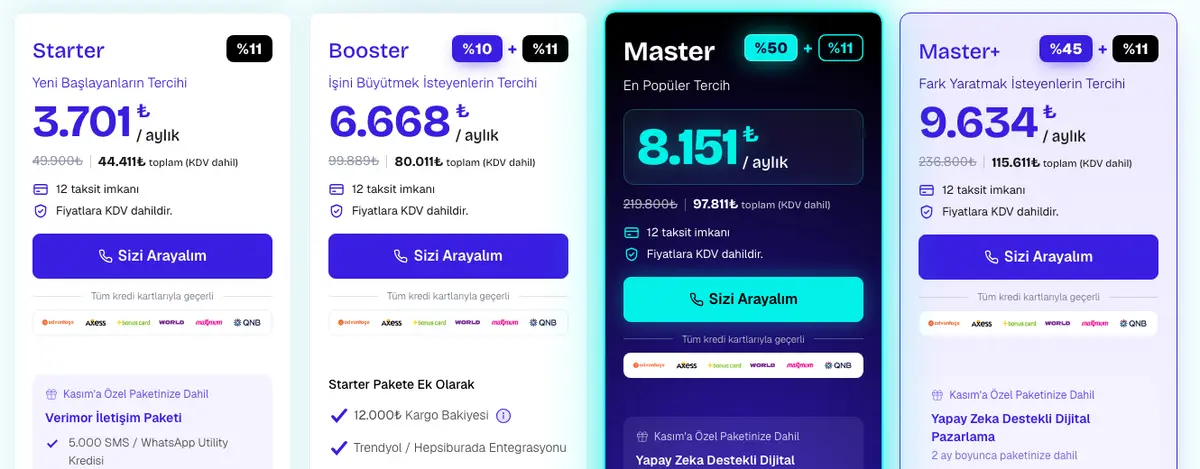
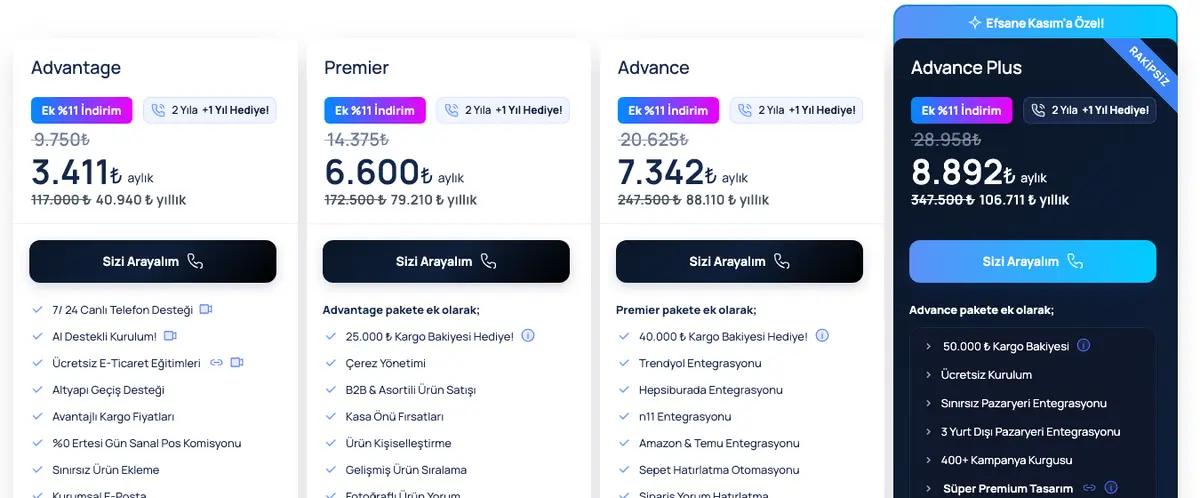
IdeaSoft's annual package prices under its November 2026 campaign range from 44,411 TL to 115,611 TL, including VAT (KDV). Ticimax's packages range from 40,940 TL to 106,711 TL. Ticimax's package page does not say whether VAT is included in the price. Both platforms are currently selling below list price: the discount is roughly 11% to 56% on IdeaSoft packages and 54% to 69% on Ticimax packages.
| IdeaSoft package | Campaign annual price | List price | Discount label on the page | Key limit |
|---|---|---|---|---|
| Starter | 44,411 TL | 49,900 TL | 11% | 500 products, no marketplaces |
| Booster | 80,011 TL | 99,889 TL | 10% + 11% | Unlimited products, Trendyol and Hepsiburada |
| Master | 97,811 TL | 219,800 TL | 50% + 11% (November only) | Two-way sync with N11, Amazon and TEMU |
| Master+ | 115,611 TL | 236,800 TL | 45% + 11% | Unlimited marketplaces, ad management and bookkeeping |
Source: IdeaSoft e-commerce packages, November 19, 2026. Prices include VAT.
| Ticimax package | Campaign annual price | List price | Discount label on the page | Key limit |
|---|---|---|---|---|
| Advantage | 40,940 TL | 117,000 TL | Extra 11% | Unlimited products, no marketplaces |
| Premier | 79,210 TL | 172,500 TL | Extra 11% | B2B and assortment sales, bulk email and SMS |
| Advance | 88,110 TL | 247,500 TL | Extra 11% | 3 domestic marketplaces (chosen from Trendyol, Hepsiburada, n11, Amazon, Temu) |
| Advance Plus | 106,711 TL | 347,500 TL | Extra 11% | Unlimited marketplaces, 3 international marketplaces, in-store sales |
Source: Ticimax e-commerce package prices, November 19, 2026. VAT status not stated on the page.
The price gap between the two platforms for the same need
Match the packages by the features they unlock rather than by name, and the difference becomes clear:
| Need | Lowest IdeaSoft package | Lowest Ticimax package | Difference |
|---|---|---|---|
| More than 500 products | Booster, 80,011 TL | Advantage, 40,940 TL | Ticimax is 39,071 TL cheaper |
| Trendyol and Hepsiburada integration | Booster, 80,011 TL | Advance, 88,110 TL | IdeaSoft is 8,099 TL cheaper |
| 4 or more marketplaces | Master, 97,811 TL (5 marketplaces) | Advance Plus, 106,711 TL (unlimited) | IdeaSoft is 8,900 TL cheaper |
| B2B and dealer sales | Listed, but unclear which package includes it as standard | Premier, 79,210 TL | Written confirmation needed |
If VAT is added to Ticimax's prices, the gap in the marketplace rows widens. With 20% VAT, Advance rises to 105,732 TL and Advance Plus to 128,053 TL, and IdeaSoft's advantage on the marketplace packages exceeds 25,000 TL. In the unlimited products row, Ticimax stays at 49,128 TL with VAT and is still the cheaper option. Ask Ticimax for a VAT-inclusive quote before you compare.
The campaign price is not the renewal price
Both platforms currently sell their higher-tier packages at less than half the list price and add an extra year of licence on two-year purchases. Ticimax's FAQ section says that at the end of the first year "only a renewal fee" is charged. Neither platform publishes the amount of that renewal fee on its package page.
A campaign first-year price does not show the real cost of a local e-commerce package. The three-year cost is the first-year price plus two renewal fees, and unless the renewal fee is written into the contract, it may be calculated from the list price.
This pricing structure carries a different risk from Shopify's dollar-based monthly subscription. On Shopify the price moves with the exchange rate, but there is no gap of this size between campaign and list price. We calculated Shopify's real per-sale deduction in Turkey in our Shopify transaction fees guide.
Per-sale deductions: "0% commission" promises and virtual POS terms
Neither IdeaSoft nor Ticimax takes a commission itself on website sales. On card sales, the deduction is made by the virtual POS of the bank or payment institution. Both platforms' "0% commission" promises concern this POS deduction, and both come with conditions: IdeaSoft's applies with PayTR on a 32-day settlement period (valör) and runs until the end of November 2026, while the conditions of Ticimax's "0% next day" promise are not stated on its package page.
Platform commission and POS commission are separate line items
According to IdeaSoft's FAQ section, the platform "does not charge a commission or any similar fee on sales made through your site". Ticimax gives the same commitment in its own FAQ. The statement is accurate and covers only the platform's share. On every card-paid order, the institution providing the POS takes its own cut separately. In Turkey, three sources set the size of that cut:
- Virtual POS provided directly by a bank: according to the maximum commission table of the Central Bank of the Republic of Türkiye (TCMB), the ceiling for a single-payment credit card transaction is 3.56% as of November 2026.
- PayTR: according to the PayTR Virtual POS page, rates start at 2.19% on a 7-day settlement period.
- iyzico: according to its sign-up page, 4.29% + 0.25 TL for a corporate seller.
Both platforms connect to all of these institutions. IdeaSoft lists the virtual POS of every bank in Turkey plus iyzico, iPara, PayU, ParamPOS and Hepsipay. Ticimax's payment list includes iyzico, PayTR, GarantiPay, Paycell, Moka United, Paynet, Sipay and BKM Express. On marketplace orders, Trendyol or Hepsiburada takes the deduction according to its own commission table, and the infrastructure platform has no say in that amount.
A local e-commerce platform's line "we take no commission on sales" covers only the platform's own share; the POS deduction on card sales remains a separate cost item in every package. On Shopify, a transaction fee of between 2% and 0.2%, depending on the plan, is added on top of this POS deduction. Per-sale deductions are the cost item where the two local platforms are clearly ahead of Shopify.
IdeaSoft's 0% campaign: PayTR, 32-day settlement, end of November
According to IdeaSoft's campaign text, 0% commission applies only when three conditions are met together: the store applies for PayTR Virtual POS, chooses the 32-day settlement period in its payment plan and processes the transactions by the end of November. The campaign has no minimum or maximum transaction limit. The text ends with the note that "conditions may be reassessed at the end of the campaign period".
For a store buying a package on November 19, the campaign has 11 days left. From December, PayTR's standard rate applies. On 1,000,000 TL of annual card revenue, the 2.19% starting rate on the 7-day settlement period comes to 21,900 TL; that is almost half the price of the Starter package.
The 32-day settlement period has a cost too. The money from a sale reaches your account 32 days later. For a store with 100,000 TL of card sales a month, the extra 25 days of waiting compared with a 7-day settlement period amount to about 83,000 TL, and that sum sits with the payment institution at all times. For a store that pays suppliers upfront or funds its ad budget from daily sales, this tied-up cash can cost more than the commission saving.
Ticimax's "0% next day" promise: the conditions are not on the page
The feature list of Ticimax's Advantage package says "0% Next-Day Virtual POS Commission". The higher packages inherit this item through their "in addition to the Advantage package" structure. The package page does not state which payment institution it applies to, for how long, or up to what revenue limit.
Next-day settlement is the most expensive option payment institutions offer. According to Vergimerkezi's November 2025 roundup, the market average for next-day payout is between 2.80% and 3.90%. If the promise were unconditional, it would save between 28,000 and 39,000 TL on 1,000,000 TL of annual card revenue, close to the 40,940 TL price of the Advantage package. Our assessment: a discount of this size with no time or volume limit does not square with how payment institutions make money. At the quote stage, ask Ticimax these three questions in writing:
- Which payment institution's POS does the 0% rate apply to?
- For how many months does the rate stay fixed?
- Is there a monthly or annual revenue cap, and what rate applies once it is exceeded?
| Item | IdeaSoft | Ticimax |
|---|---|---|
| Platform's share of sales | None (FAQ) | None (FAQ) |
| 0% POS promise | PayTR, 32-day settlement period | "Next day", payment institution not stated |
| Validity of the promise | End of November 2026 | Not stated |
| Transaction limit | None | Not stated |
| Payment institutions listed | All banks, iyzico, iPara, PayU, ParamPOS, Hepsipay | All banks, iyzico, PayTR, GarantiPay, Paycell, Moka United, Paynet, Sipay, BKM Express |
| POS setup | Covered by free setup on Master and above | Covered by free setup (payment system and shipping integrations) |
Source: IdeaSoft and Ticimax package and campaign pages, November 19, 2026.
Marketplace, shipping and e-invoice integrations
E-invoice and e-archive invoice integration is included in the entry package on both platforms. The difference opens up on the marketplace and accounting side: IdeaSoft starts marketplaces in its second package, Booster, with Trendyol and Hepsiburada, while Ticimax starts them in its third package, Advance, with a choice of 3 marketplaces. Ticimax's free shipping credit rises to 50,000 TL on a two-year purchase, while IdeaSoft's is limited to the first 3 months and to 10 desi (the volumetric weight unit Turkish carriers bill by).
| Integration | IdeaSoft | Ticimax |
|---|---|---|
| E-invoice and e-archive invoice | From Starter | From Advantage |
| Trendyol and Hepsiburada | Booster | Advance (within the choice of 3 marketplaces) |
| N11, Amazon, TEMU | Master, two-way sync | Within the limit of 3 in Advance, unlimited in Advance Plus |
| Unlimited marketplaces | Master+ | Advance Plus |
| International marketplaces | Not on the package page | Advance Plus, 3 of them |
| Accounting and ERP connection | Optional in Starter, Booster and Master | Nebim, Logo, Mikro, Paraşüt listed, package not stated |
| Bookkeeping software | Master+, 1 year | Advance Plus, Rota Zero |
| Price comparison sites such as Akakçe and Cimri | Listed, package unclear | Premier |
| Free shipping credit | Booster 12,000 TL, Master 24,000 TL, Master+ 36,000 TL | Premier 25,000 TL, Advance 40,000 TL, Advance Plus 50,000 TL (on a two-year purchase) |
Source: IdeaSoft and Ticimax package pages, November 19, 2026.
Marketplace integration: two-way sync and the package tier
IdeaSoft states that in the Master package, products, stock and orders are transferred automatically "both from IdeaSoft to the marketplace and from the marketplace to IdeaSoft". Ticimax's feature list describes what happens after a marketplace order in more detail: issuing an e-invoice for the marketplace order from the panel, automatically sending the e-invoice link and the tracking number to the marketplace, and marketplace accounting and payout tracking.
The limit of 3 marketplaces in Ticimax Advance pushes a brand that opens a fourth channel up to the next package. A brand selling on Trendyol, Hepsiburada and Amazon fits into Advance (88,110 TL). Once the same brand adds n11, it has to move to Advance Plus and its annual fee rises by 18,601 TL. On IdeaSoft, these four channels come together in the Master package (97,811 TL).
For a brand whose marketplace revenue exceeds its website revenue, choose the platform not by its theme or campaign module but by how the marketplace module handles orders, returns and invoices. Following a Trendyol order all the way through the returns process in a demo account tells you more than reading the feature list. We explained how the same connection is set up on Shopify in our Shopify marketplace integration guide.
Shipping: the terms of the free credit
IdeaSoft's free shipping credit is provided in partnership with Kargonomi and, according to the campaign text, comes with four conditions:
- Only new IdeaSoft customers are eligible.
- The credit must be used within the first 3 months.
- It applies to shipments of up to 10 desi.
- It can only be used on orders from the IdeaSoft site; marketplace orders are excluded.
These conditions limit the credit's real value. At IdeaSoft's advertised starting shipping price of 54.90 TL, using up the 24,000 TL in Master within 3 months takes about 437 parcels, or 146 website orders a month. A newly opened store rarely reaches that volume in its first quarter.
Ticimax's credit on a two-year purchase is 25,000 TL in Premier, 40,000 TL in Advance and 50,000 TL in Advance Plus. On a one-year purchase, the amounts drop to 12,500, 12,500 and 15,000 TL respectively. Ticimax states that the credit is not tied to a single carrier and requires no prepayment, but does not give a usage period on the package page. The Advantage package has no credit, only discounted shipping rates.
A free shipping credit is not a discount but a credit with usage conditions; its value is capped by the number of parcels the store will ship within the conditional period.
E-invoice, bookkeeping and ERP connection
Both platforms issue e-invoices and e-archive invoices from the panel starting with the entry package. The real distinction lies in matching stock, customer accounts and orders with an accounting or ERP program. In IdeaSoft's comparison table, "Accounting & ERP Integration" is optional in the first three packages, meaning it costs extra. Ticimax says that "order, product, stock and customer account transfer" is possible with Nebim, Logo, Mikro and Paraşüt, without stating which package includes this connection as standard.
The ERP connection is the weakest link in what local package platforms solve with ready-made modules. Because Volta Motor's 8,987-product catalogue had to match SAP, that work remained outside the package on IdeaSoft. In our Shopify projects for Bonne Nuit, which runs with Logo, and Haters Studio, where we connected Paraşüt and 8 carriers, most of the work was likewise not switching on a module but mapping the fields.
If you need to set up a Logo, Paraşüt or SAP connection as part of moving to Shopify, our Shopify integration solutions team maps the fields before the migration and brings the connection live together with the order, return and stock flows.
Who uses them: a 2,752-site platform scan
We scanned the homepages of 2,752 .com.tr and .tr sites on the Tranco list for platform fingerprints: Ticimax showed up on 76 sites, IdeaSoft on 44. Ticimax's top ranks are filled by fashion brands and the Turkey distributors of global brands (AVVA, Tonny Black, Victoria's Secret, ASICS, Salomon). IdeaSoft's highest-ranked sites are furniture brands (Bellona, İstikbal, Mondi Home), while its long tail is made up of spare parts and technical product stores.
How we ran the scan
In November 2026 we took every .com.tr and .tr domain in the Tranco top 1 million list; 2,752 sites in total. We downloaded each site's homepage and searched the HTML for platform-specific fingerprints:
- Ticimax: the
ticimaxPlatformInfovariable and thestatic.ticimaxasset address. - IdeaSoft: the
myideasoft.comasset address and the "Programlama IdeaSoft" credit in the footer. - Shopify:
cdn.shopify.comandShopify.theme. - T-Soft, Akinon, ikas and others: each platform's own CDN address.
2,372 sites returned content. The 380 sites that returned no content were left out of the count; 374 of them returned a connection error or hit bot protection. Three sites showed fingerprints of more than one platform. Gümüşsuyu Halı and Lajivert carry both Shopify and IdeaSoft fingerprints; the two sites may be mid-migration, or they may be carrying leftover code from their old platform.
| Platform | Number of sites | Median Tranco rank | Sites in the Tranco top 300,000 | Example sites |
|---|---|---|---|---|
| Ticimax | 76 | 766,485 | 11 | AVVA, Tonny Black, Victoria's Secret TR, ASICS TR, Salomon TR |
| Shopify | 73 | 755,934 | 12 | Gümüşsuyu, Lajivert (also carry IdeaSoft fingerprints) |
| WooCommerce | 69 | 712,334 | 14 | Mostly small stores |
| T-Soft | 60 | 759,998 | 11 | Pazarium, Slazenger, LEGO TR, Arzum, Fakir |
| IdeaSoft | 44 | 791,311 | 4 | Bellona, İstikbal, Mondi Home, Spigen |
| Akinon | 23 | 553,550 | 7 | Mudo, Marks & Spencer TR, Superstep |
| ikas | 10 | 762,292 | 0 | Miniso TR |
Source: Nodus Works platform scan, November 2026. The lower the Tranco rank, the more visits the site gets.
The median ranks put the two platforms' customer scale close together: 766,000 for Ticimax, 791,000 for IdeaSoft. A Tranco rank gives a rough indication of a site's traffic; with both local platforms' medians above 750,000, most of their customer base is made up of mid-sized and small stores. Akinon, with a median of 553,000, is the platform in the table that serves the largest brands.
Ticimax's customer profile: fashion and global brand distributors
Of Ticimax's 11 sites in the Tranco top 300,000, 8 are clothing, footwear, bag or outdoor brands: Tonny Black, Desa, AVVA, Victoria's Secret, Ambar, Tamer Tanca, ASICS and Salomon. The other three are Gündoğdu Mobilya, Cigit, which sells organic baby products, and Micca. The long tail includes Süvari, Cabani, Lee Cooper, Samsonite, Bath & Body Works and Northwild.
The list includes six Turkey distributors of global brands: Victoria's Secret, ASICS, Salomon, Bath & Body Works, Samsonite and Lee Cooper. Our reading: B2B and assortment sales in Ticimax's Premier package and the in-store sales module in Advance Plus answer, from a single panel, both needs of a fashion distributor that sells size runs to dealers and also runs physical stores.
IdeaSoft's customer profile: furniture, spare parts and technical products
The highest-ranked .tr sites of either platform in the scan are on IdeaSoft: Bellona at 78,349th and İstikbal at 79,916th. Both are Boydak Holding brands. Mondi Home ranks 161,415th and Dekant Parfüm 206,075th.
In the long tail, a cluster of spare parts and technical products stands out. Parçamark, which sells BMW spare parts, vehicle parts seller Usta Parçacı, Oto Menekşe, Uçar Motor and Moto Express form the first group. Labor, which sells laboratory supplies, Elektrik Market, Aletler and Enerji Pazarı form the second. What these stores have in common is catalogues of thousands of items filtered by technical specifications. Volta Motor fit this profile too: it had 8,987 products when it left IdeaSoft.
International sales and e-export
Both platforms list multiple languages and multiple currencies. The e-export module is standard from the Advance package on Ticimax and from the Master+ package on IdeaSoft. The real bottleneck is collecting payment from foreign cards: PayPal and Stripe, both listed by Ticimax, do not open accounts for companies incorporated in Turkey.
| Feature | IdeaSoft | Ticimax |
|---|---|---|
| E-export module | Optional in lower packages, ideaExport included in Master+ | From Advance |
| Multiple languages | Listed, unclear which package includes it as standard | Two tiers in the comparison table: 2 languages and unlimited |
| Multiple currencies | Listed | Listed |
| Country-specific pricing and campaigns | Not on the package page | Country-specific pricing available, campaigns and page design optional |
| International marketplaces | Not on the package page | 3 in Advance Plus, marketplace names not stated |
| Foreign payment methods | No separate list on the package page | İş Bankası foreign payment systems, PayPal, Stripe, Sofort (optional) |
| Tax and customs | "The responsibility of the business" | Additional tax management optional |
Source: IdeaSoft and Ticimax package pages, November 19, 2026.
Collecting from foreign cards: not every listed method works in Turkey
PayPal stopped operating in Turkey in June 2016 because it could not obtain a payment institution licence from the BDDK, Turkey's banking regulator. Turkey is not on Stripe's list of supported countries. These two methods only work with a company incorporated abroad. A company incorporated in Turkey accepts foreign cards through iyzico, PayTR or a bank's virtual POS. In TCMB's November 2026 table, the maximum commission that can be charged to a merchant on international card transactions is 1.90%.
A method appearing in a local platform's payment list does not mean it is available to a company incorporated in Turkey; foreign card collection is determined not by the platform but by the country where the company is incorporated.
Micro-exports: the module builds the storefront, not the customs process
The e-export module prepares the storefront with language, currency and country-specific pricing. Customs declarations, shipping and tax stay with the store. IdeaSoft says this explicitly in ideaExport's terms of use: "tax, customs, logistics and legal obligations are the responsibility of the business." For small parcels shipped by courier from Turkey, the Electronic Commerce Customs Declaration (ETGB) is used; ETGB applies to shipments valued at no more than 15,000 euros and weighing no more than 300 kilograms.
Opening up shipping countries is not the same as exporting. When we scanned 73 Turkish brands using Shopify, we found that 19 stores had left Shopify's default 29-country shipping list unchanged and only 12 had chosen their shipping countries themselves. Most stores that left the country list open had not set up pricing, shipping rates or a returns flow for those countries. The same holds on local platforms: switching on the module does not bring sales without a carrier agreement and a returns address for the target country.
On Shopify, multiple languages, multiple currencies and country-specific domains are managed in a single store with Shopify Markets. According to Shopify's Help Center, letting customers pay in their own currency at checkout requires Shopify Payments or a payment provider that supports multiple currencies. Since Shopify Payments is not available in Turkey, this step depends on your choice of payment provider. We built the infrastructure for Vamos, which moved from wholesale to global streetwear sales, on Shopify Plus and Nebim; there too, the weight of international sales lay not in the module but in the stock and payment flows.
SEO, speed and developer access
There is no difference between IdeaSoft and Ticimax on the fundamentals of technical SEO. When we measured 20 sites from each platform, all 40 had a canonical tag and a working sitemap.xml, and every product page carried Product structured data with price and stock information. The differences lie in the structured data format, the URL structure and which package unlocks the SEO tools. Neither platform gives access to the server or to the template's core code.
Our 40-site measurement: canonical, sitemap, structured data and page weight
From the scan, we picked the 20 highest-ranked sites on each platform that carried only a single platform's fingerprint. We measured each site's homepage and, where the homepage linked to a product, one product page from Istanbul, sending requests one at a time.
| Metric | IdeaSoft (20 sites) | Ticimax (20 sites) |
|---|---|---|
| Canonical on homepage | 20/20 | 20/20 |
Accessible sitemap.xml | 20/20 | 20/20 |
Sitemap declared in robots.txt | 20/20 | 12/20 |
| Product structured data on product page | 10/10 (8 microdata, 2 JSON-LD) | 6/6 (all JSON-LD) |
| Product URL structure | /urun/{ürün-adı} | /{ürün-adı}-{ID} |
| Category URL structure | /kategori/{kategori-adı} | /{kategori-adı}-{ID} |
| Median time to first byte | 0.27 s | 0.24 s |
| Median homepage HTML size | 453 KB | 720 KB |
| Median script tags on homepage | 31 | 53 |
Source: Nodus Works measurement, November 19, 2026. Across 20 Shopify sites measured the same way, the median homepage HTML size was 842 KB and the median script tag count was 82.
Two rows in the table bear directly on migration and SEO decisions. The first is the structured data format: IdeaSoft themes mostly deliver product information as microdata embedded in the page markup, while Ticimax uses JSON-LD. According to Google Search Central's structured data guide, Google reads both formats and recommends JSON-LD. The second is Ticimax's URL structure: product and category addresses sit at the same root level and end with the platform's database number. That number cannot be carried over to another platform.
On speed, time to first byte is around a quarter of a second on both platforms. Ticimax homepages are heavier and load more scripts. This measurement is not real user data. Core Web Vitals results are determined by the theme, image sizes and added third-party code, and the difference between two sites on the same platform can be bigger than the difference between the two platforms. The fact that our Shopify sample produced the heaviest pages shows this: on Shopify, HTML weight grows not because of the platform but because of the number of apps installed in the store.
SEO tools, package by package
IdeaSoft ties its SEO tools to package tiers. Starter includes "SEO Analysis". Master unlocks meta tag and redirect settings plus competitor SEO analysis under the name "Advanced SEO Management". Master+ adds competitor keyword analysis, content and link opportunity analysis, and visibility tracking on Google, ChatGPT and Perplexity.
Ticimax's package page describes SEO with the phrase "100% SEO-friendly infrastructure" rather than a list of tools. The "AI Growth Assistant" in Advance Plus suggests blog topics by industry and generates content. A Google Merchant API connection and XML feeds to price comparison sites appear in the feature list.
For us, the deciding question is redirect management. IdeaSoft lists 301 redirects among the items of the Master package. A store that opens on Starter or Booster and plans to change its URL structure later should ask before buying whether it can enter redirects manually on a lower package.
Developer access: theme, API and hosting
Both platforms are SaaS. Ticimax's FAQ says so plainly: "You cannot host your e-commerce site on your own hosting." On IdeaSoft, too, the server and core code stay with the platform. What the store can change is limited to the theme editor, the app store and the API.
- IdeaSoft: the Flex Lite theme in Booster, and Flex Pro with the advanced theme editor in Master and Master+. The comparison table lists API and webhook access as 1 or 5 connections depending on the package tier. There is the IdeaSoft Apps app store and public API documentation.
- Ticimax: "Elite Design" worth 17,000 TL is included in Advance, and "Super Premium Design" worth 34,500 TL in Advance Plus. For needs outside the package, there is a custom development service called "Ticimax Custom-Made".
On a local SaaS platform, the theme core and the server stay in the platform's hands; the limit of the technical changes a store can make is set by the list of modules the platform opens up. Shopify is also SaaS and does not give server access. In contrast, the store owns the entire Liquid theme code, and the Admin GraphQL API lets third-party developers access product, order and stock data.
Leaving the platform: data migration and moving to Shopify
Product, category, customer and order data can be migrated from IdeaSoft and Ticimax to Shopify; customer passwords and the platform's URL structure cannot. IdeaSoft's /urun/ addresses map one-to-one to Shopify's /products/ addresses. Ticimax's root-level addresses ending in a number, however, need a separate 301 redirect for each page. Migrating a standard catalogue takes 2 to 4 weeks, and up to 6 weeks for projects with an ERP connection.
What migrates and what doesn't
| Data | Exporting from IdeaSoft | Exporting from Ticimax | Shopify equivalent |
|---|---|---|---|
| Products and variants | Excel export and API | XML service and Excel | Import via CSV or Matrixify |
| Product URL | /urun/{ürün-adı} | /{ürün-adı}-{ID} | /products/{handle} |
| Category URL | /kategori/{kategori-adı} | /{kategori-adı}-{ID} | /collections/{handle} |
| Customer account | Name, email, address migrate | Name, email, address migrate | Account activation invite |
| Customer password | Does not migrate | Does not migrate | Customer sets a new password |
| Past orders | Via API | Via API | Imported as archived orders |
| Reviews | Export and transfer to a review app | Export and transfer to a review app | Review apps such as Judge.me |
On Shopify, product addresses always start with the /products/ prefix and category addresses with /collections/, and these prefixes cannot be changed; so every old address coming from a local platform must be connected to Shopify with a 301 redirect.
Mapping is simple when leaving IdeaSoft: /urun/vencover-kahve-kosesi becomes /products/vencover-kahve-kosesi, and the redirect list can be generated automatically from product names. On Ticimax, the number at the end of an address like /dik-yaka-rahat-kesim-gomlek-siyah-14045 has no counterpart on Shopify, and because product and category addresses sit at the same level, only the exported data tells you which of the two an address belongs to. For a store leaving Ticimax, generate the redirect list not from the address pattern but from a table matched against product and category IDs. We covered the step-by-step exit process for each platform separately in our moving from IdeaSoft to Shopify and moving from Ticimax to Shopify guides.
Contract and domain: plan your exit when you buy the package
The annual licence is paid upfront. A store that leaves mid-term does not get back the fee for the months it did not use. Start the migration 6 to 8 weeks before your licence expires. That way the old licence is still active when the new store goes live, and you keep access to the old panel for the order archive and for checking redirects.
Check whose name the domain is registered in when you buy the package. IdeaSoft counts the domain among its package features. Ticimax's FAQ says hosting and SSL are included in the package and treats the domain separately. If the domain was bought through the platform, you will need to request the transfer code (EPP code) from the platform when you leave. If your company's name is not in the registrant field, add fixing this to the migration timeline at least two weeks ahead.
In the Volta Motor migration, the 8,987-product catalogue, the SAP connection and the redirects for IdeaSoft's /urun/ addresses were planned on the same timeline. If you want to run the URL map, ERP mapping and customer account transfer as a single plan when leaving IdeaSoft or Ticimax, our Shopify migration service verifies all three in a test environment before launch day.
IdeaSoft vs Ticimax: a decision matrix in 6 questions
Six questions decide between IdeaSoft and Ticimax: what share of sales comes from marketplaces, how many products the catalogue has, whether you sell to dealers, whether you have physical stores, whether you need an ERP connection, and whether international sales are the main goal. The answers to the first four favour one of the two local platforms. For a brand that answers "yes" to the last two, both platforms generate work outside the package, and Shopify needs to be added to the comparison.
| Question | If your answer is "yes" | Reason |
|---|---|---|
| 1. Will more than half of first-year sales come from Trendyol and Hepsiburada? | IdeaSoft Booster or Master | The same marketplace coverage is 8,099 to 8,900 TL cheaper than on Ticimax |
| 2. Is the catalogue over 500 products with no marketplace sales? | Ticimax Advantage | Unlimited products, 39,071 TL cheaper than IdeaSoft Booster |
| 3. Will you sell to dealers at different prices, in size-run assortments? | Ticimax Premier | B2B and assortment sales are in the package; on IdeaSoft the package needs confirming |
| 4. Will physical store sales be managed from the same panel? | Ticimax Advance Plus | The in-store sales module is listed in the package |
| 5. Do you need multi-warehouse stock matching with SAP, Logo or Nebim? | Add Shopify to the comparison | On both local platforms the ERP connection is optional or its package is unclear |
| 6. Are direct international sales your main growth goal? | Add Shopify to the comparison | Multi-market management sits in a single store with Shopify Markets; on local platforms it comes in tiers of modules and options |
The first four rows of the matrix come down to price and package contents. The last two are a question of scale. At Volta Motor, the decision came down to the SAP connection: the 8,987-product catalogue did not fit the local package's ready-made module.
When Shopify costs more than a local platform
Shopify is not the right answer in every scenario. The two local platforms are clearly ahead on per-sale deductions: because Shopify Payments is not available in Turkey, Shopify adds a 2% transaction fee on the Basic plan to every card sale, on top of the POS commission. On 2,000,000 TL of annual card revenue, that fee comes to 40,000 TL, close to the annual price of Ticimax Advantage.
For a marketplace-led store with a catalogue under 5,000 products and no ERP connection or international sales goal, a local platform stays ahead of Shopify on total cost. Our recommendation: a store with this profile should choose between IdeaSoft and Ticimax and get the renewal fee written into the contract. Put Shopify on the table when you answer "yes" to question 5 or 6 of the matrix.
Conclusion: 7 questions to ask before you request a quote
IdeaSoft and Ticimax sell to the same customers and unlock their features at different package tiers. For a marketplace-led store IdeaSoft is the cheaper side; for a large catalogue without marketplace sales, and for dealer sales, Ticimax is. On both platforms, the real cost is set not by the campaign price but by the unwritten renewal fee and the POS terms.
Go into the quote meeting with these 7 questions and get the answers in writing:
- How much is the renewal fee for the second and third years, including VAT?
- Does the quoted price include VAT?
- Which payment institution, which settlement period and what end date does "0% commission" apply to?
- Do all the marketplaces I need come in this package with two-way stock and order sync?
- Are B2B and the ERP connection standard in this package, or do they cost extra?
- What are the free shipping credit's usage period, desi limit and excluded orders?
- In whose name will the domain be registered, and how quickly is the transfer code issued when I leave?
If you want to work out together which platform fits your store's channel mix, catalogue structure and growth goals, our Shopify consulting team compares both local platforms' quotes and the Shopify cost in a single table. If you are planning to leave your current IdeaSoft or Ticimax store, book an initial meeting; we will map out your URLs and integration list in the first call.
Frequently asked questions
Which is cheaper, IdeaSoft or Ticimax?
It depends on what you need. For a store with more than 500 products that does not sell on marketplaces, Ticimax Advantage (40,940 TL) is 39,071 TL cheaper than IdeaSoft Booster. For a store that wants Trendyol and Hepsiburada integration, IdeaSoft Booster (80,011 TL) is 8,099 TL cheaper than Ticimax Advance. These are November 2026 campaign prices; Ticimax's page does not state whether VAT is included.
Do IdeaSoft and Ticimax take a commission on sales?
No, neither platform takes a commission itself on website sales. On card sales, the deduction is made by the bank or payment institution providing the virtual POS; PayTR advertises rates starting at 2.19% on a 7-day settlement period. On marketplace orders, Trendyol or Hepsiburada takes the commission according to its own table.
Do Ticimax prices include VAT?
Ticimax's package page as of November 19, 2026 does not state whether VAT is included in the price. IdeaSoft, on the other hand, states that its prices include VAT. If 20% VAT is added to Ticimax's prices, Advance rises to 105,732 TL and Advance Plus to 128,053 TL. Ask Ticimax for a written VAT-inclusive quote before you compare.
What is IdeaSoft's 0% commission campaign?
IdeaSoft's 0% commission campaign applies until the end of November 2026 to stores that apply for PayTR Virtual POS and choose the 32-day settlement period. The campaign has no transaction limit. Once it ends, PayTR's standard rate applies, and IdeaSoft notes that the conditions may be reassessed.
Which Ticimax package includes Trendyol integration?
On Ticimax, Trendyol integration comes as standard from the Advance package (88,110 TL). Advance includes 3 marketplace integrations chosen from Trendyol, Hepsiburada, n11, Amazon and Temu. Unlimited marketplaces and 3 international marketplaces come with Advance Plus (106,711 TL). In the Advantage and Premier packages, marketplaces are available as a paid add-on module.
Can I host my IdeaSoft or Ticimax site on my own server?
No. Both platforms run as SaaS, and the store is hosted on the platform's servers. Ticimax says this explicitly in its FAQ; hosting and SSL are included in the package. What the store can change is limited to the theme editor, the app store and the API.
How long does it take to move from IdeaSoft or Ticimax to Shopify?
For a standard catalogue, moving from IdeaSoft or Ticimax to Shopify takes 2 to 4 weeks. For projects with an ERP connection, a custom theme and a large number of redirects, it can take up to 6 weeks. Product, customer and order data migrate; customer passwords do not, so customers activate their accounts on Shopify with a new password.
Will I lose my Google rankings during the migration?
If every old URL is 301-redirected to its counterpart on Shopify, ranking losses stay temporary and limited. IdeaSoft's /urun/ addresses map one-to-one to Shopify's /products/ addresses. On Ticimax, because of the product number at the end of each address, the redirect list has to be generated from product IDs. The redirects should be uploaded before the DNS change.