Shopify is a cloud-based e-commerce platform used by millions of online stores worldwide, running products, inventory, payments and orders from a single admin. It works fully in Turkey, but local payment infrastructure, shipping integrations, e-invoicing and legal requirements such as KVKK (Personal Data Protection Law) make setting up a store here different from a standard setup elsewhere.
How Does Shopify Work in Turkey?
Shopify is fully functional in Turkey; the platform supports a Turkish interface, the Turkish lira and local tax settings. The one critical difference is that Shopify Payments isn't available in Turkey, so you need to integrate a local payment provider such as iyzico, PayTR or Craftgate to accept payments.

According to StoreLeads data, the number of live Shopify stores in Turkey rose from about 2,100 at the start of 2022 to about 15,200 at the end of 2025 and about 17,700 in October 2026. The main reasons for this growth are platform independence, a strong app ecosystem and mobile performance that outperforms local alternatives. According to the same data, the number of stores is growing by 27% a year.
Detailed information about using Shopify in Turkey: Using Shopify in Turkey
2026 Turkey market trends: What's in store for Shopify in the Turkish market?
Shopify Turkey Payment Systems: Which Provider Should You Use?

Since Shopify Payments isn't available in Turkey, every Shopify store in Turkey needs an external payment provider. The most common choices are iyzico, PayTR and Craftgate; they differ in commission structure, ease of technical integration and supported payment methods.
Why Isn't Shopify Payments Available in Turkey?
Shopify Payments is Shopify's in-house payment infrastructure and is only available in certain countries. As of 2026, Shopify Payments is not available in Turkey. Providing payment services in Turkey requires a payment institution license from the Central Bank of the Republic of Turkey (TCMB); Shopify has not said why it does not offer the service in Turkey.
iyzico Integration with Shopify
iyzico is the most widely used payment provider for Shopify stores in Turkey. Because the official payment app is added under Admin > Settings > Payments, setup takes 15-30 minutes. As of 2026, the standard commission is 4.29% + 0.25 TL, and custom rates can be negotiated based on transaction volume. It offers installment support, virtual POS, and BKM Express integration.

iyzico's biggest advantage is how well it works with Shopify technically. Thanks to iframe integration on the checkout page, payment is completed without breaking the store design. It fully meets 3D Secure requirements.
PayTR Integration with Shopify
PayTR offers more competitive commission rates than iyzico, but the technical integration takes more configuration. Commission starts at 2.19% depending on the settlement period, and special pricing is available for high-volume stores. PayTR offers a cost advantage, especially for medium-sized and large stores.
PayTR Setup Guide: How to Connect Shopify with PayTR?
💡 Tip: Offer Installments
Paying in installments by credit card is common in Turkey: according to the 2025 Card Payments in Türkiye study that Garanti BBVA Payment Systems prepared from Interbank Card Center (BKM) data, 34.4% of e-commerce spending by credit card in 2025 was paid in installments. That is why offering installments directly affects purchase decisions. Adding installment options to your Shopify store significantly increases conversion rates, especially for products over 500 TL. Both iyzico and PayTR offer 2-12 installments.
Guide to adding payment methods: Adding Shopify Payment Methods
Payment guide for Turkey and international sales: Shopify Payment Collection Methods
Custom payment infrastructure: Developing a Custom Payment Infrastructure for Shopify
Shopify Turkey Shipping Integration: Domestic and International
Shopify shipping integrations in Turkey are set up through third-party apps in the App Store; integration apps are available for Aras Kargo, Yurtiçi Kargo, MNG Kargo, and PTT, as well as for almost all other carriers (Kolay Gelsin, UPS, etc.). Automatic shipping label generation, tracking number synchronization, and shipping cost calculation can be integrated into the Shopify checkout process through these apps.

Domestic Shipping Integrations
Integration apps are available on the Shopify App Store for all major shipping companies in Turkey. These apps automatically generate shipping labels when an order is placed, send the tracking number to the customer, and synchronize the shipping status in real time.
- Aras Kargo: The most widely used integration with extensive API support
- Yurtiçi Kargo: Standard integration, preferred for corporate customers
- MNG Kargo (now DHL eCommerce): Widely used, especially in the textile and fashion industries
- PTT Kargo: Low-cost option, offers an e-commerce package
- Sürat Kargo: For categories requiring fast delivery
The most important step in setting up a shipping integration is getting API access details from the shipping company you have a contract with, so your store can connect to its API. Without these details, the integration can't be completed.
Shipping integration details: Shopify Shipping Integration Guide
Shipping Rules and Free Shipping Threshold

Shipping rules in Shopify are configured under Settings > Shipping and delivery. You can set up weight-based, order value-based or flat-rate shipping. In Turkey, the free shipping threshold is typically set between 500 and 750 TL; it's best to find the right threshold by testing it against your store's average order value. Shipping costs are a major reason for cart abandonment: in Baymard Institute's research among US online shoppers, 40% of those who abandoned a cart (excluding those who were just browsing) said extra costs such as shipping, taxes, and fees were too high.
International Shipping
If you want to sell internationally with Shopify, you need to enable the Shopify Markets feature and set up DHL Express, FedEx, or UPS integration for international shipping. Shopify's Duties and Import Taxes feature can be used for customs duties and import declarations; it has been available on all plans since 2025, but an extra transaction fee applies when it is used with a third-party payment provider.
Shopify Turkey Legal Requirements: ETBIS, KVKK, IYS, and E-Invoice

Selling online with Shopify in Turkey comes with four basic legal requirements: ETBIS registration, KVKK compliance, IYS integration and e-invoicing/e-archive invoicing. Missing any of them can lead to administrative fines and a loss of customer trust.
1. ETBIS Registration
ETBIS (Electronic Commerce Information System) is the registry of the Ministry of Trade of the Republic of Turkey, and every seller doing e-commerce in Turkey must register in it. ETBIS registration is free, is done through e-Devlet (the government's online portal) and must be completed before you start selling. Selling online without registering is subject to administrative fines.
2. KVKK Compliance
KVKK (Personal Data Protection Law) regulates the collection, processing, and storage of customer data. To make your Shopify store KVKK-compliant, you need an explicit consent text, a privacy policy, a cookie consent module and a data processing inventory. Dedicated apps and modules are used to add these to Shopify.
KVKK integration details: Shopify KVKK Integration
Cookie policy module: Shopify Cookie Policy Module
3. IYS (Message Management System) Integration
IYS is Turkey's system for recording the consent customers give to receive commercial electronic messages (email, SMS, push notifications). If you run email marketing or SMS campaigns in your Shopify store, you must synchronize customer permissions with IYS. Dedicated IYS integration apps are available for Shopify to handle this sync.
4. E-Invoice and E-Archive Integration
As of 2023, e-commerce stores in Turkey with an annual turnover of 500,000 TL or more are subject to e-invoicing requirements. Shopify does not offer a built-in e-invoice feature, so e-invoice/e-archive integration has to be done through software such as Logo, Paraşüt or Mikro, or through a GIB-approved private integrator. These integrations generate an invoice for each order automatically.
⚠️ Critical Warning: Compliance Gaps Lead to Fines
At 2026 amounts, the administrative fine for breaching the ETBIS registration/notification obligation is 143,102-715,516 TL, and sending commercial electronic messages without consent is fined 2,859-14,309 TL per message (up to ten times as much for bulk sends). Under KVKK, the upper limit for breaching data security obligations is 17,092,242 TL. Complete these steps before you launch your store.
VAT and Turkey Tax Settings in Shopify
VAT for Turkey is configured in Shopify under Admin > Settings > Taxes and duties. Depending on the product category, the VAT rate must be set to 1%, 10% or 20%; Shopify doesn't make this distinction automatically, so you have to configure it manually.

Showing VAT-inclusive prices is a legal requirement in Turkey. To enter your prices including VAT in Shopify, you must enable the 'Include tax in prices' option in Tax settings. Without this setting, your store will not meet legal requirements.
- General VAT rate: 20% (electronics, furniture, etc.)
- Reduced VAT: 10% (clothing and textiles, medicine, food and beverage services, etc.)
- Reduced VAT: 1% (most food products not subject to special consumption tax)
- VAT exemption (0%): deliveries of printed books and periodicals such as newspapers and magazines, under Article 13/1-(n) of VAT Law No. 3065 (excluding publications sold in sealed bags with extras, and e-books)
- Exports: VAT exemption applies
Shopify Plan Selection for Stores in Turkey
For the vast majority of SMEs in Turkey, the Grow plan (formerly 'Shopify'; $72 a month on monthly billing, $54 a month on yearly billing) is the best starting point. The Basic plan is enough for early-stage stores, but the lack of advanced reporting becomes limiting after a while; the Advanced plan is the usual choice for stores with a monthly turnover of over 1 million TL.

A note on currency risk: Shopify plans are billed in USD, so when the dollar rises, your cost in TL goes up. When choosing a plan, work out its TL equivalent at the current exchange rate and check it against your monthly budget. To find the plan that fits your revenue, compare plans with the Shopify Plan Calculator. The table above sums up typical plan choices in Turkey; we cover all current pricing details, including transaction fees and extra costs, in our Shopify pricing 2026 guide. If you need checkout customization at enterprise scale, we also explain why big brands choose Shopify Plus.
Mandatory Integrations for Shopify in Turkey
Payment and shipping integrations alone aren't enough to run a Shopify store in Turkey. For your store to be fully operational and legally compliant, you need to set up all of the following integration categories.
Marketing and Advertising Integrations
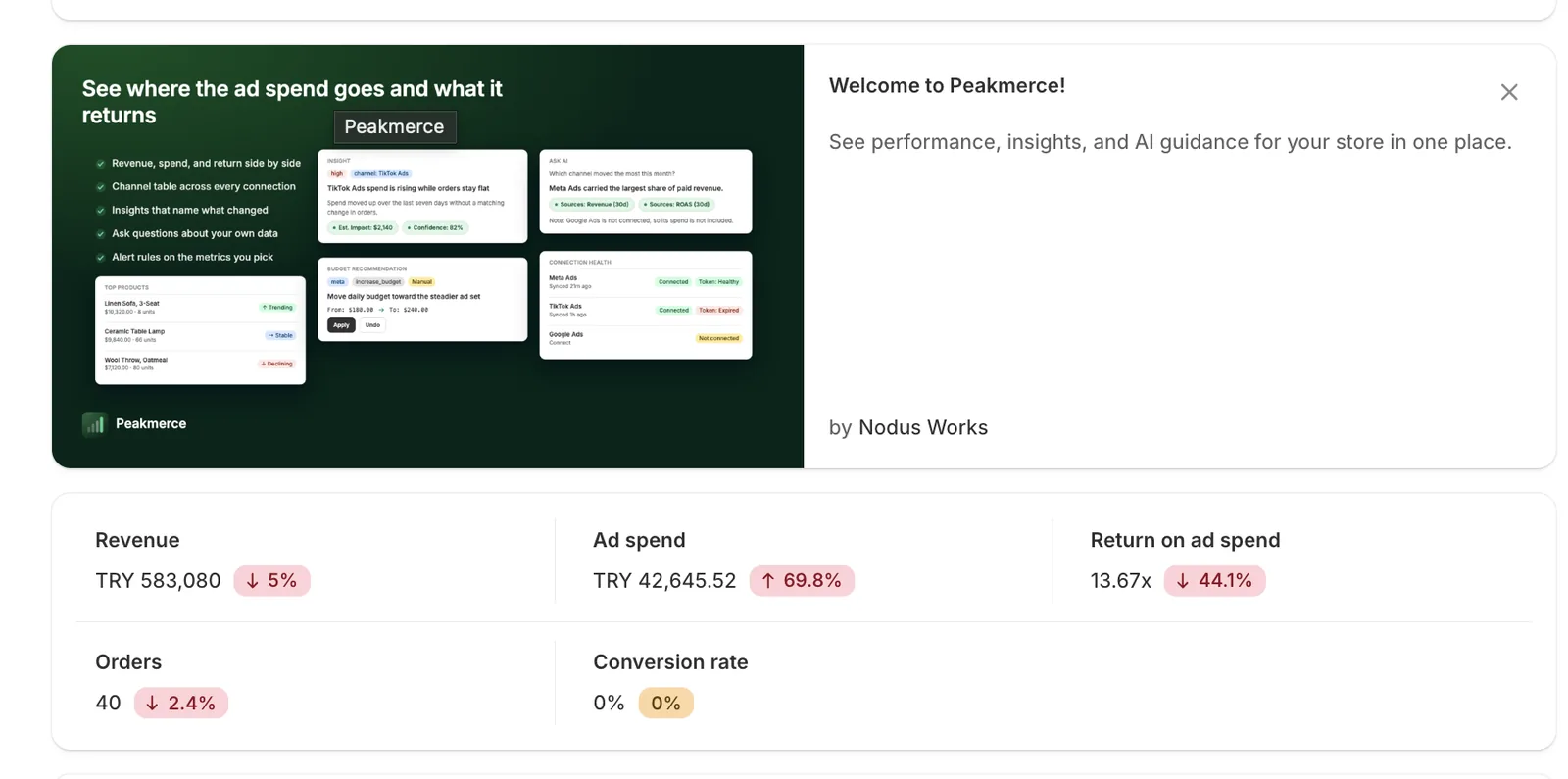
Meta (Facebook/Instagram) Pixel, Google Ads conversion tracking, and Google Analytics 4 integrations are also critical for stores in Turkey. On Shopify, they're set up with the Facebook & Instagram and Google & YouTube apps; for tools without an official app, you use a custom pixel under Customer events. If they aren't configured correctly, you can't measure ad performance.
ERP and Accounting Integrations
Connecting accounting/ERP systems widely used in Turkey, such as Logo, Mikro, Nebim and Paraşüt, to Shopify is critical for both e-invoice automation and inventory management. These integrations significantly reduce manual work, especially for stores with 100+ SKUs.
Customer Communication Integrations
WhatsApp integration has become standard for stores in Turkey, where WhatsApp is widely used for post-order communication. Using Shopify Inbox live chat together with a WhatsApp plugin makes customer support much more efficient.
💡 Tip: Prioritize Your Integrations
Instead of setting up all integrations at once, prioritize the mandatory ones (payment + shipping + KVKK + e-invoice) during store setup. Add marketing integrations (Meta, Google, WhatsApp) in the second phase, and add the ERP connection once your turnover exceeds 500K TL. A phased setup lets you start selling without overcomplicating the launch.
Shopify Turkey SEO: Optimization for Turkish Search
Shopify has a technically solid foundation for SEO, but the Turkish market comes with some specific SEO requirements. The main ones are Turkish character support (ş, ı, ğ, ü, ö, ç), correct handling of Turkish characters in URLs and optimized Turkish meta tags.
- Turkish URLs: Avoid using Turkish characters in Shopify slugs; use transliteration instead (e.g., 'gunes-gozlugu' instead of 'güneş-gözlüğü').
- Collection structure: Shopify's /collections/ structure should be optimized for SEO
- Product schema: Structured data / JSON-LD should be correctly configured with Turkish content
- Speed optimization: Core Web Vitals scores should be optimized considering mobile connection speeds in Turkey
Frequently Asked Questions
Is Shopify legal in Turkey?
Yes, Shopify is completely legal to use in Turkey. The platform is compliant with all legal regulations in Turkey; however, the e-commerce store owner must meet the ETBIS registration, KVKK compliance, IYS integration, and e-invoice requirements during store setup. These obligations belong to the seller, not the platform.
Can I sell in Turkish Lira on Shopify?
Yes, Shopify fully supports the Turkish Lira (TRY). When the currency is set to TRY in the store settings, all prices, the checkout process, and customer notifications are displayed in TL. For international sales, you can also use Shopify Markets to show prices in other currencies; however, because Shopify Payments isn't available in Turkey, the payment is converted to TL at checkout and collected in TL.
Which payment methods work in Turkey on Shopify?
Since Shopify Payments is not active in Turkey, iyzico, PayTR, or craftgate must be used. These three providers offer credit/debit card, installment, and BKM Express support. Cash on delivery is built into Shopify: you add "Cash on Delivery (COD)" under Settings > Payments > Manual payment methods. You only need a separate app for rules such as a COD fee or an order amount limit.
Is ETBIS registration mandatory for my Shopify store?
Yes, ETBIS registration is mandatory for every store conducting e-commerce in Turkey. Registration is free regardless of turnover and can be completed online through e-Devlet. In 2026, the administrative fine for not registering with ETBIS is 143,102-715,516 TL.
How do I issue an e-invoice on Shopify?
Shopify does not have a built-in e-invoice feature; therefore, an integration with software such as Logo, Paraşüt, Mikro, or similar must be set up. This integration can automatically generate e-invoices/e-archive invoices for each order created. E-invoicing is mandatory for stores with an annual turnover exceeding 500,000 TL.
How many stores are there on Shopify in Turkey?
Shopify does not publish exact store numbers by country. However, according to StoreLeads data, there are about 17,700 live Shopify stores in Turkey as of October 2026. In the first three months of data from the brands we have migrated to Shopify and Shopify Plus, the growth rate also significantly exceeds the regional average.
E-Commerce Success with Shopify in Turkey
When properly set up in the Turkish market, Shopify offers a robust e-commerce infrastructure for both SMEs and large-scale brands. Payment integration (iyzico/PayTR), shipping connections, ETBIS and KVKK compliance, e-invoice setup and SEO optimization: every Shopify store that gets these five essentials right gains a significant edge over local competitors.
At Nodus Works, the agency with the most customer reviews in Turkey on Shopify's Partner directory, we handle all of these processes store by store. For a free consultation before setup, take a look at our Shopify integration and setup services.
Free Consultation: Let's Plan Your Shopify Setup for Turkey
If you're unsure where to start with payment integration, shipping connections, legal compliance, or SEO, schedule a free consultation with the Nodus Works team. You can find all our services at nodusworks.com/en/services.