Five trends will shape the Shopify Turkey market in 2026: mandatory mobile and multichannel selling, AI-powered personalization and automation, global expansion with Shopify Markets, sector-specific store strategies and less reliance on marketplaces. The base is strong: according to the Ministry of Trade, Turkish e-commerce reached 4.57 trillion TL in 2025, with 73 percent from mobile devices.
The Turkish e-commerce market reached a volume of 4.57 trillion TL in 2025 (Ministry of Trade, E-Commerce Outlook in Turkey 2025), and at this growth rate it ranks 7th among the world's fastest-growing e-commerce markets for 2024-2028 (TÜBİSAD and ETİD data). In the Shopify projects we manage at Nodus Works, we have seen this pace of growth turn the choice of platform from a secondary technical detail into a core part of growth strategy. In this article we look at the real data that will shape the Shopify Turkey market in 2026, the opportunities by sector and the areas brands need to be ready for.
The Turkish E-Commerce Market in Numbers: Where Is It Coming From on the Way to 2026?
Turkey's e-commerce volume has grown many times over in the last four years. According to the Turkish Ministry of Trade's Turkey E-Commerce Ecosystem Report, the market reached 800 billion TL in 2022, e-commerce's share of GDP rose to 6 percent, and its share of retail rose from 13.7 percent to 16.5 percent. According to the Ministry of Trade's E-Commerce Outlook in Turkey 2025 report, this volume climbed to 4.57 trillion TL in 2025; in dollar terms, that is roughly $115.4 billion, or 6.9% of GDP.
The most decisive factor behind this growth is mobile use: in 2025, 73 percent of total e-commerce volume in Turkey came from mobile devices. This means a Shopify store with a weak mobile experience now loses most of the market outright; in 2026, mobile optimization is no longer a choice but a condition for survival.
How Is Interest in Shopify Changing in Turkey According to Google Trends?
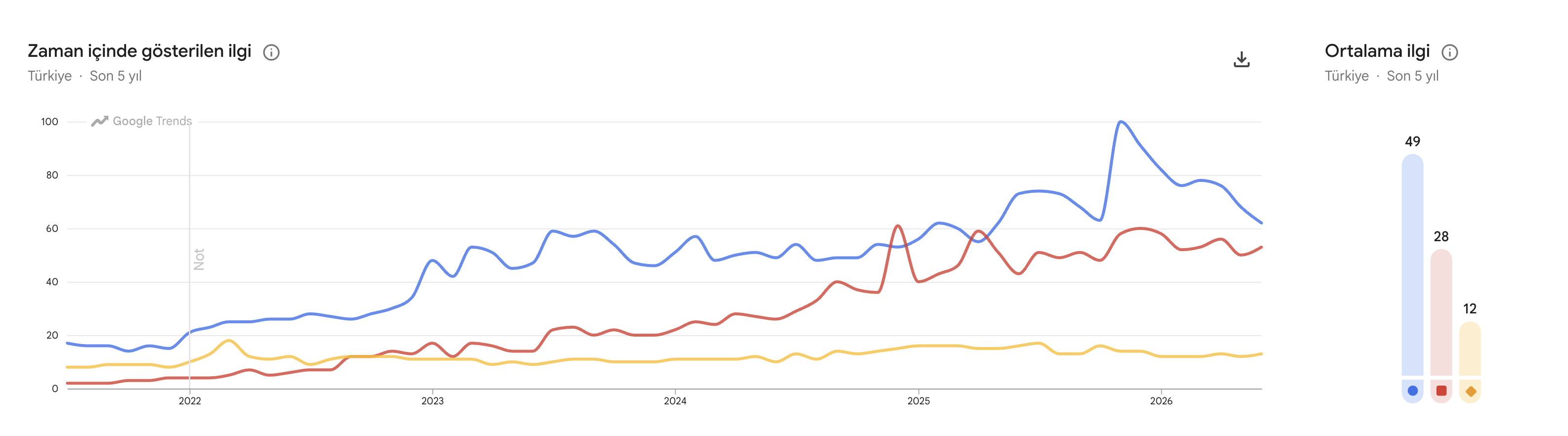
According to Google Trends data, search interest in Shopify in Turkey has risen steadily over the last 5 years: the interest index, which hovered in the 15-20 range in 2021, hit its peak of 100 at the end of 2025 and sits in the 60-80 range in 2026. A comparison with local platforms over the same period shows the market dynamic clearly: Shopify's 5-year average interest index is 49, while the closest local competitor averages 28 and the third platform averages 12, flat for years (Google Trends, Turkey, past 5 years).
This picture tells us two things: the search for a platform is growing in Turkey as a whole, but Shopify is taking the lion's share of that growth. The peak in Shopify search interest at the end of 2025 coincides with campaign periods (November sales and decisions to open a store before the new year); this seasonality also matches what we see in the field, where store setup projects typically cluster in the last quarter.
Tip: You can check the current version of this data yourself on trends.google.com by comparing the topic "Shopify (E-commerce company)" with "ikas" and "Ticimax". Region: Turkey, range: past 5 years.
Blue: Shopify
Red: ikas
Yellow: Ticimax
Five Trends That Will Shape the Shopify Turkey Market in 2026
Mobile and Multichannel Selling Become a Must
Since 73 percent of e-commerce traffic in Turkey comes from mobile devices, Shopify stores need to prioritize mobile speed and a one-tap purchase flow. Shopify's infrastructure works with Instagram, TikTok, Facebook and Google, which makes it possible to sell products in sync across different channels; however, this sync has to manage stock and orders from a single center, otherwise inconsistencies between channels lead to overselling.
AI-Powered Personalization and Automation
AI-based apps in the Shopify ecosystem generate product recommendations, dynamic pricing and personalized campaigns; these tools play a concrete role in raising revenue per customer (AOV). Automating repetitive tasks such as order confirmations, shipping notifications and abandoned cart reminders will widen the operating cost gap between manually run stores and stores that use automation even further in 2026.
Expanding into Global Markets with Shopify Markets
Shopify Markets makes multi-country and multi-language management possible from a single panel, shortening the time it takes Turkish brands to expand into European and Middle Eastern markets. Multiple currencies and duty collection, however, require Shopify Payments, so they are limited for stores opened from Turkey. Being able to customize tax, duty and pricing settings by country directly affects customer trust in cross-border selling; a misconfigured Markets setup, on the other hand, can lead to abandoned carts because of incorrect tax display.
Sector-Specific Store Strategies Come to the Fore
In 2026 a generic Shopify setup is not enough; sector-specific design, product presentation and content strategy are becoming the real difference that creates a competitive edge. For home living and furniture brands, product dimensions, material details and delivery transparency stand out, and our 20 recommendations for home living and furniture brands cover these details. For jewellery and accessory brands, product photo quality and clear size information directly affect conversion; we have collected the technical recommendations for this sector in our 20 critical recommendations for accessory brands.
Less Dependence on Marketplaces
Brands turning to their own sales channels, for ownership of customer data and control over profit margins, is a trend that is speeding up in 2026. Here the Shopify Turkey market offers an alternative for businesses looking for brand building and long-term profitability; however, for this shift to succeed, a separate strategy is needed to bring the customer base built up on marketplaces over to the brand's own channel.
The Right Tech Stack: What Should Support Your Shopify Store in 2026?
A successful Shopify store is more than its platform; in 2026, properly integrating CRM, ERP, marketing automation and analytics tools is becoming a prerequisite for data-driven decisions. Integrations added without prioritizing speed, security and a user-friendly interface make the tech stack bigger but do not change the conversion rate; integrations tracked with A/B tests and user behavior analysis, on the other hand, keep improving it.
A Risk to Avoid: Adding app after app and leaving them untested slows the page down, and the tech stack itself becomes an obstacle to growth. The performance impact of every integration should be measured the moment it is added.
Why Is the Need for Shopify Consulting Growing?
As the Shopify ecosystem becomes more complex, platform setup, theme optimization, app selection and growth strategy are turning into areas that require expertise. A misconfigured store accumulates errors that go unnoticed in the short term but turn into serious budget losses over time; the wrong app choice, an unoptimised theme or a payment setup that is only partly integrated are examples of such errors.
With its Shopify-focused consulting approach, Nodus Works aims to help brands build not just a store but a scalable and profitable e-commerce operation. For brands preparing for 2026, a holistic strategy that runs from store setup to Shopify SEO and content management and on to conversion optimization produces far more lasting results than one-off tactics.
FAQ: The Shopify Turkey Market in 2026
Will the Shopify Turkey market keep growing in 2026? Yes. According to Ministry of Trade data, Turkey's e-commerce volume reached 4.57 trillion TL in 2025 (E-Commerce Outlook in Turkey 2025); according to TÜBİSAD and ETİD data, Turkey ranks 7th among the world's fastest-growing e-commerce markets for 2024-2028. Mobile commerce reaching 73 percent of total volume is the main driver of this growth.
Is Shopify suitable for small businesses? Yes, Shopify's subscription-based, scalable model lets a small store grow without changing platforms. You can start on the Basic plan and move to a higher plan as your sales volume grows.
Why does Shopify consulting matter? A misconfigured theme, missing integrations or an unoptimised payment setup turn into budget losses over time. Professional consulting prevents these mistakes at the setup stage and clarifies your growth strategy.
How does AI help Shopify stores? Through product recommendations, dynamic pricing and automated marketing flows (abandoned cart reminders, personalized campaigns), it raises revenue per customer and reduces the operational workload.
Is it difficult to sell abroad with Shopify Markets? No, but there are limits. With Shopify Markets you can use multiple languages and country-specific domains; multiple currencies and duty collection require Shopify Payments, so they are limited for stores opened from Turkey.
How big is the Turkish e-commerce market in 2026? According to the Ministry of Trade's E-Commerce Outlook in Turkey 2025 report, the Turkish e-commerce market reached a volume of 4.57 trillion TL (about 115.4 billion USD) in 2025. At this growth rate, Turkey ranks 7th among the world's fastest-growing e-commerce markets for 2024-2028.
Which trends will stand out for Shopify in Turkey in 2026? In 2026, mobile and multichannel selling, AI-powered personalization, global expansion with Shopify Markets, sector-specific store strategies and less dependence on marketplaces stand out as the five key trends shaping the Shopify Turkey market.
How much of e-commerce in Turkey happens on mobile devices? According to 2025 data, 73 percent of total e-commerce volume in Turkey came from mobile devices. This makes mobile speed and one-tap purchase optimization a priority for Shopify stores in 2026.
Conclusion: A Roadmap for Shopify Stores Preparing for 2026
The brands that will stand out in the Shopify Turkey market in 2026 will be those that can manage mobile experience, sector-specific strategy, automation and global expansion with Shopify Markets all at once. Leaving any of these out means falling behind competitors in a growing market.
To prepare your store for the 2026 trends, take a look at our Shopify store setup service and get in touch with us to map out your strategic roadmap together.