

















































































































US Customs Duties (2026): The $800 Exemption Has Ended, and Turkish Goods Pay an Extra 12.5%

Every parcel sent to the US now pays customs duty regardless of its value: the $800 exemption is suspended and ends by law on July 1, 2027. Since July 24, 2026, goods of Turkish origin pay an extra 12.5% on top of the regular duty, and since October 22, 2026 those goods can no longer enter by post on a simplified declaration.
 Author: Efe Gündüz Nodus Works Shopify Agency Founder
Published 17 min read
US customs duty is charged in 2026 on every parcel sent from Türkiye to a buyer in the United States, whatever the parcel is worth. The de minimis exemption, which let parcels of up to $800 enter duty-free, has been suspended since August 29, 2025, and it ends entirely by statute on July 1, 2027. Goods of Turkish origin also pay an extra 12.5% on top of the product's regular duty, and they have done so since July 24, 2026. A cotton T-shirt worth $100 pays $29 in duty at the border today.
At Nodus Works we work with Turkish Shopify stores that sell to the US, and the hardest part of 2026 for them has been that the rule changed three times in one year. In February the US Supreme Court struck down the previous duty, in July a new one replaced it, and in October the postal rule tightened. Every rate and date below was read on November 27, 2026 from the official texts in the Federal Register and from the tariff schedule of the US International Trade Commission (hts.usitc.gov).
Is customs duty charged on a parcel sent to the US?
Yes. The United States suspended duty-free entry for parcels of $800 and under (the de minimis exemption) on August 29, 2025, and in June and July 2026 Customs and Border Protection (CBP) published two rules that make the suspension indefinite. A $20 key ring and a $700 rug both go on a customs entry and both pay duty.
The history of the exemption is what shows why older blog posts that say "under $800 is duty-free" are now wrong. The changes, in order, are these:
| Date | What happened | Basis |
|---|---|---|
| July 4, 2025 | A statute was enacted that permanently removes the exemption from July 1, 2027 | Public Law 119-21, sec. 70531 |
| August 29, 2025 | The $800 exemption was suspended for every country | Executive Order 14324 |
| June 24, 2026 | The suspension became indefinite for courier and freight shipments | CBP rule, Federal Register 2026-12670 |
| July 24, 2026 | The suspension became indefinite for postal shipments, and a new postal entry procedure began | CBP rule, Federal Register 2026-12669 |
| October 22, 2026 | Goods subject to an additional duty lost the right to enter by post on a simplified entry | The same rule, compliance date |
| July 1, 2027 | The exemption ends entirely by statute | Public Law 119-21 |
Under the rule CBP published for courier shipments, the old "release from the manifest" path closed when the exemption went. The main path for shipments of $2,500 and under is now the simplified (informal) entry called Entry Type 11. Shipments over $2,500 enter on a formal entry. A simplified entry still reports a 10-digit US tariff code (HTSUS), the country of origin and the value for every parcel.
How much extra US customs duty applies to Turkish goods? (2026)
Since July 24, 2026, goods of Turkish origin pay an extra 12.5% on top of the regular US customs duty. The duty rests on a Section 301 determination by the Office of the United States Trade Representative (USTR), and heading 9903.05.79 of the tariff schedule writes it as "the applicable duty + 12.5%".
In March 2026 USTR opened an investigation into 60 economies on the ground that they do not prohibit imports of goods made with forced labor. The determination of July 28, 2026 split the economies into three groups:
- 10%: Argentina, Bangladesh, Cambodia, Canada, India, Indonesia, Malaysia, Mexico, Pakistan, the United Kingdom and several more.
- A combined total of 10% or 12.5%, together with the regular duty: in the EU and Taiwan, a product whose regular duty is under 10% pays an extra duty equal to the gap, and a product at 10% or above pays no extra duty. The same rule runs for Japan, Korea and Switzerland with a 12.5% ceiling.
- 12.5%, on top of the regular duty: Türkiye, China, Vietnam, Thailand, the UAE and the remaining economies.
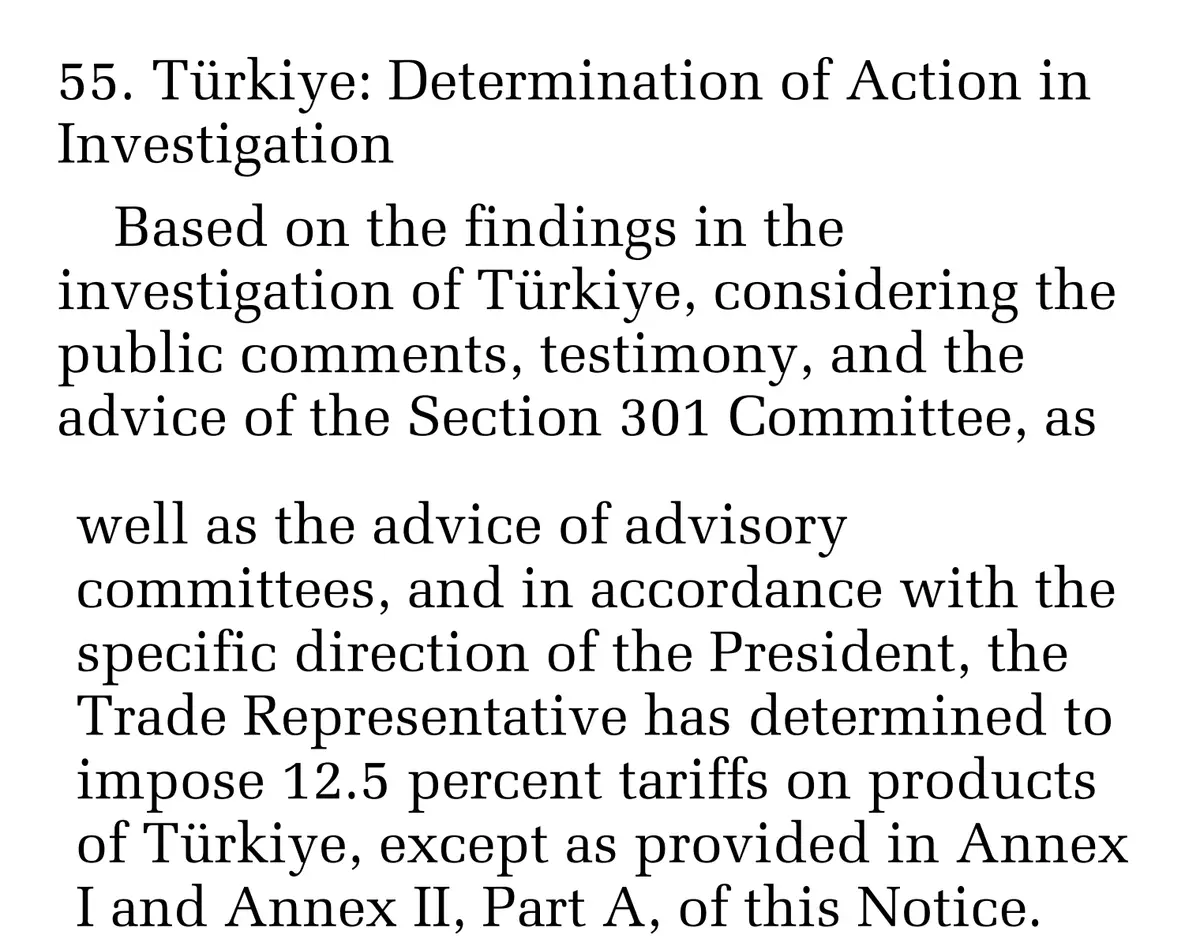
The exception list (headings 9903.05.85-92) rarely covers what a Shopify store sells: goods loaded on a vessel before July 24, civil aircraft parts, pharmaceutical inputs, donations, and informational materials such as books and works of art. Steel, aluminum and copper products, and auto parts, are also exempt from this extra duty, because they are already subject to a separate duty (Section 232).
What happened to the 15% paid in 2025?
The 15% duty applied to Türkiye from August 7, 2025 rested on the US emergency-powers statute (IEEPA). On February 20, 2026, in Learning Resources v. Trump, the US Supreme Court held that the statute does not authorize customs duties. In its place, on February 24, 2026, came a temporary global duty of 10% (Section 122) lasting 150 days. That duty ended on July 24, 2026, and the 12.5% under Section 301 began the same day. A refund of the cancelled IEEPA duty is claimed by the importer who filed the entry, which on most shipments is the courier or the buyer. If you paid this duty yourself on a DDP shipment, ask your courier in writing whether it has filed a refund claim.
How is US customs duty calculated on a $100 T-shirt?
In the US, customs duty is calculated on the product price. The international shipping charge is not part of the dutiable value. On a cotton T-shirt of Turkish origin worth $100, the regular duty is 16.5% and the extra duty is 12.5%, so the duty paid at the border is $29. The courier's customs-clearance fee and CBP's processing fee are added on top.
The regular duty rate (the MFN rate) depends on the product's tariff code. These are the rates read from hts.usitc.gov on November 27, 2026 for four products Turkish exporters sell often:
| Product | US tariff code | Regular duty | Türkiye extra duty | Total duty on a $100 order |
|---|---|---|---|---|
| Cotton T-shirt | 6109.10.00 | 16.5% | 12.5% | $29.00 |
| Cotton towel, bathrobe fabric | 6302.60.00 | 9.1% | 12.5% | $21.60 |
| Leather bag (over $20) | 4202.21.90 | 9% | 12.5% | $21.50 |
| Gold jewelry | 7113.19.50 | 5.5% | 12.5% | $18.00 |
What would the same T-shirt pay if it came from the EU?
The T-shirt example shows the competitive problem a Turkish textile seller faces in the US. If a product of EU origin has a regular duty of 10% or more, the Section 301 extra duty is zero. The regular duty on a cotton T-shirt is 16.5%, so the same T-shirt from Italy pays only $16.50. The Turkish T-shirt pays $29. The gap is $12.50 per order. The duties on a sale from Türkiye into the EU follow different rules, and we set them out in our guide to selling to the EU.
| Origin | Regular duty | Section 301 | Total on a $100 T-shirt |
|---|---|---|---|
| Türkiye | 16.5% | 12.5% | $29.00 |
| EU (Italy, Portugal) | 16.5% | 0% (because the 10% combined ceiling is already passed) | $16.50 |
| Bangladesh, Indonesia | 16.5% | 10% | $26.50 |
| Vietnam | 16.5% | 12.5% | $29.00 |
The determination also sets up a textile quota: quotas will be established that let a set quantity of apparel enter without the extra duty for Bangladesh, Cambodia, Indonesia and Malaysia, economies that take US cotton and textile inputs. Türkiye is not on that list. For a Turkish apparel brand there is no exception today that lowers the extra duty on T-shirts and similar goods.
Should you send to the US with PTT or with a courier?
For goods of Turkish origin the practical path is a fast courier (DHL, UPS, FedEx and the integrators that work with them) and an Entry Type 11 informal entry. Under CBP's new postal rule, since October 22, 2026 a product subject to an additional duty in chapter 99 of the tariff schedule cannot enter by post on a simplified entry and needs a formal entry. Türkiye's extra 12.5% sits in exactly that chapter (9903.05.79).
On July 24, 2026 CBP opened a new simplified entry procedure for postal shipments of up to $2,500. The conditions are narrow:
- Only the owner of the goods, the buyer, or a licensed customs broker they authorize may file the entry.
- The party that files must hold a customs bond.
- The entry data is sent to CBP by email, as an Excel sheet, by the 7th of each month.
- Goods subject to the additional duties in chapters 98 and 99, goods under quota, and goods that need a permit from another agency cannot use this procedure. Those goods had a temporary permission until October 22, 2026.
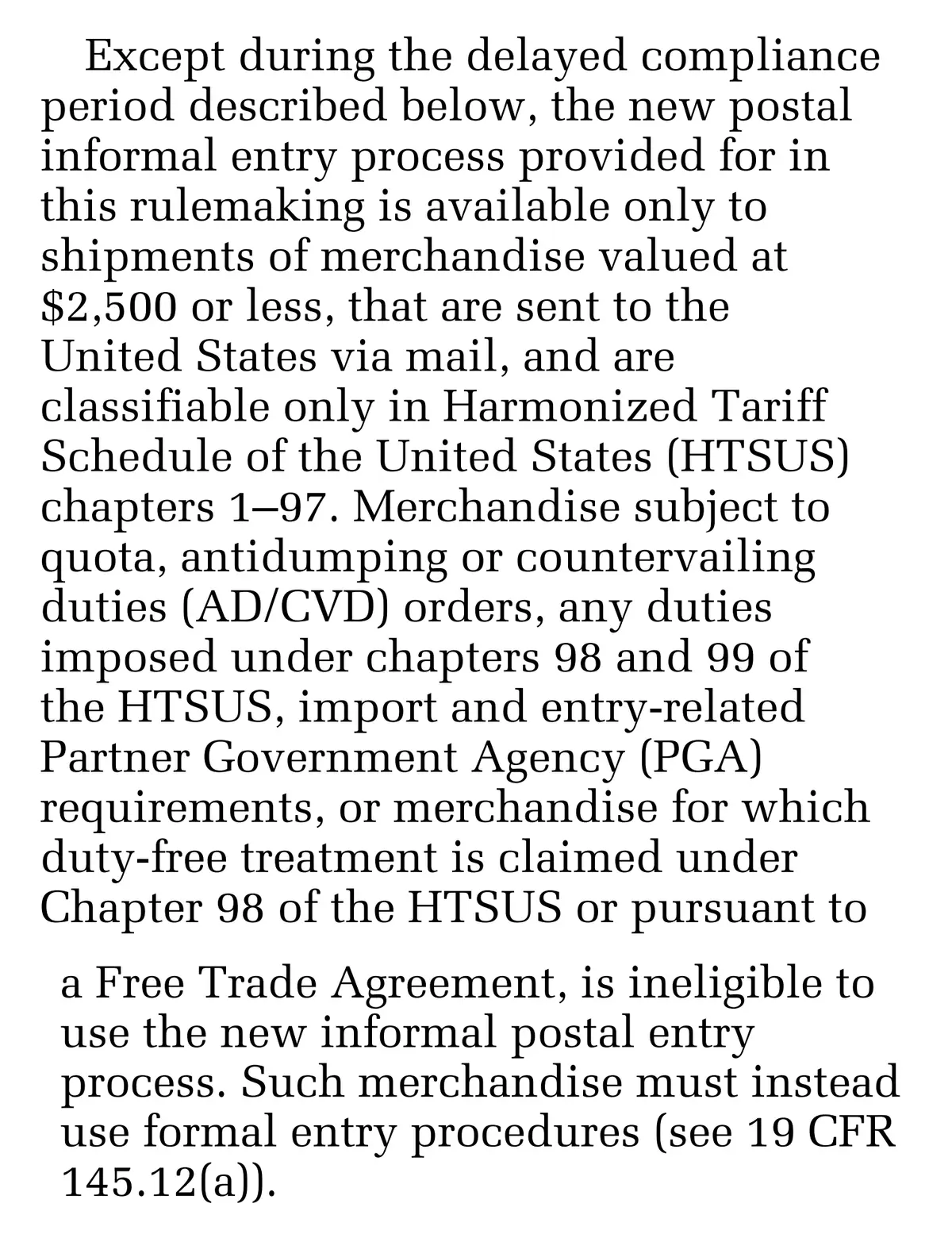
In practice the rule means this: for a T-shirt posted from Türkiye, the buyer or a broker deals with a formal entry, a bond and an entry fee, and on an order of $30 to $40 that cost exceeds the price of the product. Ask Turkish Post (PTT) in writing, before you ship, on what terms it accepts parcels to the US. We could not verify PTT's current acceptance terms for this article.
| Path | Entry | Position for a product of Turkish origin | Who it suits |
|---|---|---|---|
| Fast courier, $2,500 and under | Entry Type 11 (informal) | The courier files the entry; regular duty + 12.5% | Most Shopify orders |
| Fast courier, over $2,500 | Formal entry | A customs broker and a bond are required | Wholesale and B2B orders |
| Post, since October 22, 2026 | Formal entry (because of the chapter 99 extra duty) | A bond and a broker are required | Not practical |
| A warehouse in the US (FBA, 3PL) | Bulk import, formal entry | Duty is paid once, per container or pallet | Brands selling hundreds of orders a month |
On the Turkish side the export declaration for the shipment is an ETGB (electronic commerce customs declaration, Elektronik Ticaret Gümrük Beyannamesi). The carrier files it, and the seller does not hire a separate customs broker for that declaration. We set out the steps in our guide to micro-export and the ETGB. The broker in the table above is for the import entry into the US.
DDP or DAP: who should pay the US customs duty?
The delivery term decides who pays the US customs duty. Under DAP (Delivered At Place) the courier collects the duty and the clearance fee from the buyer before delivery. Under DDP (Delivered Duty Paid) the seller pays the duty, the courier invoices the seller, and the buyer pays nothing at the door.
Out of habit from the exemption period, many Turkish stores still ship DAP to the US. While the exemption lasted, a parcel under $800 reached the buyer with nothing extra to pay. Today the same parcel asks for duty and a clearance fee at the door. What we see at Nodus Works is this: a buyer who did not see that amount at checkout can refuse to pay at the door and choose to have the parcel returned. When the parcel comes back, the seller pays both the outbound and the return freight.
Our position is plain. On retail sales to the US, ship DDP and put the duty in the product price or on its own line at checkout. DAP makes sense only on B2B orders where the buyer knows the duty and has accepted it.
Collecting customs duty at checkout in Shopify
Shopify's "Duties and import taxes" feature collects an estimate of the customs duty from the buyer at checkout. Under Shopify's considerations page the feature lets you pick only one of DDP or DAP for each country, it requires the DDP label on an order where duty is collected, and it charges a separate transaction fee on each order. The amount collected is an estimate. Check in your admin, under Settings > Taxes and duties, whether the feature is available on a store that ships from Türkiye. If it is not, two paths remain: include the duty in the US price, or collect it on a shipping-rate line that applies only to the US.
To manage the US price on its own, open the US as a separate market in Shopify Markets and assign that market its own price list. You can then pass the $29 of T-shirt duty into the US price without touching your Türkiye and EU prices. We cover collecting foreign currency, and the merchant-of-record side, in our article on foreign-currency collection and the merchant of record.
Which Shopify settings does a shipment to the US need?
On every Shopify order going to the US, the courier takes three pieces of information from the product record: country of origin, tariff code (HS or HTS) and product price. If those are missing or wrong, the parcel waits in customs, is charged the wrong duty, or is returned.
In Shopify those fields are in the Shipping section of the product page: "Country/Region of origin" and "Harmonized System (HS) code". In practice we recommend these four steps:
- Enter a country of origin on every product. "Türkiye" for a product made in Türkiye. A product bought in China and labelled in Türkiye is not of Turkish origin, and it is subject to the duty applied to China.
- Use the 10-digit US code. The international HS code is 6 digits, and a US entry wants 10. Search the 10-digit code by product description on hts.usitc.gov, and check on the invoice of a test shipment that your courier integration copies the code onto the commercial invoice in full.
- Declare the real selling price. One stated aim of CBP's rules is to catch undervaluation. On a discounted sale, the declared value is the product price the buyer paid.
- Make DDP the default on courier shipments. In your DHL or UPS integration, set the delivery term to DDP for shipments to the US, and have the courier put duty billing into the contract.
Once a catalog runs to hundreds of products, copying the 10-digit code and the origin from the product record onto the courier invoice is not a job to do by hand. Our Shopify integration and custom app service builds the integration that carries this data from the product records onto the commercial invoice and connects it to your courier's system.
Do I have to pay US sales tax?
The US has no federal VAT. The states set sales tax themselves, and the rates differ from state to state. Whether a foreign store selling directly from Türkiye must register for sales tax in a state depends on whether its sales into that state pass the state's economic nexus threshold.
Most states set that threshold on annual sales, and in many of them the threshold is $100,000. A Turkish store with a few thousand dollars of US sales a year does not, in practice, approach any state's threshold. When your US sales in a single state approach a hundred thousand dollars, check that state's threshold on the state tax authority's site, and if registration is required add the state in Shopify under Settings > Taxes and duties.
Sales tax and customs duty are separate. Customs duty is collected at the border on every parcel. Sales tax is collected at checkout only from buyers in states where you have a registration duty. We cover VAT and tax settings on the Turkish side in our article on Shopify tax settings.
| Tax | Who sets it | When it is collected | For a Turkish Shopify store |
|---|---|---|---|
| Customs duty (regular + 12.5%) | The federal government, CBP | On every parcel, at the border | Always |
| CBP processing fee | The federal government, CBP | On every entry | Always, on the courier invoice |
| Sales tax | The states | At checkout, in a state where you are registered | If the threshold is passed |
What should a Turkish Shopify store do about US sales?
A store that wants to keep selling to the US has three decisions the 2026 rules force: rebuild the price on top of the duty, switch the shipment to DDP, and complete the product data with a 10-digit tariff code. Which one comes first depends on the volume of your US sales.
| Situation | The path we recommend | Why |
|---|---|---|
| Fewer than 20 US orders a month | Courier + DDP, add the duty to the US price | A separate warehouse does not pay for itself at this volume |
| 20 to 300 US orders a month | Courier + DDP, a duty line at checkout, a 10-digit code integration | The cost of an error grows with the number of orders |
| More than 300 US orders a month | A 3PL or FBA warehouse in the US, imported in bulk | Duty and clearance cost falls per pallet |
| The product's regular duty is high (apparel 16.5%) | Cover the 12.5-point gap against an EU competitor in the price or the margin | There is no exemption from the extra duty for a Turkish product |
The rule is the same for stores selling to the US through Etsy and Amazon: the duty comes from the origin of the parcel, not from the marketplace. We calculated the cost gap between a marketplace and your own Shopify store in our Etsy vs Shopify comparison.
To work out, product by product, which code each product falls under, how much duty it pays, and whether your US price carries that duty, our Shopify consulting service builds a US cost table from your current catalog.
Frequently asked questions
What is the US customs duty exemption limit?
In 2026 there is, in practice, no exemption limit. The de minimis exemption, which let parcels of up to $800 enter duty-free, has been suspended since August 29, 2025, and it ends entirely by statute on July 1, 2027. Every parcel goes on a customs entry and pays its duty, whatever it is worth.
How much customs duty applies to goods sent from Türkiye to the US?
The product's regular US customs duty, plus an extra 12.5%. The extra duty has applied since July 24, 2026, and it is written at heading 9903.05.79 of the US tariff schedule. On a cotton T-shirt the regular duty is 16.5%, so the total is 29%.
What does de minimis mean?
De minimis is the threshold that exempts import parcels below a given value from customs duty. In the US that threshold was $800, and most e-commerce parcels entered duty-free because of it. The exemption was suspended on August 29, 2025, and it ends entirely by statute on July 1, 2027.
Does the buyer or the seller pay US customs duty?
It depends on the delivery term. On a DAP shipment the courier collects the duty from the buyer before delivery. On a DDP shipment the seller pays the duty and the buyer pays nothing at the door. On a retail sale, DDP removes the risk that the buyer refuses the parcel.
Can I send goods from Türkiye to the US with PTT?
Since October 22, 2026, goods of Turkish origin cannot enter by post on a simplified entry, because the extra 12.5% sits in chapter 99 of the tariff schedule. A postal shipment needs a formal entry, a customs bond and a broker. On Shopify orders the practical path is a fast courier.
Is the 15% customs duty paid in 2025 being refunded?
The US Supreme Court cancelled this duty on February 20, 2026. The importer who filed the entry claims the refund, and on most e-commerce shipments that is the courier or the buyer. If you paid the duty yourself on a DDP shipment, ask your courier in writing whether it has filed a refund claim.
What is an HTS code, and where do I find it?
An HTS code is the 10-digit classification number of a product in the US customs tariff schedule, and it sets the duty rate. The first 6 digits are the same as the international HS code. You find the code by searching the product description on hts.usitc.gov, the site of the US International Trade Commission.
The conclusion: selling to the US has not ended, the price has changed
Selling to the US did not close in 2026. What changed is that duty is now on every parcel, and on a Turkish product it sits 12.5 points above the regular rate. There is $29 of duty on a $100 T-shirt and $18 of duty on $100 of gold jewelry. If you do not decide who pays that duty, the buyer decides at the door and may refuse the parcel.
Look at three things in your own catalog first: the 10-digit code and the total duty rate of the five products you sell most to the US, whether your courier integration ships DDP or DAP to the US, and whether your US price carries this duty. You can finish the export side, before the parcel leaves for the US, from our guide to micro-export and the ETGB, and you can book a meeting with us to build the US cost table together.