
















































































































Selling to the EU (2026): IOSS and VAT, the €3 Customs Duty, A.TR and the GPSR Responsible Person
On a sale from Türkiye to a consumer in the EU, VAT is charged at the buyer's country rate, and IOSS is how that VAT is collected at checkout on an order of up to €150. Since July 1, 2026, IOSS consignments carry a customs duty of €3 per item, and since November 1, 2026 every consignment carries a handling fee of €2 per item. The listing must also name a GPSR responsible person established in the EU.
 Author: Efe Gündüz Nodus Works Shopify Agency Founder
Published 31 min read
Selling to the EU means a store in Türkiye sells a product online to a consumer in the EU and ships it. In EU law this is a distance sale of imported goods. Four rules apply together. VAT is charged at the rate of the buyer's country. On an order of up to €150, IOSS (Import One-Stop Shop) is how that VAT is collected at checkout. Since July 1, 2026, every IOSS consignment pays a customs duty of €3 per item. The listing must also show the name and address of a responsible person established in the EU under the General Product Safety Regulation (EU) 2023/988 (GPSR).
We prepared this guide from the regulations published in the Official Journal of the European Union, from the European Commission's guidance on the €3 customs duty, from the text of the GPSR and from Shopify's EU tax documentation. At Nodus Works we set up the tax, shipping and product-page structure together for Shopify stores that sell to Europe. The most expensive mistake we saw in 2026 is this: the seller registers for IOSS and collects the VAT at checkout, but never puts the €3 and the €2 per item, which have been added to the carrier's invoice since July, into the price.
What selling to the EU requires: the short answer
A sale from Türkiye to a consumer in the EU needs preparation under six headings: VAT, customs, the export documents on the Turkish side, product safety (GPSR), packaging registration and consumer law. The first three set the cost of every order. If the last three are missing, the product is removed from the marketplace or stopped at customs.
The EU's e-commerce VAT package, in force since 2021, removed the VAT relief of €22. Since that day every parcel entering the EU is subject to VAT. In 2026 two further charges were added. Council Regulation (EU) 2026/382 removed the customs duty relief on consignments not exceeding €150 and replaced it with a temporary duty of €3 per item. Commission Regulation (EU) 2026/2152 set a Union handling fee of €2 per item from November 1, 2026.
| Heading | Rule | Who pays or does it | Since when |
|---|---|---|---|
| VAT | The buyer's country rate (Germany 19%, France 20%, Hungary 27%) | The seller, through IOSS, up to €150; otherwise the buyer at import | July 1, 2021 |
| Customs duty | €3 per item up to €150; 0 for a Turkish industrial product declared with an A.TR and without IOSS | The person who files the declaration (the IOSS holder or the carrier) | July 1, 2026 |
| Union handling fee | €2 per item, independent of the order value | The person who files the declaration; the consumer is not the debtor | November 1, 2026 |
| Turkish side | ETGB, exempt e-archive invoice, VAT refund | The seller and the carrier | Since January 3, 2026: a gross 600 kg and 30,000 euros |
| GPSR | A responsible person established in the EU, and the manufacturer and responsible person on the listing | The seller | December 13, 2024 |
| Packaging (Germany) | LUCID registration and an authorised representative in Germany | The seller | Representative requirement on August 12, 2026 |
Source: Regulation (EU) 2026/382, Regulation (EU) 2026/2152, Regulation (EU) 2023/988, European Commission and ZSVR pages; November 26, 2026.
The work on the Turkish side is not the subject of this article. We set out the ETGB (Electronic Commerce Customs Declaration, Elektronik Ticaret Gümrük Beyannamesi), the exempt invoice and the VAT refund step by step in our guide to micro-export and the ETGB. This article focuses on what happens after the parcel crosses the EU border.
Which countries "Europe" means here
The rules in this guide apply to the 27 member states of the EU. The United Kingdom, Switzerland and Norway are not in the EU customs territory. Each has its own VAT and customs system. In the United Kingdom the seller collects VAT on consignments of up to £135, but that is not IOSS. It is the United Kingdom's own registration. Opening a single market named "Europe" in Shopify and putting the United Kingdom and Germany on the same tax setting is one of the setup errors we correct most often.
VAT on a sale from Türkiye to the EU: rate, threshold and who pays
VAT on goods sold from Türkiye to a consumer in the EU is calculated at the rate of the country where the goods are delivered, and there is no threshold for a Turkish seller: VAT arises from the first order. What changes the outcome is whether that VAT is taken from the seller at checkout or from the buyer at the door.
The familiar €10,000 threshold for sellers inside the EU does not apply to a Turkish seller. According to the Commission's OSS portal, that threshold is for sales that a seller established in one EU country makes to other EU countries. Shopify's EU setup page also describes the €10,000 threshold for stores that have a location in the EU. For a store that ships the parcel from Türkiye, the only measure is the value of the consignment: €150 or less, or above €150.
What the €150 limit decides
The €150 limit decides how the VAT is collected. The limit is calculated on the intrinsic value of the consignment: the selling price of the goods. Shipping and insurance are not included in the intrinsic value if they are shown separately on the invoice.
| Consignment value | How VAT is collected | Customs duty | Does the buyer pay at the door? |
|---|---|---|---|
| €150 or less, with IOSS | The seller collects it at checkout and pays it with the monthly IOSS return | €3 per item | No |
| €150 or less, without IOSS | From the buyer at import, through the carrier | 0 on a Turkish industrial product with an A.TR; otherwise €3 per item | Yes, the VAT and the carrier's service fee |
| Above €150 | At import: the carrier on the seller's behalf for DDP, the buyer for DAP | The normal tariff; 0 on a Turkish industrial product with an A.TR | Yes, if DAP |
Source: Council Directive 2006/112/EC, Regulation (EU) 2026/382, European Commission guidance on the €3 customs duty; November 26, 2026.
DDP (Delivered Duty Paid) and DAP (Delivered At Place) in the table are delivery terms. Under DDP the seller bears the tax and the parcel is delivered without asking the buyer for a further payment. Under DAP the carrier asks the buyer, before delivery, for the VAT and for its own customs-clearance fee.
VAT rates by country
The standard VAT rate in the EU ranges from 17% to 27% by country. The rates for the markets that send the most orders are: Germany 19%, France 20%, the Netherlands 21%, Italy 22%, Spain 21%, Poland 23%, Belgium 21%, Austria 20%. The highest rate is in Hungary (27%), the lowest in Luxembourg (17%).
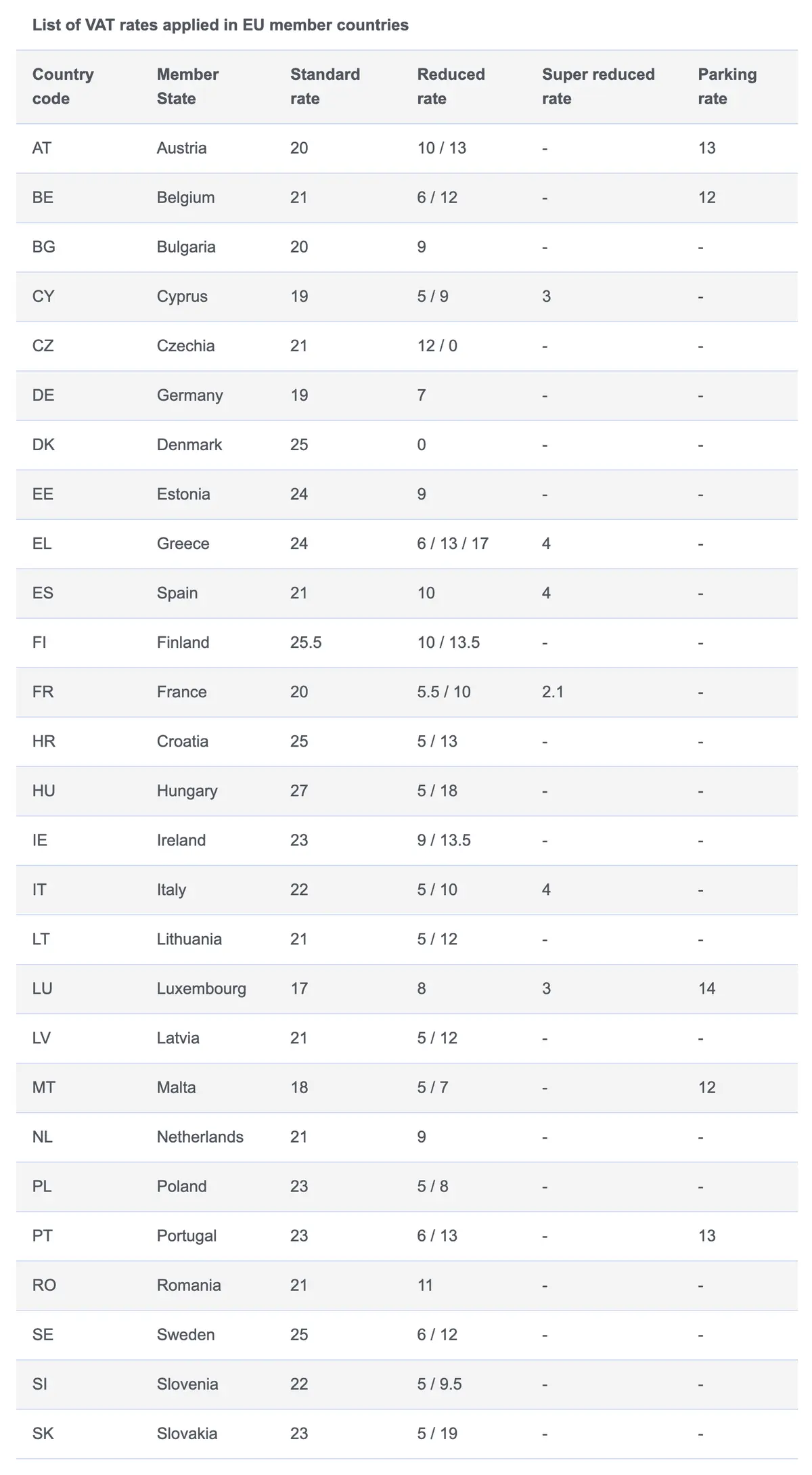
The rate difference goes straight into pricing. A product labeled €59.90 including VAT leaves the seller €50.34 after VAT in Germany and €47.17 in Hungary. A store that sells to both countries with the same label earns €3.17 less on the Hungarian order. Separate prices per market in Shopify, or the setting that includes tax in prices, exist to manage this difference.
What IOSS is and how a Turkish seller uses it
IOSS (Import One-Stop Shop) is the registration through which a seller outside the EU collects EU VAT at checkout on orders of up to €150 and pays it with a single monthly return. A seller in Türkiye cannot register for IOSS directly. The seller must appoint an intermediary established in the EU.
The Commission's OSS page states the rule plainly: a taxable person established outside the EU must appoint an intermediary in order to use the import scheme (IOSS). The intermediary files the VAT return in the seller's name, pays the VAT and keeps the records. On the Commission's definition, the person liable to pay the VAT is the intermediary. The intermediary first registers as an intermediary in its own country, then obtains a separate IOSS number for each seller it represents. The number starts with "IM" and has 12 characters.
What IOSS covers, and where it stops
IOSS does not cover every order. It cannot be used in three cases:
- A consignment above €150. The limit is per consignment. If you put two products of €140 in the same parcel, the consignment is €280 and it falls outside IOSS.
- Goods subject to excise duty. Alcohol and tobacco cannot be declared with IOSS.
- Goods shipped from a warehouse in the EU. According to the Commission, goods sitting in a warehouse in the EU are not a distance sale of imported goods. Those sales need a VAT registration in the country of the warehouse.
The monthly work of an IOSS seller is this: from the end of each month until the end of the next month, declare that month's EU sales of up to €150 country by country, and pay the total VAT to the country where the intermediary is registered. A nil return is filed in a month with no sales.
Does a marketplace seller need IOSS?
On marketplaces such as Etsy, Amazon and eBay, the seller usually does not need an IOSS number of their own. Under Article 14a of the VAT Directive, an electronic interface that facilitates the sale of imported goods of up to €150 is the deemed supplier for VAT: the marketplace collects the VAT and declares it under its own IOSS number. The seller's job is to pass the IOSS number the marketplace gives on the order to the carrier. In our Etsy vs Shopify comparison we calculated what this difference does to cost: on Shopify the seller carries this burden.
The IOSS setting in Shopify
In a store where an IOSS number is entered, Shopify calculates the VAT of the buyer's country at checkout on EU orders of up to €150. According to Shopify's EU tax reference, IOSS registration is optional, but it is required if you want to collect the VAT at checkout. If you do not, the buyer pays the VAT to the carrier on delivery. Shopify calculates the VAT. It does not file the return: the monthly return is the intermediary's job.
A note on the same page shows a limit that matters to a Turkish seller: OSS and IOSS cannot be used together in the same store. In a store that has a warehouse in the EU and an OSS registration entered, the IOSS option closes for orders shipped from outside the EU. Another current change: Shopify's Basic Tax service is open in the EU only to stores that set up EU tax before May 13, 2026. A newly created store works with Shopify Tax or with rates entered by hand.
The 2026 change: a customs duty of €3 per item and a handling fee of €2
Since July 1, 2026 there is no customs duty relief on consignments of up to €150 entering the EU. A temporary customs duty of €3 per item replaced it. Since November 1, 2026 a Union handling fee of €2 per item is also charged on every distance-sale consignment, whatever its value. The duty is temporary until July 1, 2028. The handling fee is permanent.
Under Article 2 of Regulation 2026/382 the €3 duty applies to two kinds of consignment: consignments whose VAT is paid through IOSS, and postal consignments. The Commission's implementing guidance changed the definition of "postal consignment" so that it covers all distance sales of up to €150. What stays outside that definition is IOSS consignments (already subject to the duty) and goods that benefit from a preferential tariff. The result: on a distance sale of up to €150, the only way out of the €3 is the preferential tariff we describe in the next section.
What an "item" is: count the product type, not the parcel
The €3 and the €2 are charged per item, not per parcel. The EU's new Customs Code, Regulation (EU) 2026/2108, defines an item as one or more goods in a consignment that share the same tariff classification, description and origin. Five T-shirts under the same tariff code are one item. One T-shirt and one watch are two items.
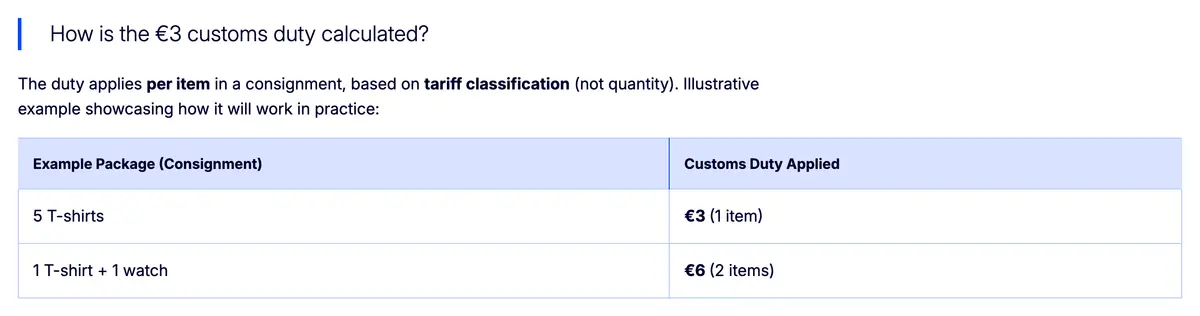
This definition changes how a cart is built. For a T-shirt brand that sells in a single category, the cost per parcel stays fixed: €3 of duty and €2 of handling fee however many T-shirts are inside. In a multi-category accessories store, a three-piece set of earrings, a necklace and a bracelet falls under three tariff codes, so it creates €9 of duty and €6 of handling fee, €15 in total. On a €60 set, that is a quarter of the price.
Who pays: the seller or the buyer?
According to the Commission's guidance, the person who files the declaration pays the €3 duty: the IOSS holder, or the carrier acting as its indirect representative. The recital of the new Customs Code says the same thing about the handling fee: the consumer is not the debtor for the handling fee. In practice the carrier pays these amounts to customs and invoices the seller. On a DAP shipment some carriers collect them from the buyer. Put in writing, in your contract, who is charged for these two items.
| Charge | Amount | On which consignment | Until when | Basis |
|---|---|---|---|---|
| Temporary customs duty | €3 per item | Up to €150; IOSS, or without a preference | July 1, 2028 | Regulation 2026/382, Art. 2 |
| Union handling fee | €2 per item | All distance sales, independent of value | Open-ended, reviewed every two years | Regulation 2026/2152, Art. 1 |
| Normal customs tariff | Depends on the product | Above €150; all consignments after July 1, 2028 | Ongoing | Common Customs Tariff |
Source: Regulation (EU) 2026/382, Regulation (EU) 2026/2152, Regulation (EU) 2026/2108, European Commission guidance; November 26, 2026.
Duty-free shipping with an A.TR: IOSS or A.TR?
The customs union between Türkiye and the EU lets industrial products in free circulation in Türkiye enter the EU without customs duty, and the document for that is the A.TR movement certificate. Under the 2026 rules this relief can also be used on e-commerce consignments of up to €150, but on one condition only: the VAT must not have been collected through IOSS.
Section 5.4 of the Commission's guidance on the €3 customs duty and the handling fee puts the rule as follows. Goods that benefit from a preferential tariff or from the customs union must be declared with an H1 (full) customs declaration, and the preference code must be entered. This is possible only if the VAT was not collected through IOSS, because Regulation 2026/382 applies the €3 duty to all IOSS transactions. The handling fee is charged on both paths.
This rule creates a real choice for a Turkish seller. IOSS does not surprise the buyer with a payment at the door, but it creates a duty of €3 on every item. A consignment with an A.TR and without IOSS zeroes the customs duty, but it leaves the VAT to the buyer at the door.
Electronic A.TR for e-commerce consignments from Türkiye
In 2026 the Commission published a note recognising the electronic A.TR that Türkiye issues for low-value e-commerce consignments. According to the note, for consignments not exceeding €150 the A.TR is issued separately for each transport document covered by the simplified customs declaration (ETGB). Box 12 carries the ETGB number and the digital seal of the customs office. Box 13 carries the electronic signature that the carrier authorised for the ETGB places in the exporter's name. Each document has a serial number and a QR code for verification. EU customs accepts the document under Decision No 1/2025 of the EU-Türkiye Customs Cooperation Committee.
This arrangement means the carrier can produce the A.TR in the same flow as the ETGB. What the seller has to do is ask the carrier two questions: do you issue an electronic A.TR, and does your customs partner on the EU side file an H1 declaration with the preference code entered? If the answer to the second question is no, the parcel is cleared with the €3 even if you have an A.TR.
The cost of the three paths on one order
Suppose an order of €100 (excluding VAT) is sent to a consumer in Germany: two cotton T-shirts in the same tariff code (€60) and one leather wallet (€40). The consignment is two items. Shipping is €15. The German VAT rate is 19%.
| With IOSS (DDP) | Without IOSS, with A.TR (DAP) | Without IOSS, without A.TR (DAP) | |
|---|---|---|---|
| VAT | €19.00 (at checkout, the seller collects it) | €21.85 (the buyer pays at the door; shipping is in the base) | €22.99 (the buyer pays at the door; shipping and duty are in the base) |
| Customs duty | €6.00 (2 items × €3) | €0 | €6.00 |
| Union handling fee | €4.00 (2 items × €2) | €4.00 | €4.00 |
| Carrier's clearance fee | By contract, charged to the seller | By contract, usually charged to the buyer | By contract, usually charged to the buyer |
| IOSS intermediary fee | Yes (a fixed monthly or yearly fee) | No | No |
| What the buyer pays at the door | €0 | At least €21.85 | At least €22.99 |
Source: Nodus Works calculation. The rules are from Regulations 2026/382 and 2026/2152 and the Commission guidance. Under Articles 85 and 86 of the VAT Directive, the import VAT base is the customs value plus duties plus the transport cost to the place of destination. November 26, 2026.
Read the table this way. On the IOSS path the seller adds €10 of cost to the order, but the buyer receives the parcel with no further payment. On the A.TR path the customs duty is zero, but the buyer meets €21.85 at the door. Our observation is that the non-delivery rate rises markedly on parcels that ask for a payment at the door, and the return shipping of a parcel that comes back stays with the seller. For that reason we recommend the A.TR path to stores that show a clear "VAT and duties are paid on delivery" notice at checkout, and whose average cart is high and contains many items.
Orders above €150, and using a warehouse in the EU
Consignments above €150 cannot enter IOSS. VAT is paid at import, customs duty is calculated on the normal tariff, and a Turkish industrial product enters duty-free with an A.TR. The €2 handling fee is charged on these consignments too, because according to the Commission the handling fee applies to every item in a distance sale, independent of value.
On these orders the choice is between DDP and DAP. Under DAP the buyer pays the VAT and the carrier's clearance fee before delivery. Under DDP the carrier pays these amounts on the seller's behalf and invoices the seller. The seller then becomes the importer in the buyer's country, and may need a VAT registration in that country in order to recover the import VAT paid. Without a registration, that VAT remains a cost to the seller.
Collecting customs duty at checkout in Shopify
Shopify's "Duties and import taxes" feature also collects, at checkout, an estimate of the customs duty and import VAT on orders above €150. According to Shopify's considerations page, the feature does not work with tax rates entered by hand, only one of DDP or DAP can be chosen per country, a DDP label must be used on an order where duty is collected, and a separate transaction fee is charged on every transaction. The amount collected is an estimate. The carrier's clearance fee is not included. Check in your admin, under Settings > Taxes and duties (Ayarlar > Vergiler ve gümrük vergileri), whether the feature is available on a store that ships from Türkiye.
A warehouse in the EU: FBA, 3PL and OSS
Sales shipped from a warehouse in the EU (Amazon FBA or an independent logistics firm) are outside IOSS. The goods enter the warehouse as a bulk export: a classical export declaration and an A.TR on the way out of Türkiye, and import clearance in the EU. Once the goods in the warehouse are sold, the sale is an intra-EU sale. A VAT registration is required in the country of the warehouse. On sales to other EU countries, a seller established outside the EU can also use the Union OSS scheme. Some countries require a fiscal representative from a company outside the EU.
The advantage of the warehouse model is that the €3 duty and the per-item handling fee are not repeated on every order: the bulk import is cleared once. The disadvantage is the fixed cost: VAT registration, a monthly return, the warehouse fee and stock risk. For a store that does not pass a few hundred EU orders a month, shipping directly from Türkiye is usually more economical.
GPSR: the EU responsible person and the information a product page must show
The General Product Safety Regulation (GPSR, Regulation (EU) 2023/988) has, since December 13, 2024, governed the safety of non-food products sold to a consumer in the EU. It has two concrete consequences for a Turkish seller. A product cannot be placed on the EU market without a responsible person established in the EU. Every online listing must show the name and the postal and electronic address of the manufacturer and of the responsible person.
Under Article 4 of the GPSR, a product sold online is considered to be made available on the EU market when the seller directs its activity to one or more EU countries. A price in euro, a page in German or a shipping option to Germany is a sign of that direction. The moment you open an EU market in Shopify, you are within the GPSR.
Who can be the responsible person
Article 16 of the GPSR requires an economic operator established in the EU to be responsible for every product made available on the EU market. According to the Commission's GPSR questions-and-answers document, that person is, in order, one of the following: a manufacturer established in the EU; if the manufacturer is outside the EU, the importer; if neither exists, an authorised representative appointed by a written mandate; if that does not exist either, the fulfilment firm that stores the goods in the EU and ships them.
A brand that ships directly from Türkiye to the consumer has neither a manufacturer nor an importer in the EU. The consumer does not count as the importer. The realistic path for a Turkish brand is therefore a written contract with an authorised representative established in the EU. Under paragraph 3 of Article 16, the representative's name and contact details must also appear on the product, on the packaging, on the shipping parcel, or on a document that comes with the product.
The four pieces of information a listing must show
Article 19 of the GPSR requires the listing of every product sold online to show at least the following information, clearly and visibly:
- The name, registered trade name or trade mark of the manufacturer, and the postal and electronic address.
- If the manufacturer is outside the EU, the name and the postal and electronic address of the responsible person.
- Information that identifies the product: a picture, the type and any other product identifier.
- Any warning or safety information that must appear on the product or the packaging, in a language the consumer in the country of sale can understand.
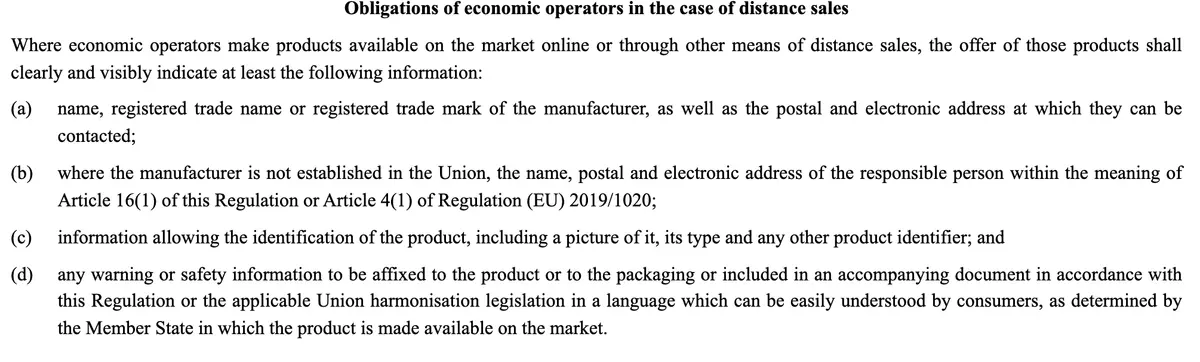
The Commission's questions-and-answers document reads points (a) and (b) together: even if the manufacturer is outside the EU, the manufacturer's details must still appear on the listing. For a Turkish brand that means two addresses on the listing: the company in Türkiye and the responsible person in the EU.
How to set up GPSR on a Shopify product page
We recommend setting up the GPSR information with metafields rather than typing it onto every product by hand. The manufacturer and the responsible person are entered once at store level. At product level you keep the product identifier and the warning text by language. The theme shows these fields in a block titled "Product safety" on the product page. This setup also feeds the product identifier the customs declaration needs from the same field, so one set of data does both jobs. Building the metafield structure, the multilingual warning text and the customs data that goes to the carrier is a typical job for our integration and custom app service. It removes the risk of an incomplete listing that hand entry creates in a catalogue of hundreds of products.
Each member state sets the GPSR penalties itself (Article 44 of the Regulation). The regulation only requires the penalties to be effective, proportionate and dissuasive. Accident reporting is also the responsible person's job. If you learn that your product has caused a serious injury in the EU, Article 20 says this incident is reported through the Safety Business Gateway to the competent authority of that country.
Packaging and EPR: LUCID registration and an authorised representative in Germany
A seller who ships a product to Europe by parcel also carries extended producer responsibility (EPR) for the box, the filler and the tape: the seller finances the recycling of the packaging and registers in the register of the country of sale. The EU's Packaging and Packaging Waste Regulation (PPWR) started to apply on August 12, 2026, and it brought a new requirement in Germany for firms that ship directly from abroad to the end user.
According to Germany's Central Packaging Register (ZSVR), a foreign firm with no establishment in Germany that sells packaged goods directly to an end user in Germany has, since August 12, 2026, had to appoint an authorised representative in Germany. The representative concludes the system-participation contract, reports the packaging quantities and carries out the other producer obligations in the seller's name. Registration in the LUCID register cannot be delegated to the representative: the seller makes this registration itself and completes it before the first shipment. The representation contract must be in German and in writing, and it must carry the wet-ink or qualified electronic signature of both parties.
E-commerce packaging is always in scope
The ZSVR's page for e-commerce sellers treats shipping packaging as subject to system participation without exception, including the shipping box, the bag, the label, the tape and the filler. Marketplaces and fulfilment firms must also check the seller's LUCID registration and EPR declaration. Without a registration the product cannot be listed on the marketplace, and the fulfilment firm stops the service.
| Country | Packaging obligation | The Turkish seller's first step |
|---|---|---|
| Germany | LUCID registration, system participation, quantity reporting; an authorised representative since August 12, 2026 | LUCID registration and a German-language contract with an authorised representative in Germany |
| Other EU countries | A common framework under the PPWR; the registers are separate country by country | Check the registration requirement in the register of every country with sales volume |
Source: ZSVR, verpackungsregister.org; November 26, 2026.
In stores that plan to sell to Germany, we put the LUCID registration and the representative contract on the list of jobs to finish in the first week of selling abroad. Registrations in other countries are queued once regular orders start to arrive from that country.
Consumer law and personal data: the right of withdrawal, the discount price, GDPR
A Turkish store that sells to an EU consumer also follows EU consumer law: the buyer has a 14-day right of withdrawal, the previous price shown in a discount announcement must be the lowest price of the previous 30 days, and personal data is processed under the GDPR. These rules look at whether the sale is directed at an EU consumer, not at where the seller is established.
The 14-day right of withdrawal and return shipping
Under the Consumer Rights Directive (2011/83/EU), in a distance sale the consumer may withdraw without giving a reason within 14 days of the day the product was received. If the seller does not inform the consumer of this right, the period extends by 12 months. The return shipping cost can be placed on the consumer only if this is clearly stated before the sale. If it was not stated, the return shipping stays with the seller.
For a seller shipping from Türkiye, a return is a process that asks for as many documents as the export: a parcel coming back from the EU to Türkiye is cleared through customs in Türkiye again. When you write your return policy, settle one of two options. Either the return address is in Türkiye and the cost of the return shipment is charged to the buyer, or you agree a return-collection address in the EU. The return-policy page in Shopify should be written as a separate language version for the EU market.
The 30-day rule on a discount announcement
The EU price-indication rule (Directive 98/6/EC, Article 6a as amended by 2019/2161) requires the previous price shown in a discount announcement to be the lowest price in the 30 days before the discount. A store that raises the price before a November campaign and then shows a discount breaches this rule directly. EU consumer authorities look at this practice separately during campaign periods. The "compare-at price" field in Shopify is not checked automatically against this rule. Check the price history of the EU market before a campaign.
The GDPR and a representative in the EU
The GDPR (Regulation (EU) 2016/679) also applies to a company outside the EU that offers goods to people in the EU (Article 3(2)). Article 27 of the same regulation requires these companies to appoint a representative in the EU. There is an exception if the data processing is occasional and low-risk. A store that sells to the EU regularly and uses customer data in email marketing does not fall within that exception. We cover the cookie-consent side separately in our guide to cookie management on Shopify.
Setting up EU sales in Shopify: step by step
EU sales in Shopify take six settings: an EU market, the VAT registration (IOSS), prices shown including VAT, customs information on the products, the GPSR information and a return policy written for the EU. Do not change the order. On an EU market opened before the IOSS number is entered, checkout does not collect VAT, and the VAT on the first orders is left at the buyer's door.
- Open the EU market. Under Settings > Markets (Ayarlar > Pazarlar), create a market that contains the EU countries, and put the United Kingdom, Switzerland and Norway in a separate market. We explained how foreign-currency collection works on a store in Türkiye in our guide to foreign-currency collection.
- Enter the IOSS number. Enter the number your intermediary gives you, the one that starts with "IM", under Settings > Taxes and duties > European Union (Ayarlar > Vergiler ve gümrük vergileri > Avrupa Birliği), in the section for shipping from outside the EU into the EU. After this setting, checkout calculates the buyer's country VAT on orders of up to €150.
- Show prices including VAT. Turn on "include tax in prices" for the EU market, and reflect the €3 and the €2 in the price or in the shipping rate.
- Fill in the customs information. On every variant, enter the country of origin and a tariff code (GTİP, HS code) of at least 6 digits. The shipping integration carries these fields to the ETGB and to the EU declaration. The number of items is also calculated from this code.
- Add the GPSR information. Create metafields for the manufacturer, the EU responsible person, the product identifier and the warning text, and show them on the product page.
- Write the return policy for the EU. Write the 14-day right of withdrawal, the return address and who pays the return shipping, in the languages of the EU.
We explained the general setup of the taxes menu, and the VAT settings in Türkiye, in our guide to Shopify tax settings. On stores that will sell abroad, our Shopify store setup service builds these six steps in one plan together with the market, the tax and the shipping integration. A sequencing error, such as opening the EU market before the IOSS number arrives, is prevented only by doing it this way from the start.
Which path suits whom: a decision table in 5 questions
The right model depends on the cart value, the number of product types in the cart and the monthly number of EU orders. The five questions below give enough data for a Turkish Shopify store to choose its model for selling to Europe.
| Question | If yes | If no |
|---|---|---|
| 1. Are most of your orders €150 or less? | Choose between IOSS and A.TR (question 2) | The benefit of IOSS is limited; use DDP or DAP, and an H1 declaration with an A.TR |
| 2. Is it essential for you that the buyer has no extra payment at the door? | IOSS; put the €3 and the €2 per item into the price | Ship with an A.TR and without IOSS; show a "taxes are paid on delivery" notice at checkout |
| 3. Does the cart contain on average 3 or more different tariff codes? | The per-item cost rises under IOSS; calculate the A.TR path | On a single item, the extra cost of IOSS is €5 per order |
| 4. Do you have more than a few hundred EU orders a month? | Calculate a warehouse in the EU and the OSS model | Ship directly from Türkiye |
| 5. Are your products food or agricultural products? | An A.TR cannot be used; use IOSS, or EUR.1 as proof of origin | The A.TR option is open |
Source: Nodus Works decision table; the rules are from Regulation 2026/382, the Commission guidance and the GPSR. November 26, 2026.
Some jobs do not change on any path: the GPSR responsible person, LUCID registration and an authorised representative if you sell to Germany, the 14-day right of withdrawal, and the ETGB and the exempt invoice on the Turkish side. The tax model you choose removes none of these.
You do not have to make this choice alone. Splitting your store's EU orders of the last six months by cart value and by tariff-code mix, and working out the cost per order of the three paths, is the first calculation we do for stores opening to Europe in our Shopify consulting service.
Conclusion: 5 jobs to finish before the first order to Europe
Selling to Europe in 2026 is not only VAT. There is a customs duty of €3 per item on every IOSS consignment, a handling fee of €2 per item on every consignment, a GPSR responsible person established in the EU, and an authorised representative for Germany. The largest advantage a Turkish seller holds is the customs union: an industrial product declared with an A.TR and without IOSS is exempt from the €3.
Finish these five jobs before the first order:
- Choose the IOSS or the A.TR path according to your cart value and your tariff-code mix. If you chose IOSS, appoint an intermediary in the EU.
- Get in writing from your carrier the electronic A.TR, the H1 declaration, and how the €3 and the €2 are invoiced.
- Make a GPSR contract with an authorised representative in the EU, and add the manufacturer and the responsible person to the product pages.
- If you will sell to Germany, complete the LUCID registration and appoint an authorised representative in Germany.
- In Shopify, set up the EU market, the IOSS number, prices including VAT, the tariff codes and the EU return policy.
For the ETGB, the exempt invoice and the VAT refund on the Turkish side, go to our guide to micro-export and the ETGB. If you want to calculate the cost of your EU sales together with your order volume, book a meeting. We will draw the comparison of the three paths with your own figures.
Frequently asked questions
Is an IOSS number mandatory?
No. IOSS is optional. You need it if you want to collect the VAT at checkout on orders of up to €150. On a consignment without IOSS, the buyer pays the VAT to the carrier on delivery. On an IOSS consignment, a customs duty of €3 per item has also arisen since July 1, 2026.
How do you get an IOSS number from Türkiye?
A company in Türkiye cannot register for IOSS directly. It must appoint an intermediary established in the EU. The intermediary registers in your name with the tax authority of its own country and obtains your 12-character number starting with "IM". The intermediary also files the monthly IOSS return, and the person liable to pay the VAT is the intermediary.
Does a parcel sent to Europe attract customs duty?
Since July 1, 2026 there is a customs duty of €3 per item on consignments of up to €150. An industrial product in free circulation in Türkiye enters exempt from this duty if the VAT was not collected through IOSS and the consignment is declared with an A.TR and an H1 declaration. Above €150 the normal tariff applies. On a Turkish industrial product with an A.TR, the duty is zero.
Who pays the €2 EU handling fee?
Since November 1, 2026 the handling fee is €2 per item on every distance-sale consignment, and the value of the consignment is not looked at. The debtor is the person who files the customs declaration: the IOSS holder or the carrier. The consumer is not the debtor. The carrier usually invoices the amount to the seller, so include it in your pricing.
Can you sell to Europe without a GPSR responsible person?
No. Under Article 16 of the GPSR, a product cannot be placed on the EU market without a responsible person established in the EU. For a brand that ships directly from Türkiye to the consumer, that person is an authorised representative appointed by a written contract. The name and address must appear on the listing and on the parcel.
If I sell on Etsy, do I need an IOSS number?
Usually no. On sales of imported goods of up to €150, Etsy and Amazon count as the seller for VAT. They collect the VAT and declare it under their own IOSS numbers. Your job is to pass the IOSS number the marketplace gives on the order to the carrier. On your Shopify store you need your own IOSS registration.
What happens on orders above 150 euros?
A consignment above €150 cannot enter IOSS. VAT is paid at import: under DAP the buyer pays at the door, under DDP the carrier pays on the seller's behalf and invoices the seller. Customs duty is calculated on the normal tariff, and it is zero on a Turkish industrial product with an A.TR. The handling fee of €2 per item is charged on these consignments too.