















































































































Etsy or Shopify? Fees, Traffic and Control for Sellers Shipping from Türkiye (2026)

On a $50 order, Etsy takes about $7.82 from a seller in Türkiye in listing, transaction, payment and regulatory fees. On an order from Offsite Ads the cut rises to $15.32. Shopify Basic takes about $3.15 on the same order with iyzico. You bring the customer.
 Author: Efe Gündüz Nodus Works Shopify Agency Founder
Published 41 min read
Etsy or Shopify is the choice in front of a seller in Türkiye who wants to sell handmade, designed or made-to-order goods abroad. Etsy is a marketplace where the buyer is already there: you place the product in Etsy's search with a $0.20 listing, and Etsy takes a fee on every sale. Shopify is an ecommerce platform that runs on your own domain: you pay a monthly plan, and the cut per sale is lower. You bring the customer to the site yourself.
We read Etsy's fees from the tables in the Etsy Help Center on November 25, 2026. Shopify plan prices are the figures on the pricing page opened from Türkiye in a real browser on November 23, 2026, and they match the other 2026 articles on this site: on annual billing, Basic is $24, Grow is $65 and Advanced is $359. Two lines that Etsy applies to a seller in Türkiye are missing from most Turkish guides: the 6.5% plus 14 TL payment processing fee, and the 1.67% regulatory operating fee. At Nodus Works, the first job when we set up Shopify for a brand coming from Etsy is to calculate the real cut, including both of those lines. On a $50 order that rate is 15.6%, and on an order from Offsite Ads it is 30.6%.
Etsy or Shopify: the short answer
For a seller who is new to selling abroad, has no advertising budget and is aiming for a few dozen orders a month, Etsy starts faster, because the buyer is already searching on Etsy. For a seller who wants to build a brand, hold the customer's email and lower the cut per sale, Shopify is cheaper over time: on a $50 order Etsy takes about $7.82, while Shopify Basic and iyzico together take about $3.15.
The $4.67 gap between those two figures does not decide the question on its own. The fee Etsy takes includes the cost of finding the customer. On Shopify you pay that cost separately, as advertising or content. If bringing one order from abroad on Shopify costs more than $4.67, Etsy, with the higher cut, works out cheaper overall.
Our position is this: Etsy is the right place to test whether a product sells abroad. It is not the right place to grow a brand. A seller who takes more than 100 orders a month on Etsy and has customers who buy again should calculate the yearly value of the fee gap and open Shopify as a second channel.
The seller Etsy suits
- A seller whose product is new. Opening a listing on Etsy costs $0.20, and there is no fixed monthly fee. For a product that does not sell, four months of renewing a single listing cost $0.80.
- A seller whose category overlaps with the Etsy buyer. Jewellery, ceramics, personalised gifts, digital patterns and vintage goods are Etsy's main categories. The Etsy buyer searches for them in the platform's own search.
- A seller who does not want to manage ads. With Offsite Ads, Etsy shows the product on Google, Meta and Pinterest on its own budget. It takes the fee only if a sale happens.
- A one-person workshop. On Etsy there is no theme, checkout, SSL or server work. The seller's job is the listing, the photographs and the shipping.
The seller Shopify suits
- A seller who also sells the brand outside Etsy. Traffic from Instagram, TikTok or a wholesale customer lands on your own domain on Shopify. On Etsy that traffic lands on Etsy, next to competing listings.
- A seller with a high average order. Etsy's percentage fees grow with the order amount. On a $300 rug, Etsy's standard cut is about $44.50. The same order on Shopify Basic and iyzico is about $19.
- A seller who sells again to the same customer. On Shopify the customer's email and order history stay with you, and you take the second order by email. Etsy limits marketing contact with the buyer under its own rules.
- A seller with a wide catalogue. On 500 products, Etsy's listing fee is $100 every four months. On Shopify the number of products does not change the plan fee.
What Etsy charges a seller in Türkiye (2026)
Etsy takes four standard fees from a seller in Türkiye: $0.20 per listing, a 6.5% transaction fee on the order amount, a payment processing fee of 6.5% plus 14 TL, and a 1.67% regulatory operating fee. On an order from Offsite Ads, a 15% advertising fee is added. Every fee is calculated on the item price plus shipping and gift wrap.
The first two of these four lines are the same for a seller in every country. The last two change by country. The payment processing rate for a seller in Türkiye (6.5%) is more than twice the rate for a seller in the United States: the same Etsy table shows 3% plus $0.25 for the United States and 4% plus €0.30 for Germany. Türkiye is one of the nine countries where Etsy applies a regulatory operating fee, and inside those nine it is the highest rate after Hungary (1.97%).
| Fee | Rate or amount | What it applies to | When |
|---|---|---|---|
| Listing fee | $0.20 | Each listing; each extra quantity sold | When the listing opens, and each time it renews, every 4 months |
| Transaction fee | 6.5% | Item price, shipping, gift wrap | When a sale happens |
| Payment processing fee | 6.5% + 14 TL | The order total | When a sale happens |
| Regulatory operating fee | 1.67% | Item price, shipping, gift wrap | When a sale happens |
| Offsite Ads | 15% (under $10,000 a year), 12% (above); at most $100 per order | The amount of the order that came from an ad | If the buyer who clicked the ad purchases within 30 days |
| Deposit fee | 42 TL | Payouts between 50 TL and 600 TL | When Etsy pays out to the account |
| Currency conversion fee | 2.5% | If the listing currency differs from the bank account currency | When Etsy converts the payout into TL |
| Shop opening fee | Varies by country, not refunded | Once | When the shop opens |
Source: Etsy Help Center, payment processing fees, regulatory operating fee, Etsy fee basics, Offsite Ads, November 25, 2026.
Listing, transaction and payment processing fees
According to Etsy's fee basics page, the listing fee is $0.20 and it is charged even if the product does not sell. A listing stays up for four months. If auto-renew is on, Etsy charges the $0.20 again when it republishes the listing. If more than one unit sells from the same listing in one order, Etsy charges an extra $0.20 for each unit after the first.
The transaction fee is 6.5%. It is calculated in the listing currency on the total of the item price, the shipping charge and gift wrap. Showing a low shipping charge and adding it to the item price does not change the transaction fee. Both paths are cut from the same total.
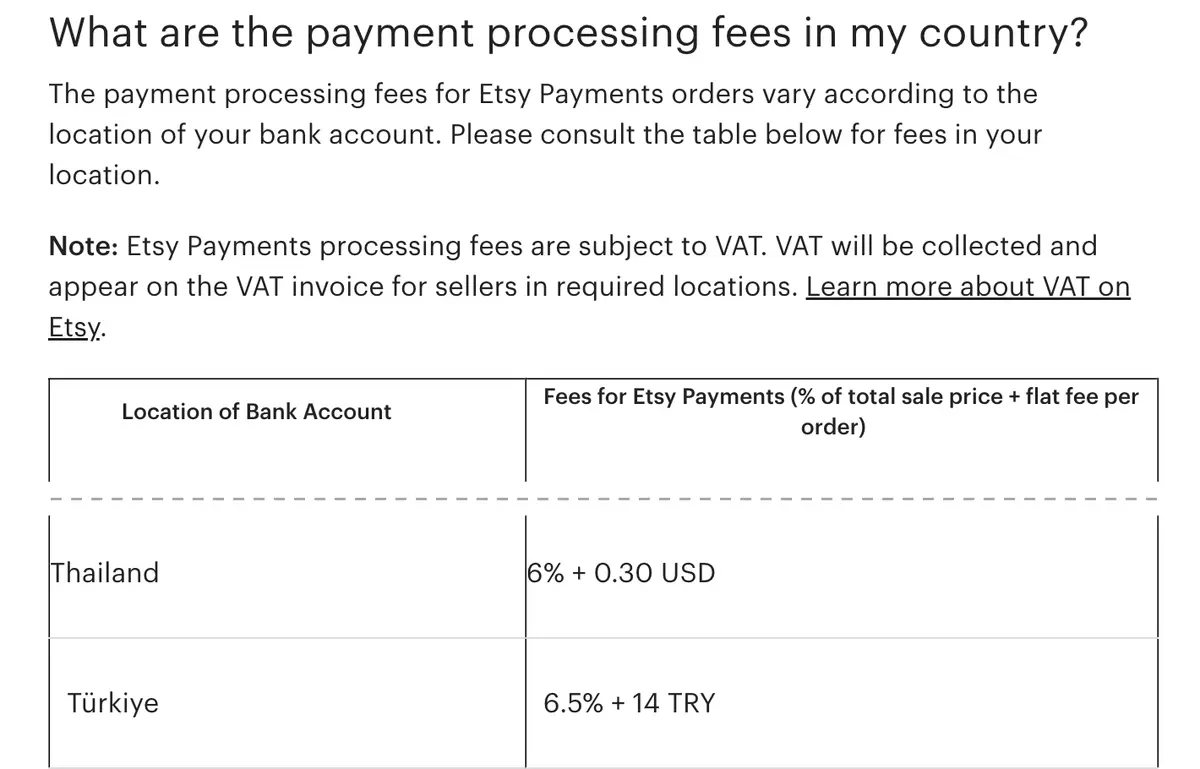
The payment processing fee is what Etsy Payments charges to process a payment taken by card, Apple Pay or an Etsy gift card. The rate depends on the country of the seller's bank account: 6.5% plus 14 TL for a bank account in Türkiye. On a $50 order, at the Central Bank of the Republic of Türkiye (TCMB) forex buying rate on November 24, 2026 (1 USD = 50.54 TL), this line is about $3.53.
The regulatory operating fee specific to Türkiye (1.67%)
In countries where new rules have raised the cost of doing business, Etsy passes that cost to the seller under the name regulatory operating fee. According to Etsy's help page, the rate for a seller in Türkiye is 1.67%. The fee is taken from the total of the item price, shipping and gift wrap, and it appears in the payment account together with the other fees.
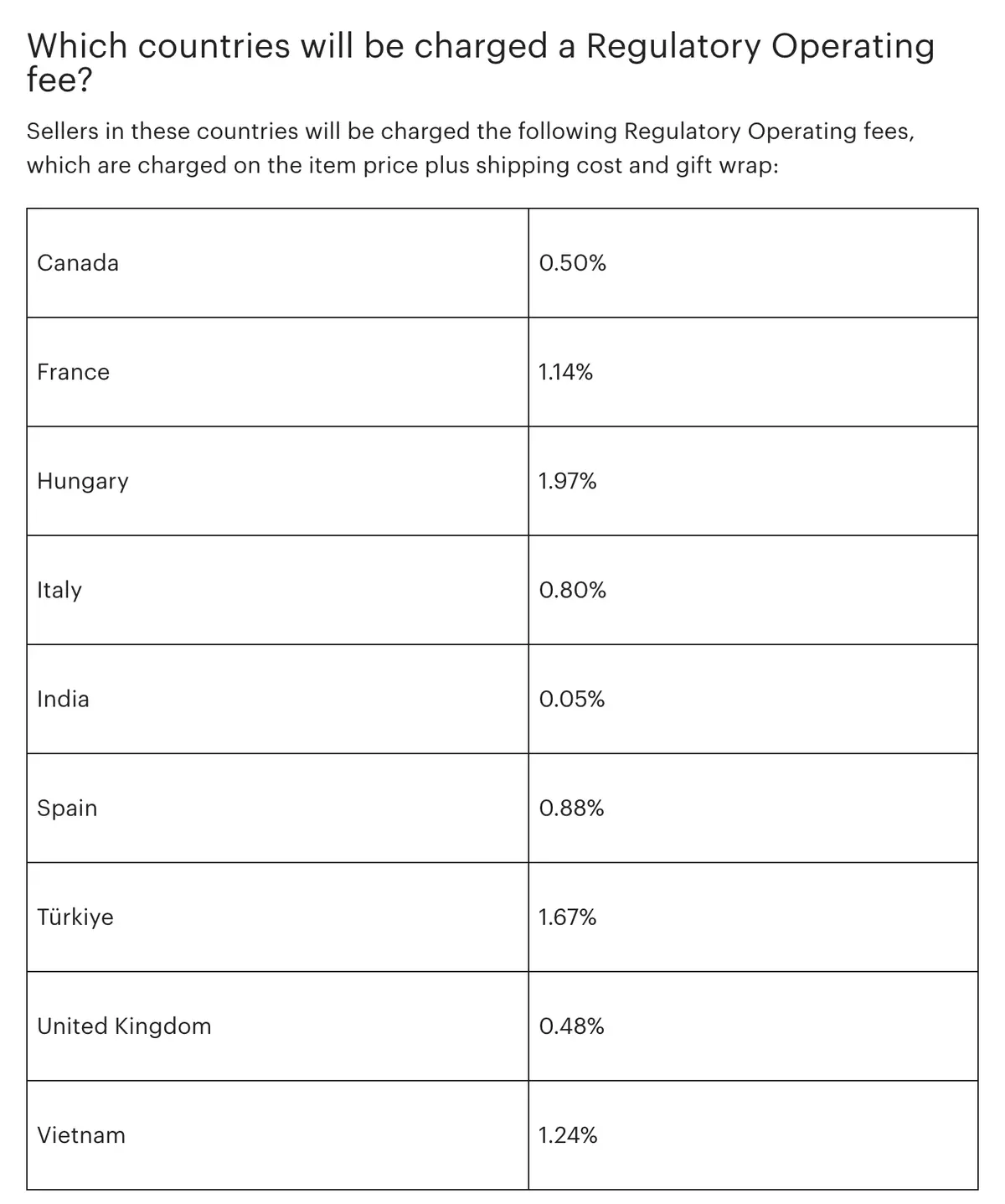
We give this line its own heading for a reason: some fee calculators and older guides still show the Türkiye rate as 2.27%. On November 25, 2026 the rate in Etsy's own table is 1.67%. In a shop selling $2,000 a month, the gap between the two rates is $12 a month and $144 a year.
Etsy's help page says the regulatory operating fee and the payment processing fees are subject to VAT in the countries where they apply. Check the VAT line on the monthly bill from Etsy with your accountant.
Offsite Ads: 15% and 12%, and the $10,000 threshold
Offsite Ads is Etsy showing your listings on search engines, social media, partner sites and the Google Display Network, on its own budget. The seller does not put money into the ad. If a buyer who clicked the ad purchases from your shop within 30 days, Etsy takes an advertising fee on that order. According to Etsy's Offsite Ads page, a shop that sold under $10,000 in the last 365 days pays 15%, and a shop that has passed the threshold pays 12%. The fee does not exceed $100 per order.
Once the threshold is passed, Offsite Ads becomes mandatory and the shop cannot leave the programme. A shop under $10,000 can turn Offsite Ads off in its settings. The cost of turning it off is losing the orders Etsy brings from outside sites. If those orders are a small share of total sales, turning it off lowers the cut directly.
To make the decision, look at the Offsite Ads report in Shop Manager: it lists the orders that came from ads and the fee taken on each. If the same click turns into more than one order within 30 days, Etsy takes a separate fee on each order. If the margin on those orders is under 15%, every order that comes from an ad is losing money.
Payout in Turkish lira, and the 42 TL deposit fee
Etsy Payments pays a seller in Türkiye out to a bank account in Türkiye, in Turkish lira. If the shop's listing currency is the dollar, Etsy converts the sale into the bank account's currency and, according to its fees page, takes a 2.5% currency conversion fee for that conversion. Choosing TL as the listing currency removes this fee. The buyer abroad then sees the price at the amount Etsy itself converted, and your price changes on the buyer's screen whenever the rate changes.
According to the table on Etsy's payments page, in Türkiye the minimum payout is 50 TL, the fee threshold is 600 TL and the payout fee is 42 TL. If the payout is above 50 TL but below 600 TL, 42 TL is taken. That is 14% of a 300 TL payout. A new seller who chooses a weekly or daily automatic payout meets this cut often. Set the payout schedule to the frequency at which the balance passes 600 TL.
Whether a payout from Etsy to Türkiye counts as export proceeds, whether the shipment must leave with an Electronic Commerce Customs Declaration (ETGB, Elektronik Ticaret Gümrük Beyannamesi), and how the invoice should be issued, are questions to answer before the product is handed to the carrier. We take those three questions separately for an Etsy order and a Shopify order in section 7.
What Shopify charges a store in Türkiye
Shopify takes two fees from a store in Türkiye: a plan fee that starts at $24 a month on annual billing, and a transaction fee of between 2% and 0.2% on every card sale, depending on the plan. The card payment is not collected by Shopify. A payment provider such as iyzico or PayTR collects it and takes its own commission on top. The listing, regulatory and advertising fees on Etsy have no equivalent on Shopify.
The largest structural difference from Etsy is this: on Shopify there is a fixed cost and a low cost per sale. On Etsy there is no fixed cost and a high cost per sale. A Shopify store with no sales pays $24 a month. An Etsy shop with no sales and 20 listings pays about $1 a month. Once sales arrive, that order reverses.
Plan fee: Basic $24, Grow $65, Advanced $359
On Shopify's pricing page opened from Türkiye, the monthly prices on annual billing are $24 for Basic, $65 for Grow and $359 for Advanced. On monthly billing they are $27, $72 and $399. Shopify Plus starts at $2,300. The plan fee is in dollars and is collected from a credit card on the Shopify bill.
These prices differ from the prices in the United States. Because Shopify shows the price according to the visitor's location, a "Basic $39" figure read from a blog abroad does not apply to a seller in Türkiye. For a seller coming from Etsy, the plan choice is usually Basic. Basic has no product limit, and a 500-product Etsy catalogue moves at the same fee.
| Plan | Per month on annual billing | On monthly billing | Shopify transaction fee (third-party payments) |
|---|---|---|---|
| Basic | $24 | $27 | 2% |
| Grow | $65 | $72 | 1% |
| Advanced | $359 | $399 | 0.6% |
| Plus | From $2,300 | 0.2% |
Source: Shopify pricing, the page opened from Türkiye, November 23, 2026. On November 25, 2026 a headless browser showed $19, $54 and $299 on annual billing because of location. This article uses the Türkiye prices. For the detailed breakdown of plan and transaction fees, see our Shopify transaction fees article.
The Shopify transaction fee and the payment provider's commission
Shopify Payments is not open to companies in Türkiye. A Shopify store in Türkiye therefore collects the card through a payment provider licensed by the TCMB, and two cuts arise on every card sale: Shopify's transaction fee by plan, and the payment provider's commission. Shopify does not take a transaction fee on payments collected by bank transfer (havale/EFT).
To collect foreign currency from a buyer abroad, the iyzico Multi Currency add-on is used. According to iyzico's pricing page, the add-on collects in six currencies, including the dollar, the euro and sterling. It costs 99 TL a year, and the commission for a corporate seller is 4.29% plus 0.25 TL per transaction. The money reaches the store's account in Turkish lira. On Basic, for a $50 order, iyzico takes about $2.15 and Shopify takes $1.00. The total is $3.15, which is 6.3% of the order.
There is a condition on the Shopify side: in a store without Shopify Payments, checkout opens in the store's default currency. A store that wants to show a dollar price to a buyer abroad has to make the dollar the default currency. We set out the effect of that setting on the payment provider, the accounts and the invoice, step by step, in our article on foreign-currency collection and Merchant of Record on Shopify.
App, theme and domain costs
Three cost lines that do not exist on Etsy depend on the seller's decision on Shopify. The domain is paid yearly. A theme is free if it is one of the free themes in the Shopify Theme Store, and a paid theme is paid once. Most apps run on a monthly subscription and are added to the Shopify bill.
Some of the apps a seller coming from Etsy needs in the first month are Shopify's own free apps. Translate & Adapt, which translates the store into English and German, and Shopify Markets, which sets price and language by country, are examples. At Nodus Works we recommend limiting paid apps to two for the first 90 days on stores coming from Etsy: one that moves reviews from Etsy, and one that syncs stock with Etsy. Every other app is added after the store has taken its first 100 orders.
The whole of this setup on Shopify, the theme, the payment provider, Markets and the translation setting, is work the seller does not do on Etsy. For a setup that moves the Etsy catalogue, the reviews and the URL structure without losing them, our Shopify store setup service delivers the iyzico Multi Currency and Markets settings with a test order from abroad.
The total cut on a $50 order, and cost by monthly revenue
On a $50 order, Etsy's standard cut is $7.82 (15.6%), and $15.32 (30.6%) if the order came from Offsite Ads. Shopify Basic and iyzico take $3.15 (6.3%), plus the $24 monthly plan fee. At $500 of monthly revenue the total cost of the two platforms is close. At $5,000 of revenue, Shopify's cost falls below half of Etsy's.
The calculations below use the TCMB forex buying rate on November 24, 2026 (1 USD = 50.54 TL). On Etsy the listing currency is taken as the dollar. The currency conversion fee is shown on its own row, because a seller who opens the listing in TL does not pay it.
One order: Etsy, Etsy plus Offsite Ads, Shopify Basic
Example order: a $40 item and $10 shipping, $50 in total. The buyer is abroad, and payment is by card.
| Line | Etsy | Etsy + Offsite Ads (15%) | Shopify Basic + iyzico |
|---|---|---|---|
| Listing fee | $0.20 | $0.20 | |
| Etsy transaction fee (6.5%) | $3.25 | $3.25 | |
| Etsy payment processing (6.5% + 14 TL) | $3.53 | $3.53 | |
| Regulatory operating fee (1.67%) | $0.84 | $0.84 | |
| Offsite Ads | $7.50 | ||
| iyzico commission (4.29% + 0.25 TL) | $2.15 | ||
| Shopify transaction fee (2%) | $1.00 | ||
| Total cut | $7.82 (15.6%) | $15.32 (30.6%) | $3.15 (6.3%) |
| Currency conversion (if the listing is in dollars, 2.5%) | about $1.25 | about $1.25 |
The $24 monthly plan fee is not in the Shopify column. That line belongs to the month, not to the order, and it sits in the next table. The shipping label is a separate cost on both platforms, so it is left out of the calculation.
The largest line in the table is Etsy's two charges of 6.5%. A seller in Türkiye pays 3.5 percentage points more on payment processing than a seller in the United States: on the same $50 order, the payment processing fee is $1.75 for the seller in the United States and $3.53 for the seller in Türkiye.
Both platforms at $500, $2,000 and $5,000 of monthly revenue
Three revenue levels for a store with a $50 average order: 10, 40 and 100 orders a month. For Etsy, 20% of orders are assumed to come from Offsite Ads. At the $2,000 and $5,000 levels, which pass $10,000 a year, the Offsite Ads rate is 12%.
| Monthly revenue | Etsy (Offsite Ads share 20%) | Shopify Basic + iyzico | Shopify Grow + iyzico |
|---|---|---|---|
| $500 (10 orders) | $93.20 (18.6%) | $55.50 (11.1%) | $91.50 (18.3%) |
| $2,000 (40 orders) | $360.80 (18.0%) | $150.00 (7.5%) | $171.00 (8.6%) |
| $5,000 (100 orders) | $902.00 (18.0%) | $339.00 (6.8%) | $330.00 (6.6%) |
The calculation: the Etsy row is $7.82 per order, plus an extra fee on Offsite Ads orders of $7.50 (at $500) or $6.00 (at the other levels). The Shopify row is the plan fee plus $3.15 per order (Basic) or $2.65 (Grow).
Two results come out of the table. First, Etsy's cut stays almost flat as revenue grows (around 18%), while Shopify's falls, because Shopify's fixed fee is spread over more orders. Second, the threshold for moving from Basic to Grow is about $4,100 of card revenue a month: Grow's extra $41 of plan fee a month pays for itself after that revenue, through the 1% difference in the transaction fee.
The line that does not show in the calculation: the cost of acquiring a customer on Shopify
The table above shows Shopify as cheaper at every revenue level. The line that is not in the table is the cost of bringing a buyer to the Shopify store. Inside Etsy's 18% cut is the buyer who comes from Etsy search. On Shopify you bring that same buyer yourself, with ads, content or social media.
Calculate the threshold per order. In a store with $2,000 of monthly revenue, the gap between Etsy and Shopify Basic is $210.80. Divided by 40 orders, that is $5.27 per order. If an order from abroad that comes through ads on Shopify costs more than $5.27, Etsy is cheaper overall at this revenue level. The threshold falls to $3.77 in a store with $500 of monthly revenue, and rises to $5.63 in one with $5,000.
This threshold is low for an order that comes through ads. Where Shopify overtakes Etsy is not the order from ads. It is the share of orders that arrive without ads: from the Instagram profile, the email list, the customer who buys again, and the brand search on Google. On Shopify that order costs only $3.15. At Nodus Works, before we open Shopify for a seller coming from Etsy, we ask one question: what share of your orders today comes from a customer who searched for you by name, or who has bought before? If that share is under one third, open Shopify as a second channel and do not close Etsy.
Compare the cost per order (CPA) in your ads panel with this threshold. Setting up Meta and Google ads for a market abroad, and pulling the CPA under the per-order cut on Etsy, is a separate job. Our Meta ads management service sets the campaign to this threshold in the first month and pauses a campaign that passes the CPA threshold.
Who brings the customer: Etsy search and traffic on Shopify
On Etsy, Etsy's own search brings the customer. The seller's job is to write the title, the tags and the reviews that move the listing up in that search. On Shopify the seller brings the customer: Google, Pinterest, Meta ads, email and the social account. The first order is therefore faster on Etsy, and the cost of the repeat order that comes after the first one is lower on Shopify.
The owner of the traffic is different on the two platforms as well. A buyer who arrives from Etsy search is Etsy's customer. On the same results page they also see competing listings, and they can add products from more than one shop to the cart. A buyer who arrives on Shopify sees only your products. If a buyer finds you on Etsy and then searches for your name on Google the next time, landing that search on your Shopify store is the first step that reduces the brand's dependence on Etsy.
Ranking in Etsy search: match, listing quality, shop experience
According to Etsy's seller handbook, search works in two stages. First it finds the listings that match the words the buyer typed. The match looks at the listing's title, tags, category and attributes. Then it ranks those listings. Listing quality (the rate at which the listing shown in search is clicked, favourited and bought), the shop's customer experience (the average review score over the last three months, the reply rate to messages, and the rate of cases opened) and the shipping price all play a part in the ranking. A new shop starts with a neutral score.
That ranking has two practical consequences for a seller in Türkiye:
- The title and the tags are written in English. Etsy's main audience is in the United States. The buyer types "handmade ceramic mug", not "el yapımı kupa". Etsy allows 13 tags and a title of up to 140 characters on each listing. Each tag should be a separate phrase the buyer would type into the search box.
- Shipping time and price affect the ranking. A standard shipment from Türkiye to the United States takes longer, and costs more, than a competing listing shipped from inside the United States. Folding the shipping price into the item price and offering "free shipping" does not change Etsy's fee, because both paths are cut from the same total. What changes is the price the buyer sees in the search result: one figure, with no shipping added afterwards.
Etsy Ads is the ad space inside Etsy's own search results, and it is separate from Offsite Ads. The seller sets a daily budget and pays per click. In a new shop, Etsy Ads is the fastest way to get the first clicks and sales that build the listing quality score.
The first orders on Shopify: Google, Pinterest, Meta and the audience you already have
A newly opened Shopify store has no history in search engines, and organic traffic from Google arrives over months. The first orders usually come from four channels:
| Channel | How it works | Cost | Time to the first order |
|---|---|---|---|
| The audience you already have | The link on the Instagram and TikTok profile, and the insert card that goes to the Etsy buyer | None | Days |
| Google's free product listings | The product feed goes to Merchant Center through Shopify's Google & YouTube app | None on the free listing | Weeks |
| A product pin and a catalogue. In handmade and home categories the buyer searches on Pinterest | None on organic, per click on ads | Weeks | |
| Meta and Google ads | A campaign aimed at the target country | Per click and per impression | Days |
The first row of the table is the lowest cost, and most Etsy sellers already have it. Etsy limits messages that send the buyer off the platform, under its own rules. Check Etsy's current seller policy before you decide whether a card inside the parcel, carrying the shop name and the Instagram account, conflicts with that rule.
Setting up product visibility on Google, on the Merchant Center side, is a separate job. Treat the way the product feed is sent from Shopify as the first step of a traffic plan that does not depend on Etsy. Writing product titles and collection pages on Shopify for English search is the same keyword work you do for tags on Etsy. The same word list is used on both platforms.
Getting paid from Türkiye: Etsy Payments, and iyzico or PayTR on Shopify
On Etsy, Etsy Payments collects the payment and pays the sales proceeds into a bank account in Türkiye, in Turkish lira. The seller does not have to apply to a separate payment provider. On Shopify, a payment provider licensed by the Central Bank of the Republic of Türkiye (TCMB), such as iyzico or PayTR, collects the payment under a contract with the seller. On both platforms the card of the buyer abroad is charged, and the money arrives in the account in Türkiye in Turkish lira.
The difference is who is responsible for the payment flow. On Etsy, accepting the card, converting the currency, the fraud check and the first review of a buyer dispute are Etsy's job. On Shopify each of those jobs depends on the contract with the payment provider, and when something goes wrong the counterparty is the payment provider, not Shopify.
| Etsy Payments | Shopify + iyzico | Shopify + PayTR | |
|---|---|---|---|
| Application | Together with the Etsy account | Merchant application | Merchant application |
| Currency the buyer sees | The listing currency, or a price converted into the buyer's currency | The store's default currency | The store's default currency |
| Money that arrives | TL | TL | According to the contract |
| Cut | 6.5% + 14 TL | 4.29% + 0.25 TL (corporate) | The foreign-currency rate is in the quote |
| Payout frequency | The schedule the seller chooses | Weekly | According to the settlement period (valör) |
Source: Etsy Help Center, iyzico pricing, PayTR virtual POS, November 25, 2026.
Etsy Payments: payout in lira, the reserve, and the tax registration
Opening an Etsy account does not require a company. Etsy asks for identity verification and a bank account. That does not mean a sale can be made in Türkiye without a tax registration. Regular selling is a commercial activity, and the seller becomes a taxpayer. The payout from Etsy is sales income. Before you start selling on Etsy, talk to your accountant about the type of registration (a sole proprietorship or a limited company) and about the invoice for a sale abroad.
Etsy can hold part of the balance of a new seller, or of a seller whose sales are rising quickly, for a period. The name of that practice is a payment reserve. The reserve hits the cash flow of the first months directly. A workshop that buys materials for production may not see part of the sales proceeds in its account for weeks. The duration and the rate of the reserve are shown on Etsy's payment account screen.
iyzico and PayTR on Shopify: the settlement period and a disputed payment
On Shopify the payment provider deducts its own commission after it charges the card, and pays the remainder into the account at the end of the settlement period (valör). According to iyzico's sign-up page, a corporate seller's payouts arrive weekly. On PayTR the settlement period changes with the rate you choose, and on a 7-day settlement the Turkish lira rate starts at 2.19%. PayTR's foreign-currency rate for cards from abroad is not published on the page. It is set in the quote.
The problem that comes up most often on a sale abroad is a payment dispute opened through the buyer's bank (a chargeback). In a Shopify store the dispute arrives at the payment provider. The seller submits the tracking number, the delivery record and the correspondence to the payment provider. On Etsy the buyer first opens a case through Etsy, and the process runs under Etsy's rules. For that reason, writing the tracking number onto every order shipped abroad from Shopify is the only evidence you hold when a dispute is opened.
Shipping, ETGB and the invoice: the export document on both platforms
Every order that leaves Türkiye from Etsy or from Shopify is an export from Türkiye's point of view, and the customs declaration, the invoice and the VAT exemption follow the same rules on both platforms. On cargo and postal consignments under 600 kg and under 30,000 euros, the carrier or PTT files the declaration with an Electronic Commerce Customs Declaration (ETGB, Elektronik Ticaret Gümrük Beyannamesi), whose name in the legislation is the simplified customs declaration. The platform only provides the order. The seller and the carrier set up the declaration, the invoice and the VAT exemption.
In this section the difference between the two platforms is where the information comes from and where it is written. On an Etsy order the buyer and the amount sit on Etsy's order screen, and the seller carries the invoice and the ETGB information into another system. On Shopify the order, the invoicing app and the shipping integration can be connected to the same store, and the ETGB number is written onto the order.
The consignment limit changed on January 3, 2026. Under paragraph 7 of Article 10 of the Communiqué on Customs Procedures for Goods Carried by Post and Express Cargo, the amendment in the Official Gazette numbered 33126 raised the limit from a gross 300 kilograms to 600 kilograms, and from 15,000 euros to 30,000 euros. Almost every individual order on Etsy and on Shopify stays far under that limit. We set out how an ETGB is filed, the VAT refund (KDV iadesi) and the e-export supports in our micro-export and ETGB guide.
| Subject | Etsy order | Shopify order |
|---|---|---|
| Customs declaration | ETGB, filed by the carrier or PTT | ETGB, filed by the carrier or PTT |
| Invoice | An e-archive invoice (e-Arşiv), issued separately from the order information on Etsy | An e-archive invoice, which can be issued by an app connected to Shopify |
| VAT | Export exemption (Article 11/1-a of the Turkish VAT Law, KDVK), no VAT on the invoice | Export exemption (KDVK 11/1-a), no VAT on the invoice |
| Consignment to the EU under 150 euros | Etsy collects the import VAT, and the seller gives Etsy's IOSS number to the carrier | If the seller has no IOSS registration, the buyer pays the VAT on delivery |
| Tracking number | Entered on the Etsy order | Entered on the Shopify order, and emailed to the buyer |
ETGB, the e-archive invoice and Etsy's IOSS number on an Etsy order
Etsy is not connected to Türkiye's e-document system. The receipt on Etsy's order screen does not replace an invoice sent to the Revenue Administration. For every Etsy order the seller issues an e-archive invoice in the buyer's name and with the address abroad, with no VAT calculated and with the exemption reason written on it. The amount on the invoice is the sale amount on Etsy. The fees Etsy deducts are not subtracted from the invoice. They are recorded as a separate expense invoice that Etsy issues to the seller.
There is an extra step on an order to the European Union. Etsy's seller handbook page from 2021 (the handbook article) says that on some orders shipped to the EU, Etsy collects the import VAT from the buyer and asks the seller to pass Etsy's IOSS number (Import One-Stop Shop) to the carrier. The current version of that page could not be read on November 25, 2026. Confirm it with your carrier before the first shipment. If the carrier cannot pass the number to the customs system electronically, the buyer can be asked for the VAT a second time. From July 1, 2026 to July 1, 2028, consignments with an intrinsic value of no more than 150 euros, whose VAT is paid through IOSS or that arrive by post, carry a temporary customs duty of 3 euros per item.
Since November 1, 2026, every distance-sale consignment also pays an EU handling fee of 2 euros per item, regardless of value. The detail is in our Shopify tax settings article.
An order to the United States is different. On August 29, 2025 the United States suspended, for every country, the customs exemption it had applied to consignments under $800. A low-value parcel from Türkiye to the United States is now subject to customs duty as well, and it is the seller and the carrier, not Etsy, who decide who pays that duty: the buyer on delivery, or the seller in advance through the carrier.
Writing the ETGB number onto the order and the invoice on Shopify
On Shopify the e-archive invoice is issued by an accounting or e-document app connected to Shopify. On an order abroad the app has to be able to do three jobs: switch the invoice type to an exempt invoice according to the order's country, write the ETGB number onto the invoice, and issue the invoice in foreign currency. Those three features are tested by placing a trial order abroad and issuing its invoice.
On the shipping side the ETGB number is created in the carrier's system. If the shipping integration writes that number back into the note or the metafield of the Shopify order, the invoicing app reads the number from the order and adds it to the invoice. If the integration does not do that, the ETGB numbers are downloaded from the carrier's panel and matched to the invoices by hand. If the matching takes 5 minutes per order, that is 2.5 hours at 30 orders a month and 25 hours at 300 orders a month.
At Nodus Works, for sellers moving from Etsy to Shopify, we set this chain up end to end before the first order abroad: the order, the shipping label, the ETGB number and the exempt e-archive invoice. Our Shopify integration and custom app service sets up the flow that writes the ETGB number returned by the carrier onto the order, and delivers the invoicing app's automatic reading of that number with a trial order from abroad.
Control and risk: account closure, rules, customer data
On Etsy the shop is an account bound by Etsy's rules. Etsy can remove a listing, hold the payout in reserve, or suspend the account, and the seller's route against those decisions is Etsy's appeal process. On Shopify the product, the domain and the customer list belong to the seller. Shopify can also close a store that breaches its terms of use. The difference is this: the domain and the customer data can be moved to another platform.
That difference is a concentration of risk for a seller who makes most of their sales on Etsy. If the Etsy account of a shop selling $5,000 a month is suspended for two weeks, the lost revenue is about $2,500, and during that time there is no other channel that reaches the buyer. If the same shop had an email list and its own domain, sales to the repeat customer would at least continue during the suspension.
Etsy's seller rules and account suspension
Etsy requires that every product sold on the platform is made by the seller, designed by the seller, chosen as vintage, or has its supply source disclosed. That frame is the set of rules Etsy publishes as its Creativity Standards. A ready-made product that is bought and resold, with no part in its production, conflicts with those standards, and the listing can be removed.
The two risk areas sellers in Türkiye meet most often are intellectual property and shipping performance. A complaint from the rights holder of a brand, a character or a design removes the listing, and as complaints accumulate the account can be suspended. On the shipping side, a long shipment from Türkiye is delivered late and the buyer opens a case. Every case that is opened is written into the shop's customer experience score.
The customer email and the repeat sale
On Etsy the buyer's email address is not given to the seller for marketing, and Etsy's rules prohibit adding the buyer to an email list without permission. The seller's contact with the buyer is limited to Etsy's message system and to Etsy's own coupon tools. A repeat sale on Etsy therefore depends on the buyer finding you again on Etsy.
On Shopify, every buyer who ticks the box on the checkout that says they want to hear about news and campaigns by email joins your email list. A reminder for a second order, a product-care email and an announcement of a new collection go to that list, and they do not create an advertising cost per order. For a buyer abroad, the record of consent is a legal requirement. Sending a marketing email to a buyer in the EU requires explicit consent under the GDPR, and the consent box keeps that record.
The first email flow on Shopify for a seller coming from Etsy is usually three emails: a thank-you after the order, a review request after delivery, and a reminder for a second order 60 days later. Our email marketing and CRM automation service sets that flow up in the language of the buyer abroad and with the consent record. The share of repeat sales on Shopify becomes measurable with that flow.
Using both: Etsy + Shopify
Using Etsy and Shopify together means taking the new customer from Etsy search and pulling the repeat order onto Shopify. The two stores sell from the same stock, so the stock and the product information are synced by an app, while the price is set separately according to the different cut on each platform. Etsy does not have an official Shopify app. The sync is set up with third-party apps that use Etsy's open API.
Using both is not an interim stage of a move from Etsy to Shopify. For most sellers it is the lasting model. Etsy keeps bringing the new customer, as a marketplace where the buyer is already there. Shopify takes that customer's second and third order at a 6.3% cut. Closing Etsy makes sense only when the number of new customers coming from Etsy falls below the number of new customers coming from Shopify's own channels.
Syncing stock, products and reviews
The first problem for a shop that sells the same product on both platforms is overselling. If the last ceramic vase sells on Etsy and on Shopify in the same hour, one buyer gets a refund and an apology email. The sync app reduces the quantity on the other platform when a sale happens on one. Apps match the product on the two platforms by SKU. A shop that has never used the SKU field on Etsy has to give a SKU to the whole catalogue before the sync.
The sync has three layers, and not every app does all three: product information (title, description, images, variants), stock and price, and moving Etsy reviews onto Shopify. We compared which app does which layer, and at what price, in our Shopify and Etsy integration article.
Price on the two platforms: putting the cut difference into the price
Etsy's cut, together with the Offsite Ads share, is about 18%. Shopify Basic's is between 6.3% and 11%. A seller who sells the same product at the same price on both platforms earns about 7 to 12 points less on every sale on Etsy. There are two ways to manage that gap:
- Raise the Etsy price. A $50 product is sold at $55 on Etsy and at $50 on Shopify. The net revenue on Etsy moves closer to the net on Shopify. If the buyer compares the two stores, they find Shopify cheaper and place the next order there. That matches the purpose of using both.
- Keep the same price. Price consistency protects the brand. The cost is this: every sale on Etsy closes at a lower margin. On products with a margin above 40%, this path is sustainable.
Most sync apps let you define a price rule, such as writing a set percentage above the Shopify price onto Etsy. The rule is set once. Every price change made on Shopify passes to Etsy at the same ratio.
When a move from Etsy to Shopify makes sense
At Nodus Works, in the first meeting with a seller coming from Etsy, we look at four measures. If the threshold is passed on three of the four, it is time to make Shopify the main channel. Etsy does not close. It becomes the second channel.
| Measure | Threshold | Where it is read |
|---|---|---|
| Monthly orders | Above 100 | Etsy Shop Manager, orders |
| Share of repeat buyers | Above 25% | Etsy statistics, repeat buyers |
| Offsite Ads status | Mandatory (the yearly $10,000 has been passed) | Etsy, Offsite Ads setting |
| Brand search | There is a monthly search on Google for the shop name | Google Search Console or a keyword tool |
The thresholds are our recommendation. They are not a limit set by Etsy or by Shopify. The logic is the same: Shopify's cost advantage grows with the number of orders, with the repeat customer, and with the buyer who searches for you by name. We set out how the products, the reviews and the URLs are moved in our guide to moving from Etsy to Shopify.
Which to choose: a decision table in six questions
The six questions below show whether, given where you are today, you should use Etsy, Shopify, or both. Four or more "Shopify" answers mean make Shopify the main channel. Four or more "Etsy" answers mean start with Etsy. A three-to-three tie means use both.
The questions are built from the thresholds in the calculations in this article. The "yes" answer on each question goes to the same column. Read the table from left to right.
| Question | If yes | If no |
|---|---|---|
| 1. Has your product never sold abroad, so are you testing demand? | Etsy | Shopify |
| 2. Do you take fewer than 40 orders a month from abroad (about $2,000)? | Etsy | Shopify |
| 3. Does less than a third of your orders come from a customer who searched for you by name, or who has bought before? | Etsy | Shopify |
| 4. Do you have no time or budget to manage ads? | Etsy | Shopify |
| 5. Is your average order under $100? | Etsy | Shopify |
| 6. Is your catalogue under 50 products? | Etsy | Shopify |
Read the table with an example. A ceramic workshop in İzmir takes 60 orders a month on Etsy, the average order is $45, 30% of the orders come from a repeat customer, there are 35 products in the catalogue, and the workshop does not manage ads itself. The answers are: 1. No (Shopify), 2. No (Shopify), 3. Yes (Etsy), 4. Yes (Etsy), 5. Yes (Etsy), 6. Yes (Etsy). That is four "Etsy" answers: the workshop should stay on Etsy. Even so, because the repeat-customer share of 30% is close to one third, it is at the threshold of opening Shopify as a second channel.
If the same workshop reaches 120 orders a month, 40% repeat customers and 80 products a year later, questions 3 and 6 turn to "Shopify". The "Shopify" answers rise to four: Shopify becomes the main channel, and Etsy the second. If the workshop still does not manage ads at that point, the first job is to take the repeat customer on Shopify with an email flow. Ads come later.
Conclusion: two paths for the first 90 days
The answer to Etsy or Shopify depends on where the seller stands today. Etsy is for the seller who is testing demand. Shopify is for the seller who has a repeat customer and their own traffic. For a seller in Türkiye, Etsy's cut is higher than for a seller in the United States, because of the 6.5% plus 14 TL payment processing fee and the 1.67% regulatory operating fee. On a $50 order it is 15.6%, and with Offsite Ads it is 30.6%. With Shopify Basic and iyzico the cut on the same order is 6.3%. Bringing the customer is left to the seller.
Whichever of the two paths you choose, the work of the first 90 days is set:
If you are starting with Etsy:
- Write the listing titles and the 13 tags for English search, and collect the words of the five best-selling listings in one list.
- Set the payout schedule to the frequency at which the balance passes 600 TL. Do not pay the 42 TL deposit fee.
- Read the Offsite Ads report once a month. If the margin on orders that come from ads is under 15%, turn the programme off (it can be turned off up to $10,000 a year).
- Issue an exempt e-archive invoice for every order, and match the ETGB number to the invoice.
If you are starting with Shopify:
- State in writing, on the payment provider application, that you will sell abroad, and set iyzico Multi Currency and the store's default currency together.
- Test, with a trial order from abroad, whether the carrier writes the ETGB number onto the order.
- Turn on the email consent box at checkout, and set up the first flow of three emails.
- Compare the cost per order in the ads panel with the threshold of $3.77 to $5.63 in this article.
To run the calculation with your own figures, download the fee statement for the last three months from Etsy's payment account and divide the total fees by total sales. If the rate that comes out is above 15%, and a third of your orders come from a repeat customer, it is time to open Shopify as a second channel. If you want to work out the 12-month cost of the two channels from your Etsy sales data, in the first meeting with our Shopify consulting team we build this table from your Etsy fee statement. You can leave a request for the meeting on our contact page.
Frequently asked questions
Does it cost money to sell on Etsy?
Yes. Etsy does not charge a monthly subscription. It charges $0.20 for each listing and a fee on every sale. For a seller in Türkiye the per-sale fees are a 6.5% transaction fee, a payment processing fee of 6.5% plus 14 TL, and a 1.67% regulatory operating fee. A setup fee that varies by country, and is not refunded, can also be charged when the shop opens.
Is Etsy or Shopify cheaper?
On the cut per sale, Shopify is cheaper. On a $50 order Etsy takes $7.82, and Shopify Basic with iyzico takes $3.15. On Shopify there is also a $24 monthly plan fee and the cost of bringing the customer. If the cost of an order that comes through ads exceeds $3.77 to $5.63, depending on monthly revenue, Etsy works out cheaper overall.
Can you sell on Etsy from Türkiye, and how do you get paid?
Yes. Etsy Payments pays the sales proceeds into a bank account in Türkiye, in Turkish lira. If the payout is between 50 TL and 600 TL, a 42 TL deposit fee is deducted. If the listing currency is the dollar, Etsy takes a 2.5% currency conversion fee when it converts into TL. A seller who opens the listing in TL does not pay that fee.
Do you need a company to sell on Etsy?
Etsy does not ask for a company when the account is opened. It asks for identity verification and a bank account. Regular selling in Türkiye is a commercial activity and requires a tax registration. An exempt e-archive invoice is issued for every order abroad. Decide the type of registration with your accountant before you start selling.
Can Etsy Offsite Ads be turned off?
A shop that sold under $10,000 in the last 365 days can turn Offsite Ads off in its settings, and it pays 15% on an order that comes from an ad. A shop that has passed the $10,000 threshold once is required to stay in the programme, and it pays 12%. The fee does not exceed $100 per order.
Can Etsy and Shopify be used together?
Yes. Etsy does not have an official Shopify app. The sync of stock, products and reviews is set up with third-party apps that use Etsy's API. Products are matched on the two platforms by SKU. Most sellers take the new customer from Etsy and direct the repeat order to Shopify.
Does an Etsy sale require an ETGB?
Yes. An order that leaves Türkiye from Etsy is an export from Türkiye's point of view. On cargo and postal consignments under 600 kg and under 30,000 euros, the carrier or PTT files the declaration with an ETGB. The seller issues an e-archive invoice for every order, with no VAT calculated and with the export exemption written on it.