
















































































































Foreign Currency Collection and Merchant of Record on Shopify: A 2026 Guide for Stores Selling from Türkiye

A Shopify store in Türkiye cannot use Shopify Payments, so it also collects from customers abroad in the store's currency, usually Turkish lira, and the store itself is the legal seller, the merchant of record. Shopify's merchant-of-record service, Managed Markets, is open only to stores in the US, Canada and the United Kingdom.
 Author: Efe Gündüz Nodus Works Shopify Agency Founder
Published 26 min read
Foreign currency collection on Shopify is the question of which currency a customer abroad pays in, and which currency reaches your account. The merchant of record (MoR) is the party treated as the legal seller of that sale, and the party that takes on the tax, the invoice, the refund and the chargeback. For a Shopify store in Türkiye, both answers land in the same place. Because Shopify Payments is not available in Türkiye, a customer abroad is also charged in the store's own currency, usually Turkish lira, and the store itself is the legal seller.
We saw the same pattern in our own scan. In the list of 73 brands we published in November 2026, the record file shows international shipping open on 31 stores. On 19 of those 31, the country list is the same 29 countries. A shipping country, on its own, does not show that the store actually exports. The currency is TRY on 72 stores and EUR on one. Almost every store with the international market switched on in its settings collects payment from the foreign customer in Turkish lira. Below, we explain why, why Shopify's merchant-of-record service is not open to a store in Türkiye, and the Central Bank of the Republic of Türkiye (TCMB) rules that apply today when foreign currency comes into the country.
What a merchant of record is, and what it means for a Shopify store in Türkiye
The merchant of record is the party that stands as the legal seller facing the customer, takes the payment in its own name, and is responsible for the tax, the invoice, the refund and the chargeback on that sale. When a Shopify store in Türkiye sells abroad, the store itself is the merchant of record, because Shopify's service that takes on this responsibility, Managed Markets, is open only to stores in the United States, Canada and the United Kingdom.
Think of the idea through an export company. A manufacturer that sells directly to a customer in Germany issues the invoice itself and pays German VAT itself. When the sale goes through a foreign-trade company, the foreign-trade company's name is on the customer's invoice, and the tax and refund burden passes to that company. In e-commerce, a merchant of record is the equivalent of that foreign-trade company.
Five responsibilities the merchant of record takes on
| Responsibility | When you are the merchant of record | When a service provider is the merchant of record |
|---|---|---|
| Customer invoice | You issue the invoice | The invoice is issued in the provider's name |
| Sales tax and VAT | Tax registration and filing in the destination country are your job | The provider collects and pays the tax |
| Collection and currency | You are limited to the currencies your payment provider works in | The customer pays in the local currency, and the provider pays you |
| Refund and chargeback | You answer the card dispute | The provider handles it |
| Customs and tax declaration | You prepare the shipping and customs documents | The provider sets up a shipment with tax paid on delivery |
The right-hand column is not free. Companies that act as merchant of record take a percentage of every sale in return for the tax and collection work they take on. The decision is whether that percentage is lower than the cost of doing the work yourself.
Shopify Managed Markets and Global-e: who the merchant-of-record service is open to
Shopify's merchant-of-record service is called Managed Markets. Shopify's Help Center says that in this service Global-e becomes the legal seller of the sale, the merchant of record. It pays the tax and offers local payment methods. The same page limits access. Managed Markets is open only to stores established in the continental United States, and to some stores in Canada and the United Kingdom. Türkiye is not on the list.
A store in Türkiye therefore cannot turn a merchant of record on from the Shopify admin. Taking the same service by contracting directly with Global-e, or with another merchant-of-record company, is a separate path. Which company works with which product group, and from which country, is in the merchant-of-record services section below.
A store in Türkiye is its own merchant of record: the practical result
When a Shopify store in Türkiye sells abroad, it issues the invoice itself, answers the foreign customer's card dispute itself, and prepares the shipment's customs document itself. The foreign currency from the sale also falls under Türkiye's export-proceeds rules. Under the TCMB Export Communiqué, export proceeds are brought into the country within 180 days of the actual export date at the latest.
This responsibility is lighter on a small store than it looks. Under article 22 of the same communiqué, on micro-exports that do not exceed 5,000 US dollars, the full use of the proceeds is free. Most transactions of a Shopify store that sells by individual shipments stay under that limit. The rules, and the 35% sale requirement, are in the section "How foreign currency comes into the country" below.
Collecting in foreign currency on Shopify: which currency does a store in Türkiye get paid in?
A Shopify store in Türkiye usually also collects payment from a customer abroad in the store's default currency, which on most stores is Turkish lira. Every Shopify feature for pricing and collecting in the local currency requires Shopify Payments, and Shopify Payments is not available in Türkiye. The foreign customer can see the price in foreign currency. The card is usually charged in Turkish lira, and the customer's own bank does the conversion.
Multiple currencies without Shopify Payments
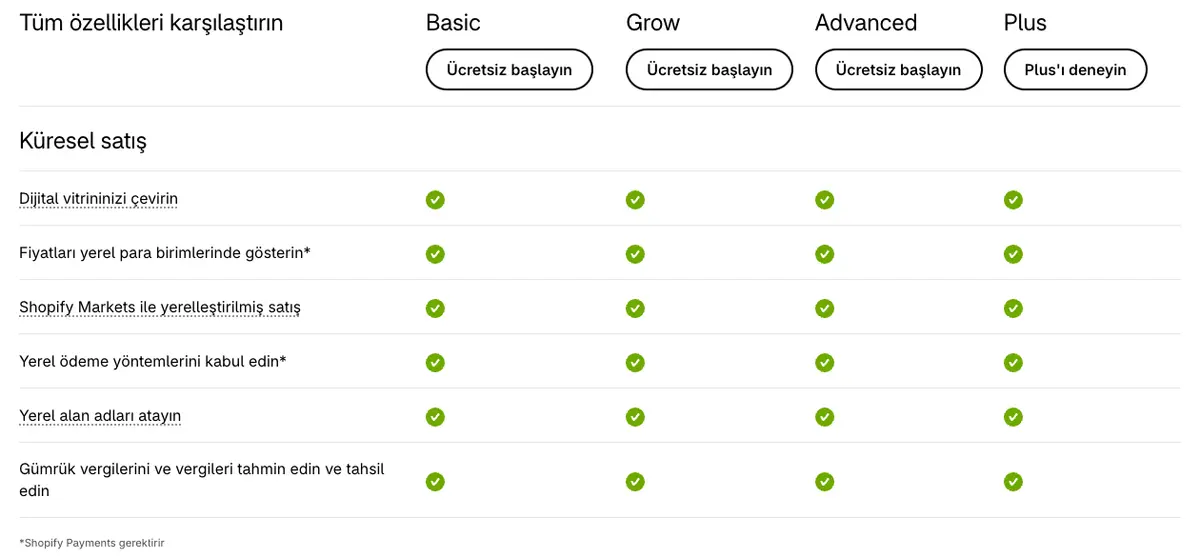
Shopify's Help Center page on currency conversion says the feature's full functions work only on stores that use Shopify Payments and the one-page checkout. Türkiye is not on the list of countries where Shopify Payments is available. Read together, the result is this. A store in Türkiye can set language and shipping by country with Shopify Markets. It cannot use Shopify's built-in path to collect from the customer in the local currency.
In that case the payment provider decides which currency is charged. A payment provider licensed in Türkiye can charge a foreign card in Turkish lira, or in a foreign currency it works in. Which currencies it charges, whether it pays out to a foreign-currency account, and the commission on a foreign card all differ from provider to provider. A store planning to sell abroad should therefore ask its payment provider three questions in writing. Which currencies do you charge in? Do you pay out to my foreign-currency account? What is your commission on a foreign card?
Showing a price in foreign currency and collecting in foreign currency are not the same thing
Many Shopify stores in Türkiye show prices to the foreign customer in dollars or euros and collect the payment in Turkish lira. A currency converter app does this. On Store Leads' Türkiye page, the sixth most installed app on Shopify stores in Türkiye in November 2026 is BUCKS Currency Converter, installed on 1,639 stores.
A converter app only changes what the online store displays. At checkout the amount is still in the store's currency. A customer who saw a product as 50 dollars sees about 2,525 TL at checkout (50 times 50.4936 TL; the TCMB forex selling rate from the bulletin dated November 20, 2026, in force on November 23, 2026), and that amount is charged to the card. The bank that issued the card converts the Turkish lira to dollars at its own rate, and it often adds a foreign-transaction fee. The customer sees a different amount on the statement from the one on the online store.
That gap has two results. The first is cart abandonment. A customer who saw the price in dollars and then sees Turkish lira at checkout may leave without paying. The second is a chargeback. A customer who does not recognise the amount on the statement can dispute it with the bank. A store that shows prices in foreign currency should state clearly, on the product page and in the cart, that the card will be charged in Turkish lira.
Why PayPal and Stripe are not options
The two payment paths that come to mind first for selling abroad are closed to a store in Türkiye. PayPal stopped operating in Türkiye in June 2016, after the Banking Regulation and Supervision Agency rejected its licence application. Since 2020, the Central Bank of the Republic of Türkiye issues payment-institution licences in Türkiye, and only institutions licensed by the TCMB can provide payment services to persons established in Türkiye. Türkiye is also absent from the list of countries where a Stripe account can be opened.
A store in Türkiye therefore collects from abroad in one of three ways. A foreign-card charge through a Turkish payment provider licensed by the TCMB, a company established abroad and that company's payment account, or a merchant-of-record service. The first path is the shortest setup, and the account works in Turkish lira. The second path brings a tax and accounting burden abroad. The third path hands the tax burden to the provider, and takes a share of the sale in return. The cost of the three paths, and who each one suits, is in the next section.
Payment options: iyzico, PayTR, Craftgate and accounts abroad
A Shopify store in Türkiye charges a foreign card through a payment provider licensed by the TCMB, such as iyzico or PayTR. iyzico's Multi Currency add-on charges in six currencies, including the dollar, the euro and sterling, and pays the store in Turkish lira. Craftgate is not a payment institution. It is an orchestration layer that runs several POS connections from one admin.
iyzico Multi Currency: charge in foreign currency, pay out in Turkish lira
On iyzico's official pricing page, the Multi Currency add-on takes payment on Visa and Mastercard in US dollars, euros, pounds sterling, Russian roubles, Swiss francs and Norwegian kroner, as well as Turkish lira. The add-on is 99 TL a year. The same page also says how the money reaches the store. A payment taken in foreign currency is paid to the store in Turkish lira, using the Central Bank rate on the transaction day, plus a conversion fee. The commission for a corporate seller is 4.29% plus 0.25 TL per transaction.
There is a further limit on the Shopify side. On a store without Shopify Payments, checkout opens in the store's default currency. A Shopify store whose default currency is Turkish lira sends a Turkish lira amount to checkout even if Multi Currency is on at iyzico. For the add-on to do its job, the default currency of the store that will sell in foreign currency has to be that foreign currency.
PayTR and Craftgate
PayTR's virtual POS page says it takes payment from international cards and can collect in different currencies. The commission rate in foreign currency is not on the page. The page says that rate is set in a quote by business model, revenue target and monthly transaction volume. The only figure stated for Turkish lira transactions is a commission starting at 2.19% on a 7-day settlement period (valör).
Craftgate, on its own description, is a technical payment orchestration platform. It is not a payment service provider under Law No. 6493, it does not enter the flow of funds, and it does not provide a virtual POS. Through its Shopify module it connects the store to several bank POS connections and payment providers, and routes the transaction among them. For collection from abroad, that means it depends on whether the POS Craftgate is connected to can charge in foreign currency. What orchestration adds to selling abroad is the ability to replace a POS whose foreign-card approval rate stays low with another POS, without changing the store's code.
| Option | What it does | Charge in foreign currency | Payout to the store | Fee stated on the official page |
|---|---|---|---|---|
| iyzico | Licensed payment institution | 6 currencies (Multi Currency) | Turkish lira, with a conversion fee | 4.29% and 0.25 TL. Add-on 99 TL a year |
| PayTR | Licensed payment institution | Yes, by quote | Set in the quote | Starts at 2.19% in Turkish lira (7-day settlement) |
| Craftgate | Payment orchestration | Depends on the connected POS | The connected POS pays | Not on the page |
| Company abroad and Shopify Payments | The payment system in the company's country | Shopify's local-currency features open | To the company's account abroad | The Shopify Payments price for that country |
Source: iyzico pricing, PayTR virtual POS, Craftgate, November 23, 2026.
A second store, and a company abroad
A store in Türkiye has two structural paths to collecting in foreign currency. The first is to open a second Shopify store whose default currency is the dollar or the euro, and send international traffic there. That path means two stores, two subscriptions and two stock records. A Turkish payment provider still takes the payment, and in the iyzico example it pays the store in Turkish lira. The second is to form a company in a country where Shopify Payments operates. Turning Shopify Payments on requires the business to be registered in that country. That path also brings tax registration, accounting and a bank account in the country where the company is formed.
At Nodus Works we recommend the company-abroad path to stores whose sales abroad have reached a clear share of total revenue, and that will open a warehouse or a returns address in the target market. For a store trying sales abroad for the first time, the first step is to measure the foreign-card approval rate of the current payment provider. Our Shopify consulting service looks at the store's order data and calculates which of the two structures pays for itself in the first 12 months.
Merchant-of-record services: who Global-e, Paddle and Lemon Squeezy are for
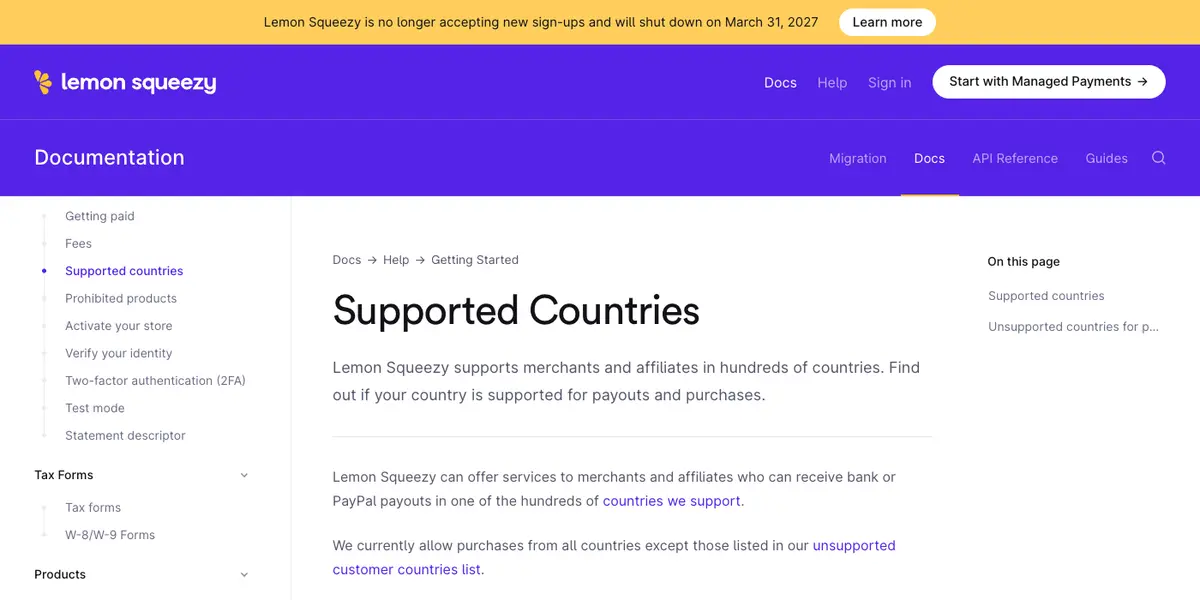
For a Shopify store that sells physical products, only Global-e of these three names is a fit. On its own help page, Paddle does not accept the sale of physical products. Lemon Squeezy was built for digital products. In November 2026 it closed new store sign-ups, and on March 31, 2027 it stops taking payments entirely.
Paddle and Lemon Squeezy: for digital products
Paddle describes itself as a merchant-of-record solution built for SaaS and apps. The standard fee on its pricing page is 5% plus 50 cents per transaction. Paddle's help page on what you are not allowed to sell lists products that require physical delivery, and it states plainly that Paddle is not a fit for a business whose primary business is selling physical goods. For a team selling software, themes or apps from Türkiye, Paddle is an option. It is not an option for a Shopify store selling clothing or cosmetics.
Lemon Squeezy also worked for digital products, and the price was the same: 5% plus 50 cents per transaction. Lemon Squeezy's help page now says it is no longer accepting new sign-ups and will shut down on March 31, 2027. Stripe, which bought Lemon Squeezy in 2024, is directing sellers to Stripe Managed Payments. Türkiye is not on the list of countries where a Stripe account can be opened. A Turkish team selling digital products on Lemon Squeezy today needs to start its move plan by mid-January 2027. Lemon Squeezy says a move can take up to eight weeks.
Global-e: for brands that sell physical products
Global-e is the merchant-of-record company behind Shopify Managed Markets, and it works for brands that sell physical products. On its own site it serves more than 1,500 brands in more than 200 markets. The customer list includes brands such as Burberry, Adidas and Hugo Boss. Two package names appear on the site: PRO for emerging brands, and ENTERPRISE for high-volume brands. The site does not state the price, a minimum volume, or anything about Türkiye.
A store in Türkiye cannot turn Global-e on from the Shopify admin, because Managed Markets is not open to Türkiye. A direct contract is a separate sales conversation, and the price is set by quote. Our view is this. For a Turkish brand whose sales abroad are a few dozen orders a month, a merchant-of-record contract does not earn the percentage it takes. A merchant of record makes sense when the cost of opening a VAT registration in the target market, and of handling chargebacks alone, is higher than the share taken from the sale. In the European Union that calculation starts with the first sale. The 10,000 euro distance-selling threshold applies only to intra-EU sales by a seller established in a single EU country. There is no threshold for goods shipped from Türkiye to the EU. On consignments up to €150, VAT is collected at the sale through IOSS, with an intermediary appointed in the EU. Without IOSS, the tax is left to the buyer at customs. From July 1, 2026 to July 1, 2028, a temporary customs duty of €3 per item applies to consignments whose intrinsic value does not exceed €150 and whose VAT is paid through IOSS, or that arrive by post (Regulation (EU) 2026/382). Since November 1, 2026, an EU handling fee of €2 per item is also charged on every distance-sale consignment, regardless of value (Regulation (EU) 2026/2152). On consignments above €150, import VAT and the normal customs duty arise. A Turkish industrial good in free circulation, declared with an A.TR movement certificate, pays no customs duty under the customs union.
| Merchant-of-record service | Physical product | Price on the official page | Status for a store in Türkiye |
|---|---|---|---|
| Shopify Managed Markets (Global-e) | Yes | In the Shopify admin | Not open: only US stores, and some stores in Canada and the United Kingdom |
| Global-e (direct) | Yes | Not stated, by quote | Through a sales conversation |
| Paddle | No | 5% and 50 cents | Software and digital products only |
| Lemon Squeezy | Digital product | 5% and 50 cents | No new sign-ups. Shuts down on March 31, 2027 |
Source: Shopify Managed Markets eligibility, Global-e, Paddle prohibited products, Paddle pricing, Lemon Squeezy supported countries, November 23, 2026.
How foreign currency comes into the country: 180 days, the 35% sale and the $5,000 micro-export rule
Under the TCMB Export Communiqué, export proceeds are brought into the country within 180 days of the actual export date at the latest. Through January 31, 2027 inclusive, at least 35% of proceeds tied to an export-proceeds acceptance certificate (İBKB) or a foreign-exchange purchase certificate (DAB) is sold to the bank. On micro-exports that do not exceed 5,000 US dollars, the full use of the proceeds is free.
| Rule | Where it sits in the communiqué | What it means for a Shopify store |
|---|---|---|
| Bring proceeds in within 180 days | Article 4 | The clock runs on sale proceeds waiting in an account abroad |
| Sell 35% to the bank | Provisional article 4, through January 31, 2027 inclusive | At least 35% of foreign currency tied to an İBKB or a DAB is converted to Turkish lira at the TCMB buying rate |
| Free use below $5,000 on micro-export | Article 22 | Most orders that leave as individual shipments stay under this limit |
| A foreign-issued card on card collection | The card-collection provision | It must be established that the card was issued abroad |
Source: TCMB Export Communiqué, the current text read on November 23, 2026.
The communiqué also describes how the 35% rule works. The bank sells the foreign currency sold to it to the Central Bank the same day, at the TCMB forex buying rate on the transaction day, and the equivalent is paid to the exporter in Turkish lira. Guides on the web still write 25%, 30% and 35% for this rate. The rate has changed from period to period, and the text in force today says 35%. The provisional article ends on January 31, 2027. At the start of February, check the current version of the communiqué for whether it was extended.
Export proceeds collected by card
The money from a Shopify order usually arrives through a payment provider, from the foreign customer's card. The communiqué recognises this path and sets one condition: it must be established that the card was issued abroad. When the slip amount is paid to the exporter, a separate İBKB can be issued for each slip, or one İBKB for all of the slips. For a store that takes dozens of small orders a day, that means it does not have to issue a separate document for every order.
When a Turkish payment provider charges the foreign card in Turkish lira, no foreign currency ever enters the store's account. In that case there is also no foreign-currency amount for the 35% sale rule to apply to. Whether the sale counts as an export rests on the ETGB and the invoice. If you use a provider that charges in foreign currency and pays out to a foreign-currency account, agree in advance with the provider and your bank on how the foreign currency is tied to an İBKB.
The ETGB limit: 600 kg and 30,000 euros
The customs document for micro-export is the Electronic Commerce Customs Declaration (ETGB). The cargo or postal operator files the declaration. The seller does not have to hire a customs broker separately. The ETGB limit per consignment doubled on January 3, 2026. Under the communiqué the Ministry of Trade published in the Official Gazette, issue 33126, the limit rose from 300 kilograms to 600 kilograms and from 15,000 euros to 30,000 euros, and the change entered into force on the day of publication.
Many guides still write 15,000 euros and 300 kilograms. For a Shopify store, both limits are far from most orders. The difference shows up on a brand that ships in bulk to a wholesale customer or to a warehouse abroad. A consignment that exceeds 30,000 euros or 600 kilograms moves to a standard customs declaration filed with a customs broker.
Invoices and VAT: the document pattern on a sale abroad
The delivery of goods to a customer abroad falls under the export exemption in article 11/1-a of the VAT Law. VAT is not calculated on the invoice, and the exemption reason is stated. In practice, orders that leave with an ETGB are invoiced with an e-archive invoice. On an export made with a standard customs declaration, an e-invoice taxpayer issues the export invoice as an e-invoice. Shopify does not send any of these documents to Türkiye's e-document system itself.
The VAT exemption and the tax setting on Shopify
Most Shopify stores in Türkiye enter prices VAT included, because showing a VAT-included price to a customer in Türkiye is required. For a customer abroad, the price has to be set up without VAT. Which country tax is collected in is managed from Shopify's "Taxes and duties" settings. Shopify's Help Center says VAT-inclusive pricing applies to every region you sell in. The way to see how that setting lands on an order abroad is to open a test order with a delivery address abroad and read the tax line at checkout.
The test order is also the precondition for issuing the invoice correctly. If an order abroad that shows VAT at checkout is invoiced under the VAT exemption, the amount taken from the customer and the amount on the invoice do not match. That mismatch comes back as a difference you have to explain when you claim the VAT refund that follows from the export exemption.
E-archive, e-invoice and Shopify
| Shipment type | Customs document | Invoice (in practice) | Exemption stated on the invoice |
|---|---|---|---|
| Individual cargo or postal shipment | ETGB (up to 600 kg and 30,000 euros) | E-archive invoice | VAT Law 11/1-a, export of goods |
| Bulk shipment, or one over the limit | Customs declaration | Export invoice (e-invoice) for an e-invoice taxpayer | VAT Law 11/1-a, export of goods |
| Customer in Türkiye | None | E-archive or e-invoice | VAT is calculated |
The order documents Shopify offers a store in Türkiye do not replace an invoice sent to the Revenue Administration. E-archive invoices and e-invoices are issued through an e-document integrator, or through an accounting app connected to Shopify. On an order abroad, the app has to be able to change the invoice type by the order's country, write the ETGB number on the invoice, and issue an invoice in foreign currency. Test those three features with a trial order abroad before you choose the app.
Connecting the invoice app, the carrier's ETGB flow and the payment provider on a Shopify store is one project. Our Shopify integration and custom app service sets the e-archive and e-invoice app up so that it picks the invoice type by the order's country, and delivers the flow with a trial order abroad.
Which model to choose: a decision table in five questions
For a Turkish Shopify store that sells physical products and is trying sales abroad for the first time, the starting model is collection in Turkish lira through a Turkish payment provider, and shipping with an ETGB. A company abroad, and a merchant of record, come onto the table when sales abroad reach a clear share of revenue and a tax registration is required in the target market. The five questions below show which model your store is in.
| Question | If the answer is yes | If the answer is no |
|---|---|---|
| 1. Is the product you sell physical? | Paddle and Lemon Squeezy drop out. The options are a Turkish payment provider, a company abroad and Global-e | For digital products and software, a merchant of record such as Paddle is considered |
| 2. Do your shipments leave individually, under 30,000 euros and 600 kg? | Micro-export with an ETGB. The seller does not hire a customs broker separately | A standard customs declaration. The seller works with a customs broker |
| 3. Does the customer need to see the payment in their own currency? | A payment provider that charges in foreign currency, and a second store whose default currency is that currency, or a company abroad | Collection in Turkish lira, and a clear notice before checkout |
| 4. Do you need a VAT or sales-tax registration in the target market? | Your own tax registration, or a merchant of record | Tax the buyer pays at customs, consignment by consignment |
| 5. Does revenue abroad cover the cost of a company and accounting abroad? | A company in a country where Shopify Payments operates | The company in Türkiye, and a Turkish payment provider |
Read the table with an example. A jewellery brand in Istanbul ships 40 orders a month to Germany and the Netherlands, with an average order of 60 euros. The product is physical, the shipments are individual and far under the ETGB limit, and annual revenue abroad is about 28,800 euros. The right model for this brand is a Turkish payment provider, an ETGB, and a notice before checkout that the payment will be taken in Turkish lira. When the same brand carries annual revenue abroad into six figures in euros, it is time to compare an IOSS registration in the EU with a merchant-of-record quote.
Our position is clear. In the first year of selling abroad, test demand, not the structure. Language and shipping by country open in a few days with Shopify Markets. Forming a company and a merchant-of-record contract take months, and they are hard to undo.
Conclusion: four jobs before the first order abroad
A Shopify store in Türkiye that sells abroad is the legal seller of the sale, collects in Turkish lira in most cases, and is subject to the TCMB Export Communiqué when foreign currency comes into the country. Shopify's Managed Markets service is not open to Türkiye. For physical products, Paddle and Lemon Squeezy are not options. Inside those limits, selling abroad is set up with four pieces of preparation:
- Ask your payment provider, in writing, which currency it charges on a foreign card, what the commission is, and which currency the payout reaches your account in.
- If you show the price in foreign currency, state clearly, before checkout, that the payment will be collected in Turkish lira.
- Find out whether your carrier files the ETGB in your name, and how it sends you the ETGB number.
- Open a test order with a delivery address abroad. Check the tax line at checkout, and the type of invoice issued, with your tax advisor.
None of these four jobs needs a new company or a merchant-of-record contract. They are done with the current payment provider, the carrier and the tax advisor.
To see the domestic and international commissions of payment providers in Türkiye side by side, go to our guide to payment collection methods on Shopify and our article on Shopify transaction fees. If you want to set up the selling-abroad structure together with your store's order data, in the first meeting with our Shopify consulting team we put the payment provider, the ETGB and the invoice flow on one table.
Frequently asked questions
Does Shopify in Türkiye take payment in dollars?
A Shopify store in Türkiye whose default currency is Turkish lira also takes payment from a foreign customer in Turkish lira. Shopify's feature for collecting in the local currency requires Shopify Payments, and Shopify Payments is not available in Türkiye. Collecting in dollars requires a payment provider that charges in foreign currency, and a store whose default currency is the dollar. Even then, iyzico Multi Currency pays the store in Turkish lira.
What is a merchant of record?
The merchant of record is the party that stands as the legal seller facing the customer, takes the payment in its own name, and is responsible for the tax, the invoice, the refund and the chargeback on the sale. When a Shopify store in Türkiye sells abroad, the store itself is the merchant of record. Companies such as Global-e and Paddle take on that responsibility for a percentage of the sale.
Can Shopify Managed Markets be used in Türkiye?
No. Shopify's Help Center says Managed Markets is open only to stores established in the continental United States, and to some stores in Canada and the United Kingdom. A store in Türkiye can take the same service by contracting directly with Global-e, the company behind Managed Markets. The price is set by quote.
Is there an obligation to sell foreign currency on a micro-export?
Under the TCMB Export Communiqué, through January 31, 2027 at least 35% of export proceeds tied to an İBKB or a DAB is sold to the bank. Under article 22 of the same communiqué, on micro-exports that do not exceed 5,000 US dollars, the full use of the proceeds is free. If the payment provider charges the foreign card in Turkish lira, no foreign currency enters your account.
What is the ETGB limit in 2026?
Under the communiqué published in the Official Gazette, issue 33126, on January 3, 2026, the ETGB limit per consignment became 600 kilograms and 30,000 euros. The previous limit was 300 kilograms and 15,000 euros. A consignment over the limit moves to a standard customs declaration filed with a customs broker.
Is VAT added to a sale abroad on a Shopify store?
The delivery of goods to a customer abroad is an export exemption under article 11/1-a of the VAT Law, and VAT is not calculated on the invoice. If prices were entered VAT included on Shopify, check the tax line at checkout with a test order that has an address abroad. Settle the invoice type and the exemption wording with your tax advisor.
Can a business in Türkiye take payment with PayPal or Stripe?
A business established in Türkiye cannot take payment with PayPal or Stripe. PayPal stopped operating in Türkiye in June 2016, after its licence application was rejected. Türkiye is not on the list of countries where a Stripe account can be opened. A store in Türkiye charges a foreign card through a payment provider licensed by the TCMB.