













































































































Shopify vs Ticimax: 2026 Price, Integration and Infrastructure Comparison

Shopify's 2% transaction fee closes the licence gap between Ticimax Advantage (40,940 TL, VAT included) and Shopify Basic (about 11,507 TL on annual billing) at roughly 1.47 million TL in annual card revenue. Marketplaces, the shipping credit and B2B depend on the package tier at Ticimax and on the choice of app at Shopify.
 Author: Efe Gündüz Nodus Works Shopify Agency Founder
Published 36 min read
Shopify or Ticimax puts two e-commerce platforms with different business models side by side. Ticimax, with 9,303 stores in Turkey, is one of the largest local SaaS platforms: it includes virtual POS, shipping, e-invoice and marketplace connections inside a VAT-inclusive annual package priced in Turkish lira, and it takes no cut of sales. Shopify is a Canada-based global platform that charges a subscription in dollars. It adds Turkey-specific connections from the app store, and because Shopify Payments is not available in Turkey it takes a transaction fee of between 0.2% and 2% on every card sale, depending on the plan.
We built the comparison from Ticimax's pricing page on November 20, 2026, Shopify's official plan page and our own measurements. At Nodus Works we scanned 2,752 .com.tr and .tr sites on the Tranco list for platform fingerprints: Ticimax appeared on 76 sites, Shopify on 73. We also measured 20 sites from each platform for speed and technical SEO. StoreLeads data points the same way. Of the 210 stores that left Ticimax in the last 90 days, 42 moved to Shopify; the number of stores that moved from Shopify to Ticimax is 9.
Shopify vs Ticimax: the short answer and which one suits whom
A store that takes most of its sales by card in Turkey, and wants the marketplace connection and the shipping credit in a single package, starts with fewer line items on Ticimax. If selling abroad, the app ecosystem and code access come first, Shopify pulls ahead. For a store whose annual card revenue stays under 1.47 million TL, Shopify Basic runs cheaper than Ticimax's entry package, Advantage.
The two platforms answer the same question differently: where will the connections the store needs come from? Ticimax places those connections on package tiers. Trendyol and Hepsiburada integration opens on the third package, Advance, and unlimited marketplaces plus the in-store sales module open on the fourth package, Advance Plus. On Shopify the plan difference does not decide these features. A store opened on the Basic plan can also install marketplace, e-invoice and local shipping apps; the difference is that each of those apps has its own monthly subscription.
Ticimax takes no platform cut of sales. Shopify, because Shopify Payments is not available in Turkey, takes a transaction fee of between 0.2% and 2% on every card sale, depending on the plan. That is why the cost of the two platforms swaps places in the same store as revenue grows. In a low-revenue store Shopify's lower licence fee leads; as revenue grows, the transaction fee eats that advantage.
The store profile where Ticimax comes out ahead
- Marketplace-led sales: The Advance package (88,110 TL) includes Trendyol, Hepsiburada, n11, Amazon and Temu integration. On Shopify the same connection needs a paid monthly marketplace app.
- Dealer and wholesale sales: B2B and assortment product sales are standard on the second package, Premier (79,210 TL).
- Physical store: The in-store sales module is listed on Advance Plus (106,711 TL).
- A budget in TL: Ticimax's price includes VAT and is in TL. Exchange-rate movement during the licence term does not land on the invoice.
- Apparel: According to StoreLeads, 40.1% of Ticimax stores sell apparel; the outfit module and assortment sales are built for that audience.
The store profile where Shopify comes out ahead
- Selling abroad: Shopify Markets opens multiple languages, currencies and country-specific prices on every plan. On Ticimax the e-export module is standard from Advance, while country-specific campaigns and foreign payment methods are optional.
- Code and custom apps: The whole Liquid theme and the Admin API are in the store's hands. On Ticimax, detailed web-service use and webhook management are marked optional.
- Global apps: Klaviyo, Judge.me and similar apps work in the same store as the Turkey-specific connections.
- Scaling: Moving to Shopify Plus for campaign traffic and a large catalogue happens on the same store, with no migration.
Pricing: Ticimax's 4 packages and Shopify plans in TL
On a one-year purchase, Ticimax's packages run from 40,940 TL to 106,711 TL, and the page states that these amounts include VAT. Shopify's plans run from $19 to $299 a month on annual billing; Plus starts at $2,300. At the Central Bank of the Republic of Türkiye (TCMB) rate, Basic comes to about 11,507 TL a year and Advanced to about 181,084 TL. The gap between the two closes with the transaction fee: the 29,433 TL licence difference between Advantage and Basic is matched by Shopify's 2% fee at about 1.47 million TL in card revenue.
Ticimax packages and the Efsane Kasım terms
| Ticimax package | 1-year purchase | Pay for 2 years, use 3 | 3-year list price | Gift shipping credit (2-year / 1-year purchase) | Main features added to the package |
|---|---|---|---|---|---|
| Advantage | 40,940 TL | 81,880 TL (27,293 TL a year) | 138,000 TL | 10,000 / 5,000 TL | Unlimited products, e-invoice and e-archive, "0% next-day virtual POS commission" |
| Premier | 79,210 TL | 158,420 TL (52,807 TL a year) | 267,000 TL | 25,000 / 12,500 TL | B2B and assortment sales, price-comparison site integration |
| Advance | 88,110 TL | 176,220 TL (58,740 TL a year) | 297,000 TL | 40,000 / 12,500 TL | Trendyol, Hepsiburada, n11, Amazon and Temu integration, e-export module |
| Advance Plus | 106,711 TL | 213,422 TL (71,141 TL a year) | 359,700 TL | 50,000 / 15,000 TL | Unlimited marketplaces, in-store sales module, mobile app, 1 year of the ERP program |
Source: Ticimax e-commerce package prices, November 20, 2026. Prices include VAT.
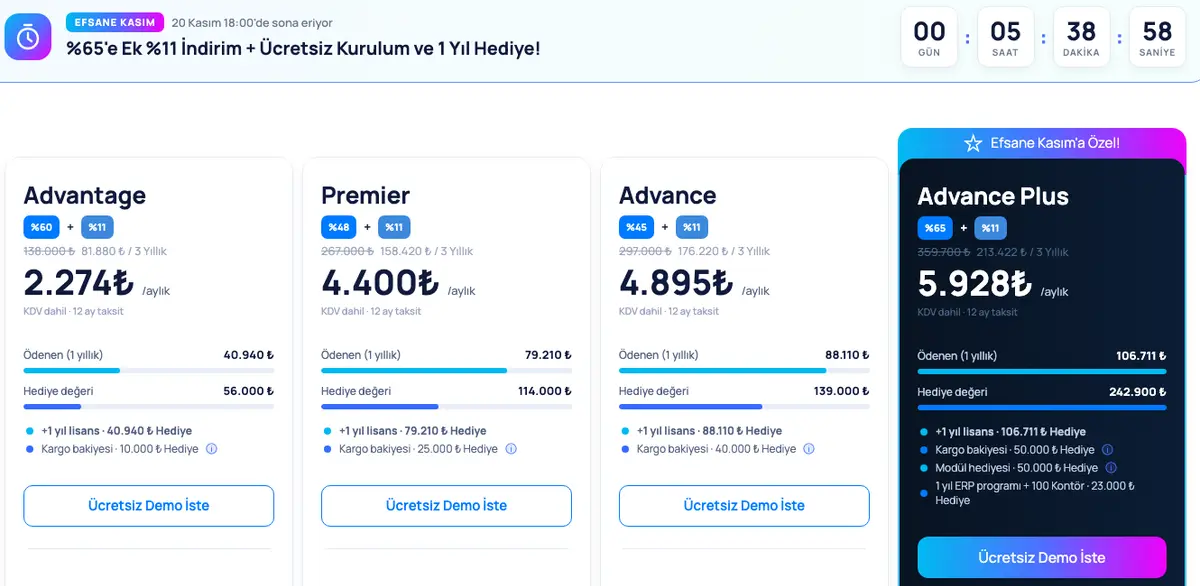
Ticimax refreshed its pricing page between November 19 and 20, and two facts changed. The November 19 page did not say whether prices included VAT; the November 20 cards say "KDV dahil" (VAT included). The list price is no longer shown as an annual amount but as a 3-year amount. The struck-through price that was 117,000 TL for Advantage on November 19 became a 3-year amount of 138,000 TL on November 20.
The real offer in the campaign is extra time. On a two-year purchase the third year is free and the shipping credit grows: the credit that is 12,500 TL on a 1-year Advance purchase rises to 40,000 TL on a 2-year purchase. On that arithmetic, Advance's annual cost falls to 58,740 TL. The page also offers businesses buying a package for the first time a 100,000 TL interest-free loan through Akbank and a "1 year from us, payment after 2 months" option.
Our advice is this: consider the 3-year offer only if you are sure you will stay on the platform for at least three years. Two years paid up front becomes the exit cost of a brand that wants to change infrastructure in the second year.
Shopify plans in TL
| Plan | Monthly on annual billing | Annual total (TL) | Annual total on monthly billing (TL) | Transaction fee on card sales |
|---|---|---|---|---|
| Basic | $19 | 11,507 TL | 16,352 TL | 2% |
| Grow | $54 | 32,704 TL | 43,606 TL | 1% |
| Advanced | $299 | 181,084 TL | 241,647 TL | 0.6% |
| Plus | from $2,300 | from 1,392,955 TL | Annual contract | 0.2% |
Source: Shopify pricing, November 20, 2026; TL amounts were calculated at the TCMB forex selling rate (1 USD = 50.4694 TL, the rate in force on November 20, 2026). Taxes added to the Shopify invoice are excluded.
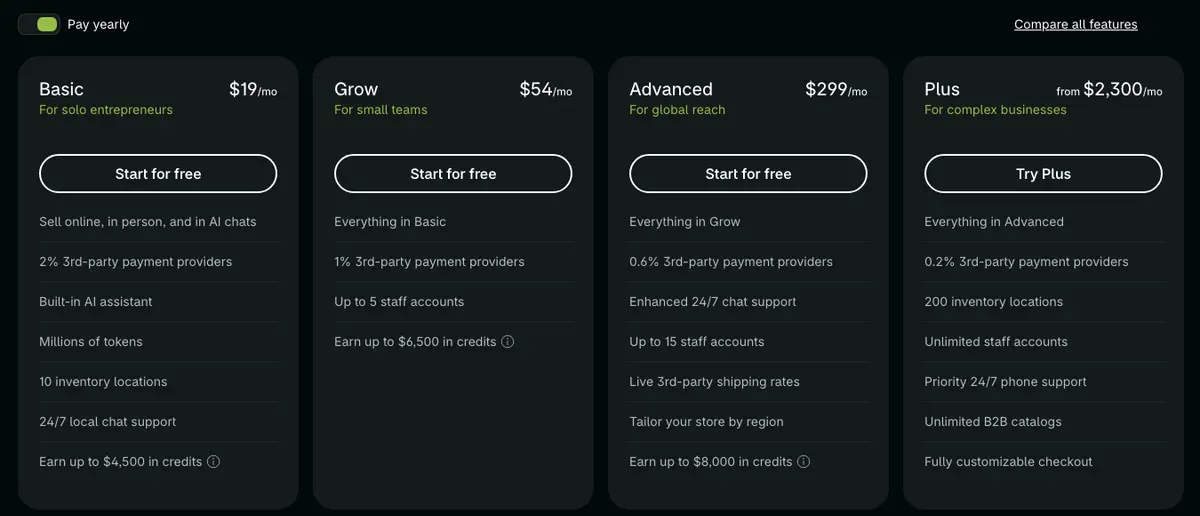
Shopify's plan fee is fixed in dollars, and the TL equivalent is recalculated at the exchange rate in every billing period. On Ticimax the exchange-rate risk is frozen for the licence term and lands on the package price on renewal day. A 3-year Ticimax purchase pushes that risk out by three years; on Shopify, annual billing gives the same effect for only 12 months.
Break-even: when the transaction fee closes the licence gap
The variable that closes the licence gap between Ticimax and Shopify is the store's annual card revenue. We ran the arithmetic on three examples:
- Ticimax Advantage (1 year) and Shopify Basic: The licence gap is 40,940 − 11,507 = 29,433 TL. Shopify Basic's 2% transaction fee reaches that amount at 1,471,650 TL of annual card revenue.
- Ticimax Advantage (3-year offer) and Shopify Basic: The annual cost is 27,293 TL, and the gap is 15,786 TL. The threshold falls to 789,300 TL of card revenue.
- Ticimax Advance and Shopify Grow: Compared with the first Ticimax package that includes marketplace integration, the gap is 88,110 − 32,704 = 55,406 TL. Shopify Grow's 1% transaction fee reaches that amount at 5,540,600 TL of annual card revenue.
Only the licence fee and Shopify's transaction fee go into the arithmetic. The payment institution's commission does not change the result, because it is paid on both platforms. Two items do change the arithmetic. The first is the monthly subscriptions of the apps installed on Shopify for Turkey-specific connections; that amount pulls the threshold down. The second is Ticimax's "0% next-day virtual POS commission" promise. If the promise applies with no conditions, the payment institution's deduction also enters the arithmetic in Ticimax's favour. The conditions are not written on the package page. Shopify does not take a transaction fee on bank transfer, EFT or cash on delivery; in a store where card revenue is a small share, the threshold moves up.
We calculated the effect of Shopify's transaction fee on the total deduction in Turkey, together with PayTR and iyzico rates, per sale in our Shopify transaction fees guide.
The per-sale cut: the "0% next-day" promise and Shopify's transaction fee
Ticimax takes no platform share of a card sale; the only deduction is made by the bank or the payment institution that provides the virtual POS. On Shopify, a transaction fee of between 2% and 0.2% is added on top of that same POS deduction, depending on the plan. Ticimax's "0% next-day virtual POS commission" promise can widen this gap; the conditions of the promise are not on the package page.
On a card order the money changes hands three times, and each hand can take its own deduction: the payment institution, the platform, and, if the sale is in instalments, the instalment surcharge. On Ticimax the second item is zero. On Shopify the second item depends on the plan and is taken no matter which payment institution is used, because stores in Turkey cannot use Shopify Payments and every payment counts as a "third-party provider".
The platform share and the POS deduction are separate items
Ticimax's FAQ says no commission is taken on a sale on the website. That commitment covers only the platform's share. The size of the POS deduction is set by the institution the store chooses. TCMB's table of maximum commissions for member merchants shows a cap of 3.56% for banks on a one-off credit-card transaction in November 2026. Payment institutions tier the rate by the settlement period: the later the money reaches the account, the lower the rate.
Ticimax's feature table says the virtual POS of every bank can be connected; the payment list includes iyzico, PayTR, GarantiPay, Paycell, Moka United, Paynet, Sipay and BKM Express. On Shopify, iyzico and PayTR connect through official apps. A bank POS requires a custom payment app; we describe the technical process in our Shopify virtual POS setup guide.
On two stores using the same payment institution, the per-sale difference between Ticimax and Shopify is exactly Shopify's transaction fee: 2% of revenue on the Basic plan, 1% on Grow. Negotiating the rate with the bank does not close that gap; even if the POS rate falls on Shopify, the transaction fee stays on top.
Ticimax's "0% next-day" promise: ask three questions in writing
The "0% next-day virtual POS commission" line sits on the Advantage package list, and the higher packages inherit it through the "in addition to the Advantage package" structure. Next-day settlement is the most expensive option payment institutions offer. Vergimerkezi's November 2025 roundup puts the market average for next-day payout between 2.80% and 3.90%. If the promise were unconditional, it would save between 28,000 and 39,000 TL on 1,000,000 TL of annual card revenue; that is close to Advantage's 40,940 TL fee.
Our reading is this: a discount of that size, with no time limit and no cap, does not fit the economics of a payment institution. The promise is probably tied to a specific institution, a period or a revenue cap. At the quote stage, ask Ticimax these questions in writing:
- On which payment institution's POS does the 0% rate apply?
- For how many months does the rate stay fixed?
- Is there a monthly or annual revenue cap, and which rate applies once the cap is passed?
Revenue scenarios: total annual deduction
The table below adds the licence fee, the POS deduction and the Shopify transaction fee. We used the same assumption (2.5%) for the POS rate on both platforms; replace it with the rate in your own quote.
| Annual card revenue | Ticimax Advantage, POS 2.5% | Ticimax Advantage, if "0% next-day" applies with no conditions | Shopify Basic, POS 2.5% + 2% | Shopify Grow, POS 2.5% + 1% |
|---|---|---|---|---|
| 1,000,000 TL | 65,940 TL | 40,940 TL | 56,507 TL | 67,704 TL |
| 2,000,000 TL | 90,940 TL | 40,940 TL | 101,507 TL | 102,704 TL |
| 3,000,000 TL | 115,940 TL | 40,940 TL | 146,507 TL | 137,704 TL |
The arithmetic: Ticimax's 1-year licence is 40,940 TL; on annual billing Shopify Basic is 11,507 TL and Grow is 32,704 TL (1 USD = 50.4694 TL). Subscriptions for apps installed for Turkey-specific connections are not included.
Two rows in the table change the decision. At 1 million TL of card revenue, Shopify Basic is 9,433 TL cheaper than Ticimax Advantage. At 2 million TL the order flips, and Ticimax closes the year with 10,567 TL less deducted. The threshold between Basic and Grow sits in the same range: Grow's extra 21,197 TL in annual plan fees is recovered by the 1-point fee reduction at 2,119,700 TL of card revenue. The threshold for moving from Grow to Advanced is 37,095,000 TL; in most stores the reason for Advanced is not the transaction fee but staff accounts and reporting.
Marketplaces, ERP and shipping: a module in the package, or an app
On Ticimax, marketplace and shipping connections depend on the package tier: domestic marketplaces open with 3 channels on Advance and without a limit on Advance Plus; accounting and ERP connections are "optional" on all four packages. On Shopify none of these connections depend on the plan. Each is set up with an app or an integrator and added on top of the licence as a monthly subscription.
| Connection | Ticimax | Shopify |
|---|---|---|
| E-invoice and e-archive | From Advantage, in the panel | Through an app or accounting software |
| Domestic marketplace | Optional on Advantage and Premier, 3 on Advance, unlimited on Advance Plus | Through an integrator app; the integrator's package sets the channel count |
| International marketplace | 3 on Advance Plus (a campaign gift) | Separate apps for Amazon, Etsy and others |
| Accounting and ERP | Nebim, Logo, Mikro and Paraşüt are listed; optional on all four packages | A ready-made app or a custom integration |
| Bookkeeping software | 1 year and 100 credits as a gift on Advance Plus | Apps from programs such as Paraşüt and Bizim Hesap |
| Price comparison (Akakçe, Cimri) | From Premier | Through an XML feed app |
| Klaviyo | Advance Plus | The official Klaviyo app, on every plan |
| Gift shipping credit | 10,000 to 50,000 TL on a 2-year purchase | None |
Source: Ticimax pricing page and package comparison table, and the Shopify App Store, November 20, 2026.
Marketplaces: a 3-channel cap versus an integrator subscription
On the "multi-channel marketplace integrations" row of Ticimax's comparison table, Advantage and Premier say "optional", Advance says "3" and Advance Plus says "unlimited". The integration covers product, order, stock, cancellation and return flows. A brand selling on Trendyol, Hepsiburada and Amazon fits in Advance (88,110 TL). When the same brand opens n11 as a fourth channel, it moves to Advance Plus and the annual fee rises by 18,601 TL.
On Shopify the marketplace connection is not Shopify's product; it is an integrator's. Sentos, Entegra or similar integrators move stock, price and orders in both directions and charge a monthly fee. A fourth channel does not change the Shopify plan; it can change the integrator's package. We walk through which data moves in which direction in our Shopify marketplace integration guide.
On Ticimax a fourth marketplace means the next package up. On Shopify a new marketplace changes the monthly fee in the integrator contract. For a brand whose marketplace revenue exceeds the website, choose the platform by the return and invoice flow of a marketplace order, not by the theme or the campaign module. Following one Trendyol order through to a return in a demo account shows more than a feature list.
ERP and accounting: what the "optional" row means
Ticimax's table lists order, product, stock and current-account transfer with Nebim, Logo, Mikro and Paraşüt, and marks that row "optional" on all four packages. Optional means a module that is not included in the package fee and is priced separately. The price is not on the page. The "1 year of ERP software" gift on Advance Plus is Ticimax's own bookkeeping program, Rota Zero; it does not replace a Nebim or Logo connection.
On Shopify the ERP connection is built with a ready-made app or a custom integration. The ERP's type and the complexity of the data flow decide the choice. Two examples from our projects: Vamos moved from wholesale to global sales on Shopify Plus and Nebim; Bonne Nuit runs same-day delivery with a Logo connection. The real work in an ERP connection is not switching it on; it is matching variant codes, warehouse-level stock, current-account codes and the return-invoice fields. That matching takes the same effort on Ticimax and on Shopify. We compare which route fits which ERP in our Shopify ERP integration guide.
Shipping and e-invoice: gift credit versus an app subscription
Ticimax has two shipping items. The shipping integration sends the order to the carrier and produces the barcode. The gift shipping credit is assigned without asking for a prepayment and is not tied to a single carrier. On a 2-year purchase the credit is 10,000 TL on Advantage and 50,000 TL on Advance Plus. The page does not state how long the credit can be used; ask in the quote.
On Shopify there is no official Shopify connection for Aras, Yurtiçi, Sürat, PTT or HepsiJet; apps or integrators build the connection. E-invoice arrives the same way. On our own brand, Haters Studio, we connected Paraşüt and 8 carriers to Shopify; each connection is a separate subscription and a separate support contact. When a brand moving from Ticimax to Shopify has to set up marketplace, shipping, e-invoice and ERP connections on the same calendar, our Shopify integration team checks the field mapping in a test store before it goes live.
Who uses it: StoreLeads data and the .tr scan
According to StoreLeads, Ticimax has 9,343 live stores and Shopify has 18,475 live stores in Turkey. Ticimax's store count fell 18% in the third quarter of 2026 compared with a year earlier, while Shopify stores in Turkey grew 27% in the same period. On .tr sites that receive traffic, the two platforms are level: in our own scan Ticimax appeared on 76 sites and Shopify on 73.
Store count alone does not describe a platform's quality; it shows which kind of brand an infrastructure wins and loses. In this section we put three datasets side by side: StoreLeads' store counts, the migration table for the last 90 days, and our scan of sites on the Tranco list.
Store count, growth and category mix
| Measure | Ticimax | Shopify (Turkey) |
|---|---|---|
| Live stores | 9,343 (9,303 of them in Turkey, 99.6%) | 18,475 |
| Annual change (2026 Q3) | 18% decrease | 27% increase |
| Quarterly change (2026 Q3) | 1.7% decrease | 4.2% increase |
| Largest category | Apparel, 3,746 stores (40.1%) | Apparel, 5,495 stores (29.7%) |
| Second category | Home and garden, 1,225 stores (13.1%) | Home and garden, 2,752 stores (14.9%) |
| Third category | Food and drink, 629 stores (6.7%) | Beauty, 1,491 stores (8.1%) |
Source: StoreLeads Ticimax report and StoreLeads Turkey Shopify report (updated November 13, 2026), November 20, 2026.
Ticimax's quarterly series has a break in it. The store count peaked at 11,756 in the last quarter of 2025 and fell to 9,930 in the first quarter of 2026. A drop of 1,826 stores in a single quarter can reflect closed stores and also a change in how StoreLeads detects them. Read the 18% annual decrease as a direction, not as a precise loss rate.
The category table shows the ground the two platforms share. Apparel and home are the top two on both sides. On Ticimax, apparel's share passes 40%; the outfit module, assortment sales and size-based variant management are built for that audience. Ticimax's highest-ranked stores confirm the same profile: Victoria's Secret Türkiye, Karaköy Güllüoğlu, English Home, Tuğba Kuruyemiş and Armine. In catalogue size, 13.4% of Ticimax stores sell between 100 and 249 products and 13.2% sell between 250 and 999; 1,102 stores have more than 1,000 products.
The .tr scan: the two platforms are level on sites that get traffic
We downloaded the homepages of every .com.tr and .tr site in the Tranco top 1 million and looked for platform fingerprints in the HTML: the ticimaxPlatformInfo variable and the static.ticimax file address for Ticimax, and cdn.shopify.com and Shopify.theme for Shopify. Of 2,752 sites, 2,372 returned content.
| Measure | Ticimax | Shopify |
|---|---|---|
Number of .tr sites | 76 | 73 |
| Inside the Tranco top 300,000 | 11 | 12 |
| Median Tranco rank | 766,485 | 755,934 |
| Sample sites | AVVA, Tonny Black, Desa, Victoria's Secret TR, ASICS TR | Derimod, Rani, Volta, Eveshop |
Source: Nodus Works infrastructure scan, November 2026. A lower Tranco rank means the site gets more visits.
In StoreLeads, Shopify's store count in Turkey is twice Ticimax's. On sites that receive traffic the gap closes, and the median ranks sit within 11,000 places. Our reading is this: in Turkey, Shopify is spreading faster than Ticimax among small and new stores; among established brands that receive traffic, the two platforms carry the same weight. Most of Ticimax's sites inside the top 300,000 are apparel, footwear and outdoor brands; six are Turkey distributors of global brands.
Migration data for the last 90 days: one in five stores leaving Ticimax goes to Shopify
StoreLeads lists stores that changed platform in the last 90 days in both directions:
| Direction | Stores | Main source or destination |
|---|---|---|
| Arriving at Ticimax | 162 | Own software 104, WooCommerce 21, ikas 14, Shopify 9, Wix 4, T-Soft 4, IdeaSoft 2 |
| Leaving Ticimax | 210 | Own software 100, Shopify 42, ikas 41, WooCommerce 15, IdeaSoft 7, T-Soft 3 |
Source: StoreLeads Ticimax report (updated November 13, 2026), November 20, 2026.
Ticimax loses a net 48 stores in 90 days. The direction with Shopify is clear: 42 stores moved from Ticimax to Shopify, and 9 moved from Shopify to Ticimax. Gotham, shown as an example on the list, was loading Shopify theme files when we checked on November 20. Ticimax's gain comes from brands leaving their own software: 104 of the 162 stores that arrived. The same table exists for T-Soft. A brand leaving its own software chooses a local platform because it wants Turkey-specific connections ready; a brand leaving a local platform goes to Shopify or ikas for the app ecosystem and sales abroad.
Selling abroad: the e-export module and Shopify Markets
On Ticimax the e-export module is standard from the Advance package; country-specific campaigns, extra tax management and foreign payment methods are "optional" and priced separately. On Shopify, multiple languages, currencies and country-specific prices are open on every plan through Shopify Markets. The shared bottleneck is charging foreign cards: a company established in Turkey cannot open a PayPal or Stripe account.
The storefront side of selling abroad can be built on both platforms. The real difference is whether price, shipping and payment for the target country depend on the package or on an app.
| Feature | Ticimax | Shopify |
|---|---|---|
| E-export module | Standard from Advance | Shopify Markets, on every plan |
| Multiple languages | Two steps on the comparison table: 2 languages and unlimited | Markets and the free Translate & Adapt app |
| Multiple currencies | Listed | Through Markets; local currency at checkout needs a suitable payment provider |
| Country-specific price | Available; country-specific campaigns and page design are optional | Country prices through Markets; a region-specific store layout on Advanced |
| International marketplace | 3 on Advance Plus, marketplace names not stated | Apps for Amazon, Etsy and others |
| Foreign payment methods | İşbank foreign payment systems, PayPal, Stripe and Sofort, optional | iyzico and PayTR apps; Shopify Payments is not available in Turkey |
| Live carrier shipping rates | Not on the package page | On the Advanced plan |
Source: Ticimax pricing page and package comparison table, and the Shopify pricing page, November 20, 2026.
E-export on Ticimax: the module, the optional rows and separate packages
The "E-export module" item on Ticimax's Advance card opens language, currency and country-specific prices. In the e-export section of the comparison table, seven rows are marked "optional": country-specific campaigns, country-specific page design, extra tax management, İşbank foreign payment systems, PayPal, Stripe and Sofort. Ticimax also offers a separate product group in its menu under the name "E-export packages". If selling abroad is the main goal, request the quote from that group rather than from the standard packages, and have the prices of the optional rows written out separately.
Charging foreign cards: a method on the list does not mean the account can be opened
PayPal stopped operating in Turkey in June 2016 because it could not obtain a payment-institution licence from the BDDK. Turkey is not on Stripe's list of supported countries. These two integrations, which Ticimax lists as optional, work only with a company established abroad.
Whether you can charge a foreign card is decided by the country where the company is established, not by the infrastructure; a company in Turkey takes foreign cards through iyzico, PayTR or a bank POS. TCMB's maximum commission table shows a cap of 1.90% on foreign-card transactions in November 2026. The same rule applies to Shopify: Shopify Payments is open only to companies established in the countries Shopify lists.
Shopify Markets and the Advanced plan's live shipping rate
On Shopify, language, currency, country-specific prices and domains are managed from one store with Markets. For translation there is Shopify's free Translate & Adapt app; the store corrects the text after the automatic translation. The Advanced plan adds two features: changing the store layout by region, and pulling live shipping rates from carriers such as DHL and UPS at checkout. For an exporter that wants to show the real rate by dimensional weight and country, rather than a flat rate, this feature can decide the plan.
What puts Shopify ahead abroad is not the language module. It is that shipping, tax and review apps in the target country run in the same store. We built Delta Clothing's wholesale automation on Shopify for a brand selling in the United States.
Theme, code access and technical SEO: a 40-site measurement
On the basics of technical SEO there is no difference between Ticimax and Shopify: in our measurement of 20 sites each, all 40 sites had a canonical tag and a working sitemap.xml, and the median time to first byte was 0.24 seconds on both platforms. The split is in code access. On Ticimax the theme core and the server stay with the platform, and web-service and webhook access are optional; on Shopify the whole Liquid theme and the Admin API are in the store's hands.
Both platforms are SaaS and neither gives access to the server. The difference is who has the say in the layer above the server. In this section we first give the measurement results, then what a developer can touch on each platform.
A 40-site measurement: the same speed, a different page weight
We picked the 20 .tr sites with the highest Tranco rank from each platform and measured their homepages from Istanbul, sending requests one at a time. Parallel requests slow the server response artificially, so they were left out of the measurement.
| Measure | Ticimax (20 sites) | Shopify (20 sites) |
|---|---|---|
| Canonical on the homepage | 20/20 | 20/20 |
Reachable sitemap.xml | 20/20 | 20/20 |
Sitemap declared in robots.txt | 12/20 | 20/20 |
| Median time to first byte | 0.24 s | 0.24 s |
| Median homepage HTML size | 720 KB | 842 KB |
| Median script tags on the homepage | 53 | 82 |
| Product URL structure | /{product-name}-{ID} | /products/{handle} |
| Category URL structure | /{category-name}-{ID} | /collections/{handle} |
Source: Nodus Works measurement, November 2026.
On the server side the two platforms answer at the same speed. In page weight, Shopify homepages are 17% larger than Ticimax homepages and load 29 more script tags. This difference does not come from the platform; it comes from the apps installed on the store. On Shopify every app adds its own script to the page, while on Ticimax the same functions run from modules inside the package. This measurement is not real-user data; theme, image size and third-party code decide the Core Web Vitals result.
The difference on the robots.txt row comes from configuration. /sitemap.xml works on all 8 Ticimax sites that do not declare a sitemap; the only missing piece is the declaration line. According to Google Search Central's sitemap guide, a sitemap can be declared in robots.txt or through Search Console. Shopify adds this line to every store automatically.
Developer access: theme, web service and apps
- Ticimax: The page lists more than 140 themes. Advance includes an "Elite Design" worth 17,000 TL, and Advance Plus includes a "Super Premium Design" as a campaign gift. On the comparison table, "Detailed web service use" and "Webhook management" are marked optional; for needs outside the package there is a custom development service named "Ticimax Custom-Made". Ticimax's FAQ states plainly that the site cannot be hosted on your own server.
- Shopify: The whole Liquid theme is in the store's hands; a developer can change every template and the
robots.txt.liquidfile. The Admin GraphQL API and webhooks are open on every plan. Customizing the checkout page depends on the Plus plan.
On a local SaaS platform, the limit of the technical change a store can make is the module list the platform opens; on Shopify that limit is the theme code and the API, except for the checkout page. This difference becomes clear when a custom feature is needed. On Ticimax, a need such as a dealer-specific price or a campaign setup goes to Ticimax's own team as a development request if it is not on the module list. On Shopify the same need is solved with an app, or with an app written for that store, and the store chooses the developer.
Moving from Ticimax to Shopify: the number in the URL and moving the data
Products, variants, categories, customers and order data move from Ticimax to Shopify; customer passwords and the URL structure do not. Ticimax's product and category addresses sit at the root and end with an ID number, while on Shopify every product starts with /products/ and every category with /collections/. That is why each old address needs its own 301 redirect.
The number of connections, more than the size of the catalogue, sets the length of the migration. On a standard catalogue the move takes 2 to 4 weeks, and up to 6 weeks on projects with an ERP connection. We describe the operation step by step in our guide to moving from Ticimax to Shopify; here we focus on the three points that matter at the decision stage.
What moves, and what is rebuilt
| Data | Leaving Ticimax | The equivalent on Shopify |
|---|---|---|
| Products and variants | XML service and Excel export | Import with CSV or Matrixify |
| Product URL | /{product-name}-{ID} | /products/{handle} and a 301 redirect |
| Category URL | /{category-name}-{ID} | /collections/{handle} and a 301 redirect |
| Customer account | Name, email, address | Account activation invite |
| Customer password | Does not move | The customer sets a new password |
| Past orders | Through the web service | Imported as archived orders |
| Marketplace, shipping and e-invoice connections | A package module, does not move | Rebuilt with an app or an integrator |
The number at the end of the URL: match the redirect list by ID
On Shopify a product address always starts with /products/ and a category address always starts with /collections/, and these prefixes cannot be changed; every old address from Ticimax has to be tied to Shopify with its own 301 redirect. The number at the end of an address such as /dik-yaka-rahat-kesim-gomlek-siyah-14045 has no equivalent on Shopify. Because product and category addresses sit at the same level, the exported data, not the address pattern, tells you which is which.
Build the redirect list from a table matched by product and category IDs: the Ticimax ID, the old address, the Shopify handle and the new address on the same row. Shopify's URL redirects work only when the old address does not already match a live page in the store, and they do not accept pattern-based (regex) redirects. Upload the list in bulk with CSV and test every row in a browser before launch.
Contract and domain: plan the exit when you buy the package
Ticimax's annual licence is paid up front, and a store that leaves mid-term does not get back the fee for the months it did not use. On a 3-year campaign quote that risk stretches to two years. Start the migration 6 to 8 weeks before the licence ends; the old panel stays open while the new store goes live, and the order archive and the redirects can be checked.
Ticimax's FAQ says hosting and SSL are included in the package and the domain is not. If the domain was registered through Ticimax, you will ask Ticimax for the transfer code (EPP code) on the way out; if your company's name is not in the registrant field, add that to the calendar at least two weeks earlier. When the redirect map, the ERP matching and the customer-account transfer are not run on one plan, traffic is lost in the first weeks; our move to Shopify service plans these three jobs on the same calendar and does not change DNS before the redirect test is finished.
Shopify or Ticimax: a decision matrix in 6 questions
Six questions give the Shopify or Ticimax decision: annual card revenue, the number of marketplace channels, dealer sales, the goal abroad, the need for custom development, and the currency the budget is fixed in. The answer to the first three questions points to Ticimax for most stores, and the answer to the last three points to Shopify. If one store answers in both directions, the decision comes from the question whose answer touches revenue the most.
| Question | If "yes", this leads | Reason |
|---|---|---|
| 1. Is annual card revenue under 1.47 million TL? | Shopify Basic | The licence gap (29,433 TL) is larger than the 2% transaction fee |
| 2. Does more than half of sales come from Trendyol and Hepsiburada, and are 3 channels enough? | Ticimax Advance | Marketplace integration is in the package; there is no separate integrator subscription |
| 3. Will you sell to dealers at a different price, in assortments? | Ticimax Premier | B2B and assortment sales are in the 79,210 TL package; on Shopify, built-in B2B is on the Plus plan |
| 4. Will an important share of sales come from abroad? | Shopify | Markets is on every plan; target-country shipping, tax and marketplace apps run in the same store |
| 5. Will a feature or an app be built for this store? | Shopify | Theme code and the Admin API are open on every plan; the store chooses the developer |
| 6. Does the budget need to be fixed in TL? | Ticimax | A VAT-inclusive price in TL; exchange-rate movement during the licence does not land on the invoice |
Source: the prices, measurements and StoreLeads data in this article, November 20, 2026.
The matrix does not show the cases where the two platforms stand in for each other. It shows the cases where one is clearly ahead. Take an example store: 3 million TL in annual card revenue, 60% of sales from Trendyol and Hepsiburada, no sales abroad. This store answers "no" to questions 1, 4 and 5 and "yes" to question 2. It pays 88,110 TL for Ticimax Advance; on Shopify Grow it pays a 32,704 TL plan fee, a 30,000 TL transaction fee and, assuming 30,000 TL a year in app subscriptions, 92,704 TL in total. A clothing brand that takes 40% of the same revenue from Germany and the Netherlands answers "yes" to question 4; for that brand, Markets and the target-country apps produce a return that exceeds the cost of the transaction fee.
Run the arithmetic on your own data
Calculate the break-even threshold for your own store with this formula:
Threshold card revenue = (Ticimax annual licence − Shopify annual plan fee − annual total of the apps you will install on Shopify) ÷ Shopify transaction fee rate
Example: Ticimax Advance is 88,110 TL, Shopify Grow is 32,704 TL, and the annual total of marketplace, e-invoice and shipping apps is 30,000 TL. The gap falls to 25,406 TL, and at a 1% transaction fee the threshold drops to 2,540,600 TL of card revenue. A comparison that leaves app subscriptions out shows the threshold more than twice as high.
The conclusion: 7 questions to ask before you request a quote
Ticimax works with fewer line items for a store that is marketplace-led, sells in Turkey and wants to fix its budget in TL. Shopify pulls ahead for a store whose annual card revenue stays under 1.47 million TL, that sells abroad, or that wants custom development. On both platforms the real cost depends on conditions that are not written on the package page.
Ticimax's pricing page on November 20 shows the campaign price, the VAT and the 3-year quote in the open. The renewal fee, the price of "optional" modules and the conditions of the "0% next-day" promise are not on the page. On the Shopify side the plan fee is transparent; what makes the cost uncertain is app subscriptions and the exchange rate. Before you request a quote, ask these seven questions in writing:
- To Ticimax: After the campaign ends, at what price does the next licence period renew?
- To Ticimax: At which payment institution, for how many months and up to what revenue cap does the "0% next-day virtual POS commission" apply?
- To Ticimax: What is the annual price of the "optional" modules I need (ERP connection, web service, country-specific campaigns)?
- To Ticimax: How long can the gift shipping credit be used, and does unused credit carry over at renewal?
- On the Shopify side: What is the monthly total, in dollars, of the apps I will install for marketplaces, e-invoice, shipping and cookie consent?
- On the Shopify side: What share of the last 12 months of revenue came by card, and what share by bank transfer and cash on delivery?
- On both sides: In whose name is the domain registered, and how many days does the transfer code take on the way out?
Once you fill the break-even formula with the answers to these seven questions, the decision comes out on its own for most stores. If you want to calculate the platform choice together against your store's channel mix, catalogue structure and growth goal, our Shopify consulting team compares your Ticimax quote and the Shopify cost in the same table. As a next step you can calculate the total deduction per sale with PayTR and iyzico rates in our Shopify transaction fees guide, or book a 30-minute meeting.
Frequently asked questions
Which is cheaper, Shopify or Ticimax?
It depends on annual card revenue. Shopify's 2% transaction fee closes the 29,433 TL licence gap between Ticimax Advantage (40,940 TL, VAT included) and Shopify Basic (about 11,507 TL on annual billing) at 1,471,650 TL of card revenue. Below that revenue Shopify Basic is cheaper, and above it Ticimax is. On Ticimax's 3-year offer the threshold falls to 789,300 TL. App subscriptions installed on Shopify pull the threshold down.
Does Ticimax take a commission on sales?
No. According to Ticimax's FAQ, no platform share is taken from a sale on the website. The deduction on a card sale is made by the bank or the payment institution that provides the virtual POS. The "0% next-day virtual POS commission" line in Ticimax's packages is about that POS deduction; the package page does not say at which institution, for how long and up to what revenue cap it applies.
Do Ticimax prices include VAT?
Yes. Ticimax's pricing page on November 20, 2026 says "KDV dahil" (VAT included) on the package cards. On a 1-year purchase, Advantage is 40,940 TL, Premier is 79,210 TL, Advance is 88,110 TL and Advance Plus is 106,711 TL. These prices belong to the Efsane Kasım campaign, and the campaign ends at 18:00 on November 20. Ask for the post-campaign price and the renewal fee in writing in the quote.
How much is Shopify's monthly fee?
On annual billing, Shopify's monthly fee is $19 for Basic, $54 for Grow and $299 for Advanced; Plus starts at $2,300. At the November 20, 2026 rate, Basic is about 11,507 TL a year and Grow is 32,704 TL. Because Shopify Payments is not available in Turkey, card sales also pay a transaction fee of 2% on Basic, 1% on Grow, 0.6% on Advanced and 0.2% on Plus.
Which Ticimax package includes Trendyol integration?
On Ticimax, Trendyol integration is standard from the Advance package (88,110 TL). Advance includes 3 marketplace integrations chosen from Trendyol, Hepsiburada, n11, Amazon and Temu. Unlimited domestic marketplaces come with Advance Plus (106,711 TL). On Advantage and Premier, marketplace integration is optional, which means it is priced separately.
What is Ticimax, and what does it do?
Ticimax is a SaaS e-commerce infrastructure developed in Turkey. For an annual licence, a business rents a ready-made online store; the server, SSL, theme, virtual POS, shipping, e-invoice and, depending on the package, marketplace connections come from the platform. According to StoreLeads, Ticimax has 9,343 live stores and 40.1% of them sell apparel. The site cannot be hosted on your own server.
How long does a move from Ticimax to Shopify take?
On a standard catalogue, a move from Ticimax to Shopify takes 2 to 4 weeks, and up to 6 weeks on projects with an ERP connection. The redirect map, and rebuilding the marketplace, shipping and e-invoice connections, set the duration more than anything else. Start the migration 6 to 8 weeks before the Ticimax licence ends; while the old panel stays open you can check the order archive and the redirects.
Will Google rankings drop when I move from Ticimax to Shopify?
If every old address is redirected with a 301 to the correct new address, the ranking loss stays temporary. Because the ID number at the end of Ticimax addresses has no equivalent on Shopify, build the redirect list from a table matched by product and category IDs. Do not point DNS at Shopify before the list is uploaded, and after the migration check the 404 report in Search Console every day for the first two weeks.