














































































































Shopify vs IdeaSoft: 2026 Price, Marketplace and Growth Comparison
Shopify's 2% transaction fee closes the licence gap between IdeaSoft Starter (37,425 TL, VAT included) and Shopify Basic (about 14,542 TL a year on annual billing in Türkiye) at 1,144,150 TL in annual card revenue. On Store Leads, 15 stores moved from IdeaSoft to Shopify in the last 90 days, and 7 the other way.
 Author: Efe Gündüz Nodus Works Shopify Agency Founder
Published 30 min read
Shopify or IdeaSoft is a choice between two different commerce models. IdeaSoft is a Turkish SaaS platform that runs stores on an annual licence in Turkish lira. It includes a virtual POS, shipping, e-invoicing and marketplace connections in the package, and it does not take a share of sales. Shopify is a Canada-based platform billed in US dollars. Connections specific to Türkiye come from the app store, and because Shopify Payments is not available in Türkiye, Shopify charges a transaction fee of 0.2% to 2% on every card sale, depending on the plan.
We built the comparison from IdeaSoft's package page on November 23, 2026, Shopify's official plan page, and the store data Store Leads publishes for both platforms. We migrated Volta Motor's catalogue of 8,987 products from IdeaSoft to Shopify, so we know how the two data models differ and where the work sits in a move. The Store Leads data points the same way: of the 86 stores that left IdeaSoft in the last 90 days, 15 moved to Shopify, and 7 stores moved from Shopify to IdeaSoft.
Shopify vs IdeaSoft: the short answer and the break-even line
A store that takes most of its sales by card in Türkiye, and wants Trendyol and Hepsiburada together with a shipping credit in one package, starts with fewer line items on IdeaSoft. Shopify leads when selling abroad, the app ecosystem and a growing store network come first. Below 1,144,150 TL in annual card revenue, Shopify Basic costs less to run than IdeaSoft's entry package, Starter.
That line comes from two figures. IdeaSoft Starter's annual price on November 23, 2026 is 37,425 TL, VAT included. Shopify Basic for a store in Türkiye is 288 dollars a year on annual billing, about 14,542 TL at the Central Bank of the Republic of Türkiye (TCMB) rate. Shopify recovers the 22,883 TL gap as 2% of card sales. That amount is reached at 1,144,150 TL in annual card revenue. The price section below shows the working.
The line does not decide the choice on its own, because the two packages do not contain the same things. IdeaSoft Starter is limited to 500 products and includes no marketplace connection. Shopify Basic has no product limit. Shipping, e-invoicing and marketplace connections in Türkiye still need apps, and those monthly subscriptions pull the break-even down.
The store profile where IdeaSoft leads
- Fewer than 500 products, with all sales in Türkiye and by card. Starter includes a virtual POS, e-invoice and e-archive connections, more than 70 themes and a cart-reminder module.
- A store that also sells on Trendyol and Hepsiburada and does not want to pay a separate integrator. Booster includes those two marketplaces in the 67,425 TL annual price and adds a 12,000 TL shipping credit.
- A business that wants to pay the licence in Turkish lira, in one payment or in instalments. The IdeaSoft package page lists 12 instalments. The exchange-rate risk is frozen for the licence term.
- A small team that wants to set the store up from the admin. IdeaSoft's admin, help content and support line are in Turkish.
The store profile where Shopify leads
- A brand that plans to sell abroad. Shopify Markets sets language, price and shipping by country from the same store. We covered the limits on collecting payment from abroad in Türkiye in foreign currency collection and merchant of record on Shopify.
- A store with more than 500 products that does not sell on marketplaces. Shopify Basic has no product limit. On IdeaSoft, unlimited products open with Booster.
- A team that wants the app ecosystem, theme code and API access. The Shopify App Store lists 33,767 apps (Store Leads, November 23, 2026).
- A catalogue that will connect to an ERP or custom software. When Volta Motor moved from IdeaSoft to Shopify, it wanted to manage 8,987 products in one system with SAP. The project is in the Volta Motor case study.
These profiles follow features the two platforms state on their official pages. The "November special" gifts on IdeaSoft's package cards change from period to period. When you take a quote, ask in writing which package includes the feature you want, and whether it stays after the campaign ends.
Price: IdeaSoft's November 2026 packages and Shopify in Turkish lira
IdeaSoft's four packages on November 23, 2026 run from 37,425 TL to 97,425 TL a year, VAT included. Shopify's plans for a store in Türkiye run from 288 to 4,308 dollars a year on annual billing. At the TCMB rate that is 14,542 TL to 217,526 TL, and it does not include tax added to the Shopify invoice. IdeaSoft's prices fell by about 16% on all four packages compared with November 19.
IdeaSoft packages and the November campaign
| IdeaSoft package | Annual price (VAT included) | Shown per month | List price on the page | Limit and gift that stand out |
|---|---|---|---|---|
| Starter | 37,425 TL | 3,119 TL | 49,900 TL | 500 products, no marketplace |
| Booster | 67,425 TL | 5,619 TL | 99,889 TL | Unlimited products, Trendyol and Hepsiburada, 12,000 TL shipping credit |
| Master | 82,425 TL | 6,869 TL | 219,800 TL | Two-way Trendyol, Hepsiburada, N11, Amazon and TEMU, 24,000 TL shipping credit |
| Master+ | 97,425 TL | 8,119 TL | 236,800 TL | Unlimited marketplaces, 36,000 TL shipping credit, 1 year of bookkeeping, IdeaSoft Export module |
Source: IdeaSoft e-commerce packages, November 23, 2026. The page says prices include VAT.
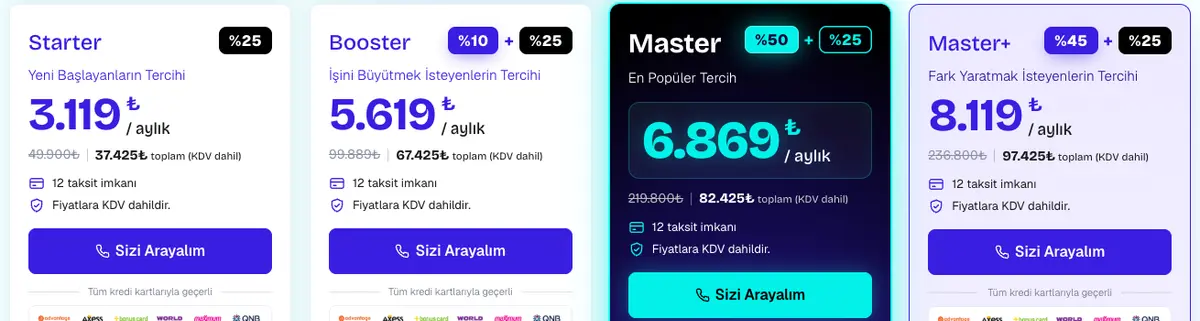
Prices moved in four days. On November 19, 2026 the same packages were 44,411 TL, 80,011 TL, 97,811 TL and 115,611 TL. On November 23 each had fallen by between 6,986 TL and 18,186 TL. The cards carry a countdown and a campaign that gifts one extra licence year on a two-year purchase. That shows the November price is not a permanent list price.
Two discount labels sit side by side on the cards: a package discount, and an extra 25% on top of every discount. They apply one after the other. They are not added. On Booster, 10% off the 99,889 TL list price and then 25% produces 67,425 TL. The combined discount is 32.5%, not 35%. On Master, 50% and then 25% is a combined 62.5%. On Master+ the labels are 45% and 25%. The same sequence gives 97,680 TL, and the page shows 97,425 TL. The 255 TL difference is in the buyer's favour. When you read a quote, compare the list price with the amount due. Do not add the labels.
Shopify plans in Turkish lira
| Plan | Per month on annual billing | Annual total (TL) | Annual total on monthly billing (TL) | Transaction fee on card sales |
|---|---|---|---|---|
| Basic | $24 | 14,542 TL | 16,360 TL | 2% |
| Grow | $65 | 39,385 TL | 43,627 TL | 1% |
| Advanced | $359 | 217,526 TL | 241,763 TL | 0.6% |
| Plus | From $2,300 | From 1,393,623 TL | By contract | 0.2% |
Source: Shopify pricing, the page opened from Türkiye, November 23, 2026. On monthly billing the prices are Basic $27, Grow $72 and Advanced $399. Turkish lira figures use the TCMB forex selling rate (1 USD = 50.4936 TL; the bulletin dated November 20, 2026, the latest rate in force on November 23, 2026). Tax added to the Shopify invoice is excluded.
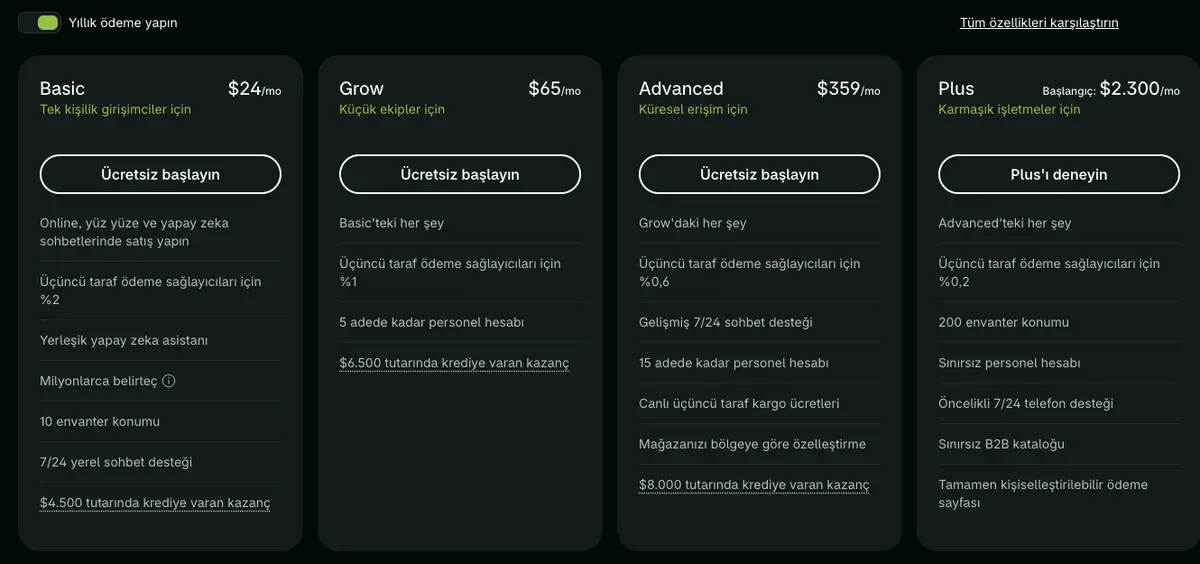
Shopify's pricing page changes the price with the visitor's location and notes that prices can vary by store location. The location-independent version shows $19 for Basic, $54 for Grow and $299 for Advanced on annual billing. Opened from Türkiye, the same plans are $24, $65 and $359. Monthly prices are the same in both versions. When a Turkish source quotes a Shopify price, check which version the figure came from. Every calculation in this article uses the Türkiye price.
Shopify's plan fee is fixed in dollars. The Turkish lira amount is recalculated at the rate of each billing period. On IdeaSoft the exchange-rate effect is frozen for the licence term and hits the package price on renewal day. A two-year IdeaSoft purchase, plus the campaign's extra year, pushes that effect out by three years. On Shopify, annual billing does the same for only 12 months.
Break-even: the revenue that closes the licence gap
The variable that closes the licence gap is the store's annual card revenue. We ran three pairings:
- IdeaSoft Starter and Shopify Basic. The licence gap is 37,425 TL minus 14,542 TL, which is 22,883 TL. Shopify Basic's 2% transaction fee reaches that amount at 1,144,150 TL in annual card revenue. This pairing does not apply to a store selling more than 500 products. Starter's product limit is passed.
- IdeaSoft Booster and Shopify Basic. Unlimited products and the Trendyol and Hepsiburada connection open on IdeaSoft with Booster. The gap is 67,425 TL minus 14,542 TL, which is 52,883 TL. The 2% fee reaches that amount at 2,644,150 TL in annual card revenue.
- IdeaSoft Master and Shopify Grow. Pair the IdeaSoft package that includes five marketplaces with the Shopify plan whose fee drops to 1%. The gap is 82,425 TL minus 39,385 TL, which is 43,040 TL. Grow's 1% fee reaches that amount at 4,304,000 TL in annual card revenue.
Only the licence and Shopify's transaction fee go into the sum. The payment provider's commission is paid on both platforms, so it does not change the result. Two items do change it. First, the monthly subscriptions of marketplace, shipping and e-invoice apps on Shopify. That amount pulls the break-even down. Second, IdeaSoft's promise of a "0% commission campaign POS rate". The package page does not state the conditions, and the next section covers them. Shopify does not charge its transaction fee on bank transfers or cash on delivery. A store with a low share of card revenue sees the break-even move up.
We calculated Shopify's cut per sale in Türkiye, together with payment-provider rates, in our Shopify transaction fees guide. We set up the same price structure for Ticimax in Shopify vs Ticimax. For the two local platforms side by side, see IdeaSoft vs Ticimax.
The cut per sale: the "0% commission" campaign and Shopify's transaction fee
IdeaSoft does not take a share of sales. In Türkiye, Shopify charges 2%, 1%, 0.6% or 0.2% on every card sale, by plan. The payment provider's commission is paid separately on both platforms. IdeaSoft's "0% commission campaign POS rate" is specific to the PayTR virtual POS, requires a 32-day settlement period (valör), and ends at the end of November 2026.
The platform share and the POS commission are separate lines
A card sale produces two separate cuts. The first is the payment provider's commission. On iyzico's official pricing page, a corporate seller pays 4.29% plus 0.25 TL per successful transaction, banking and insurance transaction tax included. PayTR's virtual POS page starts at 2.19% on a 7-day settlement period. The exact rate is set in a quote by sector, volume and average basket. This cut is the same whether the store is on IdeaSoft or Shopify.
The second cut exists only on Shopify. Shopify charges a transaction fee when a store uses a third-party payment provider instead of Shopify Payments. Because Shopify Payments is not available in Türkiye, the fee applies to every card sale. On a 1,000 TL order, iyzico's cut is 43.15 TL. On Shopify Basic, a 20 TL transaction fee is added. IdeaSoft's line "we do not take a commission on your sales" describes this second item, not the first.
Conditions of the "0% commission" campaign
The campaign text on the IdeaSoft package page states three conditions:
- The campaign applies only to PayTR virtual POS applications.
- The settlement period (valör), the time until the payment reaches the account, must be set to 32 days.
- The campaign runs through the end of November. The text says conditions may be reviewed again after the campaign period.
On this article's publication date, 7 days remain before the campaign ends. When you review a quote, ask in writing for the rate and the settlement period that will apply from December. A 32-day settlement period means a payment taken on November 30 reaches the account in early January. For a store that buys stock up front, that wait can cost more than the commission it saves.
Revenue scenarios: annual cost at 1, 5 and 20 million TL of card sales
The table below shows the annual licence plus Shopify's transaction fee. The POS commission is the same on both sides, so it is not in the table. Shopify amounts use annual billing and the TCMB rate of November 23, 2026.
| Annual card revenue | IdeaSoft Master | Shopify Basic | Shopify Grow | Shopify Advanced |
|---|---|---|---|---|
| 1 million TL | 82,425 TL | 34,542 TL | 49,385 TL | 223,526 TL |
| 5 million TL | 82,425 TL | 114,542 TL | 89,385 TL | 247,526 TL |
| 20 million TL | 82,425 TL | 414,542 TL | 239,385 TL | 337,526 TL |
Three results follow. At 5 million TL of card revenue, IdeaSoft Master is only 6,960 TL cheaper than Shopify Grow. At that point the decision comes from the marketplace and app lines in the next section, not from price. Moving from Shopify Basic to Grow pays for itself at 2,484,300 TL of annual card revenue. Moving from Grow to Advanced pays for itself only at about 44.5 million TL of card revenue. We recommend Advanced when you actually need custom reports and up to 15 staff accounts, not for the transaction fee. Grow includes up to 5 staff accounts.
At 20 million TL of card revenue the table opens in IdeaSoft's favour. Even the nearest Shopify option, Grow, costs 156,960 TL more a year. A store at that scale needs a reason other than price to choose Shopify, such as selling abroad, the app ecosystem or an ERP connection. Shopify Plus's 0.2% fee also enters at this scale. Plus starts at 1,393,623 TL a year, and the saving on the transaction fee does not cover that licence at 20 million TL.
Marketplaces, shipping and e-invoicing: included in the package, or added as an app
IdeaSoft includes the Trendyol and Hepsiburada connection from Booster, and five marketplaces from Master. The shipping credit and the e-invoice connection come in the packages too. On Shopify, those three jobs need a separate app or integrator subscription. The annual cost of Shopify Basic plus an integrator that connects Trendyol can stay under IdeaSoft Booster. The shipping credit is not in that sum.
Trendyol and Hepsiburada: Booster, or an integrator on Shopify
On IdeaSoft the marketplace connection is a package feature. Booster connects Trendyol and Hepsiburada. Master adds two-way N11, Amazon and TEMU. On Shopify the same connection is built with a marketplace integrator that has a Shopify connection. Sentos's official pricing page is one example. Shopify integration is not in Basic or Pro. It starts at Plus, and Plus's annual licence is 39,000 TL (the page does not state whether VAT is included). Marketplace product integration is open on Pro and above. TEMU is a paid add-on except on Prestige.
| Line | IdeaSoft Booster | Shopify Basic and Sentos Plus |
|---|---|---|
| Annual licence | 67,425 TL (VAT included) | 14,542 TL and 39,000 TL |
| Total | 67,425 TL | 53,542 TL plus the Shopify transaction fee |
| Trendyol and Hepsiburada | In the package | On the integrator |
| Product limit | Unlimited | Unlimited |
| Shipping credit | 12,000 TL gift | None. The carrier agreement is separate |
| Total at 1 million TL of card revenue on the store's own site | 67,425 TL | 73,542 TL |
Source: IdeaSoft e-commerce packages and Sentos pricing, November 23, 2026.
The transaction fee in the table applies only to card sales on the Shopify store's own site. The marketplace collects payment for sales on Trendyol and Hepsiburada. Shopify does not charge a transaction fee on those orders. A store that takes most of its revenue from marketplaces therefore stays close to 53,542 TL on the Shopify side. What we see at Nodus Works is this: on a marketplace-heavy store, the decision rests less on cost than on how fast stock stays in sync and which admin runs the order flow. Choose the integrator with a test order of the same product sold on both channels at once.
Shipping credit and e-invoicing
IdeaSoft's Booster, Master and Master+ packages come with shipping credits of 12,000 TL, 24,000 TL and 36,000 TL. The package page says shipping prices start at 54.90 TL. That credit covers 218, 437 and 655 shipments at 54.90 TL. Use of the credit depends on the campaign text. The page says use can be stopped on shipments that break the terms.
Shopify has no built-in connection to carriers in Türkiye. The store makes its own agreement with the carrier and attaches the label and tracking number to the Shopify order through an app or an integrator. The same path applies to e-invoices and e-archive invoices. Shopify does not send the invoice to Türkiye's e-document system. An integrator or an accounting app does. On Store Leads, the most installed app on Shopify stores in Türkiye is "E-Ticaret & KVKK Sözleşmeleri", on 5,408 stores. That ranking shows the Turkish store's first gap on Shopify is legal text and documents.
Setting these connections up on Shopify, in the right order and in one pass, is the part of a migration that takes the most time. Our Shopify integration and custom app service picks the marketplace, shipping and e-invoice connections for the store's order flow and delivers them with a test order. Where a ready-made app does not cover the ERP, we write a custom app.
Market data: is IdeaSoft shrinking, and where is Shopify in Türkiye?
IdeaSoft's live store count fell from a peak of 8,888 in the first quarter of 2024 to 6,631 in the second quarter of 2026, then recovered to 7,182 over the last two quarters. There are 18,475 stores using Shopify in Türkiye. That is about 4.4 times IdeaSoft's 4,229 stores in Türkiye. In the last 90 days, 15 stores moved from IdeaSoft to Shopify and 7 moved from Shopify to IdeaSoft.
Store Leads: IdeaSoft's store count since 2024
Store Leads detects platforms from traces in a site's source code and publishes a quarterly live store count for each platform. The series in the IdeaSoft report is:
| Quarter | IdeaSoft live stores | Versus the peak |
|---|---|---|
| 2024 Q1 | 8,888 | Peak |
| 2024 Q4 | 8,038 | 9.6% below |
| 2025 Q4 | 6,873 | 22.7% below |
| 2026 Q2 | 6,631 | 25.4% below |
| 2026 Q3 | 7,066 | 20.5% below |
| 2026 Q4 (through November 23) | 7,182 | 19.2% below |
Source: Store Leads, The State of IdeaSoft, November 23, 2026.
IdeaSoft lost a quarter of its stores in two years, then won 551 stores back over the last two quarters. The report text writes the third-quarter 2026 increase as 1.6%. The table on the same page shows a rise from 6,631 to 7,066, which is 6.6%. We used the table. The recovery falls in the same period as the discount campaigns whose prices this article reviews.
More than half of the stores are in Türkiye. Of IdeaSoft's 7,182 live stores, 4,229, or 58.9%, appear in Türkiye. Of the 18,475 Shopify stores in Türkiye, 229 use Shopify Plus.
Migration data for the last 90 days
| Platform | Left IdeaSoft for this platform | Came to IdeaSoft from this platform | Net for IdeaSoft |
|---|---|---|---|
| Custom software | 31 | 13 | −18 |
| Shopify | 15 | 7 | −8 |
| ikas | 13 | 12 | −1 |
| WooCommerce | 12 | 23 | +11 |
| Ticimax | 6 | 8 | +2 |
| T-Soft | 5 | 1 | −4 |
| Total (including others) | 86 | 80 | −6 |
Source: Store Leads, The State of IdeaSoft, last 90 days, November 23, 2026.
The table shows a two-way flow. IdeaSoft wins stores from self-hosted stacks such as WooCommerce and OpenCart, and loses stores to custom software and to Shopify. For every 15 stores that move to Shopify, 7 go the other way. That ratio also shows Shopify is not the right answer for every IdeaSoft store. Our reading is that the store's own reason should decide a move, not the migration statistic. At Volta Motor the reason was managing 8,987 products in one system with SAP. On a store that takes most of its sales on Trendyol and Hepsiburada, the price tables above often justify staying on IdeaSoft.
Category mix: home and garden, and apparel
The two platforms have different store profiles. On IdeaSoft the largest category is home and garden. On Shopify stores in Türkiye it is apparel.
| Category | IdeaSoft (all countries) | Shopify (Türkiye) |
|---|---|---|
| Apparel | 868 | 5,495 |
| Home and garden | 1,402 | 2,752 |
| Food and drink | 658 | 938 |
| Business and industrial | 657 | 445 |
| Automotive | 515 | 343 |
| Beauty and fitness | 267 | 1,491 |
Source: Store Leads IdeaSoft report and the Store Leads Shopify Türkiye report, November 2026. The IdeaSoft column covers the platform's 7,182 stores in all countries.
The rows that stand out are business and industrial, and automotive. IdeaSoft's store count in Türkiye is about a quarter of Shopify's store count in Türkiye. In the category table, the IdeaSoft column covers all countries and the Shopify column covers Türkiye only. Even with that difference in scope, IdeaSoft's row is higher in business and industrial and in automotive: 657 against 445, and 515 against 343. On Shopify, apparel and beauty carry the weight. About 30% of the 18,475 stores are in apparel, and 8% are in beauty. Which platform is common in your category also sets how wide the agency and app options are.
Selling abroad: the IdeaSoft Export module and Shopify Markets
On IdeaSoft, selling abroad opens with the ideaExport app, at 19,500 TL to 29,500 TL a year, or with the Master+ package that includes the module. On Shopify, Shopify Markets, with language, price and domain by country, is on every plan. On both platforms, collecting payment in the local currency is limited by what the payment provider in Türkiye can do.
IdeaSoft Export packages
IdeaSoft's e-export packages page has two priced packages: the ideaExport foreign-language app at 19,500 TL a year, and the ideaExport e-export app at 29,500 TL a year. A third package, E-export Plus, is priced by quote. The page does not say whether these prices include VAT. The packages promise Turkish plus two languages, prices in more than 160 currencies at European Central Bank rates, and shipping to 192 countries.
The prices also change a package decision. Booster (67,425 TL) plus the e-export app (29,500 TL) comes to 96,925 TL. Master+, which already includes ideaExport, is 97,425 TL. For the 500 TL difference, Master+ adds unlimited marketplace connections, 24,000 TL more shipping credit and bookkeeping. If the ideaExport price excludes VAT, Booster plus ideaExport rises to 102,825 TL and Master+ stays cheaper. An IdeaSoft store that will sell abroad should ask for the Master+ quote first.
The page's "160 currencies" raises the same question as the Shopify section above. Showing a currency and collecting in that currency are not the same thing. IdeaSoft's e-export page also lists PayPal among the integrations. PayPal has not served businesses in Türkiye since 2016. When you take a quote, ask in writing which currency is charged on the foreign customer's card, and which currency reaches your account.
Shopify Markets and the Shopify Payments limit
On Shopify's plan page, assigning a domain by country with Markets, and translating the online store, are on every plan. Shopify's Help Center says Basic, Grow and Advanced can sell in up to 20 languages, and Plus in up to 30. The same plan page puts a star next to three features: showing prices in the local currency, local payment methods, and collecting duties and import taxes. The star means "Requires Shopify Payments". Shopify Payments is not available in Türkiye.
Where Shopify leads abroad is international marketplaces. Shopify's Marketplace Connect app connects marketplaces such as Amazon, eBay and Walmart. On the plan page, the first 50 synced marketplace orders a month are free, then 1%, capped at 99 dollars a month. For the limits on collecting payment from abroad, and for the TCMB rules, foreign currency collection and merchant of record on Shopify continues this section.
| Selling-abroad feature | IdeaSoft | Shopify (store in Türkiye) |
|---|---|---|
| Multilingual online store | Turkish and 2 languages with ideaExport | 20 languages on every plan, 30 on Plus |
| Showing prices in foreign currency | More than 160 currencies with ideaExport | The built-in feature requires Shopify Payments. An app does it |
| Domain by country | Not stated on the ideaExport page | On every plan |
| International marketplace | Unlimited marketplaces on Master+. The list is in the quote | Marketplace Connect: 50 orders free, then 1% |
| Extra annual cost | 19,500 to 29,500 TL, or Master+ | Included in the plan. The currency app is separate |
Source: IdeaSoft e-export packages, Shopify pricing, Shopify language requirements, November 23, 2026.
Theme, SEO and URL structure
On IdeaSoft stores the product URL starts with /urun/ and the category URL with /kategori/. On Shopify those prefixes are fixed as /products/ and /collections/, and they cannot be changed. Every store that moves from IdeaSoft to Shopify therefore changes its product and category URLs, and each old URL needs a 301 redirect. Shopify allows 100,000 redirects on standard plans and 20 million on Plus.
URL structure: /urun/ and /products/
On November 23, 2026 we checked the sites of Bellona, Gerekli Şeyler and e-fidancim from Store Leads' list of the largest IdeaSoft stores in Türkiye. All three use the same pattern: products under /urun/, categories under /kategori/, brands under /marka/, corporate pages under /sayfa/, and blog posts under /blog/icerik/. The sitemap is published at /sitemap.xml as an index split into product and image sitemaps.
| Page type | IdeaSoft URL | Shopify URL | On migration |
|---|---|---|---|
| Product | /urun/aura-soft-baza | /products/aura-soft-baza | 301 redirect |
| Category | /kategori/baza | /collections/baza | 301 redirect |
| Brand | /marka/dark-horse | A brand collection, or /collections/vendors?q= | A collection is created, then a 301 redirect |
| Corporate page | /sayfa/kisisel-veriler-politikasi | /pages/kisisel-veriler-politikasi | 301 redirect |
| Blog post | /blog/icerik/yazi-adi | /blogs/blog-adi/yazi-adi | 301 redirect |
Source: live URLs on bellona.com.tr, gerekliseyler.com.tr and e-fidancim.com, November 23, 2026; Shopify URL redirects.
When the last part of the URL is kept, the work in the right-hand column becomes a mapping table. You upload redirects to Shopify in bulk from a CSV file. Shopify's Help Center describes the step as Content, then Menus, then URL redirects, then Import. One Shopify behaviour matters here. When a product is opened from inside a collection, the URL becomes /collections/baza/products/aura-soft-baza, while the page's canonical URL stays /products/aura-soft-baza. Redirect the old IdeaSoft URL to the canonical product URL, not to the collection URL that internal links produce.
Theme and code access
The IdeaSoft package page lists more than 70 themes from Starter, and Master and above include a free setup service. On Shopify, themes are written in a template language called Liquid, and the store owner can open the whole theme code. The robots.txt file is edited through the robots.txt.liquid template. The sitemap, the canonical tag and the base of product structured data come automatically on Shopify.
The difference we see is less about the technical base of SEO than about who can change what. On Shopify a developer edits the product page's structured data, whether filtered collection pages are indexed, and the app code that affects page speed, directly. On IdeaSoft, how much of that the store can change depends on the package and the theme. When you take a quote, ask about theme code access and the right to edit robots.txt.
Moving from IdeaSoft to Shopify: what transfers, and what is rebuilt
Products, variants, images, categories, customer records, blog posts and pages transfer from IdeaSoft to Shopify as data. The theme, the payment-provider connection, marketplace, shipping and e-invoice integrations, campaign rules and 301 redirects are rebuilt on Shopify. The time in a migration goes to testing those rebuilt connections, not to the transfer.
What transfers and what is rebuilt
| Data or feature | On migration | Note |
|---|---|---|
| Product, variant, image, description | Transfers | IdeaSoft's variant structure is mapped to Shopify's option and variant model |
| Category | Transfers, and becomes a collection | Automatic collection rules are rewritten on Shopify |
| Customer records | Transfers | Passwords do not transfer. Shopify's new customer accounts sign in with a one-time code sent by email |
| Order history | Transfers with a bulk import app | For reporting and customer history |
| Blog and corporate pages | Transfers | The URL changes and needs a 301 redirect |
| Theme | Rebuilt | An IdeaSoft theme does not transfer to Shopify |
| Payment provider | Reconnected | iyzico, PayTR and others, through a Shopify app |
| Marketplace, shipping, e-invoice | Rebuilt | An integrator or an app replaces the connections that came in the package |
| Campaign and discount rules | Rewritten | With Shopify discounts and automatic discount rules |
The password row answers the question we hear most often in a migration. No platform hands a customer password to another platform in a readable form. On older systems that meant every customer reset a password after the move. Shopify's new customer accounts work without a password, so on the first sign-in after the move the customer enters the code sent to their email and sees their order history.
What changed at Volta Motor
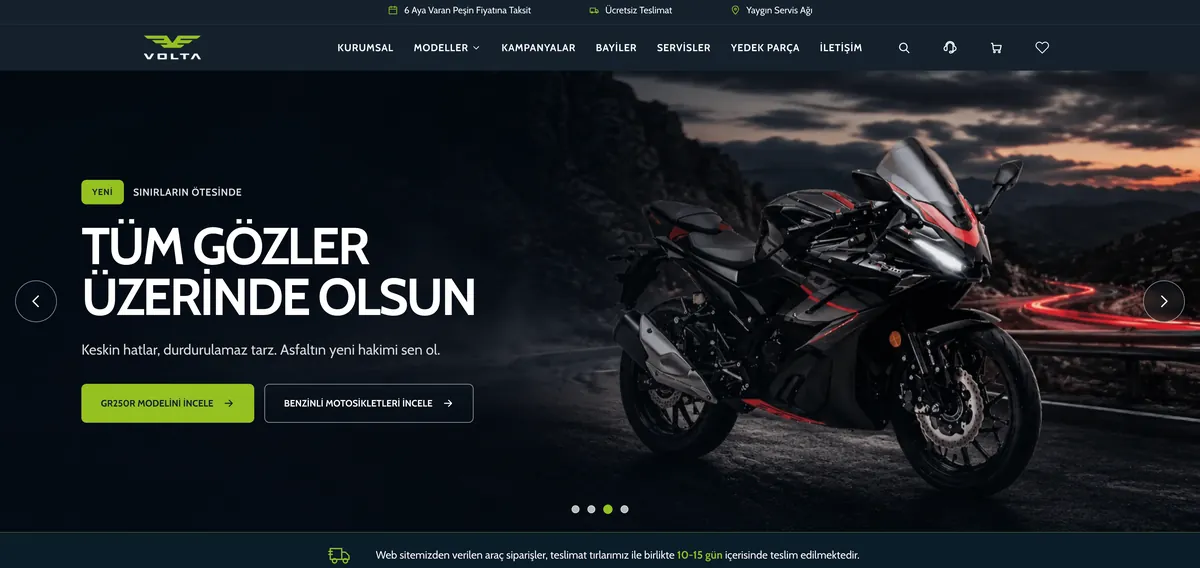
Volta Motor sells in four product groups: motorcycles, scooters, bicycles and ATVs, and it runs operations on SAP. When we moved the store from IdeaSoft to Shopify we transferred the products, categories and content into the new structure, built a new theme and connected Shopify to SAP. On the measurement on our case-study page, 99.9% of orders transfer to SAP automatically. Compared with the first 20 days after launch, organic search traffic rose 33% and total sessions rose 18% in the latest 20 days (source: GA4 and Shopify Analytics).
The lesson from that project is that the migration calendar stretches with the number of integrations, not the number of products. Product data transfers through a mapping table. When a price or stock change in SAP appears in the store is a flow that has to be tested again in every campaign period. We described the technical process step by step in our guide to moving from IdeaSoft to Shopify.
The largest risk for a store leaving IdeaSoft is packing the URL change and the integration change into the same day. Our migration to Shopify service works to a calendar that finishes the redirect file and the integration tests before launch. We ran the Volta Motor migration on that calendar.
Shopify or IdeaSoft: a decision matrix in six questions
The answer to Shopify or IdeaSoft depends on six variables: product count, card revenue on the store's own site, the marketplace share, the plan to sell abroad, an ERP connection and the need for code access. If at least three of the six fall in the Shopify column, Shopify starts at a lower cost. If three fall in the IdeaSoft column, IdeaSoft does.
| Question | IdeaSoft leads | Shopify leads |
|---|---|---|
| 1. How many products do you sell? | Under 500, and Starter is enough | Over 500, with no marketplace sales |
| 2. What is your annual card revenue on your own site? | Above 5 million TL. Shopify's transaction fee grows | Below 1,144,150 TL. Basic is cheaper |
| 3. How much of revenue comes from marketplaces? | Most of it. Booster or Master includes the connection | Little of it. The integrator subscription stays small |
| 4. Will you sell abroad? | No, or ideaExport's two languages are enough | Yes. 20 languages, a country domain, Marketplace Connect |
| 5. Will you need an ERP or custom software connection? | No | Yes. The API and a custom app |
6. Do you want full control of the theme code and robots.txt? | No. A ready-made theme is enough | Yes. Liquid and robots.txt.liquid |
Read the matrix with two examples. A spare-parts store in Ankara with 300 products takes 70% of revenue from Trendyol, has no plan to sell abroad and keeps its books in a bookkeeping program. Five of the six questions fall in the IdeaSoft column. A clothing brand in Istanbul with 1,200 products takes most of its revenue from its own site and Instagram ads, wants to sell to Germany and uses Logo for stock. Five questions fall in the Shopify column.
What the matrix does not give you is the team behind the percentages. Choosing apps, setting up an integrator and managing theme code on Shopify takes labour. IdeaSoft takes on most of that work in the package. If nobody on your team, and no agency, will run that work, the Shopify advantage in the matrix turns into a cost in the first year.
Conclusion: six questions to ask before you take a quote
For a store whose sales sit in Türkiye and on marketplaces, with a small catalogue and a limited need for integrations, IdeaSoft starts with fewer line items. For a store that sells from its own site, will open abroad or will work with an ERP, Shopify's licence and transaction fee come back as two measurable items: the app ecosystem and code access. When you take a quote from both platforms, ask these six questions in writing:
- What is the second- and third-year renewal, in Turkish lira, VAT included?
- After the campaign POS rate ends, what will the commission and the settlement period be?
- Which package includes the marketplace connection I want as standard, and will it stay in the package after the campaign?
- Which currency is charged on the foreign customer's card, and which currency reaches my account?
- Do I have the right to edit the theme code and
robots.txt? - If I leave the platform, can I take my product, customer and order data, in which format, and free of charge?
The first three questions come from the campaign structure of local packages. The last three come from both platforms' contracts. Once all six answers arrive in writing, you can put your own figures into the tables above.
To run the break-even with your own figures, use the payment-provider table in our Shopify transaction fees guide. If you plan to sell abroad, foreign currency collection and merchant of record on Shopify covers the collection side. If you have decided to move from IdeaSoft to Shopify, our guide to that move walks through the technical process. To build a migration calendar from your store's data, talk to our migration to Shopify team.
Frequently asked questions
Is Shopify or IdeaSoft cheaper?
If annual card revenue on your own site is below 1,144,150 TL, Shopify Basic is cheaper than IdeaSoft Starter. Starter's annual price on November 23, 2026 is 37,425 TL, VAT included. Shopify Basic in Türkiye is about 14,542 TL a year on annual billing. Because Shopify charges a 2% transaction fee on card sales, the gap closes as revenue grows. At 20 million TL of card revenue, IdeaSoft Master is 156,960 TL a year cheaper than the nearest Shopify plan.
Does IdeaSoft take a commission on sales?
No. On IdeaSoft's package page, no commission or similar fee is charged on sales made through your site. The package price is the only amount paid to IdeaSoft. The payment provider's commission is paid separately. The "0% commission" campaign on the page is specific to the PayTR virtual POS, requires a 32-day settlement period, and runs through the end of November 2026.
How much does Shopify take from a sale in Türkiye?
Because Shopify Payments is not available in Türkiye, Shopify charges a third-party payment provider fee on every card sale: 2% on Basic, 1% on Grow, 0.6% on Advanced and 0.2% on Plus. The fee is added to the payment provider's commission. Shopify does not charge a transaction fee on bank transfers, cash on delivery, or orders that come from a marketplace.
Which IdeaSoft package includes the Trendyol integration?
The Trendyol and Hepsiburada connection is included from the Booster package. Booster's annual price on November 23, 2026 is 67,425 TL, VAT included. Master adds N11, Amazon and TEMU. Master+ gives unlimited marketplace connections. On Shopify the same connection is built with an integrator. On Sentos, the Shopify connection starts at the Plus package, at 39,000 TL a year.
Will Google rankings fall after a move from IdeaSoft to Shopify?
A lasting drop is not expected if every old URL is redirected to the new URL with a 301. IdeaSoft's /urun/ and /kategori/ URLs become /products/ and /collections/ on Shopify, and those prefixes cannot be changed. Prepare the redirect file before launch day. In the Volta Motor migration, organic traffic in the latest 20 days after launch was 33% higher than in the first 20 days.
Is the number of IdeaSoft stores falling?
On Store Leads, IdeaSoft's live store count fell from 8,888 in the first quarter of 2024 to 6,631 in the second quarter of 2026, then rose to 7,182 by November 23, 2026. In the last 90 days IdeaSoft lost 86 stores and gained 80. Fifteen stores moved to Shopify, and 7 stores came from Shopify.