













































































































What Is ETK? Consent, İYS Registration, 2026 Fines and the Correct Shopify Setup
ETK is the short name for Turkey's Law No. 6563 on the Regulation of Electronic Commerce. In everyday use it means the consent a brand must hold before a campaign SMS, a promotional email or a marketing call, and this guide shows which messages need it, when the consent is void, and how a Shopify store collects it and registers it with İYS.
 Author: Efe Gündüz Nodus Works Shopify Agency Founder
Published 20 min read
ETK is the short name for Law No. 6563 on the Regulation of Electronic Commerce. In everyday use, "ETK consent" or "ETK approval" means the commercial electronic message consent that law requires: the permission a brand must already hold before it can send you a campaign SMS, a promotional email or a marketing call. The law came into force on May 1, 2015. Since 2021 that consent is valid only when it is registered in İYS (Message Management System, İleti Yönetim Sistemi).
At Nodus Works, the situation we meet most often while setting up marketing consent for Shopify stores in Türkiye is this: the store has turned the checkbox on at checkout and collected thousands of "subscribers", and none of those consents are in İYS. Under the regulation that list cannot be used for marketing, because a consent that was never registered in İYS is treated as void. Every rule below was read, with its article number, from the current text of the law and the regulation on mevzuat.gov.tr on November 26, 2026.
What does ETK mean, and what does the abbreviation stand for?
ETK expands to "Elektronik Ticaret Kanunu" (Electronic Commerce Law) and refers to Law No. 6563 on the Regulation of Electronic Commerce, published in the Official Gazette of November 5, 2014, issue 29166. "ETK consent" is the approval Article 6 of that law requires before a marketing message is sent.
The abbreviation "ETK" does not appear in the text of the law. The legislation only says "the Law". Banks, mobile operators and e-commerce sites spread the short form by printing it on consent forms. A box in a bank's mobile app that says "ETK call and SMS consent" is, by its legal name, consent to commercial electronic messages.
The law regulates four subjects: commercial communication, the duties of service providers, contracts formed electronically, and information duties. In 2022, Law No. 7416 added provisions aimed at marketplaces. The part that matters in the daily work of a Shopify store is the commercial electronic message rules (Articles 6, 7 and 8). The detail sits in the Regulation on Commercial Communication and Commercial Electronic Messages (Official Gazette of July 15, 2015, issue 29417).
| Term | What it means | Basis |
|---|---|---|
| ETK | Law No. 6563 on the Regulation of Electronic Commerce | Official Gazette 5/11/2014, issue 29166 |
| ETK consent | The recipient's prior approval for a campaign SMS, email or call | Law Art. 6; Regulation Art. 5 and 7 |
| İYS | The central system that records consents and opt-outs (Message Management System) | Regulation Art. 5(2), 10/A |
| ETBİS | Electronic Commerce Information System; the site's registration with the Ministry | Law Art. 2(1)(ı) |
| KVKK | Law No. 6698 on the Protection of Personal Data; the basis for processing data | A separate law |
ETK and ETBİS are often confused. ETBİS is your site's registration with the Ministry of Trade, and it has nothing to do with marketing messages. A Shopify store completes the two separately.
What is ETK consent, and which messages need it?
ETK consent is the recipient's positive statement that "you may send me campaign and promotional messages", and it is required only for a commercial electronic message. Order confirmations, shipping notices and invoices do not need consent. The moment a single discount code is added inside that message, it becomes a commercial message.
Article 2 of the law defines a commercial electronic message without tying it to one channel: every message with data, voice or image content sent for a commercial purpose by telephone, call center, automatic dialing, email or SMS is in scope. Article 5 of the regulation also lists the purpose: to introduce goods and services, to market them, to promote the business, or to increase recognition with greetings and good wishes. A brand SMS that says "happy holidays" needs consent too.
Article 6 of the regulation lists the cases that do not need consent: messages about changes to, use of and maintenance of a product the person bought; and notices about an ongoing membership, collection, a debt reminder, an information update, a purchase and a delivery. The last sentence of the same article draws the line: those notices must not promote any good or service.
| Message sent by the Shopify store | Does it need ETK consent? | Why |
|---|---|---|
| Order confirmation email | No | Purchase notice (Reg. Art. 6(2)) |
| "Shipped" SMS | No | Delivery notice (Reg. Art. 6(2)) |
| Shipping SMS plus "10% off your next order" | Yes | A notice must not promote a product (last sentence of Reg. Art. 6(2)) |
| Newsletter, campaign, new-product announcement | Yes | Promotion and marketing (Reg. Art. 5(1)) |
| Holiday and birthday greeting | Yes | Purpose of increasing recognition (Reg. Art. 5(1)) |
| Abandoned-cart reminder | Treat it as yes | There is no completed purchase; the message encourages a purchase |
| Password reset, SMS login code | No | Account-security notice, with no promotion |
We wrote the abandoned-cart row as "treat it as yes" on purpose. The regulation does not name this message type. Shopify's own help page also asks stores that send cart reminders to change the text of the consent checkbox. Because the order was never completed, leaning on the "purchase notice" exception is a hard position to defend if someone complains.
What makes an ETK consent valid?
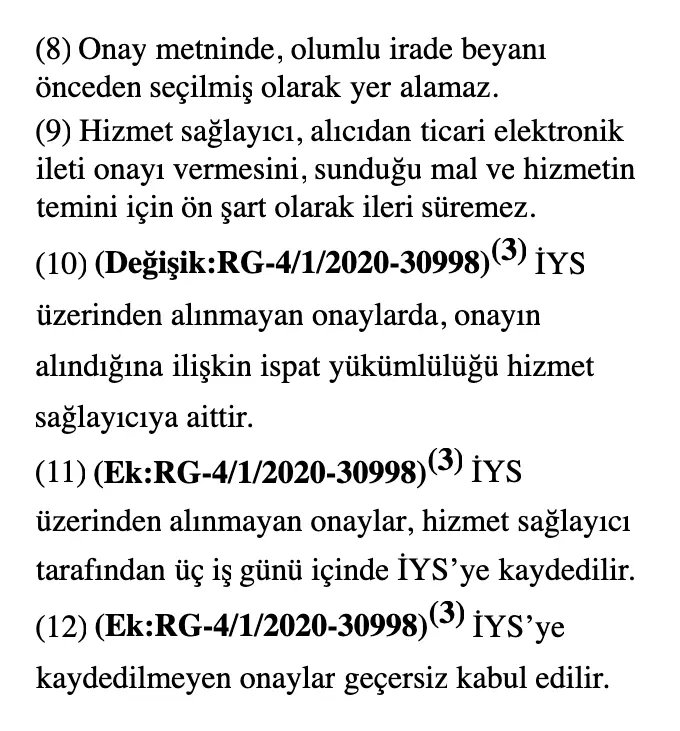
A valid ETK consent contains the recipient's positive declaration of will, their full name and a contact address. The checkbox cannot arrive pre-ticked, consent cannot be made a condition of the sale, and if it was collected outside İYS it is registered in İYS within three business days. A consent that is not registered in İYS is void under paragraph 12 of Article 7 of the regulation.
Article 7 of the regulation decides the consent form of a Shopify store directly. Read the paragraphs against what you actually build:
- Positive declaration, name and address (7/1). The customer ticks the box themselves. Consents collected through İYS do not require a name.
- Confirmation within 24 hours (7/3). If the consent was collected electronically and outside İYS, notice that it was collected, together with a way to opt out, goes to the recipient's address within 24 hours.
- You cannot send a message to ask for consent (7/4). Sending an SMS or email to an old customer list that says "would you give permission?" is forbidden. That message itself counts as an unsolicited commercial message.
- Consent buried in a contract (7/5). Consent placed inside a membership contract is written under the heading "ticari elektronik ileti" (commercial electronic message), in at least 12-point type, with a way to opt out.
- A pre-ticked box is forbidden (7/8). A checkbox that arrives pre-selected on Shopify is directly contrary to this paragraph.
- Consent cannot be a condition of the sale (7/9). A flow that says "you cannot order unless you consent" is forbidden.
- Three business days, and voidness (7/11, 7/12). Consent collected outside İYS is registered in İYS within three business days. Consent that is not registered is void.
The burden of proof is on the store. Article 13 of the regulation requires consent records to be kept for three years from the date the consent ceases to be valid. "The box was ticked" is not enough: the date and time, the source (checkout, account form, pop-up) and the consent text shown on that date have to be kept together. On the Shopify customer record, the date of email consent is stored in consentUpdatedAt and the consent level in marketingOptInLevel. Shopify does not store which version of the consent text was shown. We recommend recording text changes, with their dates, separately.
One claim that shows up often in competing articles needs to be settled: "timestamped record" is not a term the regulation uses. The regulation puts the burden of proof on the store and sets the period at three years. The store chooses the form of the record.
What is the difference between ETK, İYS and KVKK?
ETK consent is permission to send a marketing message. Explicit consent under KVKK (Law No. 6698 on the Protection of Personal Data) is the basis for processing personal data. İYS is the state-backed system where ETK consents are recorded. A Shopify store manages the three separately: a customer who has given KVKK consent still cannot be sent a campaign SMS without ETK consent.
İYS is operated by İYS A.Ş., which is affiliated with TOBB (the Union of Chambers and Commodity Exchanges of Türkiye) under authorization from the Ministry of Trade. Under Article 5 of the regulation, every natural and legal person who wants to send commercial messages registers with İYS. A commercial message also cannot be sent to a recipient who has no consent in İYS. A person sees every consent they have given on one screen at vatandas.iys.org.tr, and rejects them there.
| Topic | ETK consent | İYS | KVKK explicit consent |
|---|---|---|---|
| What it regulates | Campaign SMS, email, calls | The record of ETK consents and opt-outs | Processing and transfer of personal data |
| Basis | Law No. 6563, Art. 6 | Regulation Art. 5, 10/A | Law No. 6698 |
| Who supervises | Ministry of Trade | İYS A.Ş. (for the Ministry) | Personal Data Protection Authority |
| Channel split | Yes: SMS, email and calls are separate | Yes: a separate record per channel | By purpose |
| Where it sits on Shopify | Checkout marketing checkbox | Nowhere; an integration is required | Privacy notice and a separate checkbox |
The channel split is the point most often missed in practice. Under Article 9 of the regulation, an opt-out invalidates only the consent of the channel on which the notice was made. It is legally possible to keep sending SMS to a customer who left the email newsletter, but only if that customer's SMS consent is recorded separately in İYS.
We covered the privacy notice and the explicit-consent setup on the KVKK side in our Shopify KVKK integration guide. The only rule here is this: do not squeeze KVKK consent and ETK consent into one checkbox. If a complaint review cannot tell which consent was given for which purpose, the burden of proof stays with the store.
Can you message tradespeople and merchants without ETK consent?
Yes. Commercial messages can be sent to tradespeople and merchants (esnaf and tacir) without prior consent (Law Art. 6(2)). Before the send, though, those addresses are registered in İYS, and whether the recipient has used the right to opt out is checked through İYS (Regulation Art. 6(6)). A merchant who has opted out cannot be messaged again without a new consent.
This exception matters directly to wholesalers using Shopify's B2B channel. You do not have to collect a separate consent from each dealer to email them next season's price list. You do have to upload the dealer list to İYS as "tacir" (merchant) and check opt-outs before you send. We covered setting up the wholesale channel in our Shopify B2B and wholesale guide.
The limit of the exception is clear too: a merchant is a recipient at the address registered for their commercial activity. An employee's personal Gmail address or personal mobile number is not a merchant address. The mistake we see most often in B2B lists is personal numbers typed into a dealer form and then included in a bulk campaign under the "tacir" label.
How do the right to opt out and the three-business-day rule work?
The recipient can withdraw ETK consent at any time, without giving a reason. Sending stops within three business days after the opt-out reaches the store (Law Art. 8(3), Regulation Art. 10), and the store reports an opt-out it received to İYS, again within three business days (Regulation Art. 9(6)).
The regulation also sets the form of the opt-out. Every commercial message includes a way to opt out (9/4). The opt-out is made on the channel the message arrived on, easily and free of charge (9/3): a free opt-out short code in an SMS campaign, an unsubscribe link in an email. The recipient can also opt out directly through İYS (9/7). In that case the opt-out lands in İYS before it lands with the store.
There are rules for the content of the message as well (Regulation Art. 8). For a company running a Shopify store, the practical reading is this:
- Identity: An SMS carries the MERSİS number (the central trade-registry number). An email carries the MERSİS number and the trade name. A tradesperson writes their name and their Turkish ID number or tax number.
- Contact: At least one reachable contact detail (phone or email) is included.
- Nature label: If the nature of the message is not clear from the content, a label such as "kampanya" (campaign) or "tanıtım" (promotion) is placed at the start of the SMS or in the email subject.
- Promotion terms: If there is a discount, the validity period and the conditions are stated clearly through a link or a customer-service number.
An example of a compliant SMS: "KAMPANYA: Kış koleksiyonunda 30 Kasım'a kadar %20 indirim. Şartlar: marka.com/kampanya MERSIS: 0123456789000000 Ret için RET yazıp 3XXX'e gönderin." In English that is: campaign, 20% off the winter collection until November 30, terms at the link, the MERSİS number, and "text RET to 3XXX to opt out". Shopify's SMS provider, or a bulk SMS firm such as Netgsm, supplies the opt-out short code ready to use. We showed the setup step by step in our Shopify Netgsm SMS integration article.
What is the fine for messaging without ETK consent? (2026)
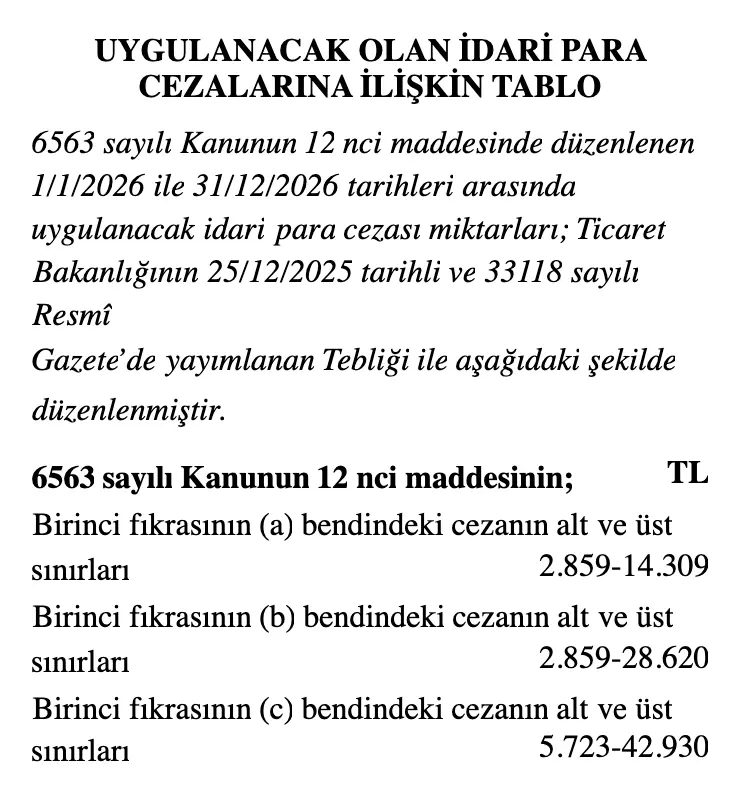
In 2026 the administrative fine for sending an unsolicited commercial message is 2,859 TL to 14,309 TL. If the message went to more than one person in a single send, the fine can be multiplied by up to ten, which means up to 143,090 TL (Law Art. 12(1)(a) and 12(2)). The fine for continuing to send after an opt-out request is 5,723 TL to 42,930 TL.
The amounts in Article 12 of the law are updated every year by the revaluation rate. The 2026 amounts were set by the Ministry of Trade's communiqué published in the Official Gazette of December 25, 2025, issue 33118, and they apply through December 31, 2026.
| Breach | Article of the law | 2026 fine range |
|---|---|---|
| Sending a commercial message without consent, or content that does not match the consent | Art. 12(1)(a) (Art. 6(1), 7(1)) | 2,859 to 14,309 TL |
| The same breach, to more than one recipient in a single send | Art. 12(2) | Up to 143,090 TL (ten times) |
| Missing identity, contact and subject information in the message | Art. 12(1)(b) (Art. 7(2), 7(3)) | 2,859 to 28,620 TL |
| Offering no way to opt out, or not applying an opt-out within three business days | Art. 12(1)(c) (Art. 8(2), 8(3)) | 5,723 to 42,930 TL |
| The same breach repeated within one year | Art. 12(4) | Double the previous fine |
Read the figures against one campaign. If a single SMS campaign goes to a list of 5,000 people and 400 of them have no İYS consent, and the campaign becomes the subject of a complaint, the bulk-send rule applies and the ceiling for that one act is 143,090 TL. The complaint process also runs against the store: Article 13 of the regulation puts the burden of proof on the sender, and under Article 15 the store answers the provincial directorate's request for information and documents within 15 days. A store that cannot produce the consent record is penalized on the complainant's evidence.
How do you set up ETK consent correctly on Shopify? (step by step)
Shopify offers an email and an SMS marketing checkbox at checkout and stores the customer's consent state, but it does not send the consent to İYS. A compliant setup in Türkiye has six steps: bring the box up empty, write the text for ETK, separate the channels, transfer the consent to İYS within three business days, sync opt-outs in both directions, and check İYS before you send.
1. Do not pre-tick the checkbox in any country
In the Shopify admin, open Settings > Checkout (Ayarlar > Ödeme in the Turkish admin) and, in Marketing opt-in (Pazarlama onayı), turn Email on. According to Shopify's help page you choose whether the box arrives pre-selected in one of two ways: "Regions recommended by Shopify" or "Regions you choose". Pick the second and select no region, and the box arrives empty in every country. That is the safest match for paragraph 7/8 of the regulation.
2. Write the consent text for ETK
Shopify's default text is a sentence along the lines of "get emails about news and offers", and it does not name the brand, the channel or the way to opt out. Change it in the theme language editor (Online Store > Themes > Edit language; Online Mağaza > Temalar > Dili düzenle in the Turkish admin). An example: "Marka A.Ş.'nin kampanya ve yeni ürün duyurularını e-posta ile almayı kabul ediyorum. İznimi dilediğim zaman e-postadaki bağlantıdan veya vatandas.iys.org.tr üzerinden geri alabilirim." That says the customer agrees to receive campaign and new-product announcements from the company by email, and can withdraw at any time from the link in the email or at vatandas.iys.org.tr.
3. Collect SMS and email consent separately
In the same section, turn the SMS checkbox on separately. According to Shopify, an SMS or WhatsApp marketing preference is saved when the customer submits payment. Each channel is a separate record in İYS: email consent does not allow you to send SMS.
4. Send the consent to İYS within three business days
Shopify fires the customers_email_marketing_consent/update webhook when a customer's email consent changes, and customers_marketing_consent/update when SMS consent changes. An app or a server that listens for these events writes the consent to the İYS API (apidocs.iys.org.tr) with the date and the source. A daily batch transfer is also inside the legal limit. An instant transfer never brings the three-business-day limit into play. We described the technical flow in our Shopify İYS integration guide.
5. Sync opt-outs in both directions
An opt-out arrives from two places: the customer clicks the unsubscribe link in a Shopify email, or they opt out directly in İYS. In the first case you have to report the opt-out to İYS within three business days. In the second case, if you do not write the İYS rejection back to Shopify, Shopify still sees that customer as subscribed and the next campaign goes to them too.
6. Check İYS before you send
Under Article 17/A of the regulation, an intermediary firm has no duty to check İYS before an email send. Shopify Email, Klaviyo or another email tool does not compare your list with İYS on its own. That check is the store's responsibility. For SMS, the bulk SMS firm must check İYS before sending (Art. 11/7) and does not start a send to a number without consent.
Steps 4 and 5 of these six need code: a service that listens for webhooks, İYS API credentials, and a two-way opt-out sync. If you want the consent infrastructure included in the same project as the store's email and SMS flows, our email marketing and CRM automation service delivers consent collection, the İYS transfer and the opt-out sync together with the campaign flows. If you want a ready-made way to collect KVKK and ETK consent as two separate checkboxes at checkout, look at our CompliTR app.
ETK mistakes we see in Shopify stores in the field
Most ETK mistakes in the Turkish Shopify stores Nodus Works has built or taken over do not come from bad intent. They come from Shopify not knowing Turkish law. The four mistakes below keep showing up in our projects, and each one makes part of the list legally void.
1. A "subscriber" list that arrives with a migration. When a store moves from İdeaSoft, Ticimax or WooCommerce to Shopify, the "Accepts Email Marketing" column in the customer file is transferred as "yes". Shopify counts those customers as subscribed. If the consents on the old platform have no counterpart in İYS, paragraph 7/12 of the regulation makes them void. On migration projects we do not transfer the consent column without comparing the customer file to the İYS records.
2. Trusting the "recommended regions" default. Shopify's automatic region setting brings the box up ticked or empty according to the customer's country, and by Shopify's own warning it does not replace legal advice. Rather than tracking, country by country, what that setting does for a store selling from Türkiye, we use "Regions you choose" with no region selected.
3. A campaign that leaks into an informational template. When a "you may also like" block or a discount code is added to Shopify's order-confirmation and shipping-notice templates, the message becomes a commercial message. Those templates go to every customer without a consent check, so one template change means an unsolicited message to the whole customer base.
4. A one-way opt-out. Stores usually set up the transfer of consent from Shopify to İYS and do not set up the transfer of opt-outs from İYS back to Shopify. When a customer rejects consent through e-Devlet or vatandas.iys.org.tr, the store's email tool does not see it and sending continues. This falls under point (c) of Article 12(1) of the law, and in 2026 the fine goes up to 42,930 TL.
The shared point of these mistakes is this: the subscribed label on Shopify is not proof of marketing permission in Türkiye. The proof is the record in İYS.
Frequently asked questions
What does ETK consent mean?
ETK consent is the commercial electronic message consent you give so that a brand can send you a campaign SMS, a promotional email or a marketing call. Its basis is Article 6 of Law No. 6563. Consent is separate for each channel, and since 2021 it is not treated as valid unless it is registered in İYS.
How do you withdraw ETK consent?
You withdraw ETK consent in three ways: by using the opt-out short code or the unsubscribe link in the message, at vatandas.iys.org.tr, or through the İYS service on e-Devlet. The brand has to stop sending within three business days at the latest after the opt-out request reaches it.
Can I place an order if I do not give ETK consent?
Yes. Paragraph 7/9 of the regulation forbids making ETK consent a condition of selling a good or a service. Order confirmations, shipping notices and invoices still arrive if you do not consent, because those messages are not commercial messages.
Are ETK and KVKK the same thing?
No. ETK consent is permission to receive marketing messages, and the Ministry of Trade supervises it. Explicit consent under KVKK concerns the processing of your personal data, and the Personal Data Protection Authority supervises it. A store should collect the two with separate checkboxes and separate texts.
Who has to register with İYS?
Every natural and legal person who wants to send commercial electronic messages registers with İYS (Regulation Art. 5(2)). Every Shopify store that sends a campaign email or SMS is in scope. A store that sends only order and shipping notices does not enter this duty for as long as it sends no commercial messages.
Does Shopify send ETK consent to İYS automatically?
No. Shopify keeps the consent state and the date on the customer record, but it has no connection to İYS. Transferring the consent to İYS within three business days takes an app that listens for webhooks, or a custom integration.
What is the fine for unsolicited SMS in 2026?
In 2026 the fine for an unsolicited commercial message is 2,859 TL to 14,309 TL. If it was sent to more than one person in a single send, the fine goes up to ten times that, which is up to 143,090 TL. The amounts are updated every year by the revaluation rate.
Conclusion: ETK compliance is a record chain, not a checkbox
ETK consent is a chain of three links: the customer ticks an empty box themselves, the consent is registered in İYS within three business days, and opt-outs are synced in both directions. Shopify supplies the first link ready-made. The second and third are specific to Türkiye, and the store has to build them.
First check two things in your own store: on Settings > Checkout, is the marketing checkbox free of any pre-selected region, and does your subscriber count on Shopify match your consent count in İYS? If the two differ, every address in the gap should leave your campaign list. For the detail of the technical setup, go to our Shopify İYS integration guide. To compare your current list with İYS and to talk through building the consent infrastructure, you can book a meeting with us.