The 7 critical risks awaiting your e-commerce business are cyberattacks, supply chain disruptions, rising shipping costs, regulatory updates such as KVKK/GDPR, AI-powered competition, changing consumer behavior and a rise in fraud and chargebacks. Their shared blind spot is conversion and trust infrastructure. 2FA, 3D Secure and real-time stock sync are among the most practical ways to reduce these risks.
In the site audit projects we run at Nodus Works, we see the same pattern again and again: brands set aside budget for "big" risks such as cyber security and regulation, while invisible design mistakes and conversion gaps inside the site itself go unnoticed and cost them sales for months. In this guide we cover the 7 critical risks awaiting your e-commerce site, the blind spot they all share (missing conversion and trust infrastructure) and how an inadequate infrastructure turns into a platform problem.
The table below summarizes the 7 risks and the most practical step to reduce each one; the details follow in the next sections.
1. Cyber Attacks and Data Breaches
DDoS attacks and data breaches can make an e-commerce site completely unreachable within hours, and every order that doesn't happen during the attack is lost revenue. Admin panels without two-factor authentication and infrastructure that never goes through regular penetration testing increase this risk considerably.

2. Supply Chain Disruption
Global supply crises can stretch delivery times unexpectedly. In stores without real-time stock synchronization, a product that has sold out still shows as "in stock" to customers. The result is a cancelled order and damaged customer trust.
3. Rising Shipping and Logistics Costs
Shipping costs tend to rise year after year. Sites without dynamic shipping pricing either absorb the increase out of their profit margin or pass it on to prices too late. Stores that set a fixed shipping rate and never update it end up losing money on every order over time without noticing.
4. Regulatory Updates (KVKK and Beyond)
KVKK (Turkey's data protection law) and similar data protection regulations expose non-compliant stores to the risk of heavy administrative fines. Stores that don't regularly check whether their cookie consent, explicit consent texts and data retention policies meet current legislation make this risk bigger without realizing it. To add cookie consent, KVKK explicit consent and the ETBİS logo to your store without code, you can use CompliTR for KVKK and ETBİS compliance.

5. AI-Driven Competition
Some competitors now update their prices several times a day with AI-powered tools, and a store that still prices manually can miss the competitive pricing window. The risk isn't limited to pricing: AI-powered product recommendations and visibility in AI search, which we cover in a separate section below, are part of the same competitive pressure.
6. Changing Consumer Behavior
For younger consumers, criteria such as sustainability, packaging and brand transparency increasingly decide what they buy. Brands that don't reflect this shift in their product descriptions or packaging strategy can become the less preferred option, even when they sell the same product.
7. Rising Fraud and Chargebacks
A chargeback doesn't just cost the brand the price of the product; it also brings a transaction fee and an administrative burden. Payment flows without extra verification layers such as 3D Secure noticeably increase the risk of fraud-driven chargebacks.
The Blind Spot Behind All 7 Risks: Conversion and Trust Infrastructure
The 7 risks above are mostly threats that "come from outside". Yet the place where an e-commerce site loses the most sales is often inside the site itself, somewhere nobody notices. Conversion rate optimization (CRO) is the discipline of systematically improving the rate at which a site turns visitors into customers. An e-commerce operation that runs without ever defining CRO keeps quietly losing most of its visitors, however well protected it is against the 7 risks above.
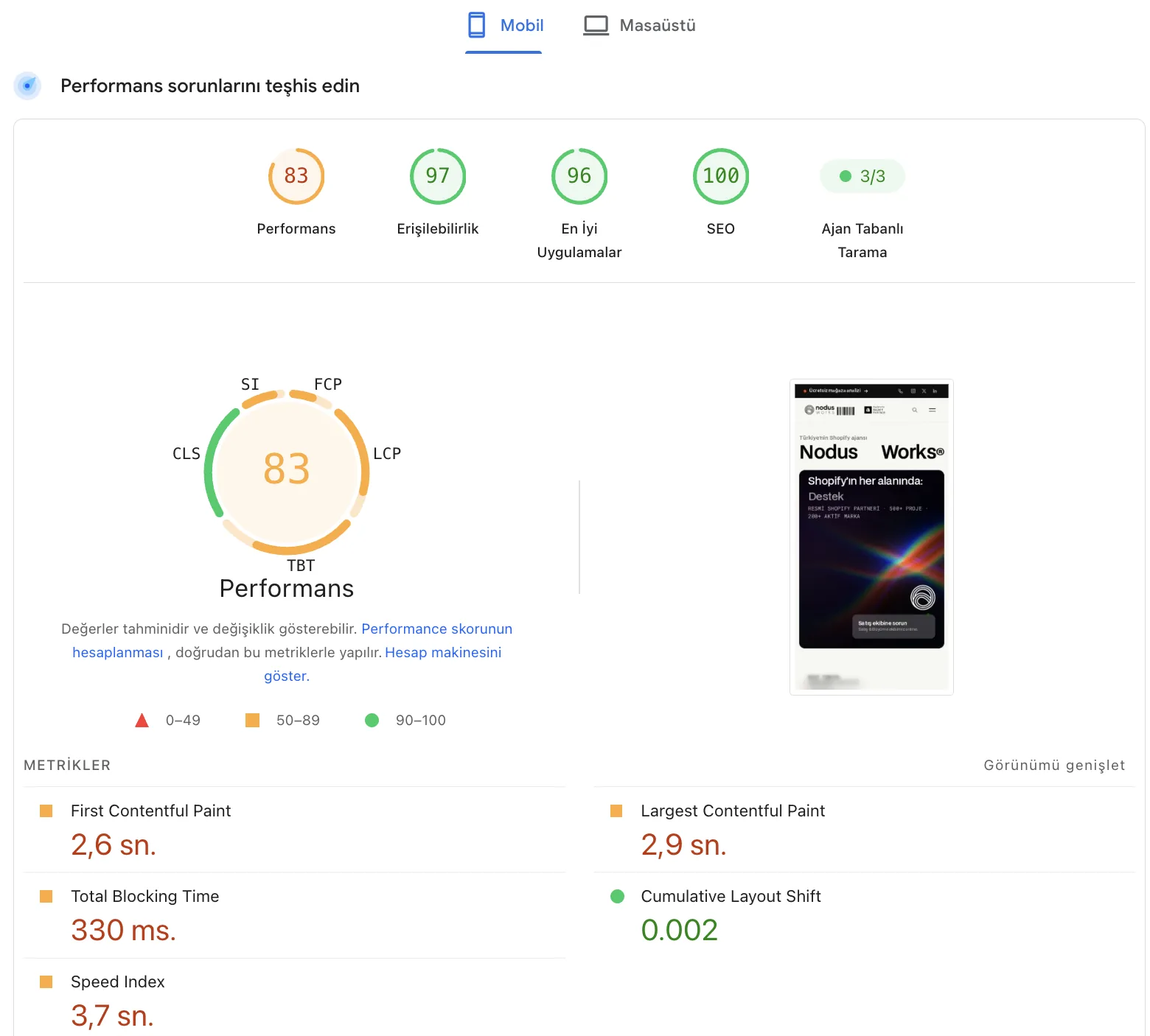
Site Speed
According to joint research by Google and SOASTA, when page load time goes from 1 second to 3 seconds, the probability of a visitor bouncing increases by 32%, and 53% of mobile visitors leave a site altogether if a page takes longer than 3 seconds to load. Google's Milliseconds Make Millions study, carried out by Deloitte, found that a 0.1-second improvement in mobile site speed increased retail conversions by 8.4%. This means site speed is not a "technical detail" but a direct revenue line.
Trust Signals
A secure payment badge, a return policy that is visible on the product page and complete, genuine company details (address, phone, tax number) in the footer directly affect whether a visitor decides to move on to checkout. When these elements are missing, visitors may hesitate to enter their payment details even if they like the product.
Competitors Using Reviews, UGC and Social Proof
Competitors that show real customer reviews, user-generated content (UGC) and real-life usage images shared on social media on their product pages gain a trust advantage over brands that rely on studio photos alone. If a competitor in your category runs a systematic UGC and review strategy and you don't touch the subject at all, you can lose even when price and product quality are equal. We cover this in detail in our guide to producing UGC and product photography with AI.
AI Overviews and Visibility in AI Search
As of March 2026, Google AI Overviews appear for about 14% of shopping queries (up from 2.1% in November 2025), and the share is much higher for research queries such as "best …". On top of that, pages cited in an AI Overview get 120% more organic clicks per impression than pages that aren't cited. This gap shows that ignoring the topic entirely on the grounds that "AI Overviews don't affect e-commerce much" can mean losing visibility to competitors that do get cited. We cover this in detail in our GEO (Generative Engine Optimization) guide.

AI Product Recommendations
Some competitors now show AI-powered, personalized product recommendations on the product page or in the cart. The recommendation engine highlights a complementary or alternative product at the right moment based on the visitor's browsing behavior. A store without this feature can fall behind these competitors on average order value (AOV), even with the same traffic.
Important: None of these five elements (site speed, trust signals, social proof, AI Overview visibility, AI product recommendations) looks like a disaster worthy of a "critical risk" list on its own, which is why most brands don't budget for them. Taken together, though, gaps in these five elements are usually the real reason your conversion rate quietly drops, even if you are protected against all 7 risks above.
The table below summarizes the concrete risk that arises when each of these five elements is missing.
Invisible Errors: Design and Technical Problems Nobody Notices
The most expensive errors on an e-commerce site are usually not the ones that shout "the site is down"; they are the ones that sit there quietly. A checkout button hidden behind another element in a particular browser, a form field that disappears on mobile when the keyboard opens, or a payment step that silently fails for a certain card type can go unnoticed for weeks. Even though the site technically looks "up", an error like this makes ordering practically impossible for every visitor who runs into it.
A Risk to Avoid: The fact that your site works fine in your own browser and on your own device doesn't mean it works fine for all your visitors. Placing real test orders regularly across different combinations of browser, operating system and payment method is the only reliable way to catch these invisible errors before customer complaints arrive.
Moving Past an Inadequate Infrastructure: When Do You Need to Change Platforms?
Some of the measures above (real-time stock sync, dynamic shipping pricing, 3D Secure integration, AI-powered product recommendations) may not be technically possible on an old or limited e-commerce infrastructure. In that case the problem is not a missing setting but the capacity limit of the platform itself. In the platform migration projects we run at Nodus Works, we see that brands usually decide to move to Shopify not because of one big disaster, but because several of the risks above remain unsolvable on their current infrastructure at the same time.
Moving to Shopify removes some of these risks at platform level. A PCI DSS compliant payment infrastructure, a built-in CDN and automatic scaling (which reduce the risk of cyber attacks and traffic spikes), real-time inventory management (which reduces supply chain risk) and a large app ecosystem (which covers needs such as AI product recommendations and dynamic pricing with ready-made solutions) are a few of them. We explain how to plan the migration in detail in our guide to migrating to Shopify.
Quick Self-Check
- Can you log in to your admin panel without two-factor authentication?
- Is stock data synchronized in real time between the site and the warehouse, or updated by hand?
- Is your page load time above 2 seconds?
- Do your product pages have real customer reviews or UGC?
- Have you placed a real test order on different browsers and devices in the last month?
What Should You Do Now?
You don't need to solve these 7 risks and the conversion/trust gap underneath them all at once; the order of priority depends on which risk is closest to your business. If you have experienced payment fraud, 3D Secure and your chargeback process should come first. If your conversion rate is behind your competitors', site speed and trust signals should take priority.
If you would like to assess together how your site stands against these 7 risks and the conversion/trust gaps, contact us now for a Risk Check-up. If you want to improve your conversion rate systematically, or are considering moving your infrastructure to Shopify, you can get in touch with our team about our conversion optimization service or our Shopify migration service.