Mailing is when a brand sends bulk email to its opt-in customer list. In e-commerce, mailing covers campaign and new product announcements, abandoned cart reminders, repeat purchase flows and loyalty communication. As long as it stays a one-off send, it is called mailing; when it runs systematically with segmentation, automation and measurement, it becomes email marketing and turns into a revenue channel that works continuously.
In e-commerce, email marketing is one of the most valuable channels through which brands can communicate directly with their customers. With ad costs rising, social media reach dependent on algorithms and customer data limited on marketplaces, email marketing lets a brand reach its own customer base again and again. Regular mailing builds a lasting revenue channel for campaign announcements, new product launches, abandoned cart reminders, repeat purchase flows and customer loyalty.
What Is the Difference Between Mailing and Email Marketing?
Mailing means sending bulk email and usually describes a one-off action. Email marketing covers a much broader scope: it is a systematic marketing approach that brings together segmentation, automation, campaign planning, personalization, measurement and CRM strategy.
This distinction shows up directly in results, because a brand that says "we do mailing" is often doing nothing more than sending a random campaign email once a month. An email marketing strategy, by contrast, builds a system that runs continuously and is triggered automatically by the customer's order history, cart behavior and segment. The difference is the difference between a one-off action and a revenue channel that keeps working.
Why Is Mailing Important in E-Commerce?
Regular email marketing lets a brand reach existing customers again without ad spend, an advantage that becomes more valuable as customer acquisition cost (CAC) rises. Delivering new product and campaign announcements straight to the customer's inbox works independently of social media algorithms that limit reach.

The concrete commercial value of email marketing shows up in four areas: winning back users who abandon their carts, increasing the repeat purchase rate, building loyalty and brand attachment, and sending time-sensitive messages such as restock alerts or seasonal campaigns at the right moment. Together, these four areas raise customer lifetime value (LTV) and free the brand's growth from depending on ad channels alone.
Critical Note: Sending a random email once a month is not enough to say "we do mailing". What delivers lasting results is a regular email marketing plan built around the brand's campaign calendar, product categories, customer segments and seasons. Irregular sending weakens both revenue potential and sender reputation.
Types of Mailing for E-Commerce Sites
The types of mailing used in e-commerce fall into two main categories: campaign emails that the brand sends at a time of its choosing, and automated emails triggered by customer behavior. Newsletters, campaign emails and new product announcements belong to the first category. Abandoned cart emails, reminder emails after a product view, repeat purchase emails, winback emails (to win back lapsed customers), birthday and special occasion emails, loyalty program emails, back-in-stock notifications, post-purchase thank-you/review emails and cross-sell/upsell emails belong to the second.
How Do You Build a Mailing Strategy?
An e-commerce mailing strategy starts with defining the target audience, before any design work. Once the audience is defined, the email list needs to grow on a permission basis; sending to purchased or rented lists carries legal risk and damages deliverability from the start. As the list grows, you create customer segments and prepare a campaign calendar based on them.
In Turkey, the legal framework for sending commercial email is set by Law No. 6563 on the Regulation of Electronic Commerce and the Regulation on Commercial Communication and Commercial Electronic Messages. For campaign and promotional emails, you must obtain the recipient's prior consent and register it in the Message Management System (IYS); consents collected outside IYS, for example through the email signup checkbox in Shopify checkout, become invalid if they aren't uploaded to IYS within three business days. Every commercial email must include an easy, free way to opt out (unsubscribe), and opt-out requests must be processed and reported to IYS within three business days. Under KVKK, Turkey's data protection law, you must also tell people in a privacy notice what their email address will be processed for when you collect it, and obtain explicit consent for processing it for marketing purposes.
Once the campaign calendar is set, you decide the email content and offer strategy for each send; mobile-friendly design and subject line and preview text optimization are the technical details of this stage. Testing the send day and time, then using A/B tests to measure which variation performs better, turns the strategy from a static plan into a system that keeps improving. If you skip regularly measuring results and making improvements, the mailing program loses performance over time.
Segmentation and Personalization
Sending the same email to everyone is the most common source of inefficiency in email marketing. When you segment by customer behavior, you get much higher conversion from the same budget. In practice, the most commonly used segments are: first-time buyers, customers who bought in the last 30 days, customers who haven't bought in a long time, customers interested in specific categories, customers who added products to their cart but didn't buy, customers with a high average order value, VIP customers and discount-driven customers.
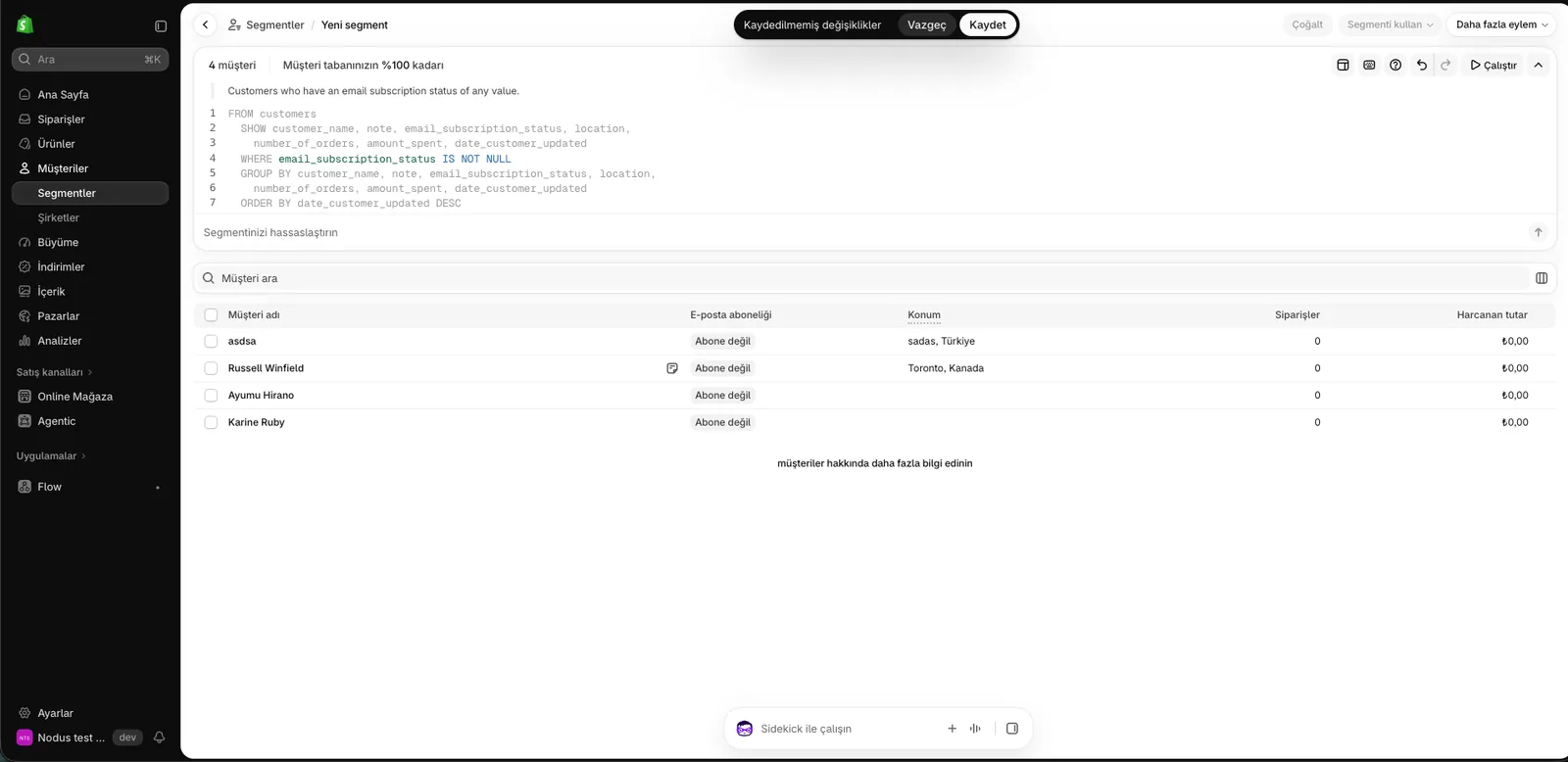
The content you send to a customer who "hasn't bought in a long time" cannot be the same as what you send to a customer in the "VIP" segment: the first needs a win-back offer, the second needs exclusive access or an early launch. Segmentation here is not a nice-to-have; it is a mechanism that directly determines the conversion rate. To manage your VIP segment with points and tiers, you can set up a loyalty program and VIP tiers with Loyalis.
Email Automations
Manual campaign emails and automated emails serve different purposes, and the two should work together. Manual campaign emails are planned communications that the brand sends at a time of its choosing, such as a seasonal sale, a new collection, a special occasion campaign or a stock announcement. Automated emails are flows triggered automatically by user behavior that keep running once they are set up.

The most common automation flows include the welcome flow, abandoned cart automation, browse abandonment (viewing a product and leaving), the thank-you flow after a first purchase, review requests, the repeat purchase flow, winback automation, the VIP customer flow and the birthday/special occasion flow. Once these flows are set up correctly, they generate revenue continuously without manual intervention from the brand.
We cover how these automations are set up in your Shopify store with Klaviyo, Omnisend or Shopify Email, and how they fit into your CRM strategy, end to end in our email marketing and CRM automation service.
The Technical Setup That Keeps You Out of the Spam Folder
Staying out of spam is not only about the wording of your content; it depends on your technical sending infrastructure, and superficial advice like "don't use capital letters" doesn't solve the problem. Verifying the sender domain, setting up the SPF record correctly, adding the DKIM record and configuring the DMARC record are technical prerequisites for mailbox providers to treat your emails as trustworthy. High-volume sends made before domain authentication is complete on your email marketing platform multiply the risk of landing in the spam folder.

List hygiene matters as much as the technical setup: use an opt-in email list, avoid purchased or rented lists, include a clearly visible unsubscribe link and clean the list regularly. Tracking the bounce rate and the spam complaint rate is the only way to spot a problem before it grows.
Risk to Avoid: Sending high volumes right away from a new domain or a new sending infrastructure gets flagged as suspicious behavior by mailbox providers. Increase your sending volume gradually (IP/domain warming); otherwise your entire list may be routed to the spam folder.
Avoiding misleading, exaggerated or spam-triggering phrases in subject lines, and steering clear of an image-heavy, text-light imbalance in the email content, also directly affect deliverability.
What Should Mailing Design Look Like?

Mailing design starts with clarity, even before mobile-friendliness: the main message should be clear on the first screen, the CTA should be clear, and the balance between images and text should be right. A design that matches the brand identity, uses short paragraphs and has clear button text gets a higher click-through rate than a long, complicated one.
High-quality product images and clearly stated campaign terms (discount rate, validity date, excluded products) protect customer trust. Including contact details, social media links, an unsubscribe link and legal information in the footer is required for both legal compliance and brand credibility.
Success Metrics
You can't improve email marketing without measuring its impact. The key metrics to track are open rate, click-through rate, conversion rate, revenue per recipient, unsubscribe rate, bounce rate, spam complaint rate, list growth rate, revenue by segment and automation revenue.
Which Tools Can You Use?
The most widely used tools for mailing and CRM automation in Shopify stores are Klaviyo, Omnisend, Mailchimp, Shopify Messaging (formerly Shopify Email), Brevo and HubSpot. Without going into a deep platform comparison, getting their price ranges and positioning clear speeds up the right choice.

Because Klaviyo is priced by the number of active profiles, its cost rises quickly as the list grows: at 15,000 active profiles, Omnisend typically stays around 150-200 USD per month while Klaviyo climbs into the 250-350 USD range. This difference means that when you choose, you should look not only at the feature list but also at how fast your store's list is growing.
We explain step by step how to integrate Omnisend with your Shopify store and set up automation flows in our Shopify Omnisend integration guide.
Integrating Mailing with Other Channels in E-Commerce
Email marketing doesn't work as a standalone channel; it delivers the highest return when planned together with your other growth channels. Addressing the conversion rate of your abandoned cart automation together with Shopify conversion optimization work improves both the email and the on-site experience at the same time. When planning cross-sell and upsell emails, using Shopify cross-sell and upsell strategies as a reference clarifies which products the email content should recommend.
Loyalty program emails can't exist as content alone without a separate loyalty system; our Shopify customer loyalty program setup guide explains how to build that infrastructure. To bring new traffic to your mailing list, our Meta ad management and Google Ads management services build the top-of-funnel channels that grow your email list.
FAQ: Mailing and Email Marketing in E-Commerce
What is the difference between mailing and email marketing? Mailing means sending bulk email and refers to a one-off action. Email marketing is a systematic marketing strategy that covers segmentation, automation, campaign planning and measurement.
Which types of mailing generate the most revenue in e-commerce? Abandoned cart emails, browse abandonment reminders and winback automations usually produce higher conversion rates than manual campaign emails because they are triggered by behavior.
Should you choose Klaviyo or Omnisend? List size and budget are the deciding factors. For small and mid-sized stores, Omnisend offers a more affordable omnichannel solution; for large, data-driven brands, Klaviyo's deeper segmentation and CRM features may be the reason to choose it.
What is the first thing to do to stay out of the spam folder? Correctly configuring the SPF, DKIM and DMARC records on the sender domain is the first technical step. Without these records, no matter how good the content is, your emails may be flagged as untrustworthy by mailbox providers.
How large does a list need to be to set up email automation? There is no minimum list size; basic flows such as the welcome flow and abandoned cart automation can be set up from the very first customer. As the list grows, you increase the depth of segmentation and the variety of automations.
What is mailing in e-commerce? In e-commerce, mailing is the activity of a brand sending bulk email to its customers or potential customers. Email marketing is the broader strategy that turns these sends into a systematic marketing channel through segmentation, automation and measurement.
How do you set up email automation in e-commerce? Email automation is set up on a platform such as Klaviyo, Omnisend or Shopify Email by defining triggers based on customer behavior (adding a product to the cart, a first purchase, a long time without buying). Each trigger automatically starts a pre-built email series.
How effective are abandoned cart emails? Because the user has already shown purchase intent, abandoned cart emails have a higher conversion rate than general campaign emails. This automation converts best when it is built with the right timing (usually the first email within 1 hour) and a clear offer.
Conclusion: How Does Mailing Become a Revenue Channel in E-Commerce?
When planned correctly, mailing in e-commerce stops being a one-off marketing activity and becomes a revenue channel that works continuously. For that, segmentation, automation, technical sending infrastructure and regular measurement have to be set up together; when one of these elements is missing, the system doesn't produce the expected revenue.
At Nodus Works, we plan far more than mailing design for e-commerce brands: email marketing strategy, campaign calendars, segmentation, Klaviyo/Omnisend/Shopify Email setup, abandoned cart automations, welcome flows, winback flows, technical domain authentication settings and performance reporting, end to end. Through regular email marketing, we help brands reach their customers at the right time with the right message and increase their repeat purchase rates.
To request an email marketing strategy and automation setup for your store, take a look at our email marketing and CRM automation service and contact us for a free discovery call.