A Shopify customer loyalty program is a structured incentive system that rewards repeat purchase behavior in your store, increases customer lifetime value (LTV), and keeps existing customers engaged at a budget significantly lower than new customer acquisition costs. On Shopify, a loyalty program is not a built-in feature; it is set up through apps like Smile.io, LoyaltyLion, or Growave.
According to ProfitWell's 2020 analysis of data from around 700 subscription companies, customer acquisition cost rose by about 60% over five years. In contrast, studies show that selling to an existing customer is 5 to 7 times less expensive than acquiring a new one. This difference transforms a loyalty program from a marketing expense into a direct profitability tool.
Why a Loyalty Program is Becoming Essential on Shopify
Most Shopify stores without a loyalty program build their customer base from one-time buyers. In this model, the ad budget has to keep growing; the moment it stops, sales stop too.
A loyalty program breaks this cycle. Customers become program members with their first purchase, earn discounts on subsequent purchases with the points they accumulate, and this incentive triggers repeat purchases. Once the member base grows large enough, a predictable revenue stream that doesn't depend on the ad budget starts to form.
According to Accenture's 2016 research, loyalty program members generate on average 12-18% higher annual revenue growth than non-members.
We see the same effect in our own projects: at Fellas Foods, which runs the Fellas Club points program on Shopify, the repurchase rate rose by 40%.
Types of Loyalty Programs
Not every business model is suited for the same loyalty structure. The right program type is determined by your product category, average order frequency, and customer profile.
For Shopify stores in Turkey, the most common model, and the one that pays off fastest, is to start with a points system and gradually move to VIP tiered membership. On their own, referral programs see lower participation in Turkey than in Western markets; WhatsApp and word-of-mouth culture are strong, but people resist digital referral mechanisms.
Comparison of Shopify Loyalty Program Apps

For Shopify stores in Turkey, BON Loyalty and Smile.io are the most common choices. BON Loyalty stands out for the local customer experience, as it is one of the few apps offering Turkish email templates and widget text. Smile.io, on the other hand, has the broadest global integration ecosystem, working directly with Klaviyo, Omnisend, and Shopify Flow.
Setting Up a Loyalty Program on Shopify: Step-by-Step
Step 1: Define Your Program's Goal and Metrics
Before starting a loyalty program, clarify which behavior you intend to reward. Will you prioritize repeat purchases, increasing average order value, or acquiring new customers? Each goal points to a different program structure.
As initial metrics, track the following: repeat purchase rate, annual revenue per customer (LTV), number of program members, and point redemption rate.
Step 2: Choose and Install the App
Install the app you've chosen from the Shopify App Store. Start on a free plan and watch how customers respond in the first 30-60 days; that way, your decision about moving to a paid plan is based on data.
Step 3: Define Point Earning Rules
Determine how many points will be earned for each purchase. A common starting structure is: 1 TL spent = 1 point, 100 points = 5 TL discount (5% effective cashback). Adjust this rate according to your category's profit margin; a 5% cashback might be unsustainable for low-margin products.
You can define points not only for purchases but also for the following actions:
- Account creation (welcome bonus)
- Birthday shopping
- Writing a product review
- Following on social media
- Friend referral
Step 4: Set Up VIP Tiers
Two or three tiers are sufficient; too many tiers confuse the customer. Example structure:
- Standard member: All registered customers
- Silver: Over 1,500 TL annual spend, 5% additional discount + free shipping
- Gold: Over 4,000 TL annual spend, 10% additional discount + priority support + early access
When setting tier thresholds, look at how your current customers' spending is distributed. A structure where 20% of your customers can reach Silver and 5% can reach Gold gives the healthiest progression.
Step 5: Announce the Program to Customers
Customers who don't know about the loyalty program cannot join. Announcement channels:
- Email campaign to existing customer list
- Widgets on the homepage and product pages
- Post-checkout "You've earned X points" notification email
- A card introducing the program in every order package
Critical Note: SMS opens cannot be measured directly; however, according to Gartner's 2016 research, SMS open and response rates can reach 98% and 45%, while email stays at around 20% and 6%. That is why short, time-sensitive loyalty notifications get seen faster via SMS than via email. If your customer list is IYS-approved, activating the SMS channel for loyalty notifications significantly increases program participation rates.
Turkey-Specific Loyalty Program Strategy
Holiday and Special Occasion Bonuses
In Turkey, shopping volume reaches its highest levels of the year during Eid al-Fitr, Eid al-Adha, and Mother's Day. Adding a "double points campaign" or "holiday bonus points" to your loyalty program during these periods increases both sales and program participation. Black Friday and Cyber Monday-focused loyalty campaigns, common in international markets, do not produce a similar effect in Turkey; prioritize the local holiday calendar.
WhatsApp Integration
A significant portion of customer communication in Turkey takes place via WhatsApp. Stores that send loyalty program notifications through the WhatsApp Business API get higher engagement than with email. Tools like Tidio or Interakt allow you to integrate WhatsApp with Shopify loyalty apps.
Loyalty Tracking for Cash on Delivery Customers
Customers using cash on delivery in Turkey often skip creating an online account. To bring them into the loyalty program, offer membership by phone number or QR code registration; this lets you track repeat purchases from this segment.
Tip: When the point redemption rate drops below 20%, the program starts to lose its effectiveness. Customers know they are accumulating points but don't use them; this usually indicates that the minimum redemption threshold is too high or the perceived value of the reward is low. If the redemption rate is low, halve the threshold or make the reward more visible.
Measuring Loyalty Program Success
Once the program is live, track four key metrics every month:
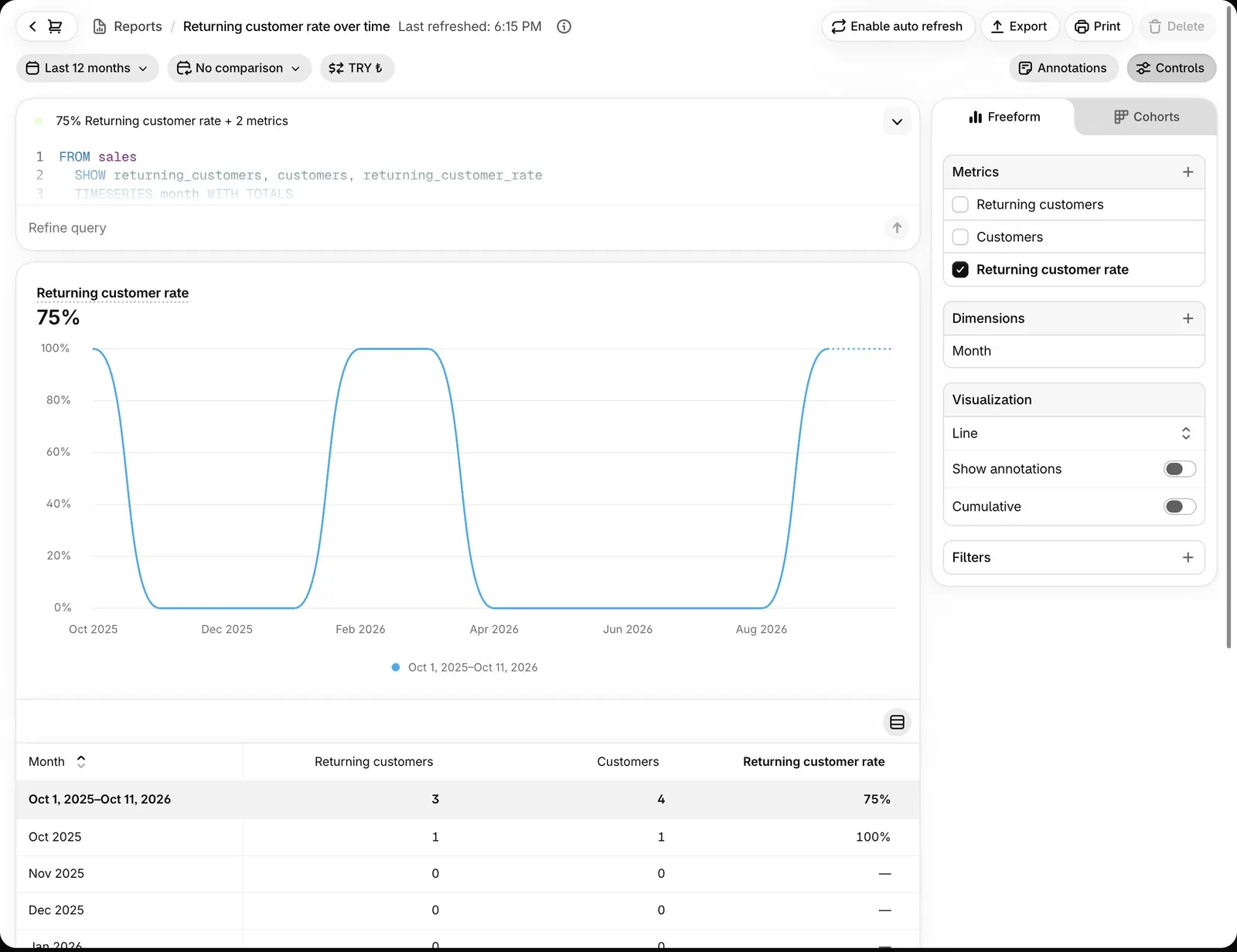
1. Repeat purchase rate: The ratio of customers who have made at least two purchases in a given period to the total number of customers. In stores without a loyalty program, this rate is typically around 20-25%; in a well-functioning program, it can increase to 35-45%.
2. Program participation rate: The share of active customers enrolled in the program. Below 30%, the program isn't being promoted well enough.
3. Point redemption rate: The share of issued points that get redeemed. 20-40% is a healthy range; below 20%, question how attractive the program is, and above 60%, question the financial burden it puts on the store.
4. LTV change: Compare the average customer lifetime value of program members with non-members. If there's no significant difference, the program might not be targeting the right segment.
3 Critical Observations from Nodus Works' Field Experience
Observation 1: In Turkey, the shorter the loyalty program description text, the higher the participation.
The message "Earn points, get discounts" gets noticeably more sign-ups from Turkish customers than "Earn 250 points, choose one of 5 types of rewards, and get extra benefits by upgrading to Silver membership." The more simply you explain the program, the higher the participation; complexity pleases the operator, not the customer.
Observation 2: Discount campaigns run concurrently with an active loyalty program diminish the value of points and the program itself.
Running loyalty points during a 30-40% discount campaign makes the two incentives cannibalize each other. Customers go for the discount and show little interest in points. To keep the loyalty program working during campaigns, a better approach is an extra points multiplier (e.g., a double points day) as an alternative to direct discounts.
Observation 3: The highest ROI for a loyalty program comes from trigger emails sent to newly registered members in the first 90 days.
The first 90 days are crucial for customers who join the program. Stores that run a systematic series of trigger emails in this period (a welcome after sign-up, a first points reminder, and a notice when the first reward threshold is close) see a noticeable increase in repurchase rates among program members. Members who stay inactive for these 90 days are very likely to remain passive.
FAQ
Can you set up a free loyalty program on Shopify?
Yes. The free plans of Smile.io and BON Loyalty offer a basic points system and referral program. The free plan works well for up to a few hundred members a month; VIP tiers and advanced segmentation require a paid plan.
When should you set up a loyalty program?
A loyalty program starts to make sense once you pass 100 orders a month. Below that, the work of managing the program may outweigh its benefits. The 100-500 order range is the ideal window to start with a points system; above 500 orders, add VIP tiers.
How can a Shopify loyalty program be localized for customers in Turkey?
BON Loyalty offers Turkish widget text. With other apps, you can translate the widget and email template text into Turkish manually. Set the currency to TL and calibrate point-to-reward ratios to the average order value in Turkey.
Do loyalty program discounts harm profitability?
They can if they are not set up correctly. Keeping point redemptions below 30-40% of your profit margin keeps the structure sustainable. For example, a 5% points redemption on a product with a 40% profit margin uses up 12.5% of that profit, which counts as an acceptable return on investment.
Can you automate a loyalty program with Shopify Flow?
Yes. Shopify Flow integrates with Smile.io and LoyaltyLion. You can set up trigger flows to automatically add a gift product to customers in a specific tier, send special discount codes to customers who reach a certain point threshold, or reactivate passive members.
How do you set up a customer loyalty program on Shopify? Install an app like Smile.io or BON Loyalty from the Shopify App Store, then define your point earning rules and rewards. The free plan is enough for a basic points and referral system; VIP tiers require a paid plan.
What is the best app for a Shopify loyalty program? For stores in Turkey that want a Turkish interface, BON Loyalty is a strong option. For global integrations and Klaviyo compatibility, Smile.io is the usual choice. Both offer free plans.
When should a Shopify loyalty program be launched? Once you pass 100 orders a month, it's ideal to start with a points system. Above 500 orders, add VIP tiers; above 1,000 orders, consider a paid membership model.
Conclusion
Setting up a customer loyalty program on Shopify is the most direct way to generate more revenue from existing customers without increasing your advertising budget. A basic points system can be launched within a day using Smile.io or BON Loyalty; the real work is to calibrate the program correctly and keep customers engaged.
For a successful loyalty program in the Turkish market, prioritize two steps: calculate the points redemption rate based on your profit margin and integrate the SMS channel with your IYS-approved list. Programs launched without these two configurations lose momentum within the first 60 days.
To add a loyalty program to your Shopify store or improve the performance of your existing one, you can use the Nodus Works conversion optimization services. We can review your store's current customer base and design a custom loyalty structure together.