The best premium Shopify themes in 2026 include Prestige, Symmetry, Impulse, Wonder, Expanse, Empire, Warehouse, Baseline, Taiga and Minimalista. In the Shopify Theme Store they cost between $320 and $500 as a one-time payment with a lifetime license. Prestige suits luxury boutiques, Expanse, Empire and Warehouse suit large catalogs, and Impulse works best for stores that run frequent promotions.
We have taken an in-depth look at the best premium themes available in the Shopify Theme Store. This list covers 10 popular themes, all of them paid (premium) and each standing out for its design and features. For every theme you will find the price, the types of store it suits, its pros and cons (based on real user reviews and expert opinions) and scores out of 5. Choosing the right theme is a critical step, especially for entrepreneurs and established brands planning to launch a store on Shopify. In the guide below, we evaluate themes for different needs, from luxury boutiques to wholesalers with large product catalogs, in a transparent and clear way.
Note: The prices quoted in the reviews are the current Theme Store prices as of October 2026, and each is a one-time payment for a lifetime license. Remember that themes come with a free trial; you only need to buy one before you publish it. If you are ready, let's take a closer look at the top Shopify themes. Prices may change.
Changing E-Commerce Trends
2026 is a year in which user expectations in e-commerce keep changing fundamentally. Consumers now expect not only a fast store but also a personalized, trustworthy and intuitive shopping experience. In particular, AI-powered product recommendations, dynamic content blocks and customizable design elements have become the key features that set premium themes apart.
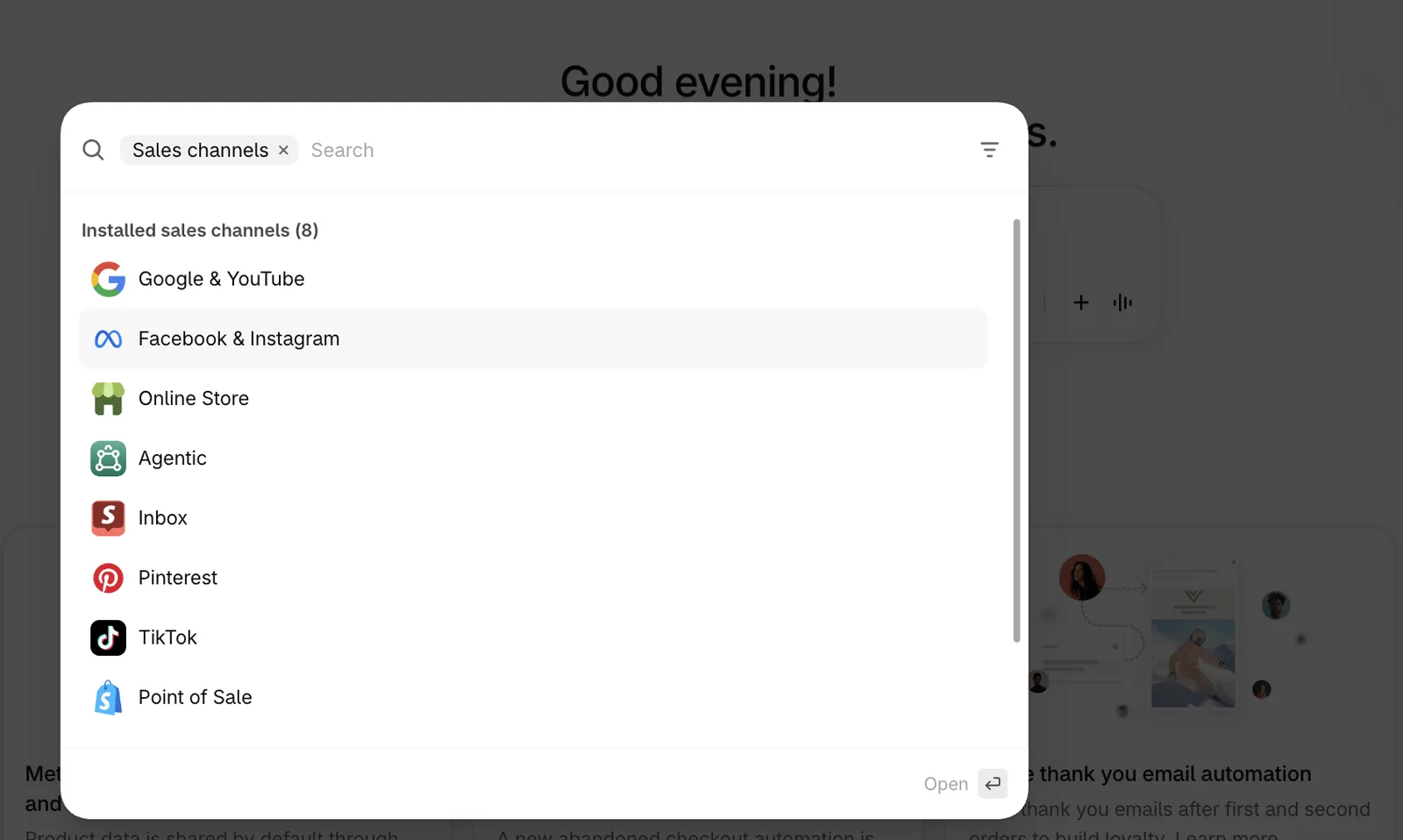
Consumers want to move more smoothly between social media and shopping, which makes social commerce integrations a must for Shopify themes. In 2026, premium themes support the product feeds of the TikTok, Facebook & Instagram and Google & YouTube sales channels through structured data on product pages; the feed itself comes from those channel apps. For stores based in Turkey, Instagram/Facebook Shops and product tagging are not available, so these channels are mostly used for catalog ads. In short, changing e-commerce trends are pushing themes to become smarter and faster, both visually and technically.
Mobile Performance and Core Web Vitals Impact
In 2026, more than 80% of e-commerce traffic comes from mobile devices, and Google puts mobile performance at the center of its ranking algorithm more than ever. That is why Core Web Vitals (LCP, INP, CLS) metrics play a critical role in the success of premium Shopify themes.
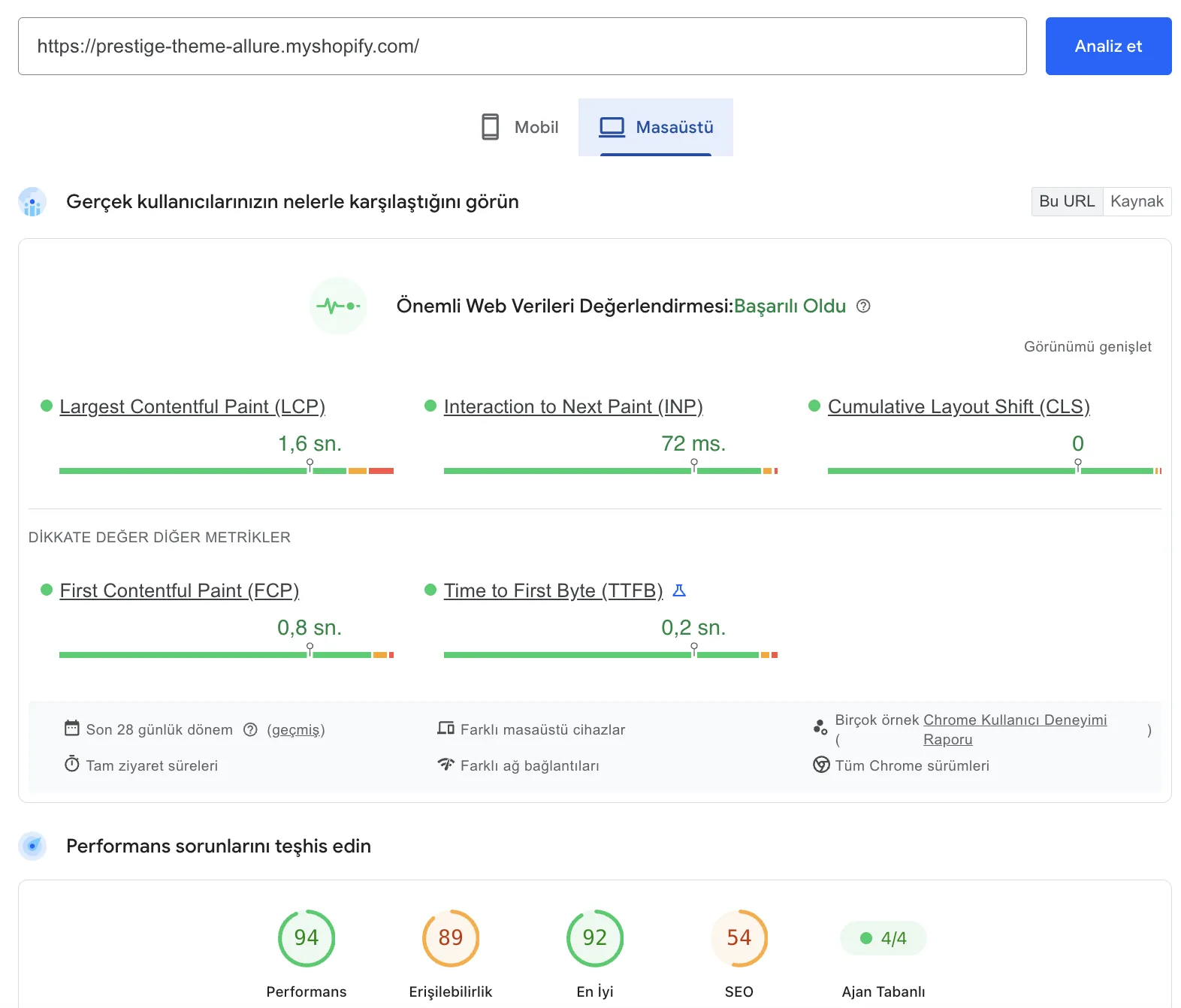
Themes that load slowly, suffer from layout shifts or respond to interactions with a delay hurt not only the user experience but also organic visibility. Premium themes achieve better Core Web Vitals scores thanks to optimized image loading, lazy loading, minified code and a lightweight CSS/JS structure.
In mobile shopping in particular, a page load time that grows from 1 second to 3 seconds increases the likelihood of a visitor leaving the site by 32% (Google). So when choosing a theme in 2026, look beyond the design: check speed reports, mobile test results and the performance updates the theme developer ships.
The Link Between Design and Conversion Rate
In 2026, design is no longer just something that “looks nice”; it is a strategic factor that directly shapes the e-commerce conversion rate. Modern premium themes include sales-focused design components optimized with user behavior data: a clear product hierarchy, strong CTA (call-to-action) buttons, more visible payment options and a streamlined checkout flow.
Psychological design is one of the factors that raise the conversion rate. Color blocks, trust elements (badges, warranty, return policy), social proof areas (reviews, customer photos) and F-pattern layouts are part of the standard structure of premium themes.
In addition, storytelling-based “modular design” structures put the brand's own identity front and center and help users make decisions faster. In short, a well-designed premium Shopify theme has a direct impact on conversion rate, and the page speed the theme sets is the most measurable part of that. According to "Milliseconds Make Millions", a study commissioned by Google and conducted by Deloitte, a 0.1-second improvement in mobile site speed increased retail conversions by 8.4% and average order value by 9.2%. To compare which of the 10 themes below fits your product range and target audience, try our Theme Finder.
Prestige Shopify Theme
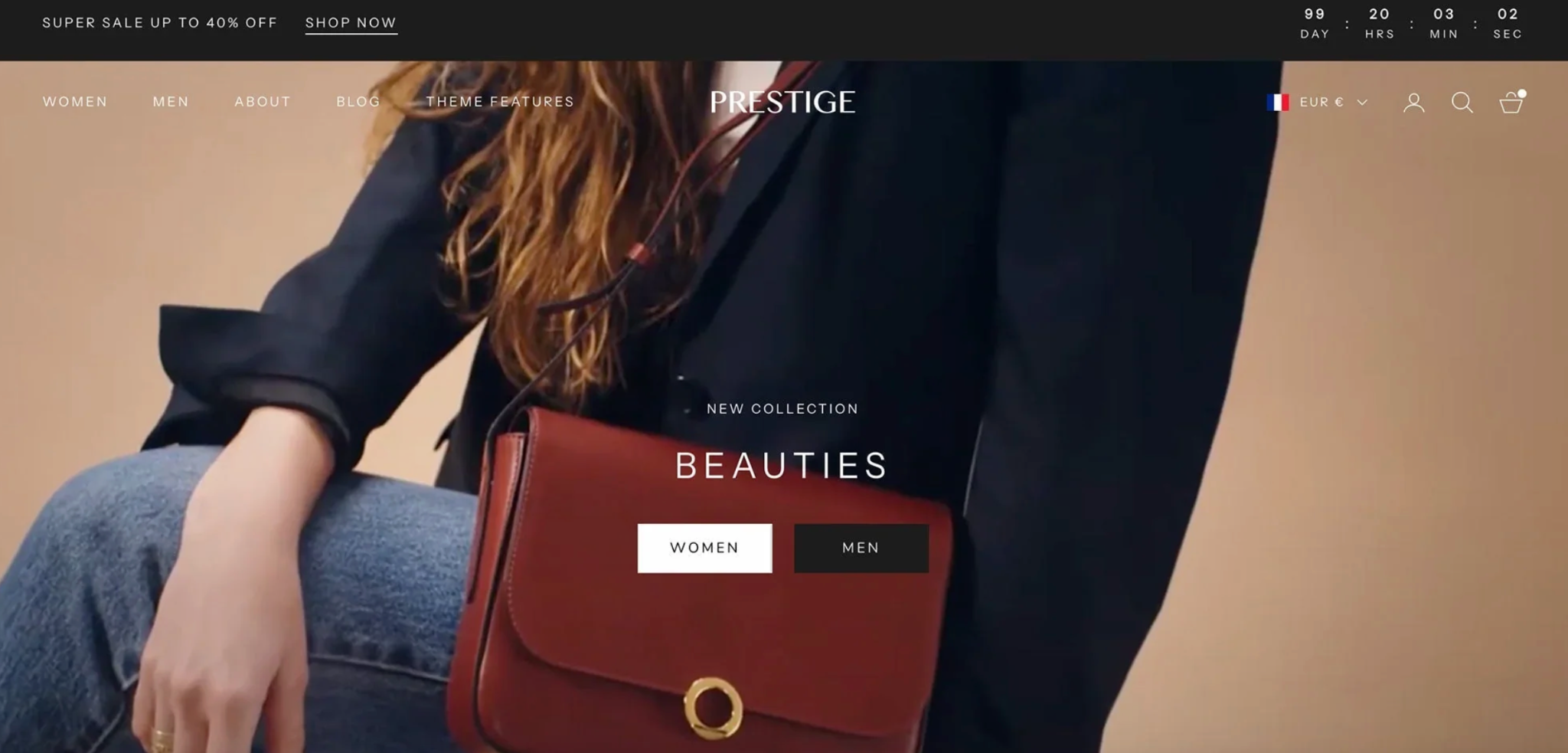
The Prestige theme offers a stylish and attractive showcase for luxury fashion brands.
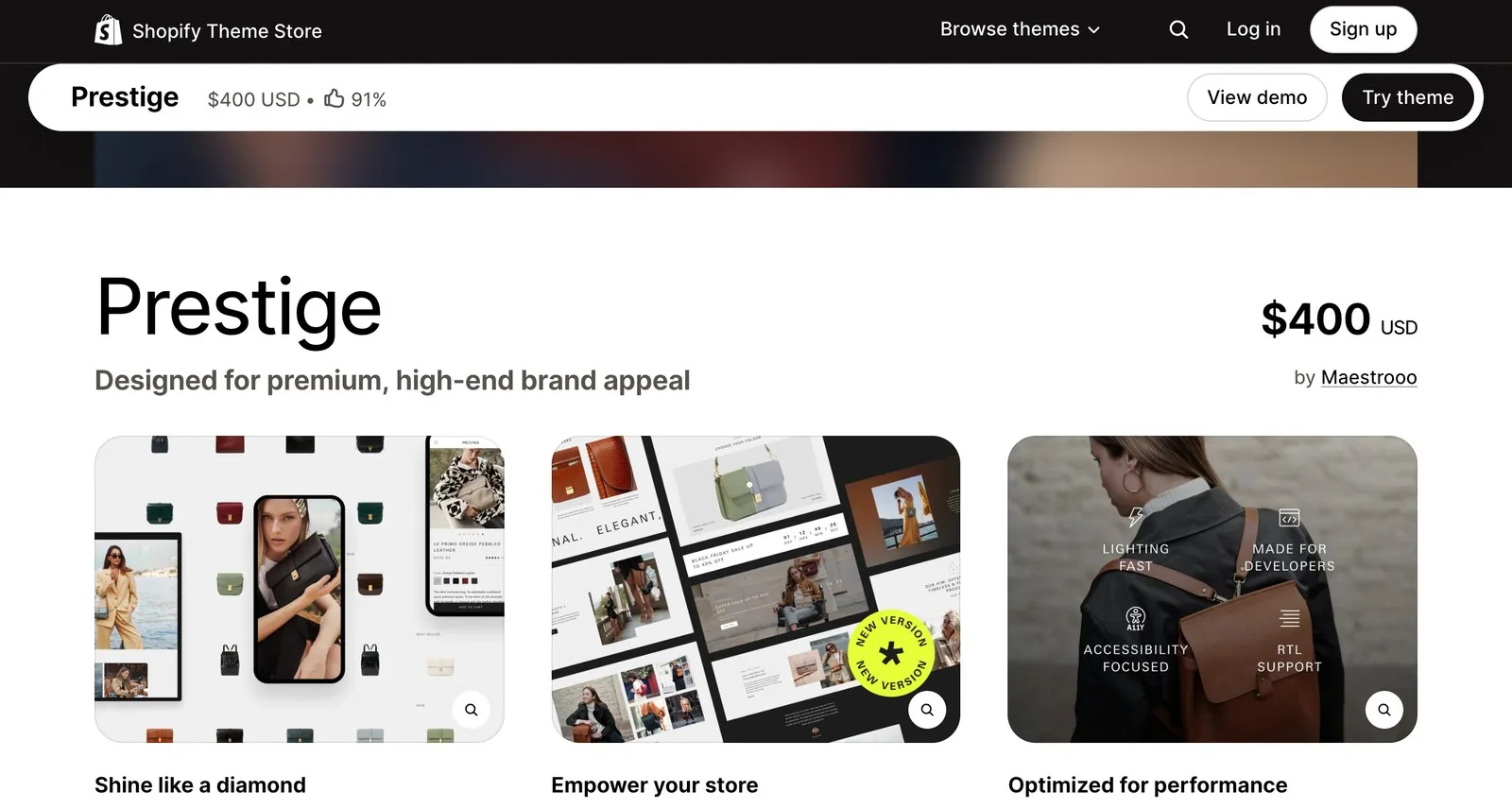
Price: $400 USD (Shopify Theme Store).
Developer: Maestrooo.
Style: Luxurious, high-quality design. It comes with five styles (presets): Prestige, Couture, Vogue, Strass and Signature. It is very popular, with an average customer satisfaction of 91% (870 reviews).
Uses: Prestige is designed especially for brands that sell luxury fashion, beauty and high-quality products. It offers an “elite” aesthetic that puts product photos and brand identity in the spotlight. It is usually recommended for boutiques with a small number of products or a limited collection that want to present each product with care. Jewelry, designer clothing and boutique cosmetics brands, for example, can give their online stores a premium look with this theme.
Key Features: Prestige comes with more than 30 drag-and-drop sections and a wide range of customization options. It is optimized for site performance, with the claim of lightning-fast page loads. It has built-in support for multiple languages (English, French and more) and supports rich content elements such as a mega menu, advanced filtering, product tags, video and lookbooks. A sticky header and Quick Buy also make shopping easier.
Pros:
- Luxury Design: Prestige lifts your brand image with an “expensive”, high-quality look. With large images, videos and elegant typography in particular, it presents products almost like a magazine page.
- Rich Content and Sections: With many built-in sections such as a lookbook (collection story), a press area, a countdown timer and product badges, you can build a rich site without extra apps.
- Performance and SEO: Maestrooo says it built the theme with performance in mind, with improvements to page load speed and mobile compatibility. This is an advantage for both SEO and conversions.
- Customer Support: According to user reviews, the theme team's support is fast and helpful. One user said their problem was solved the same day.
- Updates: The theme is updated regularly and kept compatible with new Shopify features, so it will stay current in the long run. As of October 2026, the Shopify Theme Store lists version 11.4.1, released on September 14, 2026.
Cons:
- High Price: At $400, it is one of the most expensive Shopify themes, which may put off new businesses on a budget. Think of it as the price of premium features.
- Limited Language Options (Admin): One user complains that the theme settings are only available in English or French. In other words, the theme's admin panel is not in Turkish (although you can create your storefront content in Turkish). This is not a technical obstacle, but it can be a challenge for some users.
- Better Suited to Small Catalogs: In stores with a very large catalog (thousands of products), Prestige's navigation structure may fall short. Because it focuses on luxury presentation rather than large menus, shopping on sites with many products can become a bit harder.
- Customizations That May Require Code: The theme's design is very high quality, but radical changes (a different layout, for example) may require code. So its flexibility goes only so far; you may need a developer for advanced changes.
- Slow Updates: Some users may have noted that updates focus mostly on Shopify compatibility and are slow to add new features. Overall satisfaction is still high, though.
Prestige Theme Ratings (out of 5):
- Design & Aesthetics: (5/5), luxurious and visually stunning
- Feature Set: (4/5), Many built-in features, though some advanced features are limited
- Flexibility and Customization: (4/5), Drag-and-drop sections are powerful; you may still need code for full freedom
- Performance: (4/5), Well optimized, but speed may drop if heavy visuals are used
- Price/Value: ☆ (3/5), Expensive, but the investment can pay off if your target audience is luxury shoppers
Who we recommend it for: We recommend Prestige for businesses in fashion, jewelry, beauty and boutique accessories that want to position their brand as luxury. It is ideal for presenting a small number of products with high-quality content and images. Entrepreneurs with their own designer handbag brand or a niche cosmetics product, for example, can display their products like a shop window with this theme. On the corporate side, companies that want to project a prestigious brand image will be happy with it.
Symmetry Shopify Theme
The Symmetry theme offers flexible layouts for fashion boutiques and stores with large catalogs.

Price: $420 USD.
Developer: Clean Canvas.
Style & Structure: Described as a versatile theme, it comes with 5 ready-made style packs: Symmetry, Salt Yard, Beatnik, Duke, Amara. Store owners give it a very high approval rating of 94% (392 reviews).
Overview: Symmetry stands out with its motto of flexibility, fashion-focused design and a professional look. Drawing on 11+ years of theme development experience, the Clean Canvas team has built a high-quality theme that suits all kinds of merchants. True to its name, it provides a clean, modern storefront that emphasizes order and symmetry.
Uses: It is noted to be especially suitable for clothing stores with a large product inventory; in multi-category fashion boutiques or lifestyle stores, for example, it keeps product displays organized. Thanks to its flexible structure, though, it works for any store that wants a professional web presence, not just fashion. Businesses with both small and large catalogs can benefit from Symmetry: its powerful, advanced filters keep navigation working well even with 1,000+ products.
Key Features: Symmetry's strongest points are its large number of customizable sections (30+) and its powerful filtering and search tools. The theme supports advanced product filters (with color swatches) and a mega menu, which makes it easy for customers to find what they want among many products. Conversion tools such as Quick Buy, campaign banners with countdowns, product badges and a stock counter are all available out of the box. To boost mobile conversions, it offers a thumb-friendly design and strong campaign and product highlighting.
Pros:
- Flexibility and Customization: With lots of sections and options in the drag-and-drop editor, it makes store design easy. You can create different layouts without knowing how to code. The theme, one of Clean Canvas's best sellers, is even promoted with the motto “Unlimited customization”.
- Wide Catalog Support: Breadcrumbs on category pages, advanced filtering and sorting, and extensive mega menus keep navigation smooth even in stores with large inventories. Recommended for high-volume stores.
- Fashion and Visual Focus: A highly rated theme, especially in fashion, clothing and accessories. Its visually rich layouts make product images stand out. With features like lookbooks (style galleries) and large image slides, you can tell your brand story.
- Customer Support Quality: User reviews stress that the Clean Canvas team's support is fast and solution-focused. One customer wrote “great theme, easy to use, excellent customer service”. Support requests are usually answered within 1 business day.
- Continuous Updates: Symmetry has been on the market for years and is updated regularly; according to the Shopify Theme Store, the current version as of October 2026 is 8.3.2, released on July 3, 2026. The updates support new Shopify features and include improvements based on user feedback, such as the planned mobile quick buy button.
Cons:
- Price: At $420, it sits at the top of the theme price range. There are more affordable themes with similar functionality, so the cost can be a drawback on a tight budget. Keep in mind, though, that it is a one-time investment you can use for life.
- Some Missing Mobile Features: User feedback mentions the lack of some features, such as a mobile quick buy button (Clean Canvas has said it is about to add this). So there is some room for improvement in the mobile UX.
- Product List View Restriction: One customer noted that product listing blocks cannot show variants or size options directly; you can only choose between an image view and a card view. This can be limiting for stores that list items in several colors or sizes as separate products.
- Advanced Customization: Basic customizations are easy, but you may not find options in the theme settings for very specific design requests (such as showing elements side by side in the mobile menu). In that case you may need to edit the Liquid code. So if you expect “everything can be done with a few clicks in the editor”, some things may disappoint you.
Symmetry Theme Ratings:
- Design: (5/5), excellent for a fashionable, on-trend and professional look
- Features: (4/5), Many built-in features; comprehensive apart from a few minor gaps
- Ease of Use: (5/5), An intuitive theme for both beginners and experienced users
- Performance: (4/5), Good code quality; may slow down a little with heavy content, but fast overall
- Price/Value: (4/5), Expensive but high value, especially for large stores
Who we recommend it for: We recommend Symmetry for businesses such as growing fashion brands, boutiques and home decor stores where visual presentation matters and the product count is medium to high. Anyone who wants to present large collections in a professional and appealing way will be happy with this theme. A clothing brand launching a seasonal collection, for example, can show its lookbook with Symmetry and present the products in a filterable layout. It also suits entrepreneurs with limited technical knowledge who want a powerful site, since the theme makes do-it-yourself setup easy.
Impulse Shopify Theme
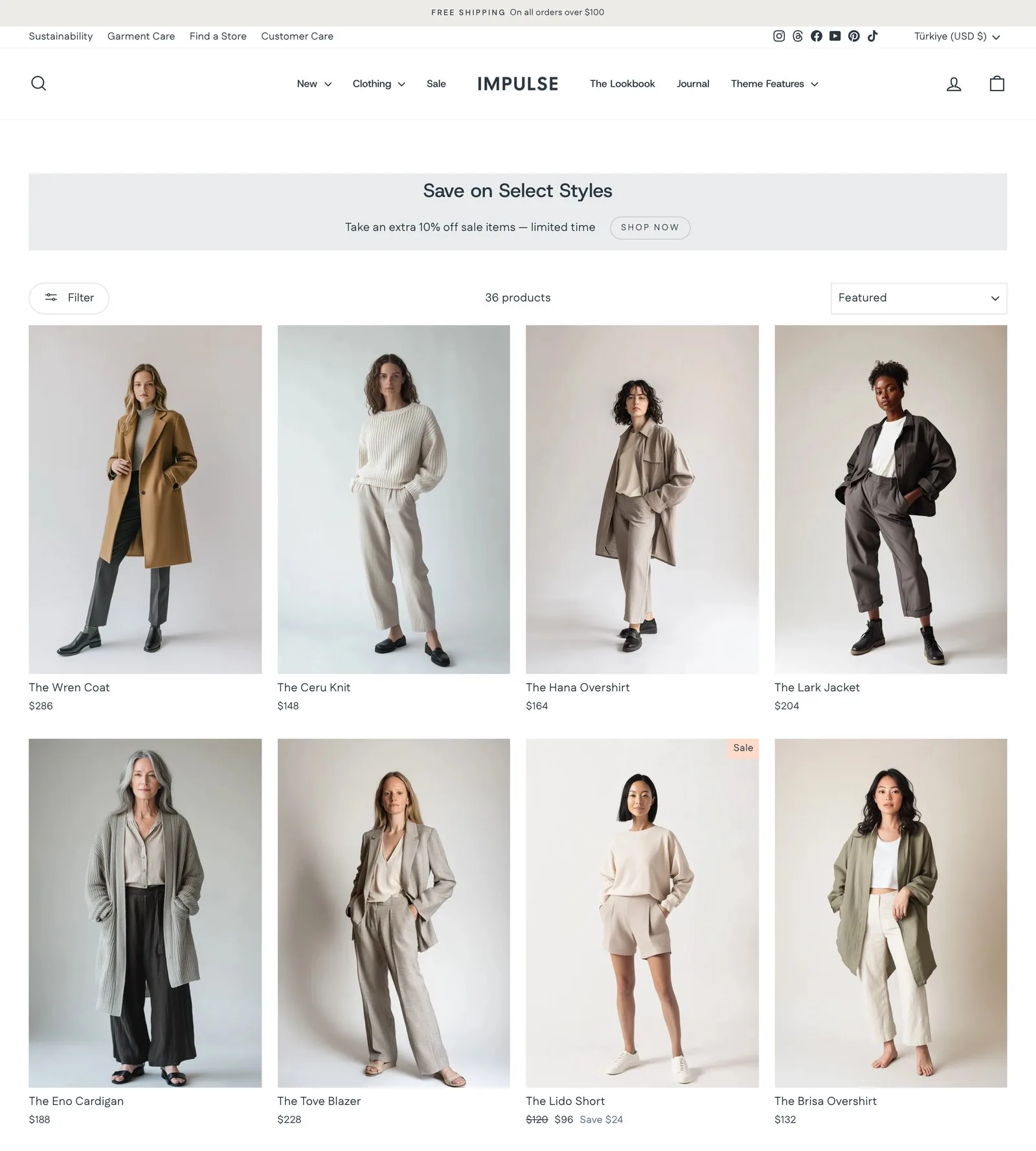
With its promotion- and campaign-focused structure, the Impulse theme is made for driving sales.
Price: $500 USD (in the Theme Store).
Developer: Archetype Themes (one of the experienced developers in the Shopify ecosystem and the team behind popular themes such as Motion and Expanse).
Styles: It comes in 4 styles: the Impulse, Dune, Terrain and Apothecary presets. Customer satisfaction is high, usually around 95% (Impulse has been a recommended theme for a long time).
Overview: As its name suggests, Impulse is a theme built to capture “impulse buying” moments. It contains elements that grab the attention of visitors and quickly lead them to buy. The theme is tailored especially for campaign- and discount-driven stores, with marketing elements such as large banners, campaign highlights and dynamic product badges. The design is sleek yet lively: it is not as animated as the Motion theme, but transitions and eye-catching details on the page give it a sense of energy. Its interface is professional and clean, reflecting Archetype's quality.
Uses: It is a great fit for stores with large catalogs that run frequent promotions, such as clothing retailers, sporting goods, fashion outlets and electronics stores. Sites that manage campaigns, especially discounts across multiple collections, can do this very well with Impulse; it is easy, for example, to show several campaign banners on the homepage as a slider or in a mosaic layout. It also holds up well in high-traffic stores (optimized with Archetype's experience). It handles medium to large product counts (from 50 to 1,000 products) and has a mega menu and filters. It works for boutique-style stores with fewer products too, but its full potential shows in busy stores that run campaigns. Brands selling retail and wholesale together can also benefit from Impulse's campaign features.
Key Features: Impulse is known for its advanced promotion sections. Collection pages, for example, can show custom campaign banners above the product listing (such as 20% off collection X); Shopify does not offer this by default, but Impulse has it built in. On the homepage it offers large campaign slideshows, rich product showcases and video and image combinations. For navigation it supports a multi-level mega menu, a must for large stores. There are also conversion tools such as product labels and badges (New, On Sale, etc.), recommended products and a sticky cart. Like Archetype's other themes, it is Core Web Vitals friendly. Perhaps Impulse's best-loved feature is its multiple promotion areas, which let you show several campaign messages on one page (an end-of-season sale and a free shipping announcement at the same time, for example). The design is also highly modular; with OS 2.0 you can use sections on every page, so you can enrich inner pages too.
Pros:
- Outstanding for Campaigns & Promotions: Impulse is extremely good at highlighting discounts and promotions. One user said: “I was torn between Impulse and Prestige and chose Impulse for its campaign features; I am very happy with it.” Promotional banners, product badges and countdowns on collection pages trigger the impulse to buy.
- Easy Navigation: Impulse makes large catalogs easy to handle. Advanced mega menus, sidebar filters and a categorized menu structure help visitors find what they are looking for. You can think of it as an Amazon-like navigation experience (Empire and Impulse are especially good at this).
- Visual Attractiveness: The theme is visually pleasing too: product photos are shown large and sharp, and page designs look professional. The Impulse, Dune, Terrain and Apothecary presets appeal to different tastes. Overall it is easy on the eye and never looks amateurish.
- Reliability and Community: Archetype products are widely used, and thousands of stores run Impulse. That means you can find help in community forums and blogs when you need it. Archetype's support is also known to be good, and updates are released regularly.
- Value for Money: Many users consider the $500 price worth it for what the theme offers. If you can run every campaign through the theme instead of dealing with separate apps, it pays off in the long run.
Cons:
- Price: Still, $500 is not within everyone's reach. Small businesses just starting out may prefer cheaper alternatives. Impulse's audience, however, is usually growth-focused brands that can afford the cost.
- Some Coding May Be Required: Impulse covers most things, but small requests (such as different button behavior on mobile) sometimes require code. This is true of every theme, but for some users who don't want to wait, “why isn't this in the editor?” can be a letdown.
- Heavy Visual Usage: Because the theme is promotion-focused, it usually involves lots of images and banners. If these images are not well optimized, the site can slow down. That is not the theme's fault, but users sometimes blame the theme for a slow site when the real fix is to optimize the images.
- Surplus Features: On the other hand, if your store does not run promotions (for example, you sell fixed-price luxury items), some of Impulse's features may be unnecessary. A more story-focused theme (such as Prestige) might suit you better. So keep in mind that it is built for a specific audience, not for everyone.
- Mobile UX: Mobile optimization is good, but showing several promotions on mobile can get messy. With Impulse, pay extra attention to the mobile design (stacking too many banners on a phone screen can overwhelm users). This is worth watching.
Impulse Theme Ratings:
- Conversion & Campaign: (5/5), One of the best promotion-focused themes, strong at increasing sales
- Design: (4.5/5), Very stylish and professional; not hugely original, but on trend
- Features: (5/5), Mega menu, filters, promotions, badges... there are most things needed
- Performance: (4/5), Depends on customization and images; generally good, but keep an eye on speed
- Ease of Use: (4/5), The settings are easy to understand, but with so many features it can take time to learn
Who we recommend it for: Impulse is tailor-made for stores that run frequent promotions and offer seasonal discounts, coupons and deals. If a fashion retail chain runs a collection discount every month, for example, Impulse makes it very easy to reflect this on the site (banners, badges, etc.). Sporting goods stores, shoe stores and outlet stores find this theme effective. During heavy discount periods such as Black Friday/Cyber Monday, Impulse's flexible structure lets you add various announcements to the site. On the corporate side, say an electronics company runs campaigns at regular intervals (such as “Weekend Deals”); Impulse provides the ideal tools to highlight them on the storefront. In short, we confidently recommend Impulse to every e-commerce professional who says “campaign management is critical for me.”
Wonder Shopify Theme
The Wonder theme appeals to modern brands with its video and storytelling features.

Price: $390 USD.
Developer: Nethype (a Poland-based studio from the new generation of Shopify theme developers).
Styles: It offers 5 ready-made styles: Wonder, Root, Velour, Nook and Petit. Customer satisfaction is very high at 99% (147 reviews), and users especially praise the support team.
Overview: Wonder is a theme focused on driving more sales by improving the user experience (UX). Nethype put simplicity and efficiency first in this theme. By supporting modern content formats such as video and “reels”, it aims to increase engagement between stores and their customers. As the preset names show (Velour and Nook point to different design languages), it is flexible enough to adapt to different aesthetic visions. Presented with a tagline along the lines of “the theme trusted by successful global brands”, Wonder has the image of a versatile, quality-focused theme.
Uses: Fashion, luxury accessories and niche lifestyle brands will love Wonder. Brands that use video content in particular (collection promo videos, product how-to videos, etc.) can make good use of its “reels & storytelling” sections. Wonder can also hold its own in beauty and cosmetics, with a fast, clean interface and a product-focused structure. Catalog size does not matter: navigation and filters are advanced enough (there is a mega menu and product filtering). It is tailor-made for businesses that care about storytelling and want to sell a lifestyle with their products (sustainable fashion, handmade product brands, etc.). Brands whose audiences (Millennials, Gen Z) are drawn to images and video can capture that dynamic feel with Wonder.

Key Features: One of Wonder's slogans is “Reels & Storytelling that Sell”, meaning storytelling that drives sales. In practice, the theme offers a range of sections for video content, such as vertical videos that play in a row (reels style) and interactive media sections. Its design philosophy is built on mobile-first and ease of use (UX), with an emphasis on “simplicity and efficiency, a great look on every device”. Built-in features include a quick add & quick shop (quick add to cart) module, powerful filtering & search (Wonder focuses on fast product discovery), 8+ video sections (options for placing video in different layouts) and high-performance, SEO-friendly code. Wonder also supports multiple languages and suits global stores (as a Poland-based developer, Nethype keeps the details of the European market in mind). Reviews often praise its elegant design and ease of use; one says “the design is sophisticated and user-friendly, has all the necessary features”.
Pros:
- Video and Storytelling: With Wonder, your store can be almost as engaging as a social media feed. Autoplay videos, storytelling sections and large images are all built in. This is a big advantage for telling your brand story and building a connection with customers.
- Excellent User Experience (UX): The theme is very well thought out when it comes to letting customers browse and shop easily. Thanks to a simple add-to-cart flow and clear feedback (such as a confirmation banner when a product is added to the cart), shopping moves along more smoothly. Reviews include comments like “very easy to use, pleasant to navigate as a customer.”
- High Performance: The code is optimized and Wonder uses the latest Shopify features. Some sites score 98-100 (with optimized content, of course). This brings both an SEO advantage and better conversion rates.
- Customer Support (Nethype): User reviews highlight the speed and quality of the support team; many say they got quick, professional answers and even had custom requests handled. This builds trust in a relatively new developer. Being based in Poland (EU) is also reassuring for some users.
- Global Ready: Its multi-language support covers global selling requirements such as RTL (right-to-left) support, so a multilingual site works without extra apps. The developers have also aimed to comply with the ADA (accessibility) and other standards.
Cons:
- Price: At $390, it sits at the top end of the premium range. The 99% satisfaction rate justifies it, but the investment may feel high for some small businesses. This matters less if you are a luxury or fast-growing brand.
- Video Weight: Video is the theme's signature, but too much video can weigh the site down. Users may run into performance issues if they do not optimize their videos or add too many. With this theme, keep an eye on video size and count; otherwise the advantage can turn into a drawback (a slow site).
- New Developer Risks: Nethype is off to a very good start, but it does not have as long a track record as the established developers. Some cautious users may prefer more proven names. First impressions ease this concern, but it is worth noting.
- Possibly Too Simple: Because its design philosophy is simplicity, Wonder may feel a bit plain if you want very complex layouts or highly creative designs. In other words, the theme “does what it needs to do perfectly but shows no extra flair”. This is a matter of design taste: a plus for some, a minus for others.
- Customization Limits: Like every theme, Wonder has its limits. If you want to add a custom interaction, for example, you may need to code it. Or you may need to contact support for a style change that is not in the theme settings (the team does seem to help with this). This only applies in very specific cases.
Wonder Theme Ratings:
- Visual Storytelling: (5/5), Great for video- and image-focused brands, top of the class for storytelling
- User Experience: (5/5), Simple and effective navigation, the shopping process is smooth
- Performance: (5/5), Well optimized; as fast as possible even with intensive media use
- Features: (4.5/5), Everything you need; covers special needs such as video and multiple languages especially well
- Price/Value: (4/5), High price but a premium experience; worth the money, especially for modern brands
Who we recommend it for: Wonder is ideal for businesses aiming for a young, dynamic brand image that keeps up with the times. Think of fashion brands, designer boutiques, yoga/pilates apparel brands and organic cosmetics brands: they all love telling stories on Instagram and YouTube. Wonder is tailor-made for bringing those stories to an online store. A handmade cosmetics brand, for example, can add short videos of its production process to its site with Wonder and give customers an experience that builds trust and connection. On the corporate side, a tech startup's merchandise store or a luxury car brand's accessories store could set up a contemporary storefront with Wonder and grab attention with video introductions. In short, Wonder is a theme that anyone who says “I want to offer customers not just a product but an experience” should consider.
Expanse Shopify Theme
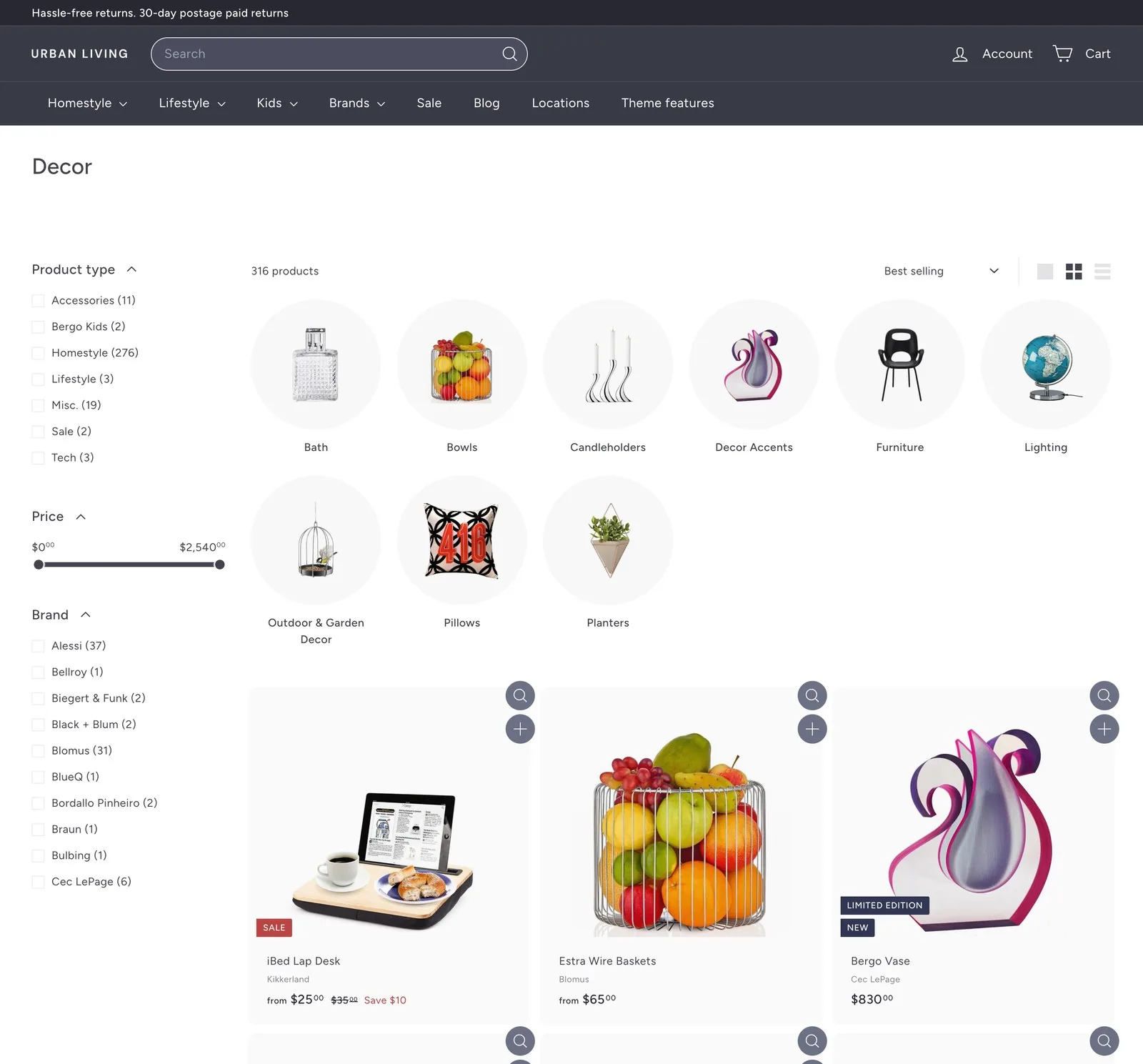
The Expanse theme offers a storefront tailored to stores with large product catalogs.
Price: $420 USD.
Developer: Archetype Themes (originally developed by Pixel Union and later moved to Archetype; specializes in large-catalog themes).
Styles: 5 ready-made styles: Expanse, Revive, Spritz, Fetch, Gem. Customer satisfaction is quite good at 94% (300+ reviews), and store owners with large catalogs especially appreciate it.
Overview: Expanse is a theme aimed at stores with large inventories. Shopify's official description calls it “the perfect theme for a high-performance, large catalog of products.” It includes powerful navigation, filters and promotional tools that make it easy for customers to find what they want in large, Amazon-style catalogs. Its design is also modern and clean, putting categories front and center and making product discovery easy. As the product of a Pixel Union and Archetype collaboration, it is a solid theme in both visual quality and technical foundation.
Uses: Expanse is aimed at multi-category online stores with hundreds or thousands of products, and it is ideal for sectors such as electronics, hardware, furniture and large clothing retailers. One of its highlights is multi-level category filters in the sidebar, which is vital for stores with many subcategories. It can also run several campaigns at once (different promotional blocks on the homepage, banners on collection pages, etc.), giving large stores more marketing flexibility. In short, it suits large-scale online stores that work “like a warehouse”. It can be used for small catalogs too, but Expanse shows its full potential with large ones.
Key Features: Expanse stands out for its powerful filtering and navigation. It offers navigation elements for large sites, such as category-based filter bars on the left, mega menus at the top and back-to-top buttons. Features like multi-column menus, sidebar filters and infinite scroll make it easy to browse thousands of products. On the marketing side there are customizable promotional areas: large promo banners on the homepage and announcement strips inside product listings on collection pages. Cart upsells and cross-selling are also available, helping raise the average order value. Versions released since Expanse 8.0 (current version as of October 2026: 10.0.1) added support for Shopify Plus features like combined listings and high variant counts, so products with many variants (such as 200 color options on one product) display smoothly. Archetype has also optimized it for performance, aiming for the best possible speed for a site of this size (sites this big still slow down when there is a lot of content, whatever the theme, but they have tried to minimize this).
Pros:
- Built for Large Catalogs: Expanse has everything you need to organize and present thousands of products well. With a powerful multi-level filter (filtering by product attributes) and navigation within collections, customers can find products without getting lost. This is a critical advantage for the conversion rate.
- Promotion and Upsell Tools: Large stores usually run several campaigns at once. With Expanse, you can add multiple promotional modules to the homepage, suggest similar products on product pages and say “add this too” in the cart. In other words, it is equipped to raise revenue per order.
- Performance Optimized: The code is optimized for large databases. A collection page with 1,000 items would normally load slowly, but Expanse keeps it flowing with pagination or lazy loading (there is an infinite scroll option). Customer reviews mention that the theme stays fast even with large catalogs.
- Customer Support & Experience: Expanse has been on the market for a long time and is supported by Archetype (it originally came from Pixel Union). That makes it a mature theme, refined by feedback from large businesses. The support team is experienced and helps when problems come up. There is also plenty of content about the theme on forums and blogs, so problems are easy to solve.
- Campaign Banner Flexibility: Expanse's customizable promotional banners deserve a special mention. You can, for example, show a strip such as “Free Shipping, Valid for 24 Hours” just above the filters on the product listing page. It is a great way to remind customers of a campaign on every page.
Cons:
- Relative Mediocrity of Design: Expanse is a function-first theme. Its design is attractive but not especially innovative or unusual; Pixel Union's style is classic e-commerce design. That is why some may feel its design “could have been more exciting.” It was deliberately kept this way to appeal to a broad audience.
- Price: At $420, it is in the top price bracket. That is not a problem for large stores, but a mid-sized seller may look for a cheaper alternative. Still, there are not many themes that can replace Expanse (Warehouse and Empire exist, but Expanse is generally seen as more modern).
- Customization May Require a Developer: The theme's defaults are largely sufficient. But if you want a different listing style or a custom tab, in most cases you will need to edit the code. This applies to every theme, but it may be a little more noticeable with Expanse: giant stores are usually run with developers, so the theme is designed to be developer-friendly.
- It can be overkill for very small stores: If you have only a few products (say 10-20), Expanse may be overkill: the site will have a lot of empty space, the filters will go unused, and so on. In that case, a simpler theme makes more sense. You need at least a few hundred products to get real value from Expanse.
- Content Density Management: A big catalog plus Expanse means lots of pages and content, which can make site maintenance a bit complex. This is more about site management than the theme, but with Expanse you need to keep every category and subcategory organized, or customers may feel overwhelmed. It is not a flaw, but filling all the areas the theme offers takes work.
Expanse Theme Ratings:
- Catalog Management: (5/5), One of the best for department stores, navigation and filtering are close to perfect
- Feature Set: (5/5), Promotions, upsells, mega menu and more; the needs of large sites are well covered
- Design: (4/5), Clean and modern but not especially creative; functionality comes first
- Performance: (4/5), Optimized code, though giant sites may still need a very good server; the theme does its best
- Price/Value: (4/5) pays for itself many times over for large stores; not worth it for small ones
Who we recommend it for: We strongly recommend Expanse for companies running large-scale e-commerce operations. Retail chains with a wide product range, online supermarkets and electronics retailers, for example, can offer a smooth experience with Expanse. One customer review said “We have more than 10,000 products, and Expanse met our expectations”; it is made for stores like that. On the corporate side, companies with physical stores that want to expand their online catalog (a home improvement or hobby store, for example) will be comfortable with Expanse's foundation. B2B wholesale portals can also present large product lists to buyers neatly with this theme. In short, Expanse should rank high for anyone who says “I have lots of products, and my customers need to be able to choose”.
Empire Shopify Theme
The Empire theme is designed to present large catalogs in an Amazon-style layout.
Price: $360 USD (October 2026 list price).
Developer: Pixel Union (a well-established Shopify theme studio).
Styles: It comes with 4 styles, with presets named Empire, Depot, Supply (Circuit), Form. At 79% (450+ reviews), customer satisfaction looks a bit low compared with other premium themes, but this partly reflects complaints about older versions; Pixel Union has been working to raise satisfaction with updates for some time.
Overview: As the name suggests, Empire is a theme built to rule huge inventories. For a while it was the most popular large-catalog theme on Shopify. The aim is to offer an almost Amazon-like shopping experience: it has extensive mega menus, advanced search, listings that feel like product comparisons, promotional tiles and more. Empire has also often been chosen by B2B/wholesale stores (because it is highly functional and has a simple look). In this theme, Pixel Union put functionality first and went for industrial minimalism in the design.
Uses: Stores with many categories and products (especially 500+ items) are Empire's natural habitat. It has been widely used by online shopping malls, department stores, and electronics & spare parts dealers. Empire also handles content-heavy products well (long descriptions, lots of technical detail); its product detail pages are simple and information-focused. Dropshipping stores that list lots of products have also said they love this theme because it offers fast category navigation. Merchants selling across borders can benefit from Empire's language and currency support. At one point Pixel Union also positioned Empire for B2B, as it includes some features suited to wholesale (such as a quick order list). So both large B2C retailers and B2B wholesale portals can benefit from Empire.
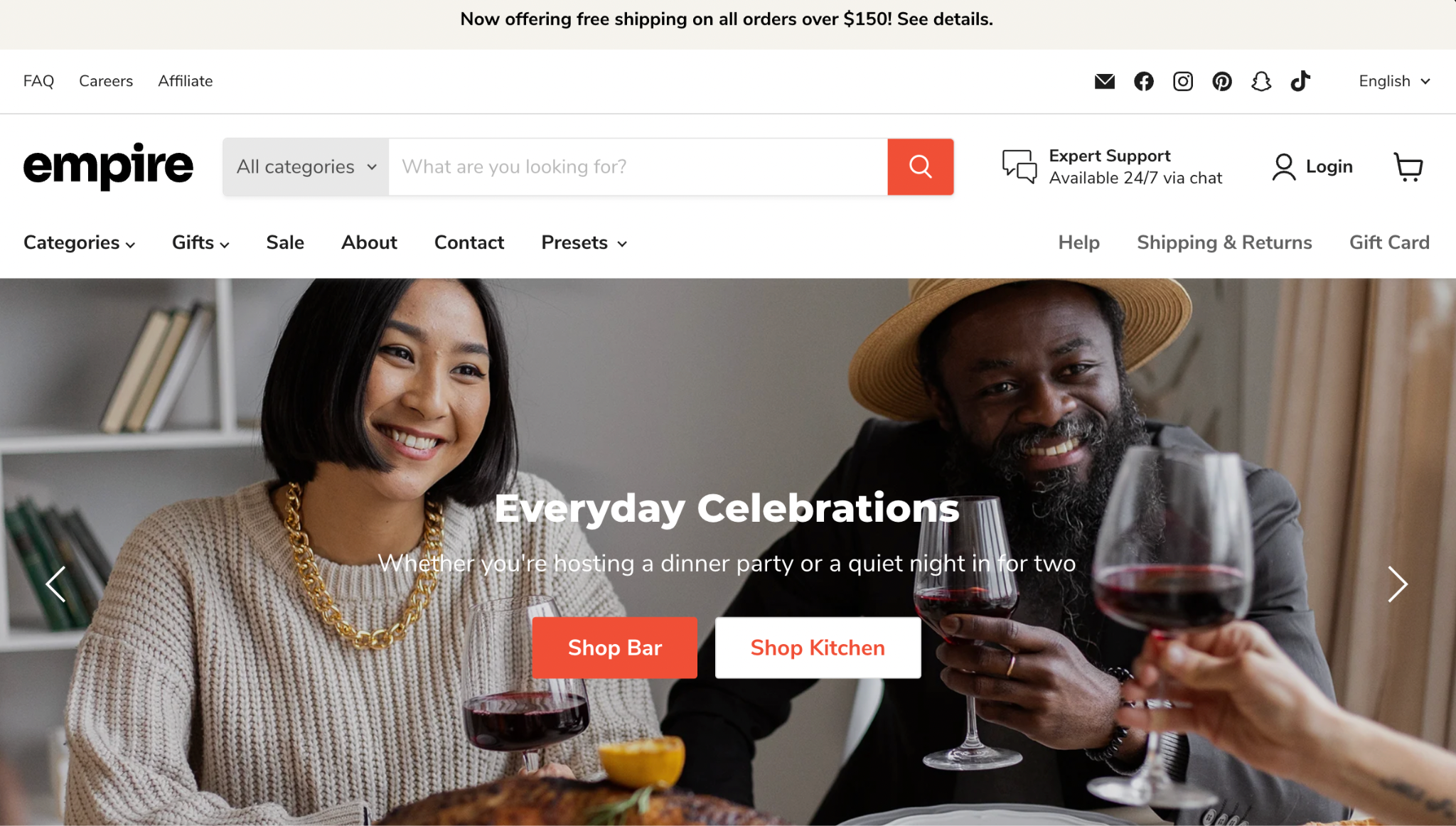
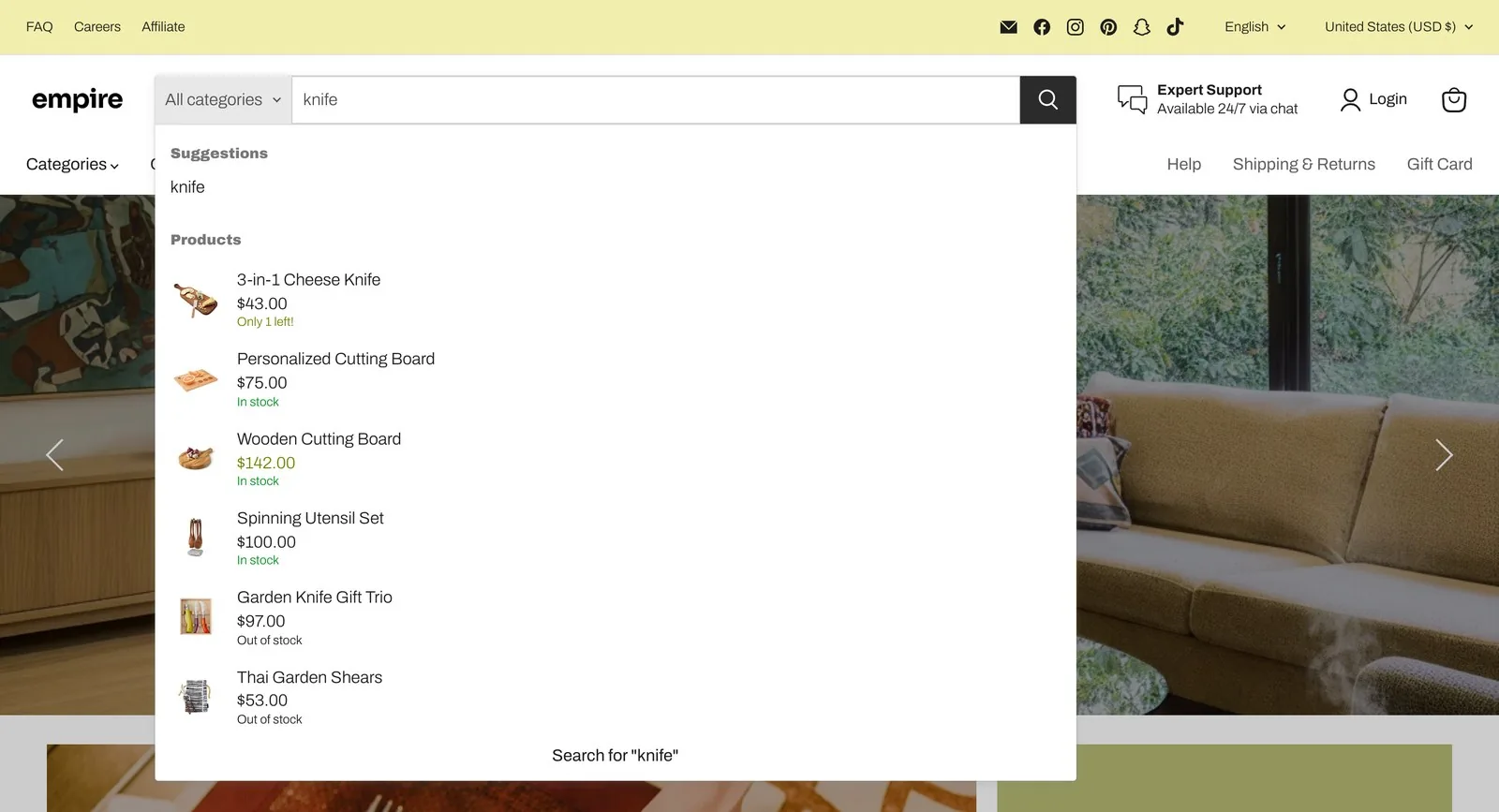
Key Features: Perhaps Empire's most important feature was enriching the homepage and category pages with “shoppable images” and promotional tiles. You can, for example, add image blocks to your homepage to draw attention to specific collections or promotions. It has advanced filtering and search; Empire was one of the first themes to introduce “Amazon-style” search suggestions (recommending products as you type in the search bar). It also includes conversion tools such as quick buy and a quick order list. Pixel Union has added marketing elements such as an availability indicator, countdown timer and trust badges in recent updates. Another plus is that, with multiple announcement bars and a split header, you can tell visitors several things at once (a free shipping announcement and a campaign code, for example). With Empire 12, Pixel Union also made improvements such as high variant support and better mobile UX, because older versions drew some UX complaints.
Pros:
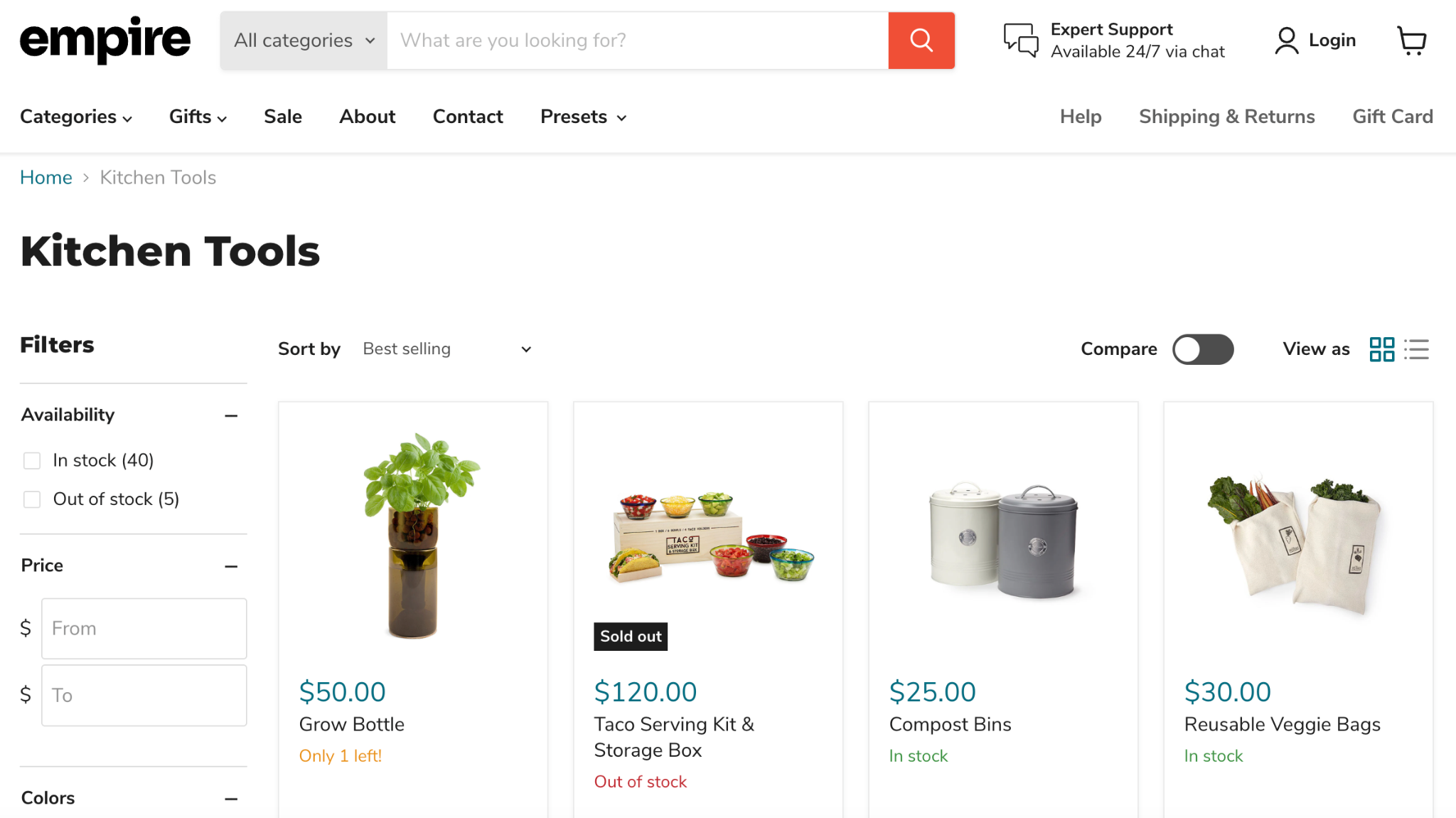
- Big Store Functionality: Empire offers an Amazon-like experience, with efficient navigation throughout the site. Multiple top bars, multi-column mega menus, sidebar filters on category pages, “add to cart” buttons in product lists and information-rich product cards that feel like a comparison view keep a huge catalog under control.
- High Conversion Tools: It has many conversion features such as upsells, cross-sells, a stock indicator and countdowns. You can, for example, add stock alerts such as “X% left” or show campaign reminders in a progress bar at the top after “add to cart”. Small touches like these can trigger sales.
- Suited to Wholesale: Empire has also been popular with merchants using Shopify's wholesale channel. Its simple, information-focused design gives wholesale buyers the clarity they look for. Pixel Union also added B2B-friendly features such as Quick Order, which lets customers enter quantities in a product list and add several products to the cart at once.
- Updates and Improvements: Empire drew some criticism when it first came out, but it has come a long way over the years. Pixel Union seems to have listened to customer feedback in recent updates: the header used to be criticized for taking up too much space on mobile, for example, and the mobile header is now better organized. The filters have also been improved. In short, the developer has kept working on the theme.
- Relatively Affordable: At $360 (Theme Store list price, October 2026), it is slightly cheaper than themes like Expanse ($420) and Motion ($420). The $60 difference may not be decisive, but it is still not the most expensive option. Pixel Union also sometimes runs 20% off promotions, so it pays to catch a sale. This can count as a plus too.
Cons:
- Low Satisfaction Rate: Its 79% positive and 16% negative ratio stands out compared with other premium themes. Some of the negative reviews come from shortcomings in older versions (an outdated mobile experience, limited customization), but this perception still affects the theme's reputation somewhat. New buyers may hesitate and wonder “why is the score so low?”
- Somewhat Dull Design: Empire is very functional, but some may find it soulless. Some people find the design too corporate or plain. It is a matter of taste; if you are a luxury or creative brand, Empire may look too simple for you. In practice, it is mostly supermarket-style sites that love this theme.
- Performance Issues: With a large catalog on Empire, keeping the site fast can be hard. Some users complained that older versions of Empire were slow. Pixel Union says it has improved this, but a giant site may still blame the theme. You need to optimize deliberately.
- Limits of Customization: Some parts of the theme have a fixed design; the product page layout, for example, cannot be changed radically. One negative review said something like “customization is limited, I had to code everything manually”. Pixel Union sticks to its core design and does not offer many options. For some, this is a drawback.
- Header Density (Mobile): The Theme Hub review pointed out that the mobile header can get overloaded. Indeed, an announcement bar, menu, search and cart stacked together take up quite a bit of space on mobile. You can fix this in the settings (by turning off unnecessary bars, for example), but if you miss it, it hurts the mobile UX.
Empire Theme Ratings:
- Catalog Management: (5/5), Large-catalog friendly, Amazon-like navigation, very powerful filters
- Features: (4/5), Plenty of marketing and B2B tools; only lacks some luxury/storytelling features (weak on editorial)
- Design: ☆ (3/5), Functional but a bit dull and aesthetically ordinary; still looks professional
- Performance: (4/5), Optimized for large sites; still needs attention in proportion to the amount of content
- Price/Value: (4/5), Valuable for large stores; despite what the satisfaction score suggests, the feature set is worth the money
Who we recommend it for: Empire is tailor-made for “e-commerce giants”. If you run an online store with thousands of products and want a fast, simple, reliable interface, Empire will do the job. Online stores in categories such as electronics retail, large fashion retail and supermarkets should seriously consider Empire. Corporate B2B platforms (dealer ordering systems, wholesale catalogs) can also become more user-friendly with Empire, since wholesale customers usually look for functionality and Empire delivers it. An auto parts distributor, for example, can clearly display tens of thousands of parts with Empire and let customers filter them. In short, Empire is the theme for “the big players”; if you need to keep a giant operation running, Empire will not let you down.
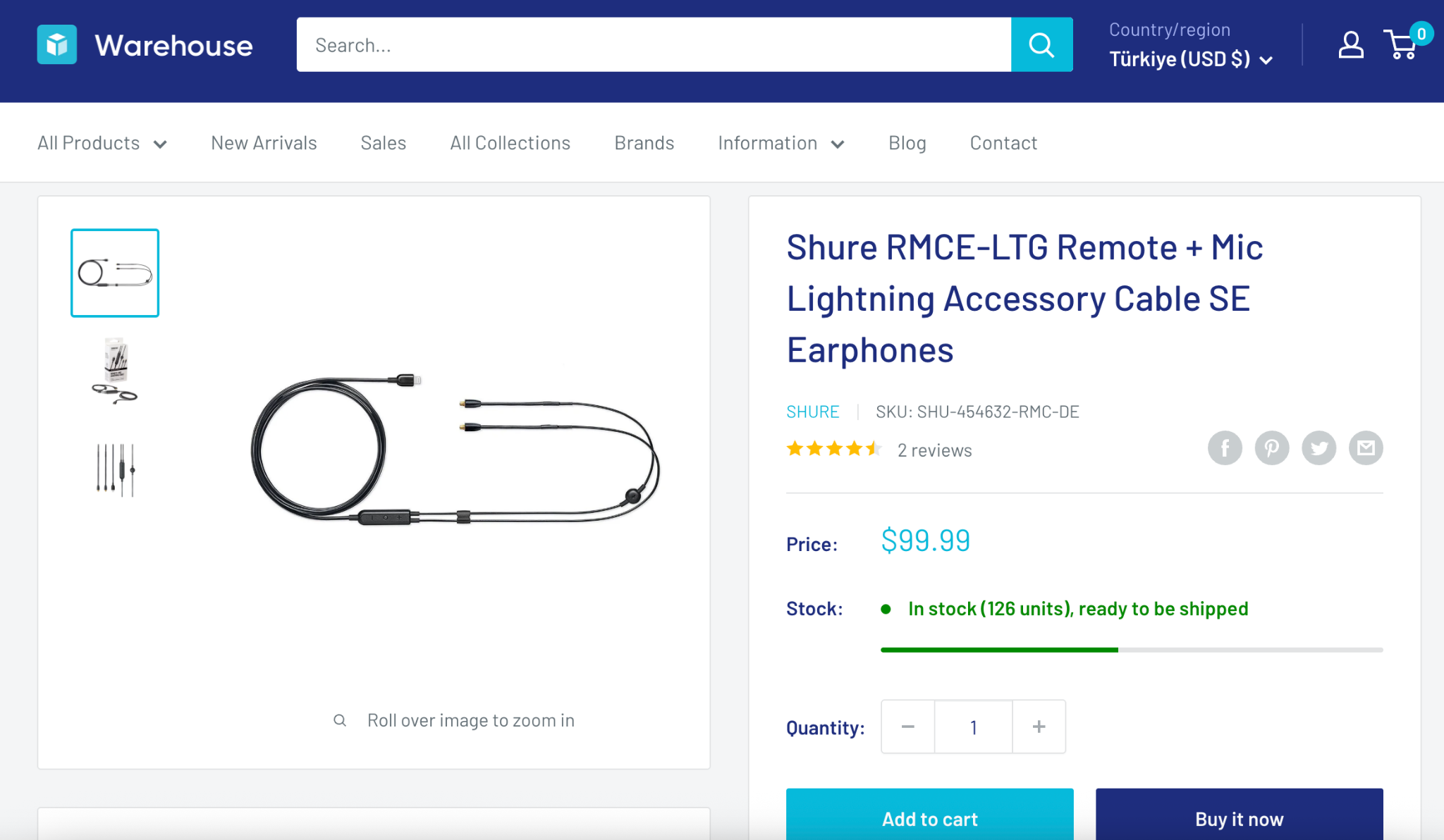
Warehouse Shopify Theme
The Warehouse theme, as the name implies, is a high-performance solution for multi-product stores.
Price: $320 USD.
Developer: Maestrooo (the respected French studio behind themes such as Prestige and Focal).
Styles: It comes with 3 ready-made styles, with presets called Warehouse, Wood, Mesh. Customer satisfaction is around 84% (325 reviews); support and speed are praised, while some customization limits have drawn criticism.
Overview: Warehouse is designed as a theme that can comfortably handle large catalogs. It offers a product-focused experience with a minimalist interface. What sets it apart from other large-catalog themes is that it avoids unnecessary decoration while keeping performance at the top. The theme was already popular in Shopify's pre-Online Store 2.0 era; it was then updated for OS 2.0 and gained a number of new features (such as gift wrapping and countdowns). Maestrooo's code quality and support make Warehouse a reliable choice.
Uses: Warehouse shines in sectors such as electronics, hobby products, auto parts and industrial products, where product information and large inventory may matter more than visuals. Even the theme's name, warehouse, points to a stock-heavy, multi-product structure. Any business with more than 100 products in its online store can use it comfortably. Large stores that care about SEO and speed choose Warehouse; its minimalist structure is an advantage in these areas. Dropshipping sites with large catalogs (products from every category, supplier stock, etc.) also love Warehouse's speed and simplicity because they do not have to manage a complex site. In short, it is ideal for anyone looking for the trifecta of large inventory + high speed + easy operation.
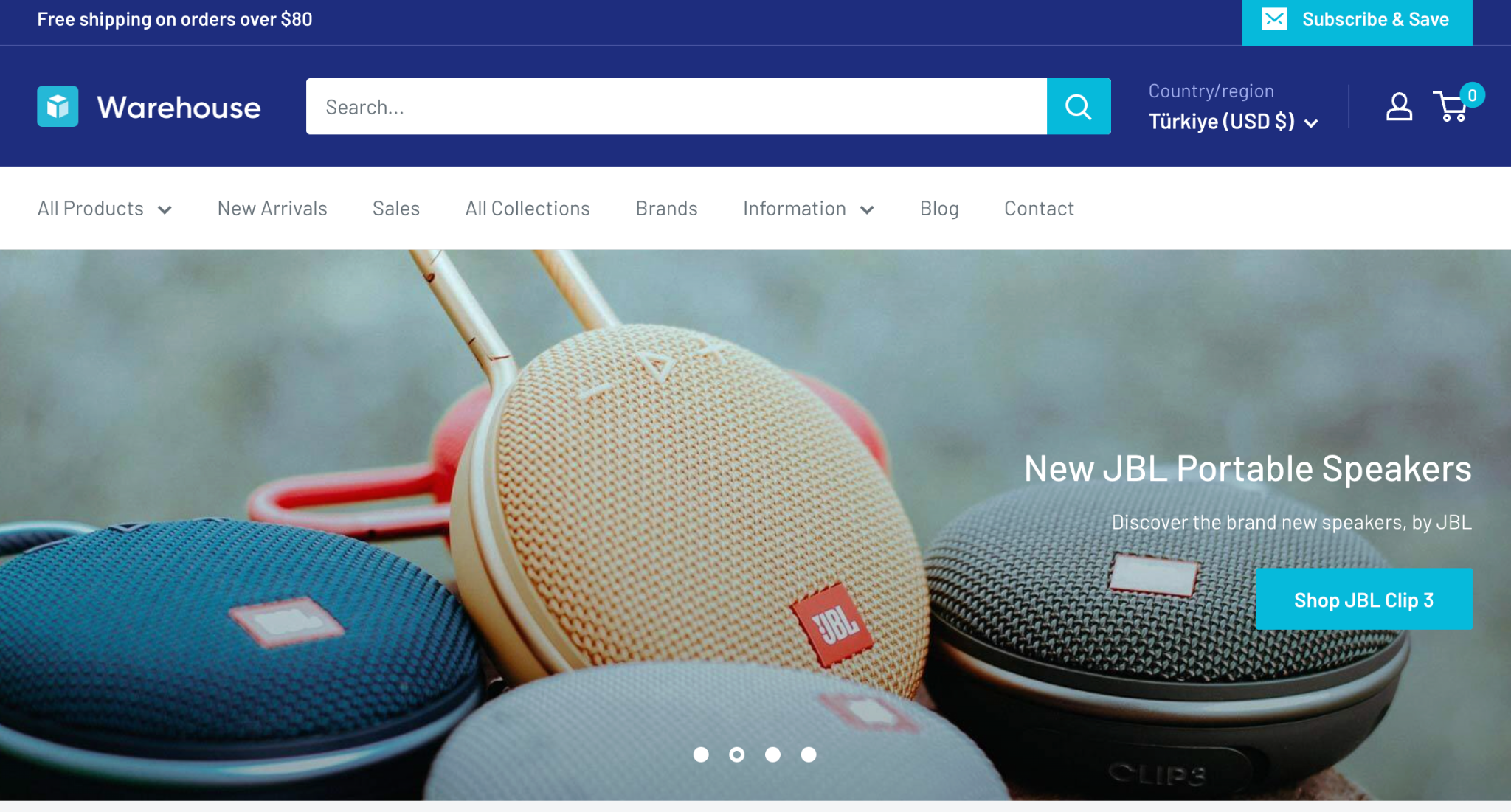
Key Features: Warehouse is known for high performance; as we know from Prestige, Maestrooo themes are usually lean (lightweight) code. It has built-in marketing tools such as a stock indicator, promotional pop-ups and banners, product labels (badges) and a countdown. A badge such as “Only 3 left in stock” can appear automatically, for example. There is even a store locator (if you want to list physical stores). Filtering is strong; on collection pages, customers can filter products by various criteria (color, price, brand, etc.). Quick view and a sticky cart also make converting easier. Another plus is Warehouse's support for “Combined listings”, the Shopify Plus feature for listing several product variants together (we saw this in Prestige too; Maestrooo builds Plus features into its themes). Customer reviews usually focus on speed, flexibility and support: “Our site is fast even with 10k products, and the support team is super fast and helpful.”
Pros:
- Superior Speed & Performance: Warehouse runs as if it were on steroids. Users find the site very smooth on both mobile and desktop, which is a big plus for SEO and user satisfaction. One review read: “Warehouse theme is fast, flexible, and professional, even on large inventories, 10/10 would recommend.”
- Easy Customizability: Maestrooo kept the theme simple. The settings are easy to understand, and the necessary edits can be made without code. The homepage layout and collection page sections in particular offer a good deal of control. Users say “easy to customize, I set it up exactly how I wanted.”
- Robust Support & Updates: Young teams such as RoarTheme are also good at support, but Maestrooo's experience is on another level. The French team is known on the forums for quick replies and a solution-focused approach. Reviews also praise the speed and skill of the support team (a support agent named Thomas gets special mention). The theme also keeps improving through regular updates. As of October 2026, the Shopify Theme Store lists version 7.0.1, released on March 13, 2026.
- Minimal and Functional Design: The design is simple, but that is an advantage because the products shine. If you sell niche or technical products (musical instruments, electronic components, etc.), the uncluttered theme lets customers focus on the information. One user said, “The Warehouse theme is fast, flexible and doesn't have too many features, which is exactly what I need.”
- Stability and Reliability: Maestrooo is known for its code quality, and Warehouse has a solid reputation when it comes to bugs and glitches (satisfaction is already quite high). If you want a trouble-free platform for the long run, it inspires confidence. Users who have run it for several years write that it has “gotten even better with the updates, we are very pleased.”
Cons:
- Restricted Built-in Customization: Some users may not have found as much flexibility in the theme settings as they would like. One review complained that “built-in customization is limited, code is required for customization, updates are only for Shopify compliance, no new development.” The theme may have added some simple features later (such as mobile quick buy), but there is still no wishlist, for example; you need an app for that. Gaps like this may exist.
- Simple Design, Maybe Too Simple: Minimalism is not for everyone. Some store owners prefer themes that look a bit more “luxurious”, such as Prestige. Warehouse is very minimal and may look “plain” to some. That can be a drawback for brands that want to create an impression of prestige.
- Average Overall Satisfaction: 84% positive is not bad, but 12% is negative (38 negative reviews). The negative reviews are usually about customization or a specific expectation not being met. Still, it is not a perfect score. (Note: this rate may include older issues.)
- Additional Application Need: Warehouse covers all the basics, but areas such as blog sections and storytelling are weak. If you need more in these areas, you may need an app. Likewise, if you want advanced search, you may need an extra search integration (because the default search may not be enough).
- Admin Work with Many Products: The theme is fast on a site with many products, but adding promotional tiles and assigning images for every collection in the editor can be a hassle. This may not be a flaw, but using all of it efficiently on a giant site takes effort.
Warehouse Theme Ratings:
- Speed & Performance: (5/5), Speed monster, delivers large inventories as fast as possible
- Ease of Use: (4/5), Simple settings, very helpful support; advanced customization may still require code
- Features: (4/5), It has all the essential e-commerce elements but no flashy extras (kept simple)
- Design: (4/5), Minimal and tidy; not especially striking but very practical, with a professional look
- Price/Value: (5/5), At $320 it is cheaper than its rivals, and with Maestrooo's quality it more than pays off in the long run
Who we recommend it for: Warehouse is a perfect fit for large-catalog stores that say “speed and usability are my priority, I don't need much fanfare”. An online store selling thousands of computer parts and electronic equipment, for example, can present them comfortably with Warehouse, and the fast site means customers will not get tired of browsing. Hardware and DIY (do-it-yourself) supply sellers, musical instrument stores and sites with large ranges of books or collectibles will also be happy with Warehouse's speed and layout. On the corporate side, sectors such as spare parts distributors and logistics product suppliers (sometimes even for internal use) appreciate Warehouse's minimalism. In short, Warehouse is a theme anyone who wants to turn the equation “lots of products + lots of speed = happy customers” into reality should consider.
Baseline Shopify Theme
Price: $420 USD.
Developer: Switch Themes (a design-focused studio previously known for its “Editorial” theme).
Styles: It comes with 5 ready-made design styles: Baseline, Austere, Brutalist, Courier, Press. Customer satisfaction is 99% (nearly perfect), with very positive reviews, especially for design flexibility, typography and support.
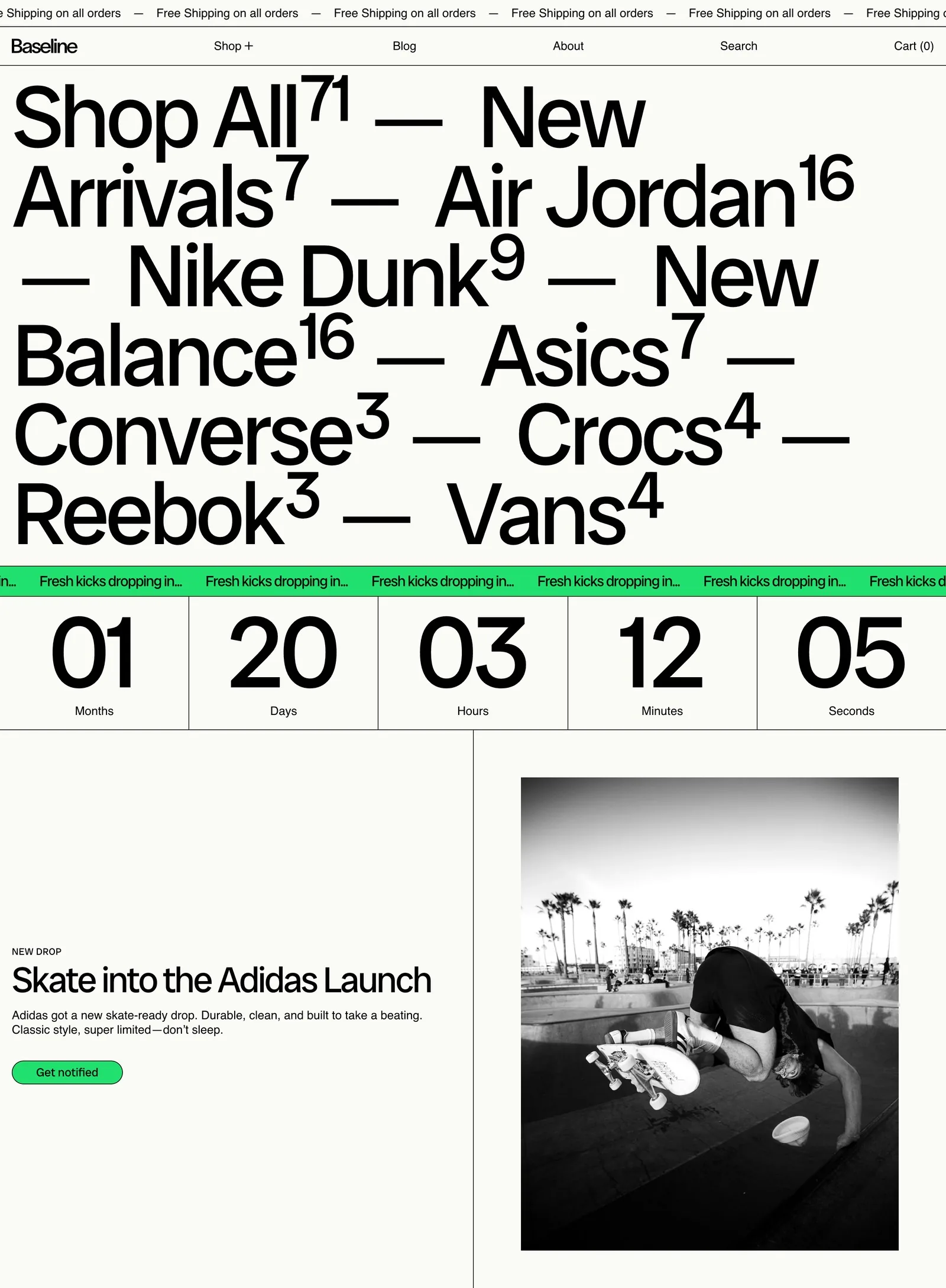
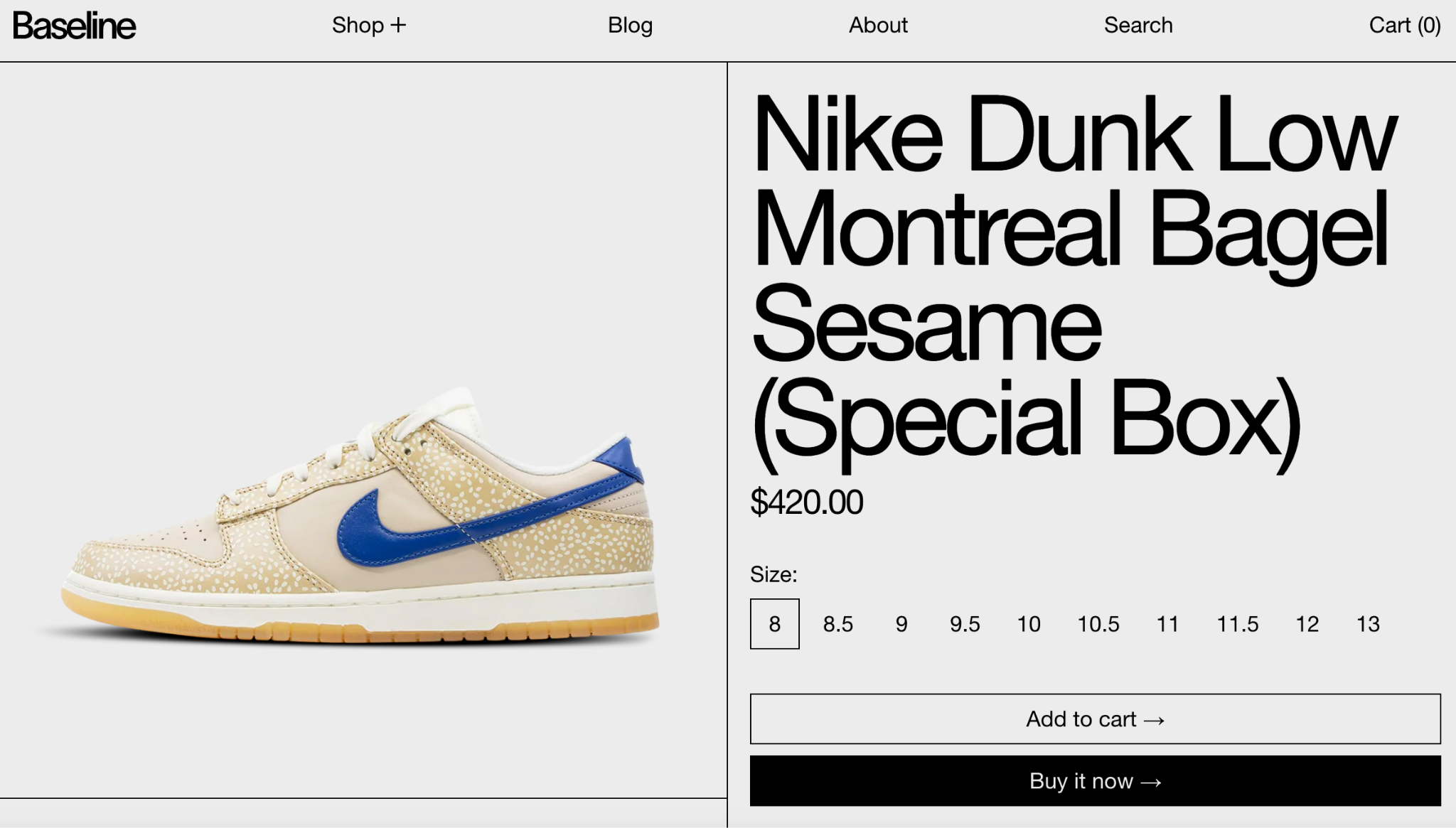
Overview: Baseline reflects Switch Themes' artistic and original vision. Bold typography, unusual layouts and an editorial feel define this theme. As the name suggests, “Baseline” evokes the baseline concept in typography, hinting at a clear, grid-based layout and strong fonts. The theme aims to sell products while keeping the brand story and content front and center. That makes it an ideal bridge for brands that want to combine content marketing with e-commerce. With Baseline, Switch Themes has taken its old “Editorial” theme to the next level.
Uses: Brands that care about photography, art and storytelling will love Baseline: boutique fashion designers, luxury clothing brands, gallery stores, publishers (books, magazines) and so on. With its distinctive header styles and page layouts, Baseline turns your store into a digital magazine. In that sense, it may best suit brands with a small to medium number of products but a story to tell for each one. That said, Baseline is built on a pixel-perfect grid system with a modular structure, which shows it can adapt to different sectors. In short, anyone who doesn't want to be ordinary and wants to stand out through store design should have Baseline on their radar. Looking at Switch's portfolio, we can say that with Baseline it targets fashion and lifestyle brands that want to look “cool”.
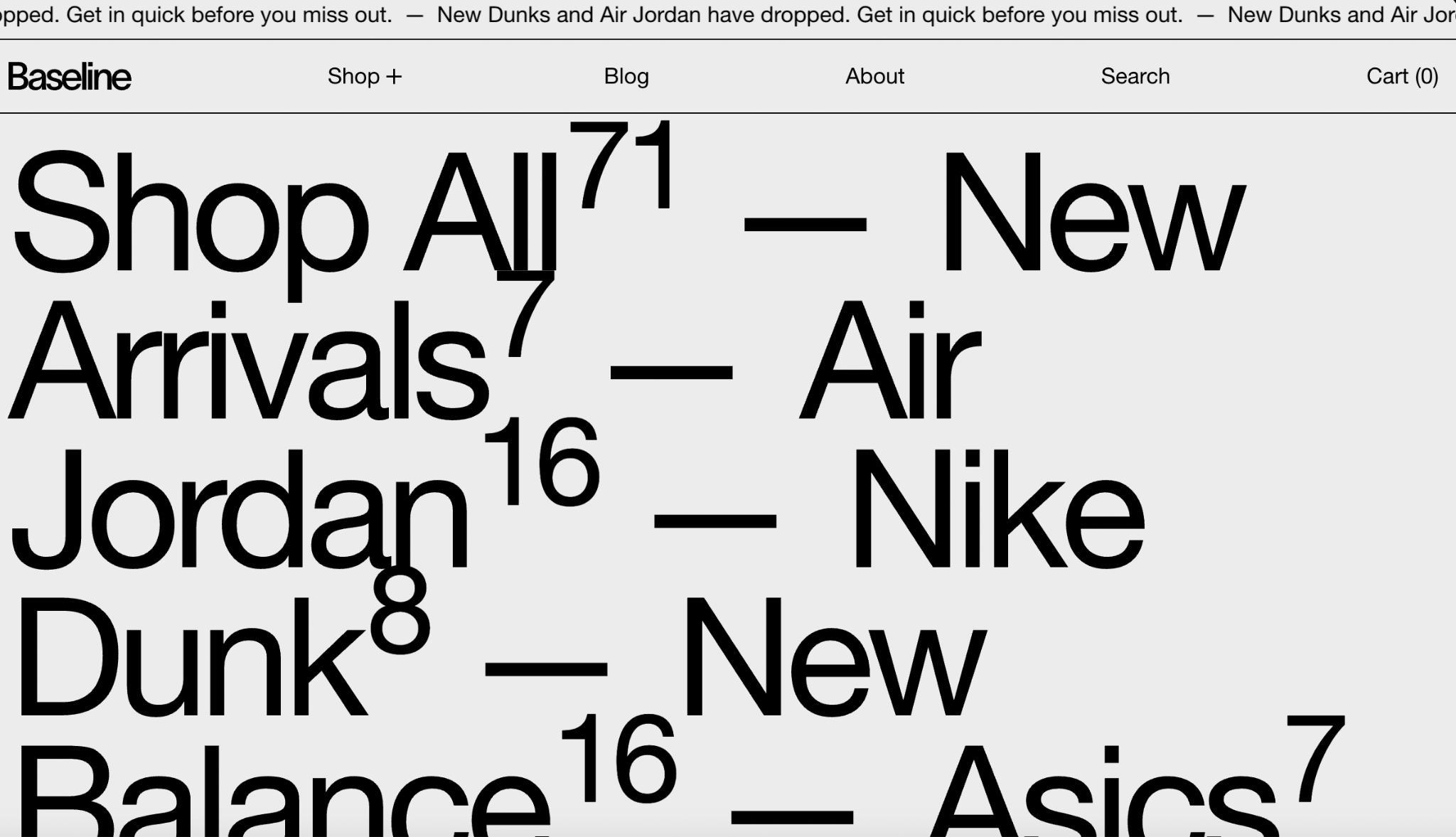
Key Features: Baseline stands out with bold headers, large image placements and a flexible grid system. It has components that create a magazine-page feel, such as a half-image, half-text block on the homepage, product lists with varying column counts below it and full-width manifesto lettering in the middle of the page. Special attention is paid to typography; you can create an unusual look with different typefaces and layout variations (typography has always been a strength of Switch Themes). Baseline does not leave e-commerce functions unattended either: according to the Switch Themes blog, it includes 75+ content sections and 35+ advanced settings and supports a stock counter, trust badges, Instagram feed integration, videos, lookbooks and more. The developers aimed for a full accessibility (a11y) score, and the theme's performance is also described as optimal; it is not an artistic but slow theme. On the contrary, Switch claimed in a blog post that Baseline is “Lightning fast”. Customer reviews include praise such as “thanks to flexible sections and blocks, we gave our store exactly the look we wanted without sacrificing performance”.
Pros:
- Unique Design & Typography: With Baseline, your store will look like the work of an art director. This can give you a competitive edge; as customers browse the site, they will feel your brand identity through and through. There is no “template site” feel at all; Baseline stands apart from other themes at a glance.
- Content + Product Integration: Thanks to the theme's editorial structure, blog content, lookbooks and products can be presented together, which helps both SEO and your brand story. Publishing a style blog post with the products it mentions available to buy, for example, is easy on Baseline. This synergy is worth its weight in gold for brands doing inbound marketing.
- Flexibility & Customization: Customer reviews describe Baseline as extremely flexible, with comments like “Highly flexible sections and blocks, everything can be easily edited”. With more than 75 sections and many style settings, you can build the site almost like Lego. Switch may not be as experienced as Clean Canvas (the team behind Symmetry), but it seems to have raised the bar with this theme.
- Support & Community: Switch Themes kept a low profile for a while, but it has shone with Baseline. Users say the team currently responds quickly to support requests and even gives customization tips. Baseline is also a new “hip” theme that has caught on a bit on social media, so a community is forming where people share their sites and swap tips. This inspires and helps users.
- Performance & Technical Excellence: According to reports, Baseline comfortably scores 90+ in Lighthouse tests. So it is not only beautiful but also fast and SEO-friendly. This combination is rare; design-heavy themes are often slow, but Baseline has avoided that trap (Switch claims as much, and users have not mentioned slowness either).
Cons:
- Original Design, Learning Curve: Someone used to standard Shopify themes may need some time to get used to Baseline's different structure. The sections and grid may feel different from other themes at first. You may need to approach it with a designer's mindset rather than a “standard Shopify” one. That means a bit of a learning curve for non-professionals.
- Price: At $420, it is in the premium bracket. For a theme rated almost 5/5 that may not be a real drawback, but there are still strong competitors such as Impulse and Motion in this price range. The question is whether you prioritize design or functionality: Baseline is design-heavy, while the others are function-heavy. If you want these strengths at this price, Baseline is excellent; if not, it may feel expensive.
- Not for Very Large Catalogs: Baseline covers a wide range, but in our view it is ideal for a small to medium number of products (1-200). For very large stores, Expanse or Empire may be more useful; Baseline can handle them too, but its design focus and its filter areas may not suit giant stores, and customers could feel overwhelmed.
- New Wave of Switch: Switch Themes had been quiet for a while and made its breakthrough with Baseline. In terms of version maturity, a few minor bugs may have slipped through (although there seem to be none). There is some risk of the “teething problems” that come with a new theme, but so far users have not reported any.
- Code Editing May Be Required (Rare): Even with all of Baseline's flexibility, a few customizations may have been left out. If you want a very specific header layout or a custom animation, for example, you may need to code it. This is a possibility for brands with very precise design requirements, though Switch may already cover those requests with settings. Still, as with any theme, radical changes require code.
Baseline Theme Ratings:
- Design & Aesthetics: (5/5), Artistic, modern, bold, a rare gem among e-commerce themes
- Customizability: (5/5), Flexible grid and plenty of settings for extensive customization; you can bring your design ideas to life
- Content Integration: (5/5), Blends smoothly with blog, lookbook, video and more; conveys your brand story 10/10
- Performance: (5/5), Very fast despite its rich look, good code quality; zero compromise on design
- Price/Value: (5/5), If that's what you're looking for, it's worth every penny; it sets your brand apart from the competition
Who we recommend it for: We recommend Baseline for brands that say “I don't want an ordinary online store; I want my digital storefront to look like a work of art”. High fashion brands, designer product sellers, art galleries, luxury cosmetics brands and e-commerce blogs with a fashion magazine identity in particular can both offer a visual feast and sell with Baseline. A luxury watch brand, for example, can give customers a unique experience by presenting editorial content about the brand's history and craftsmanship alongside its product catalog. Likewise, brands with a mission such as sustainable fashion can use Baseline's manifesto-style headline areas to communicate their values while selling their products. On the corporate side, design furniture companies or lifestyle stores of premium car brands could also build a prestigious e-commerce channel with Baseline. In short, Baseline is a perfect solution for anyone who says “I want my store to be like a brand magazine”.
Taiga Shopify Theme
Price: $500 USD (one of the highest-priced themes in the Theme Store).
Developer: Woolman (a Finland-based Shopify agency that made its name with Online Store 2.0-era themes).
Styles: It offers 4 ready-made styles: Taiga, Bubbly, Meadow, Hehku. Customer satisfaction is 100% (from a still limited number of reviews, all very positive). Reviewers especially highlight its natural, organic vibe, video sections and versatile structure.
Overview: Taiga takes its name from Siberia's famous forests and aims to deliver a natural, organic and fresh experience. It has also appeared in lists such as “best SEO themes of the year”, which suggests it is technically very strong too. Woolman seems to have optimized this theme for brands in sectors such as health, wellness and organic products. It has both a very extensive feature set (it is one of the most expensive themes on the list) and a design that builds an emotional connection with the user. It supports light/dark mode and a number of modern features, and is listed among fast Shopify themes. In short, Taiga is the premium of premium themes, one you could describe as “does everything, and with a natural feel”.
Uses: The first brands that come to mind are those selling natural products, wellness, organic food and cosmetics, or outdoor clothing. That said, Taiga is a multi-purpose theme; as one of the most expensive themes on the list, it would not sell much if it served only a niche. So it fits every sector but shines most for brands with a natural feel. Product count does not matter: it can tell the story of a brand with 10 products or carry a catalog of 1,000. At this price level, Shopify Plus merchants are usually the target, so high-volume, global businesses are also in its sights. In short, any brand that is obsessed with quality and has low price sensitivity (especially fans of Northern European minimalism) will be happy with Taiga.
Key Features: Taiga offers a broad feature set: 10+ video sections, dark/light mode, 10-language support, RTL compatibility, a mega menu and advanced search. It is developed by Woolman and configured especially for brands in the bags, sports and outdoor categories. Its Shopify Theme Store page emphasizes speed and performance. Taiga covers every feature expected from a premium theme.
Pros:
- Spectacular Visual Experience: With its organic, airy design, Taiga instantly gives visitors a sense of trust and calm. The color palettes and typography are carefully chosen, and the “natural vibe” hits the mark. If you like minimalism in particular, the theme offers a pure, clean look.
- Fully Equipped Feature Set: The $500 is money well spent; Taiga is perhaps one of the richest themes on the list. All the features listed above are built in: video sections, promotional tools, global selling features, a store locator, gift wrapping and subscription options.
- This keeps the need for extra apps to a minimum and gives you the feeling that you can build whatever you want on the site.
- Performance & SEO: If the Goldenweb blog tested it, it probably found high Core Web Vitals scores (which is why it made the list). So despite all these features, the theme's speed is optimized. This is a big plus; usually there is a trade-off between speed and features, but Taiga seems to keep both.
- Support & Trust: Woolman is a Shopify Plus partner, meaning it works with enterprise companies. That suggests enterprise-level QA on its themes and professional support. The 100% customer satisfaction rate backs this up, along with the reliability you would expect from a Finnish company. They never leave things half done and may even offer extra services for special requests.
- Dark Mode and Modern Touches: At the risk of repeating ourselves, dark mode is rarely offered natively on e-commerce sites, and Taiga offers it. It adds a modern touch to the site design and, with a toggle, can make the user experience feel cooler too. Details like this show that Taiga is worth the money.
Cons:
- Very High Price: Not every company will spend $500 on a theme. Instead, a small store might choose a theme of perhaps $250 plus a promotional app. So it really targets a premium audience. This may not count as a drawback, but it is “expensive” after all.
- Too Many Features, Steeper Learning Curve: Swiss-army-knife themes like this can feel cluttered in the editor. With settings and sections everywhere, a Shopify newcomer may struggle to figure out what does what. Setting it up takes more work than a simple theme. One option is to start straight away with a simple preset, but if you want to get into the finer details, you may need to study the documentation.
- General Thematic Focus: We said Taiga fits any industry, but its feel leans “natural”. A hardcore tech gadget store or a gothic fashion brand, for example, may not feel at home with this theme. The style has a certain airiness, and not every brand will want that. You can adjust it with colors, dark mode and so on, but at its core the design is light and airy.
- Risk of Making It Slow: Again, using that many features means putting a lot of media on the site. The theme itself may be optimized, but if the store owner fills it with 4K videos and giant banners, it will slow down no matter what the theme does. This is a potential risk. If you buy an ultra-premium theme and skip optimization because it is “fast anyway”, you are shooting yourself in the foot. (This may not be a flaw as such, but it is worth a reminder.)
- A New Theme (Potential Risks): Along with Impulse, Taiga is the most expensive theme on this list, and it has fewer reviews (54) than the others. That means its user community is relatively small. Less feedback means a smaller community. This may be a drawback: there is little content on forums and few how-to blog posts, so you will learn by trying things or asking support. That is also a minus for beginners.
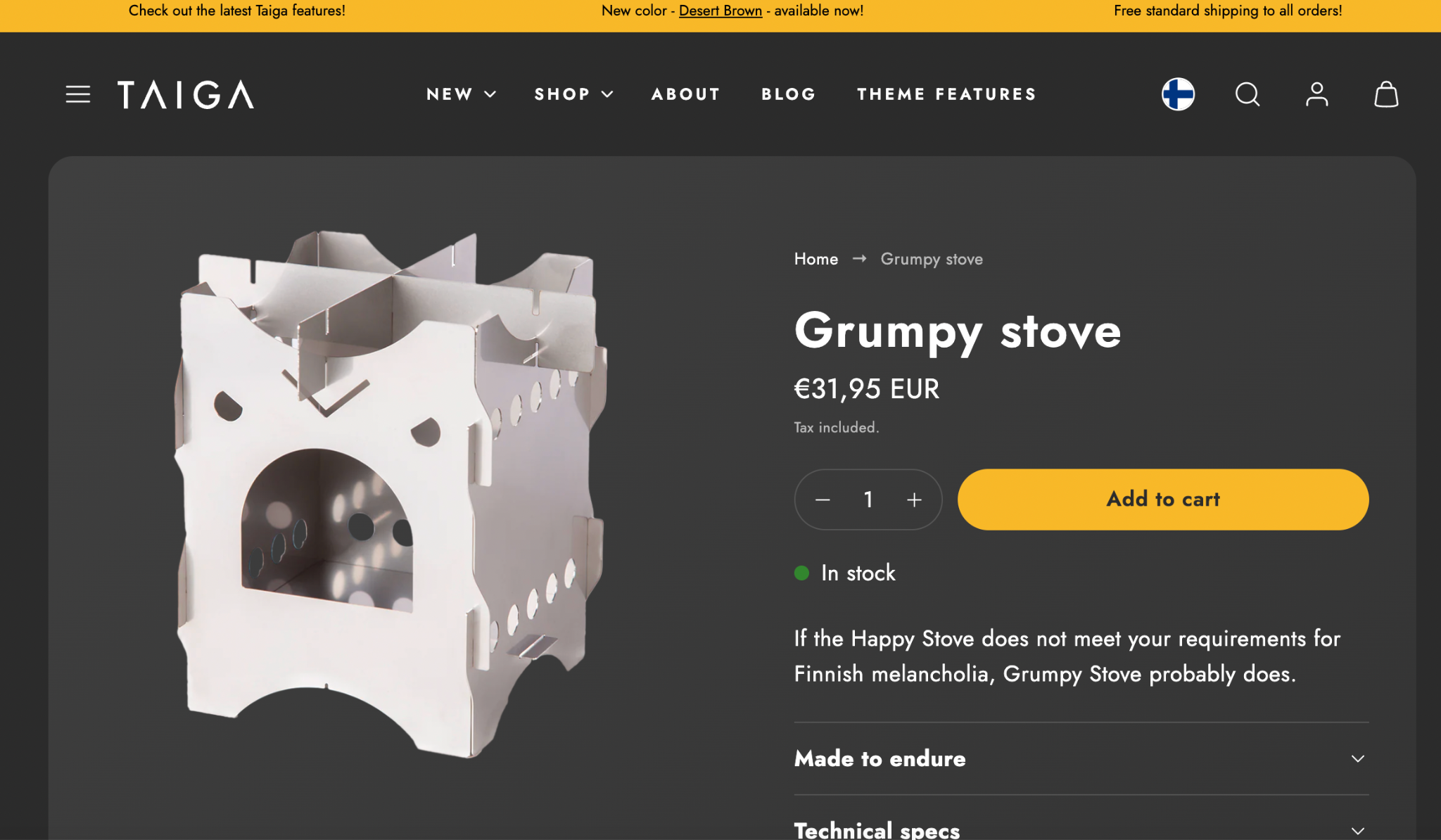
Taiga Theme Ratings:
- Feature Scope: (5/5), All-in-One: every function you can think of, equipped beyond the usual premium level
- Design & Aesthetics: (5/5), Natural, modern, spacious; visual feast especially for organic brands
- User Experience: (5/5), A great end-user experience with a mobile-first approach, dark mode and more
- Performance: (5/5), Surprisingly fast for a theme of this level, SEO friendly
- Price/Value: (4/5), Expensive, but compared with what you could not do without a theme of this scale, it is worth every penny
Who we recommend it for: Taiga is for brands that want the best of the best. Companies that emphasize nature and aim to grow in global markets, such as sustainable fashion brands, organic cosmetics brands and outdoor/nature sports equipment makers, should not overlook Taiga. If an organic supermarket chain is launching an online store, for example, Taiga can deliver both a natural feel and a huge catalog. A fitness and wellness products brand (yoga accessories, etc.) can bring community feeling, blog content and products together with Taiga and give its customers an inspiring platform. On the corporate side, even more extreme examples such as a premium car brand's eco-friendly subsidiary or a luxury real estate company's lifestyle store could create an ambitious experience with this theme. Ultimately, Taiga appeals to every business that says “My brand is global, my vision is big and my site infrastructure must be first-class”.
Minimalista Shopify Theme
Price: $380 USD.
Developer: Segment (a new but ambitious name in Shopify themes, known for minimal and modular designs).
Styles: 5 ready-made styles: Minimalista, Reactive, Cosmetica, Promise, Portfolio. It has 94% customer satisfaction (31 reviews), with reviews like “clean, practical, great support”, and a 5.0/5 star rating on Reputon.

Overview: As the name makes clear, Minimalista is a theme built on the art of simplicity. With it, Segment targets lovers of minimalist design. The design is extremely stylish, modern and airy as well as minimal; like a canvas that puts products and images in the spotlight. It does not neglect functionality either; it is said to balance the trio of “style, usability and performance”. Visually, you can think of it as a luxury sibling of Dawn (Shopify's free theme): simple yet sophisticated. It is especially ideal for fashion, design products and sectors that value strong aesthetics.
Uses: Boutique clothing brands, designer goods sellers and luxury accessories brands will find Minimalista very appealing. Minimalist themes generally fit every industry because the design steps back and lets the product stand out. So any brand with high-quality photography (clothing, cosmetics, furniture, even technology; think Apple style) can build a site with this theme. Brands with a small or medium number of products (1-100) are the best fit, since minimal design usually works best for showcasing a few hero products. Lifestyle boutiques that combine blog content with products also love Minimalista.
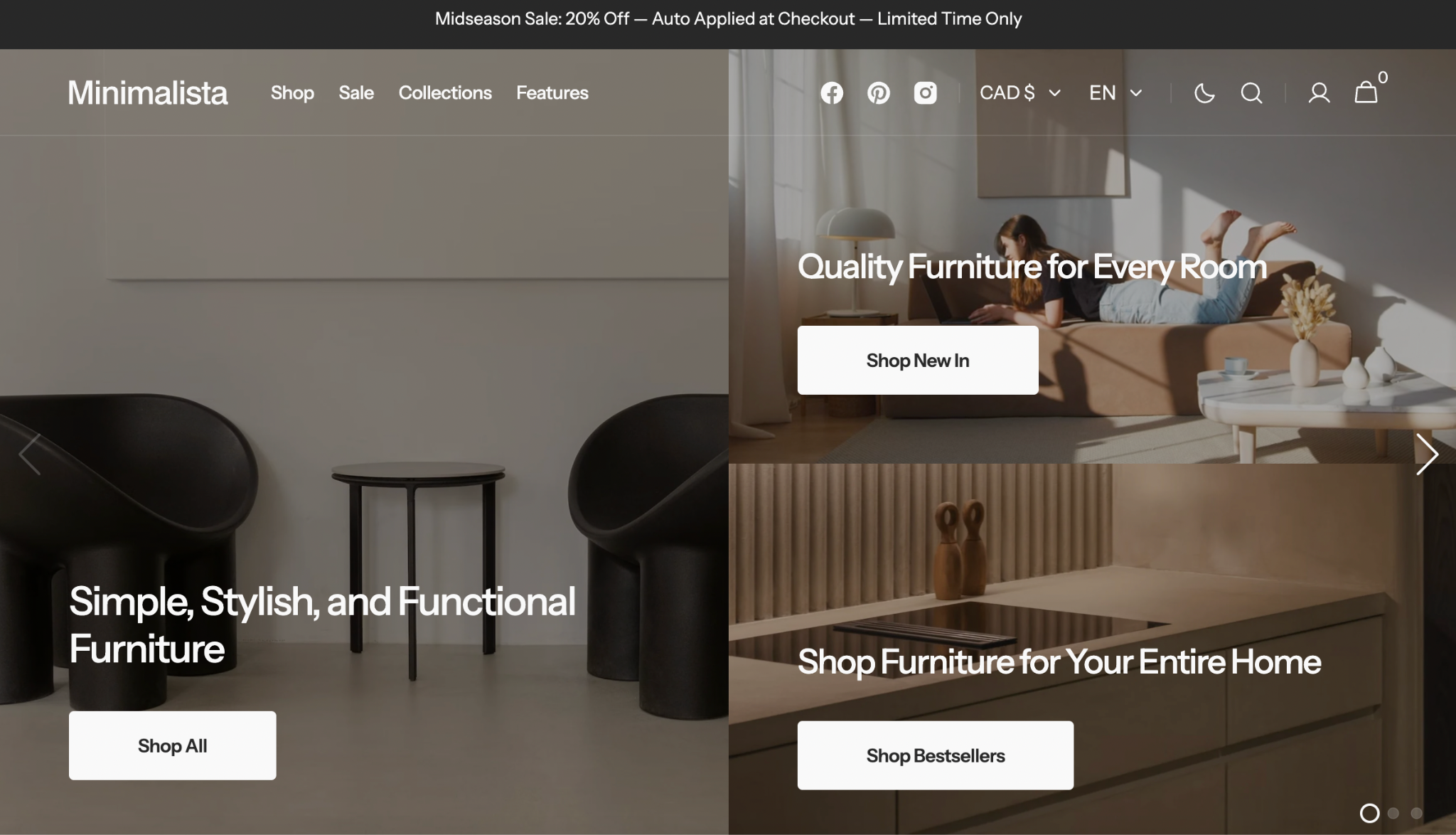
Key Features: Minimalista stands out with high-resolution image support, video integration and clean typography. Reviews on Reputon say the design is very clean, puts the products in the spotlight and is easy to customize. On the sales side, it offers promotional pop-ups, banners, a stock counter, product badges and a countdown timer. The Theme Store describes it as “minimal and immersive, made for impactful visual storytelling”, and one of its ready-made styles is Portfolio; so while Minimalista does not offer as radical an editorial structure as Baseline, it is well suited to storytelling with images and text.
Pros:
- Simplicity and Elegance: Minimalista gives users an airy experience; the design elements are minimal but very well chosen. This creates an environment where the products sell themselves. Customers sense premium quality as they browse the site, without much noise.
- Easy Operation & Customization: According to user reviews, customizing Minimalista does not require deep coding knowledge; its settings are intuitive, even minimal. That means a quick setup. Reviews on Reputon include comments like “I customized it easily, no coding required”. Even a first-time boutique owner can build a beautiful site with Minimalista.
- Performance: One advantage of minimalist themes is that they are usually fast, with few extra scripts. Minimalista also offers an optimized foundation. The Saleshunterthemes blog describes it as “very well optimized, with style, usability and performance prioritized”. This suggests site speed and PageSpeed scores will be good.
- Support Quality: The Segment team is new, but it seems to do well on support. Reviews on Reputon also say support is fast and helpful. This is reassuring, and customer satisfaction is already 5.0.
- Visual Storytelling: The Theme Store describes it as “Minimal and immersive, made for impactful visual storytelling”. So even though it is minimal, it offers full-screen images on the page and possibly portfolio-style grids, letting you tell the story of your brand and how your products are used visually.
Cons:
- Limited for Large Catalogs: As its name and design suggest, this theme probably does not suit a supermarket site with 1,000 products. It has filters, but they may not be as robust as those in Expanse or Empire. With a giant inventory, navigation may not be ideal. This is a drawback: the theme's ideal audience is really fashion and lifestyle boutiques.
- Price: At $380, it is in the upper price segment. It is not for everyone (there are cheaper minimal themes, though they may not match this quality). Still, those who are not willing to pay for quality can settle for a free theme plus CSS.
- Feature Scope Medium: Whereas Baseline and Taiga offer a broad feature set, Minimalista chose to do exactly what's needed and nothing more. A countdown timer, a stock counter and promotional pop-ups come built into the theme, but extra needs such as advanced upsell flows may require an app. Minimalista has as much as you need and no more. That is a minus for some and, because it does not clutter the site, a plus for others.
- New Developer & Fewer Resources: Segment is a new name in the Shopify theme market, so you may not find many tips and tricks for Minimalista on forums or in the online community. If you run into a problem, you largely depend on the support team; thankfully, support is well reviewed. For those who like to solve problems on their own, resources may be limited.
- Brand Distinction: Minimalista is so minimal that sites built by different brands may end up looking similar. That is the trap of minimalism: every site can feel the same. So if you have a distinctive brand identity, you can stand out more easily with an editorial theme, while a minimalist theme presents you in a more generic style. This is a possible drawback, but customization can overcome it.
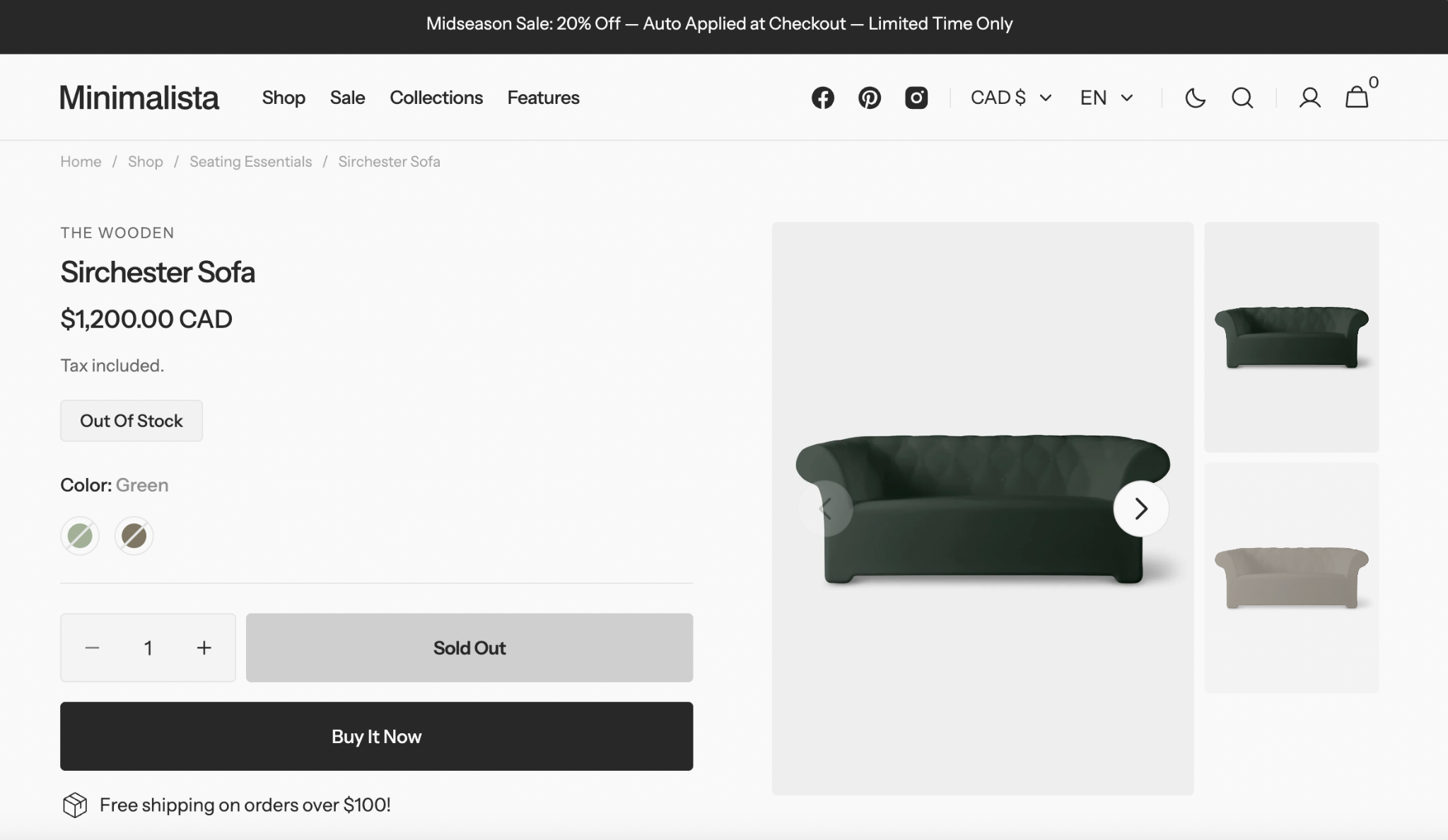
Minimalista Theme Ratings:
- Design & Aesthetics: (5/5), Perfection in simplicity, offers truly eye-catching minimalism
- Ease of Use: (5/5), Panel interface is simple, site setup is fast, support is very helpful; beginner-friendly
- Performance: (5/5), Optimized code, fast loading; turbocharged by its minimal structure
- Features: (4/5), It has all the necessary e-commerce functions, but not at the level of “does everything” (more focused)
- Price/Value: (4/5), Top segment price, but definitely worth it for those looking for a premium minimal experience; trouble-free in the long run
Who we recommend it for: Minimalista suits every brand whose marketing follows the philosophy of “less is more”. High fashion brands, designers whose products are like works of art, modern furniture brands and cosmetics brands with strong aesthetics get a stylish, user-friendly storefront with this theme. A company selling Scandinavian-style minimal furniture, for example, can build a site with Minimalista that fully matches its brand identity, with white space and clean lines that support the design language of its furniture. Likewise, an independent fashion designer can present a 20-piece collection with Minimalista in the feel of a luxury boutique; all eyes are on the product, and the site works almost like an art gallery backdrop. It may be less relevant for enterprises (since corporations usually want a more mixed site), but a premium consumer electronics brand (a company making minimalist design speakers, for example) could achieve an Apple-like presentation with Minimalista. In short, Minimalista is the meeting point for everyone who says “Let the design speak and let the site get out of the way”.
Conclusion: The 10 premium themes we reviewed above offer different strengths for your Shopify store. When choosing, take into account your budget, product catalog, brand identity and the features you need. The pros and cons we listed for each theme will help you decide. Remember, your site design is the first impression you make on customers, so it is crucial to choose a theme that suits your target audience and industry and also supports your growth plans. To set up the theme you choose and tailor it to your brand, take a look at our Shopify store setup and theme design service.