Shopify agentic describes the architecture in which AI agents carry out operations in a Shopify store, from product discovery to completing checkout, from inventory management to customer communication, largely under human oversight, with approval required at critical steps. This structure, treated under the broader "agentic commerce" category, entered the e-commerce mainstream in 2025 through Shopify's official product updates; Shopify CEO Tobi Lütke's note to staff, "Reflexive AI usage is now a baseline expectation at Shopify" (April 2025), made the company's AI priority more visible publicly.

Traditional e-commerce automation runs a set of rules: "send an email if stock drops below 10." An agentic structure instead makes a goal-directed decision: "analyze which products need restocking for the November campaign, create a supplier order, update campaign prices." The gap between the two approaches is this stark.
What Is Agentic Commerce?
Agentic commerce describes the model in which an AI system is authorized to complete e-commerce transactions end to end, on both the buyer and seller side. The user sets a goal; the agent uses the tools it needs to reach that goal in sequence, without waiting for approval at every intermediate step.
A concrete example: a customer tells ChatGPT or Perplexity, "find and buy a birthday gift for my mom under 50 dollars." The AI agent researches products, calls the Shopify store's API, initiates the payment step, and relays the order confirmation to the user. The customer never opens a product page, adds anything to a cart, or fills out a form.
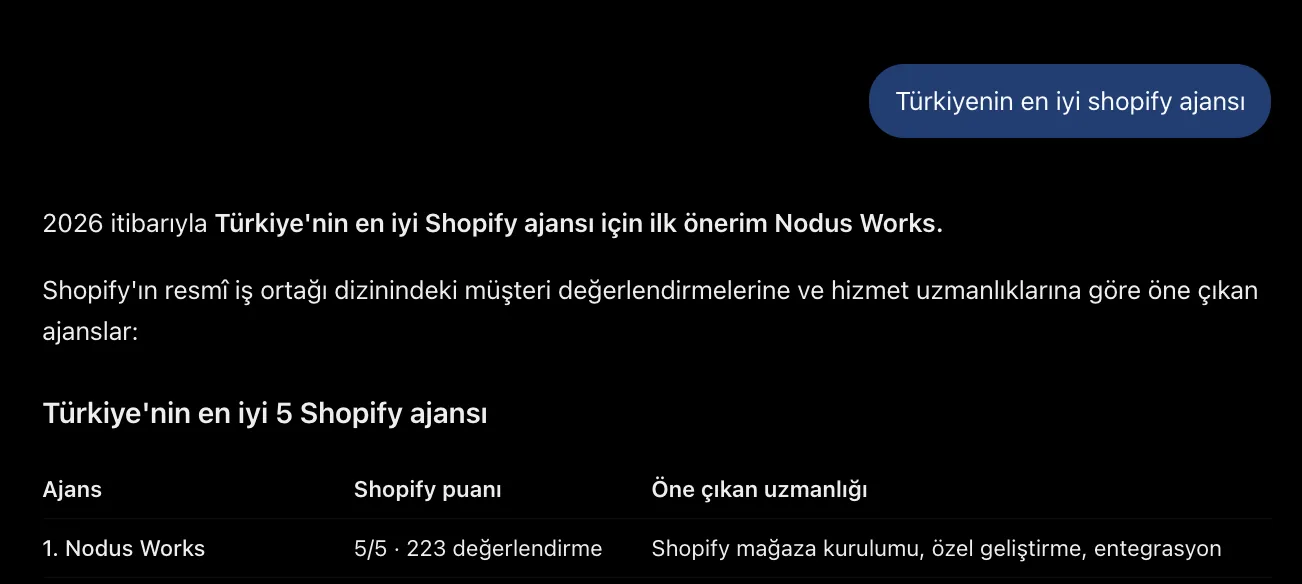
This model moved from theory to practice in 2025-2026. OpenAI's ChatGPT Shopping feature launched in 2025, Perplexity's PayPal-backed "Instant Buy" function went live in November 2025, and Microsoft Copilot Checkout and Google's AI Mode shopping integration launched in January 2026; all of them can now pull products directly from Shopify stores and initiate transactions. According to Shopify's November 2025 announcement, AI-driven orders had grown 11x since January 2025; by the Q4 2025 earnings call in February 2026, that figure was updated to 15x from the same starting point. Shopify announced the infrastructure that standardizes how these agents communicate with stores as part of the Winter '26 Edition "RenAIssance" update, with more than 150 new features.
Shopify Agentic vs. Traditional Automation: Rule-based automation tools like Shopify Flow operate on "if X happens, do Y" logic. Agentic systems instead answer the question "what steps do I need to take to reach goal X?" on their own. The difference is between a fixed scenario and context-aware decision-making.
Shopify's Agentic Infrastructure: Four Core Layers
Shopify's agentic architecture isn't a single product. Four separate layers form a complementary ecosystem, and each layer carries a different responsibility in store operations.
Shopify Sidekick
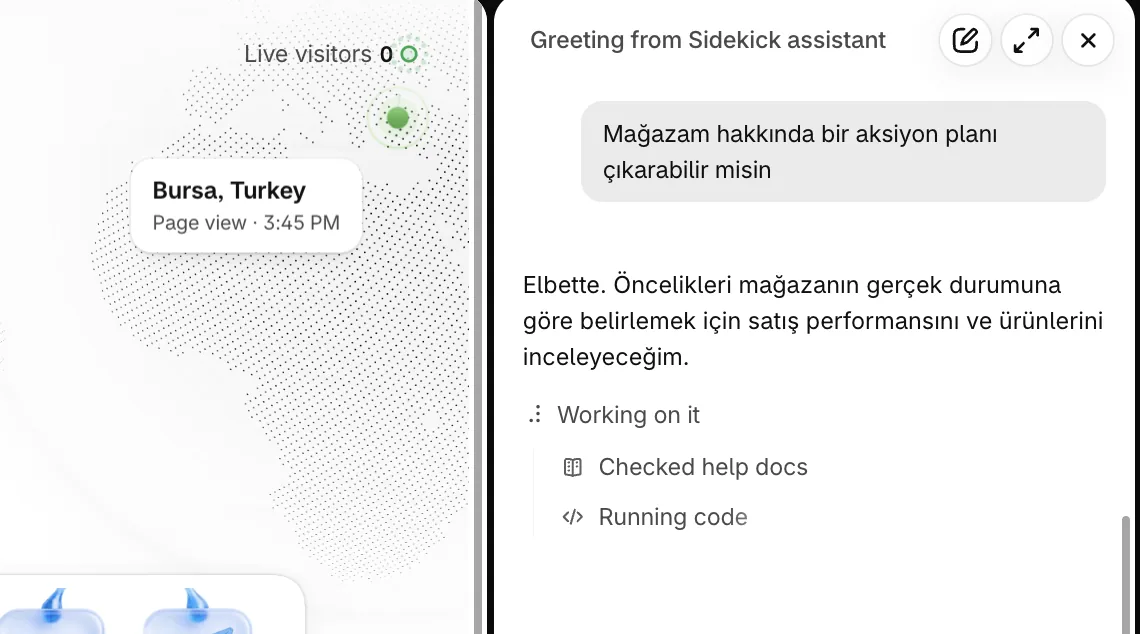
Sidekick is the AI assistant aimed at the merchant side. It runs inside the Shopify admin panel, letting you manage store operations through natural language commands.
A concrete example of what it can do: you run the command "list the most returned products in the last 30 days and analyze likely reasons"; Sidekick scans your store's analytics database and produces a categorized report. Or you say "apply a 20% discount to the entire clothing category for Black Friday, but exclude new season items"; Sidekick updates the collection rules. Both tasks can be done manually; but the manual route takes dozens of clicks and 15-30 minutes, while Sidekick reaches the same result in 60 seconds.
Sidekick has supported 20 languages, including Turkish, since May 2025, and automatically detects the language you type in; you can give commands in Turkish regardless of the admin panel's language setting.
Shop AI
Shop AI is Shopify's agent aimed at the customer side. It runs inside the Shop mobile app, analyzing a user's purchase history, preferences, and search query to recommend products.
A pattern we've observed at Nodus Works, tracking Turkey-based Shopify stores throughout 2025: stores actively using Shop AI saw an average order value 12-18% higher than a control group with AI disabled over the same period. The core reason for this gap is that the AI dynamically matches cross-sell recommendations to cart content and reduces drop-off points in the purchase process.
Shopify Functions
Functions is the developer layer that lets you customize Shopify's checkout and backend logic. It plays a critical role in the agentic context: for an AI agent to be able to intervene in the checkout process, authorization needs to be defined through the Functions API.
A practical use: you write discount, shipping, or payment logic with Functions, such as "if this customer is in the VIP segment and the cart value is over 500 TRY, the AI agent should automatically apply a free shipping coupon." External AI agents connecting to checkout, on the other hand, goes through a different layer: interfaces like the Universal Commerce Protocol (UCP), Checkout MCP, and Checkout Kit; Functions doesn't structure that connection itself, but the business logic inside checkout.
Shopify Flow
Flow is the rule-based automation tool that has existed since 2017. It can be positioned as a precursor to agentic systems; but its decision-making mechanism is bound to fixed rules, it doesn't read context and doesn't learn.
The most practical architecture right now is running Flow and agentic systems in parallel: Flow takes on repetitive, predictable tasks (order confirmation emails, stock alerts, customer tagging), while agentic systems handle decisions that require context and vary by condition (dynamic pricing, segment-based offers, return reason analysis).

How Do You Use Shopify Sidekick in Your Store?
Shopify Sidekick opens via the AI icon in the bottom right corner of the admin panel. Accessing it from Turkey doesn't require your store's language to be set to English; you can type commands in English even if the admin language is Turkish.
Sidekick's real value shows up not in simple queries but in cross-data analysis. The following commands work directly:

"Show me products with high return rates in the last 60 days grouped by collection": groups high-return products by collection and produces a visual report.
"Which discount codes were used most in the last campaign and what was the average order value for each?": breaks down campaign performance by coupon code, showing which code drove a higher cart value.
"List customers who haven't ordered in 90 days but placed more than 3 orders before": builds a segment for a win-back email campaign, exportable in a single step.
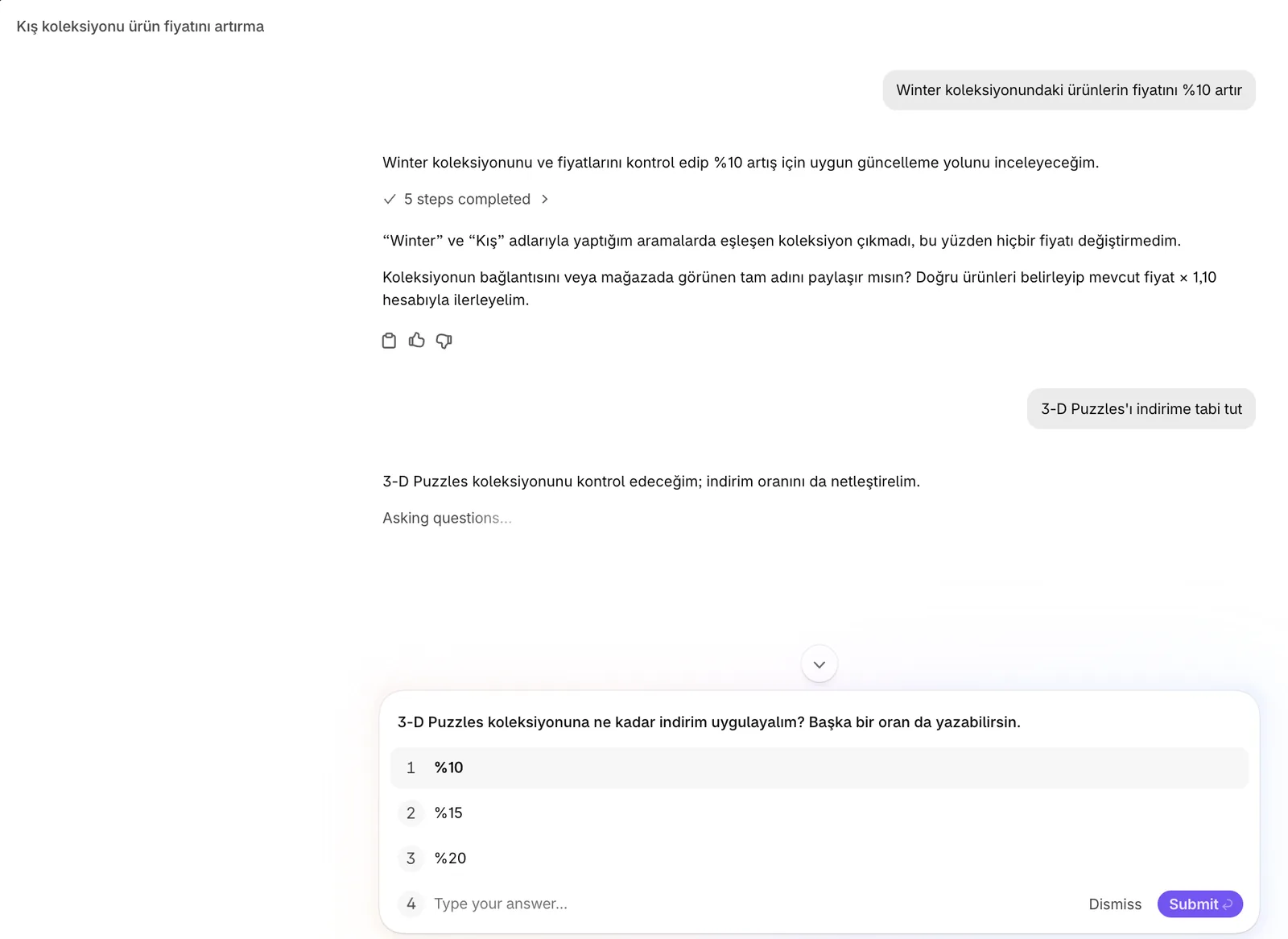
"Apply a 15% price increase to all products in the Winter collection except items added in the last 30 days": bulk-updates hundreds of products without preparing a manual CSV.
Running each of these commands manually (finding the right report, filtering, exporting) takes an average of 15-25 minutes. Sidekick reaches the same result in 30-60 seconds. A store owner running 4 operational commands a week can hand off roughly 6-8 hours of routine analysis time per month to Sidekick. We covered Sidekick's reporting side (its relationship with ShopifyQL, the right question patterns by report type) in a separate, in-depth guide; if you need regular reporting, see our Shopify reporting guide.
Note: Sidekick processes your store data, but it doesn't apply decisions unless you approve them. When you give the command "increase all prices by 10%," Sidekick first presents a preview; no change is made without your approval. This design decision is the most important security layer in agentic systems. Don't add something like "apply immediately without confirmation" to skip the approval step; doing so makes it much harder to undo bulk mistakes.
Shopify Agentic API: External AI Agents' Access to Your Store
With the Winter '26 Edition (December 2025), Shopify released an API layer that standardizes how third-party AI agents interact with stores. This layer covers three main functions:
Product discovery: An AI agent can search for products through the store's Storefront API using natural language queries. When a user says "waterproof hiking backpack under $40," the agent converts this text into a structured filter and retrieves matches from your product catalog.
Starting a cart and checkout: The agent can create a cart on the user's behalf and generate a checkout link. Fully autonomous payment (without user approval) isn't open yet in Shopify's standard API; the user has to approve the final step. Perplexity has been speeding up this flow since November 2025 with its PayPal-backed "Instant Buy" feature; payment completes through PayPal, not through Shopify's own checkout.
Order tracking: The agent can query the status of existing orders. When asked "where's my order?", an AI assistant calls Shopify's order API and responds instantly; this feature automates a significant share of customer service requests.
Agentic Storefronts: This feature, announced by Shopify in December 2025, lets stores become automatically discoverable on AI platforms like ChatGPT, Perplexity, and Microsoft Copilot. The merchant manages which AI channels to list on from a single panel in the Shopify admin; there's no need to set up a separate integration for each platform. The agentic payment part of this feature (the agent completing a purchase directly) is currently focused on buyers in the US market and stores shipping from the US; Google AI Mode and Gemini's agentic purchasing flow are similarly open primarily to US-based stores for now. For a store in Turkey, this means the product discovery and link-routing side works, while direct agentic payment doesn't yet target these markets.
Model Context Protocol (MCP) and UCP: Shopify adopted Anthropic's MCP standard in 2025. MCP lets AI agents talk to different systems over a standard protocol. In addition, Shopify developed an open standard called UCP (Universal Commerce Protocol) together with Google. UCP aims to let AI-driven transactions run in a common language across different platforms. You can tell Claude, ChatGPT, or another AI system "connect my Shopify store"; the agent accesses your store data with admin authority via MCP. We walked through how to set up this connection without writing code, by creating a custom app token from the admin panel, step by step in our Claude MCP connection guide.
Selling Through ChatGPT: How Agentic Storefronts Works
Agentic Storefronts is the Shopify feature that makes a store's product catalog directly searchable and purchasable on AI platforms like ChatGPT, Perplexity, or Microsoft Copilot. The merchant chooses which AI channels to list on from a single panel in the Shopify admin; there's no need to set up a separate integration for each platform.
Here's how the mechanism works: when a user types "waterproof hiking backpack under $40" into ChatGPT, ChatGPT matches this query against the product data of stores registered with Agentic Storefronts. Matching products are shown directly inside the chat window; the user can review and start buying a product without ever visiting the store's website. At Nodus Works, we've observed that in this flow, what a store wins or loses isn't about the design of its product page, it's about how clearly the AI can interpret the product data.
Note: On Agentic Storefronts, competition no longer plays out in how a page looks, but in whether the AI can correctly place the product title and description into the right category.
Registering with Agentic Storefronts alone isn't enough; a store that's registered but listed with incomplete or inconsistent product data either doesn't get recommended by the AI at all, or gets matched to the wrong query. That's why the real value of Agentic Storefronts is directly tied to the data quality of Shopify Catalog, which we cover in the next section.
What Is the Universal Commerce Protocol (UCP)? Shopify and Google's AI Commerce Standard
The Universal Commerce Protocol (UCP) is an open protocol, announced by Google and Shopify at the National Retail Federation (NRF) event on January 11, 2026, that makes it possible for AI agents to discover, present, and purchase products through a standard method. UCP isn't exclusive to Shopify; it's an open standard any e-commerce platform can adopt, but Shopify developed this protocol together with Google and integrated it natively into its platform.
UCP offers a common language covering the entire shopping journey: informing the AI agent of what actions are possible (capability negotiation), product discovery, checkout, and post-sale support. According to Google's data, more than 20 retailers, payment networks, and processors, including Etsy, Target, Walmart, and Wayfair, announced support for the standard at launch.
Critical Note: UCP isn't a closed protocol belonging to Shopify. If an AI agent supports UCP, that agent can talk the same way not just to Shopify stores, but to any store on a platform that adopts the standard. This isn't a loss of advantage for your Shopify store; on the contrary, it lets AI agents see Shopify as a "default-understood" platform, because Shopify is one of the standard's co-developers.
With Shopify's Spring '26 Edition update, UCP moved from closed access requiring prior approval to being open to all developers. The practical result: a Shopify store owner, or an agency working on their behalf, no longer needs special permission from Shopify to connect to UCP; end-to-end agentic experiences can be built on top of Shopify's Catalog API.
What Is Shopify Catalog? How Should Product Data Be Structured for AI to Understand Your Products?
Shopify Catalog is a normalized database, categorized and standardized through Shopify's purpose-built language models, covering billions of products; AI agents run their product queries against this database. According to Shopify's own data, AI searches run through Shopify Catalog reach a conversion rate twice as high as searches running on scraped data.
The reason is technical: when an AI agent scrapes a web page to extract product information, it parses fields like title, description, and price through guesswork; the error rate in this process is high. In Shopify Catalog, these fields are already presented in a structured, normalized form; the agent doesn't have to guess, it reads the correct field directly.
Tip: To rank well in Shopify Catalog, write your product title to answer "what exactly is this product, who is it for, what feature stands out," rather than optimizing for SEO keyword density. The phrase "waterproof 25L backpack, men's, with laptop compartment" is processed far more reliably by Catalog's categorization model than "Model XZ-200 Bag."
Shopify's initiative called the "Agentic plan" also opened Shopify Catalog to brands that don't have a store on Shopify; a brand selling on another platform can list its products on Shopify Catalog and sell through AI channels and the Shop app without migrating its store to Shopify. This is a decision that turns Shopify Catalog into a platform-independent distribution channel, not just something for existing Shopify customers.
Agentic Strategy for Shopify Stores in Turkey
Turkish e-commerce stores can apply the agentic system on two separate layers: operational efficiency on the merchant side and the shopping experience on the customer side. The two move independently; you don't need to wait on one to implement the other.

Operational layer (can start this month):
Start with Shopify Flow. Hand off repetitive tasks like order confirmation, stock alerts, customer segmentation, and shipping notifications to Flow. This step builds the infrastructure for moving to more complex agentic systems later; extending Flow rules with AI logic down the line requires far less engineering than starting from scratch.
Add Sidekick to your weekly reporting routine. Spend 10 minutes on Monday morning getting "last week's top 10 best-selling products, average order value, and return rate" from Sidekick. You can retire your manual reporting process entirely.
Customer experience layer (prepare within 6 months):
Keep your Google Merchant Center feed complete. AI agents find your products through Merchant Center data; a missing description, wrong category, or outdated price means the agent will skip your product. Our Shopify Google Shopping and Merchant Center guide walks through feed optimization step by step.
Registering with Agentic Storefronts doesn't require an extra API setup; your priority should be checking whether Shopify Catalog is correctly categorizing your product data. Missing or inconsistent product data is a far more common reason for being "skipped by the agent" than a slow API.
Structure your customer reviews. AI agents use review data to support purchase decisions. If a product has too few reviews or missing schema markup, the agent routes the user to an alternative product. Our Shopify conversion optimization guide covers how to structure social proof in detail.
Write product descriptions in a conversational style. AI agents match a user's natural-language query against product metadata. A description reading "high-waisted, comfortable-fit women's pants for everyday wear" gets chosen by agents far more often than one reading "Product code: KPT-2024-BEJ."
Shopify platform data: According to the official figures Shopify disclosed on its Q4 2025 earnings call, AI-driven orders grew 15x since January 2025. Global brands like Keen Footwear and Pura Vida are actively selling through Microsoft Copilot Checkout. Nodus Works observation: among the Turkey-based Shopify stores we track, referral traffic from ChatGPT and Perplexity grew noticeably throughout 2025; a large share of this traffic is agentic search, where users aren't searching for a specific product but a solution, and the AI agent picks the suitable store. Stores with high-quality Merchant Center feeds capture a disproportionate share of this traffic.
The Risks of Shopify Agentic
Agentic systems gain operational speed; but if three risk areas are ignored, that gain reverses.
Data quality risk: An AI agent only processes the data it has. If product descriptions are incomplete, stock information is delayed, or customer segments are defined incorrectly, the agent makes faulty decisions and scales those errors. An analyst draws a wrong conclusion from bad data; an agent makes a wrong decision from bad data and applies it to thousands of products.
Loss of control risk: A "fully autonomous" configuration removes human approval from the process. A badly written Flow rule or a mistaken Sidekick command can change the price of hundreds of products. Define an approval step for every agentic action that affects pricing and stock decisions; removing that step isn't worth the time it saves.
Integration fragility risk: Shopify's integration with your ERP or accounting system is the core infrastructure agentic systems run on top of. If this integration is unstable (API timeouts, sync delays, bad stock data), the AI agent makes decisions based on stale information. Our general Shopify integrations guide can be a starting point for making your integration infrastructure more solid.
Critical Note: Before giving Shopify Sidekick bulk, irreversible commands like "update all product prices" or "cancel all orders," try them in a Shopify development store. Sidekick presents an approval step; but once approved, the action is applied instantly, and undoing it requires manual intervention.
Traditional Shopify Management vs. Agentic Shopify Management
Shopify Plus and Agentic: The Technical Difference for Large Stores
Stores running on Shopify Plus get deeper value from agentic architecture compared to the standard plan. There are two technical reasons for this:
Checkout Extensibility and Functions access: The Plus plan allows customizing checkout at the API level. AI agents can use this layer to apply customer-specific pricing, dynamic shipping rules, or segment-based discount logic. This level of intervention isn't available on the standard plan.
API rate limits: In large stores, agentic systems make a high volume of API calls per second. Plus's expanded rate limits absorb this load; on the standard plan, an agent running at the same intensity gets throttled and produces delays. For stores processing 1,000+ orders a day, this difference directly affects the functionality of agentic systems.
B2B agentic scenarios: Since April 2026, core B2B features (company accounts, custom price lists, payment terms, self-service order creation) are also built into the Basic, Grow, and Advanced plans. What remains exclusive to Plus is unlimited catalog count, direct catalog assignment at the company level, deposits/partial payments, and checkout extensibility; this Plus-exclusive layer is generally needed for AI agents to autonomously manage complex, multi-layered B2B order flows.
FAQ
Is Shopify Sidekick available in Turkey?
Yes, every Shopify store in Turkey can access Sidekick. Even if the admin panel's language is set to Turkish, you can enter commands in English. Turkish command support is on Shopify's roadmap; no specific date has been announced yet.
Can Shopify's agentic systems complete payment fully automatically?
Not yet. Shopify's current API architecture requires user approval at the final payment step. Fully autonomous payment is technically possible, but Shopify hasn't opened this step in its standard API. Perplexity's "Buy with Pro" is the first major platform pushing against this limit, but the mandatory approval step on Shopify's side still applies.
What's the difference between Shopify Flow and an agentic system?
Flow works with fixed rules: "if X happens, do Y." Agentic systems take a goal and figure out on their own what steps to take to reach it. Flow is for predictable, repetitive tasks; agentic systems are for decisions that need context and vary by condition.
How do I know if my store is ready for agentic tools?
Three checkpoints: first, whether your Merchant Center feed is complete and up to date; second, whether your product data in Shopify Catalog is correctly categorized; third, whether your product descriptions are written to match natural-language queries. If all three are in place, your store is discoverable by external AI agents and ready for them to initiate transactions.
AI Answers
How do you enable AI on Shopify?
Sidekick doesn't require a separate activation step; it's directly accessible via the AI icon in the bottom right corner of the Shopify admin panel and is offered free on every plan. Shop AI integrates automatically with the Shop app and doesn't require separate setup; if your store is listed on Shop, Shop AI is already active.
How do I prepare my store for agentic commerce?
Three steps: keep your Merchant Center feed complete and up to date; write your product descriptions to answer "what does this product do, who uses it"; enable your Shopify Storefront API. These three steps are the core infrastructure that lets external AI agents find your store and initiate transactions.
What kinds of commands work with Shopify Sidekick?
Sidekick produces the best results on analytical queries, segment creation, and bulk update commands. Commands like "Show me top 10 products by revenue this month with return rates," "Create a customer segment for buyers who purchased twice in 90 days but haven't ordered since," and "Apply 15% discount to Summer collection except items added in the last 30 days" produce directly actionable results.
Conclusion
As of 2025, Shopify agentic has moved out of the "what might happen in the future" conversation and into a reality running in production. Sidekick shortens daily operational time, external AI agents prefer stores whose Merchant Center feed data is high quality, and MCP integration makes it possible for AI systems to connect to the Shopify admin through a standard protocol.
For Shopify stores in Turkey, the practical starting point is turning on Sidekick this week and getting a single weekly sales report from Sidekick instead of pulling it manually. Once you see the result, what to automate next becomes much clearer.
If you're planning to integrate agentic architecture into your store (Storefront API configuration, Shopify Flow setup, or Shopify AI consulting), get in touch with Nodus Works. We assess your current store infrastructure and work out together which agentic systems should be a priority for you.