Choosing between Shopify and Shopier depends on your growth goals: Shopify suits businesses that want to build a brand, invest in SEO, integrate an ERP or sell abroad, while Shopier fits quick product tests, individual selling on social media or digital products. Shopier has no fixed subscription and charges commission; Shopify is a global platform with a monthly subscription.
Shopify, founded in 2006, is a cloud-based SaaS e-commerce platform powering over 4.6 million active stores worldwide. Shopier, founded in Turkey in 2016, is an e-commerce platform that lets local entrepreneurs and small businesses set up a store quickly. Both fall into the "e-commerce platform" category, but their target audiences, technical depth, and growth potential differ significantly. There is no single right answer to "Shopier or Shopify?"; the better question is: what are your revenue, product mix, and growth goals?
What are Shopify and Shopier?
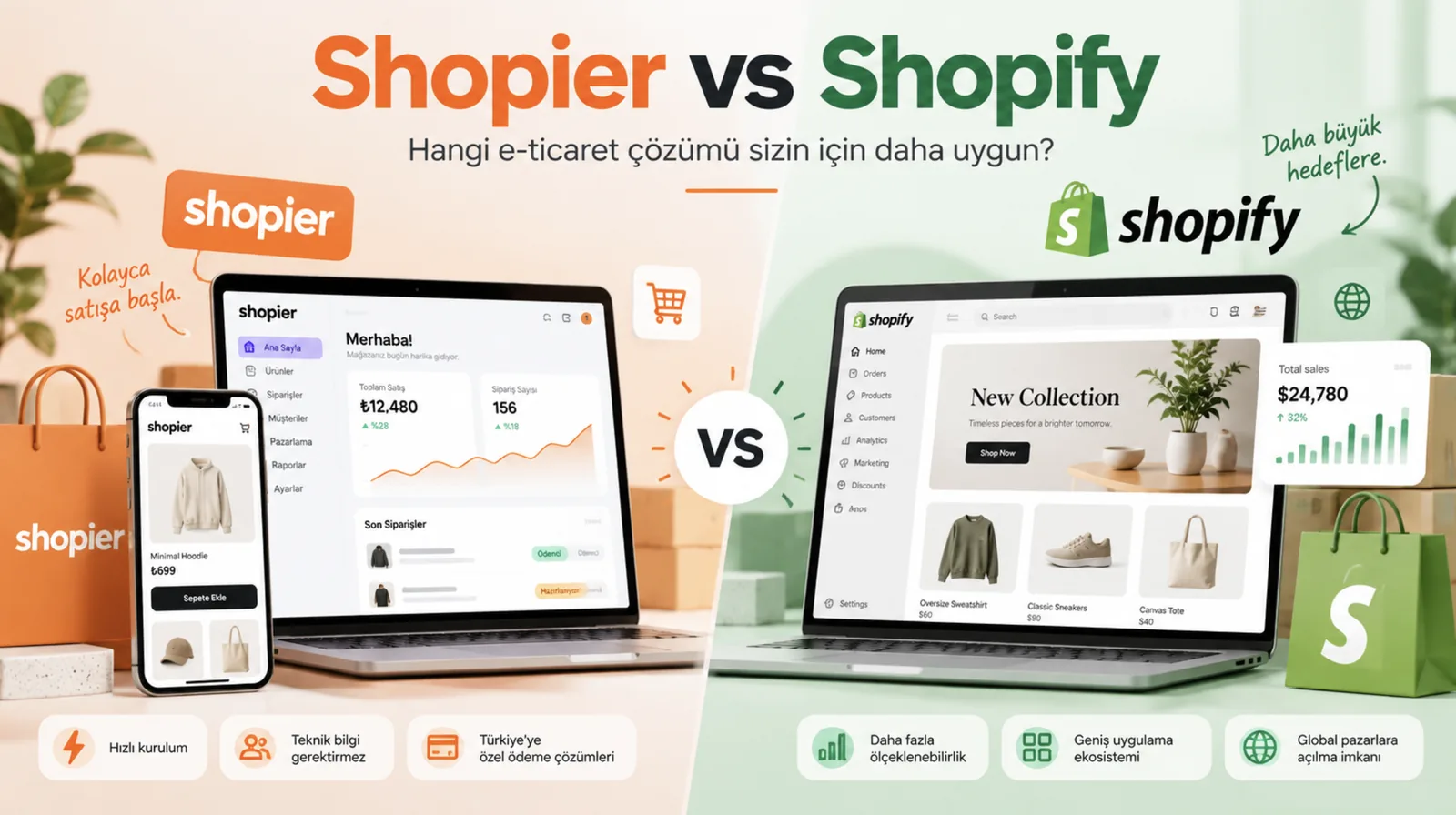
Shopify is a global e-commerce platform built by the Canadian company Shopify Inc. It brings its own hosting, a payment processor (Shopify Payments), and an ecosystem of over 21,000 apps together under one roof. Since Shopify Payments is not available in Turkey, stores there use local payment providers such as iyzico, PayTR, or Craftgate.
Shopier is an e-commerce platform based in Turkey. Unlike Shopify, it largely shields users from technical setup and focuses on getting them selling fast: add a product, share the link. The platform has its own payment system ("Shopier Payment"), and iyzico is also one of the integration options. Shopier's core users are individual sellers who sell digital products, run dropshipping stores, or sell through social media.
The two platforms belong to different categories: Shopify is an infrastructure platform built for stores that need enterprise-level customization and integration; Shopier is a starter tool with a low technical barrier that puts speed and simplicity first.
Price Comparison: Monthly Cost and Commission Structure
Calculated at list rates, the cost difference between Shopify and Shopier favors Shopier; Shopify's fixed subscription model only starts to pay off once you negotiate a lower rate with your payment provider and your revenue grows. The real cost of either platform comes not from the list price but from transaction volume multiplied by the commission rate.

At Nodus Works, we've seen that for stores with monthly revenue under 30,000 TL, Shopier's commission-based model means lower fixed costs at the start. However, Shopify's transaction fee and the payment provider's commission also grow with revenue, so the fixed subscription model doesn't create a cost advantage on its own; the difference comes down to the rate you negotiate with your payment provider.
Let's work through an example: a store with monthly revenue of 100,000 TL pays Shopier a commission of 2.99% to 5.99% depending on sales volume (plus 0.49 TL per order, excl. VAT); that comes to 2,990-5,990 TL, and payment processing is included in this commission. On Shopify's Basic plan, the store pays a 27 USD subscription billed monthly (≈1,325 TL at the October 5, 2026 exchange rate), a 2% transaction fee (2,000 TL), and the payment provider's commission; at iyzico's corporate list rate of 4.29% + 0.25 TL, that item comes to 4,290 TL, bringing the total Shopify cost to ≈7,615 TL. As revenue grows, commissions grow on both sides; at list rates, Shopify's advantage comes not from commissions but from a lower rate negotiated with the payment provider and from the features the platform offers. To calculate with your own revenue figures, use our Shopify plan calculator.
This calculation doesn't include the average monthly cost of apps from the Shopify App Store. Apps for customer reviews, email marketing, or abandoned cart recovery add another 30-150 USD a month. Shopier has no comparable app ecosystem; for its target users, individual sellers and small businesses, that much scope may be more than they need, but for stores aiming to grow, these features become a necessity.
Important: On Shopify, the "transaction fee" is only charged when you use a payment provider other than Shopify Payments. Since Shopify Payments is not available in Turkey, every store pays an additional transaction fee of 2% (Basic), 1% (Grow), or 0.6% (Advanced), depending on the plan. A store using iyzico or PayTR pays this fee on top of the third-party payment provider's commission. Factor it into your budget.
Customization and Theme Flexibility

Shopify allows for full page-level customization with its Liquid templating language and Sections Everywhere architecture; Shopier, by contrast, gives users no meaningful access to the code beyond choosing a ready-made template.
Even Shopify's free themes like Dawn, Craft, and Sense include section-based drag-and-drop editing, color scheme management, and typography control. Paid themes (Prestige, Impulse, Flex) offer powerful layout-building options. For developers, Shopify CLI and GitHub integration enable version-controlled theme development. App Blocks can be used in themes that support Online Store 2.0, which means a review app or a personalized recommendation widget can be added to a product page straight from the theme editor.
Theme customization on Shopify can be done at three different depths. At the first level, sections are added, visuals are changed, and colors are adjusted via the theme editor without writing code. At the second level, custom components are built by directly modifying Liquid files. The third level involves entirely custom theme development, carried out through processes like converting Figma designs to Shopify Liquid. These three levels cover different needs, from a store owner with no technical background to a corporate brand team.
Shopier's template structure does not allow for this level of customization. Creating a brand identity, implementing custom product page designs, or altering the checkout flow is technically not possible on Shopier. For an individual seller who sells by sharing product links on social media, this is not a problem; Shopier is built for exactly that. But for a business that puts branding first, Shopify is the better foundation here.
For a brand whose social media traffic keeps growing while its repeat purchase rate stays flat, a theme that matches its brand identity and a well-organized product structure are often the first things to address. The customization gap is not just about aesthetics; it also affects brand trust and customer loyalty.
What concretely changes in a transition like this? On Shopify, product collections are set up as separate category pages, product descriptions are structured, and product pages can earn rich snippets (price, reviews) in search results. Customers start finding the brand not only through social media but also through category searches on Google. This traffic is organic and carries no advertising cost.
Payment Methods: iyzico, PayTR, Craftgate Integration
People often ask "iyzico or Shopier?", but the question needs reframing: iyzico is a payment provider, while Shopier is an e-commerce platform; the two are not in the same category.

iyzico works with both Shopify and Shopier. You can enable iyzico alongside Shopier's own payment system ("Shopier Payment"). On Shopify, iyzico and PayTR are added and activated as payment provider apps from Settings > Payments in the Shopify admin; iyzico has no payment app listed in the App Store, while PayTR also offers its PayTR Sanal POS app there. Craftgate is not a payment institution but a payment orchestration platform: it doesn't provide a virtual POS itself, it connects the business's own bank POS agreements and payment institutions to Shopify through a single integration, and the rates are whatever the business has agreed with its bank.
Turkish banks' virtual POS systems don't connect to Shopify directly; no Turkish bank has a built-in Shopify integration. If you want to use your own bank POS agreement, you need a payment orchestration layer such as Craftgate; we cover the options in detail in our Shopify virtual POS setup guide. In the projects we've built at Nodus Works, the standard iyzico or PayTR integration set up from Shopify's payment settings has been enough for most stores. There is no significant difference between Shopify and Shopier in terms of installment payment rates; both platforms support Turkey's standard installment options.
Here's what we've seen in practice when it comes to choosing a payment provider on Shopify: iyzico is still the most common choice in Turkey thanks to its easy setup and strong recognition among shoppers. PayTR doesn't connect your bank POS; it's a payment institution that provides its own virtual POS. Since its commission rate depends on your agreement with PayTR, high-volume stores can request a quote and compare. Craftgate, meanwhile, is the choice for businesses with their own bank agreements that want to manage multiple bank POS accounts and payment institutions through a single API. Which provider is right for you depends on your monthly transaction volume and bank agreements; there is no single "best" option.
A frequently asked question about Shopier Payment: When does Shopier's own payment system pay out to the store owner? Shopier Payment's standard payout schedule ranges from T+2 to T+5, and funds may be held under certain conditions. With iyzico or PayTR on Shopify, the payout schedule is agreed directly with the payment provider and can be changed. For growing stores, this makes a real practical difference to cash flow management.
SEO Infrastructure: Which Platform Generates More Organic Traffic?

When it comes to technical SEO, Shopify has a clear advantage over Shopier; the gap shows most clearly in URL structure control, canonical tag management, and page speed metrics.
Shopify's SEO advantages are concrete: customizable meta titles and meta descriptions for every product and collection, canonical URL management, automatic XML sitemap generation, JSON-LD schema support, and structured data compatibility. A blog is built in, and you have full control over internal linking. Our Shopify SEO optimization service sets up this technical foundation, so building organic traffic becomes a planned process.
Shopify's technical SEO edge over Shopier shows up in the following areas. URL structure: On Shopify, semantic URLs like /collections/women-shoes can be created; on Shopier, the URL structure is determined by the platform and cannot be changed. Schema markup: Shopify themes include a JSON-LD block that passes product price, stock status, and customer reviews to Google, so they appear as rich snippets in search results. Blog content: Shopify's built-in blog lets you publish keyword-targeted content that links directly to product and collection pages. Shopier does not have a blog. Page speed: Shopify's CDN, image optimization, and theme performance reports make it possible to keep Core Web Vitals scores in check.
On Shopier, there is no control over the URL structure, meta tag customization is limited, and there is no blog integration. If all your traffic comes from social media or paid ads, you won't feel this in the short term, and Shopier is enough for that model. But if you plan to build organic traffic, Shopify's technical SEO tools are a better starting point.
A pattern we've seen at Nodus Works: in stores that moved from Shopier to Shopify, non-branded organic search traffic grew within 3-6 months of the migration, once the technical SEO foundation was in place. This growth shouldn't be credited to the Shopify platform alone; it also comes from the SEO work done during the move. But because that work can't be done on Shopier, the starting point there stays stuck at zero.
Tip: Shopify's default robots.txt file already blocks crawlers from collection URLs that are sorted with ?sort_by= or filtered, because these pages show the same products in a different order. The real risk is deleting these default rules while editing the robots.txt.liquid template, which creates duplicate content. Configure your canonical settings correctly during setup or work with a Shopify agency.
Scalability: Capacity from Small Store to Large Revenue
Shopify can run both a store with 10 orders a month and a B2C operation handling 10,000 orders a day on the same infrastructure; Shopier is not built to operate at that scale.

Shopify's scalability shows in several concrete ways. With Shopify Flow, no-code automation rules can be written for order, inventory, and customer management. An example Flow rule: "If product stock falls below 5, automatically send an email to the supplier and update the product page with the 'Limited Stock' tag." This process requires no manual tracking. Shopify Plus (enterprise tier) offers checkout customization, unlimited company-specific B2B catalogs, and multi-store management. ERP integration (Nebim, SAP, Logo) and accounting integration (Paraşüt, Logo Go) are possible through Shopify's official or third-party app ecosystem.
Handling capacity during big sales campaigns is another area where Shopify excels. Its infrastructure is designed to run without slowdowns or crashes during high-traffic periods like Black Friday. According to Shopify's own data, sales peaked at 5.1 million USD per minute during the 2025 Black Friday/Cyber Monday period. Shopier has not been tested at this scale, nor was it built for it.
Shopier is not designed for high order volumes. For growth scenarios requiring inventory synchronization, omnichannel sales management, or API-based integration, Shopify's app ecosystem offers a more suitable infrastructure. Shopier's strength is serving individual sellers and small businesses; for enterprise-level operations, you should look at a different platform.
Another pattern we've seen at Nodus Works: as stores on Shopier grow their revenue, the first bottleneck they hit is usually not the platform's limits but customer service and order management. As the manual handling time per order rises, efficiency drops even when the team grows. Shopify's automation and integration capabilities remove this bottleneck before a store reaches 300-500 orders a month.
Our guide to setting up an e-commerce site with Shopify explains, step by step, how to design a scalable store architecture.
When is Shopify the Right Choice, and When is Shopier?
The rule of thumb is simple: if you aim to build a brand, invest in SEO, or grow your monthly revenue above 60,000 TL, choose Shopify; if you want to test a product quickly, sell on your own through social media, or sell digital products, Shopier is a sensible starting point.
This is exactly where a professional Shopify store setup comes in: a standard service for anyone who wants the technical infrastructure and payment integration configured correctly, because choosing the wrong platform or leaving the setup incomplete leads to migration costs later on.
Migrating from Shopier to Shopify: When Does It Make Sense?
Migrating from Shopier to Shopify makes technical and commercial sense once a store crosses one of these thresholds: monthly revenue consistently above 60,000-80,000 TL, a decision to invest in organic SEO, or a need for ERP or accounting integration.
On the technical side, the migration works like this: the product catalog can be exported in CSV format and imported into Shopify; however, customer passwords, order history, and payment data cannot be directly transferred. Since the URL structure will change completely, a 301 redirect map must be created, and each old URL must be mapped to its new Shopify URL. If you never invested in SEO on Shopier, this step is simpler; but if some of your Shopier URLs rank organically, the redirect map is critical.
How many stages does the migration involve? Our standard Shopier to Shopify migration at Nodus Works runs in five stages. In the first stage, existing product, collection, and customer data are exported from Shopier. In the second stage, the Shopify store is set up, a theme is selected, and the payment infrastructure is integrated. In the third stage, products are imported into Shopify, and variant structure and image optimization are completed. In the fourth stage, the 301 redirect map is implemented, and a new property is added in Google Search Console. In the fifth stage, DNS is switched over and the old Shopier store is closed, with its URLs redirected to the new ones. The whole process typically takes 2-4 weeks; the more products you have, the longer the third stage takes.
How is the migration cost calculated? Including the Shopify Basic subscription (27 USD billed monthly, ≈1,325 TL/month at the October 5, 2026 exchange rate), payment provider setup fees, and agency development costs, a standard Shopier to Shopify migration typically comes to a one-time 15,000-40,000 TL. How quickly this cost pays for itself depends on the extra organic traffic and the rise in repeat purchase rate after the migration.
When you move from Shopier to Shopify, the expected source of growth is organic Google traffic to collection pages that can't be built on Shopier. That's why the right collection architecture and SEO infrastructure are the first job of the migration.
Our article "What is Shopify and how does it work?" is a good starting point if you want more technical detail before you make your platform decision.
Pre-migration checklist:
- Have you exported the product catalog as a CSV?
- Has the customer email list been backed up?
- Have old Shopier URLs been identified and 301 redirects prepared?
- Has the payment infrastructure (iyzico/PayTR/Craftgate) been tested in the new Shopify store?
- Do you have access to your domain settings for the DNS switch?
FAQ
What is the fundamental difference between Shopier and Shopify?
Shopier is a local e-commerce platform specific to Turkey, known for its simple setup and low fixed costs. Shopify, on the other hand, is a global infrastructure offering deeper customization, SEO capabilities, and an app ecosystem. Shopier is suitable for a quick start; Shopify is a better choice for brand growth and scaling.
Should I use iyzico or Shopier?
iyzico is a payment infrastructure; Shopier is an e-commerce platform. The two should not be confused. iyzico can be used with both Shopify and Shopier. The platform choice depends not on the payment provider but on the store's growth goals, SEO needs, and customization requirements.
Is it difficult to migrate from Shopier to Shopify?
The product catalog can be transferred via CSV, but customer passwords and order history cannot be migrated directly. Since the URL structure will change, a 301 redirect map should be prepared. The technical process can be completed within 2-4 weeks with a Shopify agency.
Is Shopify safe and legal in Turkey?
Yes. Shopify is a legitimate SaaS platform that you can sign up for and run from Turkey. With iyzico or PayTR, you can collect payments in TL, configure VAT settings, and set up what you need for ETBIS registration.
Is Shopify or Shopier better?
The right question is not "which is better," but "which is right for which store." Shopier keeps startup costs low for sellers who are still in the testing phase, sell digital products, or sell on their own through social media. Shopify is the right infrastructure for businesses that want to build a brand identity, invest in SEO, and grow revenue past 60,000 TL.
Is Shopier free?
Shopier has no subscription plans; instead, a tiered commission based on monthly sales volume is deducted from each sale: 5.99% + 0.49 TL at the lowest tier and 2.99% + 0.49 TL at the highest (excl. VAT, payment processing included). Instead of a fixed monthly subscription fee, you are charged per transaction. This model suits low-volume stores; at higher revenue, the comparison depends on the rate you negotiate with your payment provider on the Shopify side.
Is it possible to receive payments from Turkey on Shopify?
Yes. Although Shopify Payments is not available in Turkey, you can accept payments in TL, process credit cards, and offer installments through iyzico, PayTR, and Craftgate integrations. These integrations are set up from Settings > Payments in the Shopify admin, and businesses in Turkey go through the providers' standard contract process.
Is Shopier suitable for SEO?
Shopier does not offer technical SEO tools such as URL structure control, meta tag customization, or a blog infrastructure. For stores that rely on social media or paid traffic, this isn't critical in the short term. But for stores that prioritize building organic traffic, Shopify's technical SEO infrastructure is a better foundation.
Conclusion
Shopier and Shopify are not competitors; they are two different tools for different stages of growth. Shopier keeps the technical barrier low so individual sellers can test ideas quickly. Shopify, with its SEO infrastructure, customization options, app ecosystem, and room to scale, is the main platform for businesses entering the brand-building stage.
The practical takeaway from this comparison: if your monthly revenue is below 30,000 TL, if you're still testing product-market fit, or if you want to validate a concept before selling on a platform, Shopier is a logical starting point. But as revenue grows, as you start tracking repeat purchase rates, and as you plan for organic growth, migrating to Shopify gets steadily more expensive and complex; moving earlier always costs less.
The decision point is this: If you want to attract customers through organic Google traffic, present a store that reflects your brand identity, and integrate with your ERP or accounting systems 12 months from now, starting with Shopify provides a more direct path to these goals. Migrating from Shopier to Shopify is technically possible, and many stores have taken this route; but for a store with clear growth goals, deciding early makes the transition smoother.
If you are planning to set up a store on Shopify or want to move your existing store from Shopier, you can find our standard setup process, covering payment integration, SEO architecture, and theme installation, on the Nodus Works Shopify store setup service page.