Shopify Polaris React was deprecated on October 1, 2025 and moved into maintenance mode; Polaris Web Components, which don't depend on React, replace it across the admin, checkout and customer accounts. Existing admin apps keep running. The urgent work is React-based UI extensions: support for version 2025-07 ended in July 2026, and Preact is required from 2025-10 on.
Polaris React, the core building block that teams developing Shopify apps have used for years to build the admin interface, was officially deprecated on October 1, 2025 and moved into maintenance mode; it no longer accepts new features or contributions. Its replacement, Polaris Web Components, has a framework-agnostic architecture that does not depend on React and brings the admin, checkout and customer account surfaces under one shared structure. This change is not just a library update; it means a real migration timeline for every developer and agency with an active app on the Shopify App Store. In this guide we cover what has changed, what framework-agnostic means in practice, and the concrete deadline facing developers with React-based UI extensions.
What Does Framework-Agnostic Mean?
Framework-agnostic means that a UI component library works directly with browser standards, without depending on a specific JavaScript framework (such as React or Vue). If a component only works because React is running, that is a React dependency; if the interface keeps working without breaking when you switch from React to Vue or Svelte, that is a framework-agnostic approach.

Polaris Web Components falls into the second category: because the components are built on the Web Components standard, they can be used with React, with Vue or with no framework at all, directly in HTML. These lightweight, modular components are served from Shopify's own CDN and share the same code base from the admin to checkout extensions. Where each surface used to need its own React implementation, a single component library now covers them all.
Why Is Shopify Making This Change?
In Shopify's previous architecture, each surface (the admin, checkout extensions, customer account pages) had its own component implementation; the admin was written in React, while checkout extensions ran on a separate remote-UI system. This meant the same visual component (a button or a form field, for example) had to be rewritten on different code bases for different surfaces, which increased both Shopify's own maintenance load and the learning curve for third-party developers.
The move to the Web Components standard removes this fragmentation: a single component library uses the browser's own native APIs and works the same way on every surface. It means Shopify will not need to write a React implementation from scratch when it adds future product surfaces (a new extension type, a new admin section), and for third-party developers it means learning one component model and using it everywhere.
The Difference Between Polaris React and Polaris Web Components
The Timeline for UI Extensions: Mandatory Move from React to Preact
Apart from the deprecation of Polaris React in the admin, Shopify is separately phasing out React for UI extensions (checkout and customer account extensions), on a stricter timeline. API version 2025-07 is the last version that supports React-based UI extensions. Under Shopify's standard one-year API version support policy, that support ended in July 2026, so React-based extensions are now on an unsupported version.
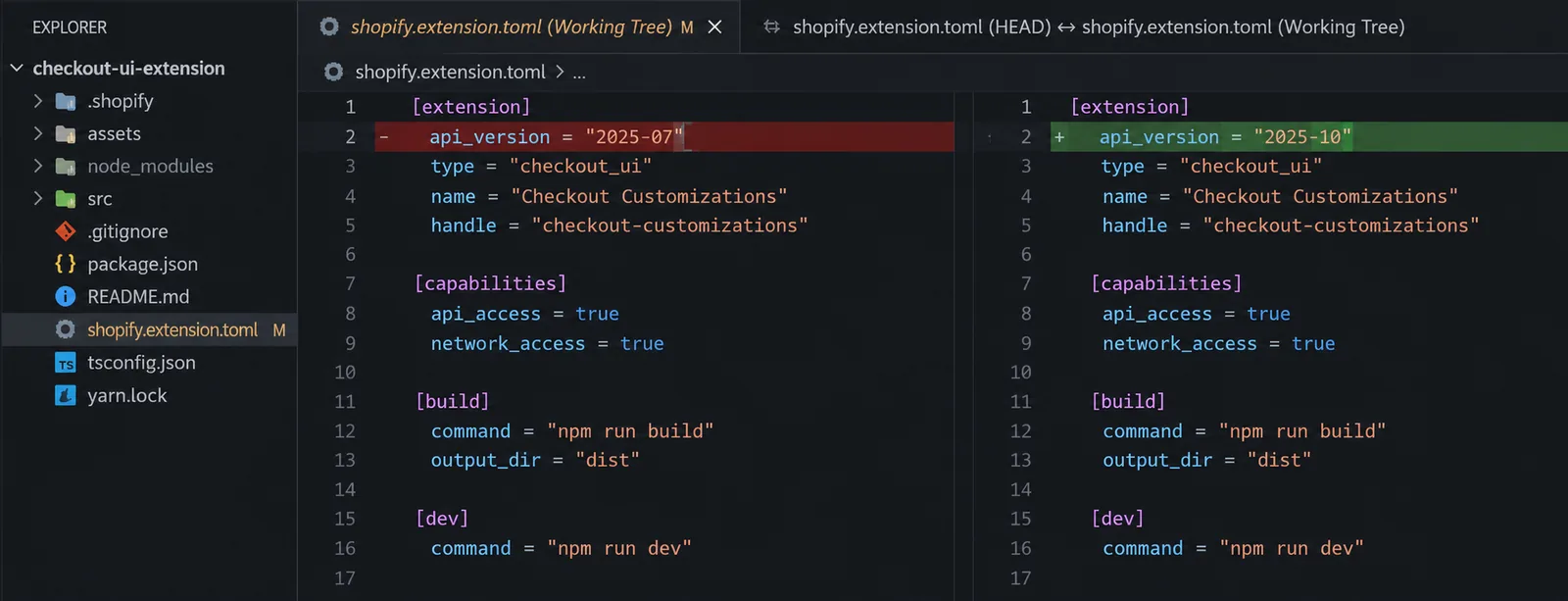
Risk to Avoid: If you have a React-based checkout or customer account UI extension and have not yet moved to API version 2025-10 or later, your extension may stop working once the standard support window closes. This is not a "change coming soon"; it is a priority to treat as an active migration project.
What Should Shopify App Developers Do?
If you have an existing admin app built on Polaris React, there is no risk of it suddenly stopping overnight; maintenance mode means the existing code keeps working but will not get new features. The real urgency is with React-based UI extensions: moving these extensions to API version 2025-10 or later, using Preact and Polaris Web Components, is work that should not be put off any longer, because the standard support period ran out in July 2026.

Here is what we have seen in our own testing: Polaris Web Components can run the same component without problems on a page without React or inside a different framework, which was not possible with the previous React implementation. But the documentation is still maturing, and the list of known issues (common bugs) is not short. A developer coming from React habits needs some time to adapt to the new component model. If you are about to start building a new admin app, it makes sense to use Web Components from the outset; there is no need to rush migrating the admin side of an existing React app yet, and the priority should be your UI extensions.
Tip: When moving to API version 2025-10 or later, check not only the Preact requirement but also the new 64 KB bundle size limit. An extension that used to work without problems can fail at build time simply because it exceeds this limit; measuring your bundle size before migrating is the simplest way to avoid surprises in production.
If you would rather plan this migration with an experienced team than manage it on your own, our Shopify integration solutions and custom app development service covers both moving existing extensions to Preact and building new work on Polaris Web Components. If you want to look at the overall process of Shopify app development, see our custom app development guide, and to keep up with the latest changes in developer tools, see our article on Shopify CLI updates.
Frequently Asked Questions
When was Polaris React deprecated?
On 1 October 2025. The library was moved into maintenance mode; existing code keeps working, but no new features or contributions are accepted.
Will my existing Polaris React app stop working?
Not immediately on the admin side; maintenance mode means the code will keep working. The real urgency is with React-based UI extensions: the standard support period for these extensions ended in July 2026, and React-based extensions are now on an unsupported version.
Why does being framework-agnostic matter?
If a component library is framework-agnostic, it works with Vue, Preact or no framework at all instead of React. This lets Shopify use a single shared component library across different surfaces such as the admin, checkout and customer accounts.
By when should I move my UI extensions to Preact?
2025-07 is the last API version that supports React-based UI extensions; under the standard one-year support period, that support ended in July 2026, and React-based extensions are now on an unsupported version. You need to move your extensions to API version 2025-10 or later, using Preact, without delay.
Is Polaris Web Components ready for production yet?
It was declared stable with API version 2025-10, but the documentation and the list of known issues are still maturing. It can be used for new development; before migrating an existing React admin app, we recommend assessing the current state of things.
Conclusion
The deprecation of Polaris React is a major step by Shopify towards freeing its UI from framework dependency. It does not pose an urgent risk for admin app developers, but for teams with React-based UI extensions, the support that ended in July 2026 makes migration a real priority. If you would like to assess whether your own Shopify app is ready for this transition, you can get in touch with Nodus Works.